Disclosure: As an Amazon Associate, IronGym Lab earns from qualifying purchases. If you buy through verified Amazon US links on this page, we may earn a commission at no extra cost to you. Direct-sale equipment lines referenced for hardware comparison are explicitly labeled as not sold on Amazon and carry zero affiliate links.
Evaluating pin pipe safeties vs strap safeties comes down to matching your 4-post power rack geometry, barbell finish priorities, and training movements rather than crowning one universal winner. Pin-pipe safeties use a solid steel inner pin sleeved inside an outer steel pipe, giving zero sag for heavy rack pulls and pin presses at a lower entry cost. Strap safeties suspend 2 in (50.8 mm) or 3 in (76.2 mm) reinforced nylon webbing between J-hook style brackets, protecting barbell knurling, absorbing drops quietly without rebound, and letting you stagger front-to-rear heights on coarse hole grids.
Before selecting either catch system from our best power rack attachments hub, confirm two non-negotiable rules: both styles require a 4-post cage of exact matching inside depth, and safety attachments carry their own load ratings independent of your rack frame. This technical comparison breaks down compatibility rules, capacity bottlenecks, bench-zone micro-adjustments, and verified Amazon US options.
In This Safety System Comparison
- Quick Verdict: Pin-Pipe vs. Strap Safeties by Use Case
- Side-by-Side Spec, Fit & Rating Table
- 4-Post Rack Depth, Tube Size & Pin Fit Rules
- Manufacturer Load Ratings & The Weakest-Link Rule
- Barbell Knurling, Offset Bench Precision & Pin-Press Rigidity
- Adjustment Speed, Clearance & Long-Term Inspection
- Decision Summary: Choose Pin-Pipe vs. Strap Safeties
- Verified Amazon US Pin-Pipe & Strap Safety Picks
- CR-* Rules, Citations & FAQs
Quick Verdict: Pin-Pipe vs. Strap Safeties by Use Case
Because rigid steel pipes and flexible nylon straps behave differently under static holds versus sudden barbell drops, your training style and rack hole pattern dictate the right safety system. Review the scenario matrix below to match the catch mechanism to your setup.
| Lifter & Home Gym Scenario | Recommended Safety Type | Technical Reason & Trade-Off |
|---|---|---|
| Bench pressing on 2 in or 3 in uniform rack holes | Strap Safeties | Staggering front and rear brackets creates intermediate catch heights between coarse holes (CR-RACK-BENCH-01). |
| Protecting aggressive or stainless barbell knurling | Strap Safeties | Nylon webbing eliminates metal-on-metal contact and reduces finish abrasion on 20 kg (~44.1 lb) Olympic shafts. |
| Heavy rack pulls, pin squats & dead-stop pin presses | Pin-Pipe Safeties | Rigid steel pin-and-pipe construction delivers zero stretch or catenary sag for consistent starting bar height. |
| Noise-sensitive basement or shared-wall garage gyms | Strap Safeties | Reinforced nylon absorbs downward barbell momentum without sharp steel-on-steel clatter or upward bounce. |
| Entry-tier 4-post cage builds on a tight budget | Pin-Pipe Safeties | Often bundled with base 4-post cages at Budget ($50–$100) replacement cost, provided load stays within safety rating. |
| Half racks, 2-post squat stands & wall-folding racks | Neither (Use Spotter Arms) | Pin-pipes and straps require 4 uprights at a matching depth (CR-RACK-ATT-04); open-front frames need spotter arms. |
Side-by-Side Spec, Fit & Rating Comparison
The table below summarizes published engineering specs, compatibility gates, and manufacturer rating examples across both safety architectures. Notice how identical rack families—such as Titan Fitness’s X-3 Flat Foot 30 in cage—yield starkly different rated capacities depending on whether pin-pipes or safety straps are installed.
| Audit Factor / Specification | Pin-Pipe Safeties | Strap Safeties |
|---|---|---|
| Required Rack Architecture | 4-post power rack only (CR-RACK-ATT-04) | 4-post power rack only (brand-specific half-rack variants rare) |
| Rack Inside-Depth Sensitivity | Strict depth match required (e.g., 24 in, 30 in, or 36 in) | Strict depth match required (e.g., 24 in, 26 in, 30 in, or 36 in) |
| Primary Load-Bearing Material | Solid steel inner pin + hollow steel outer pipe sleeve | 2 in (50.8 mm) or 3 in (76.2 mm) reinforced nylon webbing + steel brackets |
| Barbell Contact Surface | Bare or powder-coated steel pipe (marks bar finish & knurl) | Soft woven nylon strap (preserves shaft coatings & knurling) |
| Published Capacity (Titan X-3 30 in) | 650 lb (294.8 kg) rackable capacity per Titan Fitness | 5,000 lb (2,268.0 kg) per strap / 10,000 lb (4,535.9 kg) dynamic drop |
| Published Capacity (Titan T-2 26 in) | Included stock with base cage (check manual per revision) | 3,100 lb (1,406.1 kg) per strap / 6,200 lb (2,812.3 kg) combined drop |
| Direct-Sale 3×3 Example Rating | REP PR-4000/5000 11-ga 2 in pipe (not sold on Amazon) | REP Strap Safeties 2.0: 1,000 lb (453.6 kg) pair (not sold on Amazon) |
| Height Adjustment Geometry | Level front-to-rear only; locked to upright hole grid | Level or offset slope; splits 2 in (50.8 mm) holes into finer steps |
| Deflection / Sag Under Load | Rigid (zero stretch on rack pulls and pin presses) | Catenary sag in center; shifts effective catch height slightly lower |
| Adjustment Workflow | Slow: thread full 34 in+ pin completely out of both uprights | Fast: J-hook style brackets swing out one upright at a time |
| Typical Amazon Retail Tier | Budget ($50–$100) standalone set (often bundled with racks) | Mid-Range ($100–$250) upgrade accessory |
4-Post Rack Depth, Tube Size & Pin Fit Rules
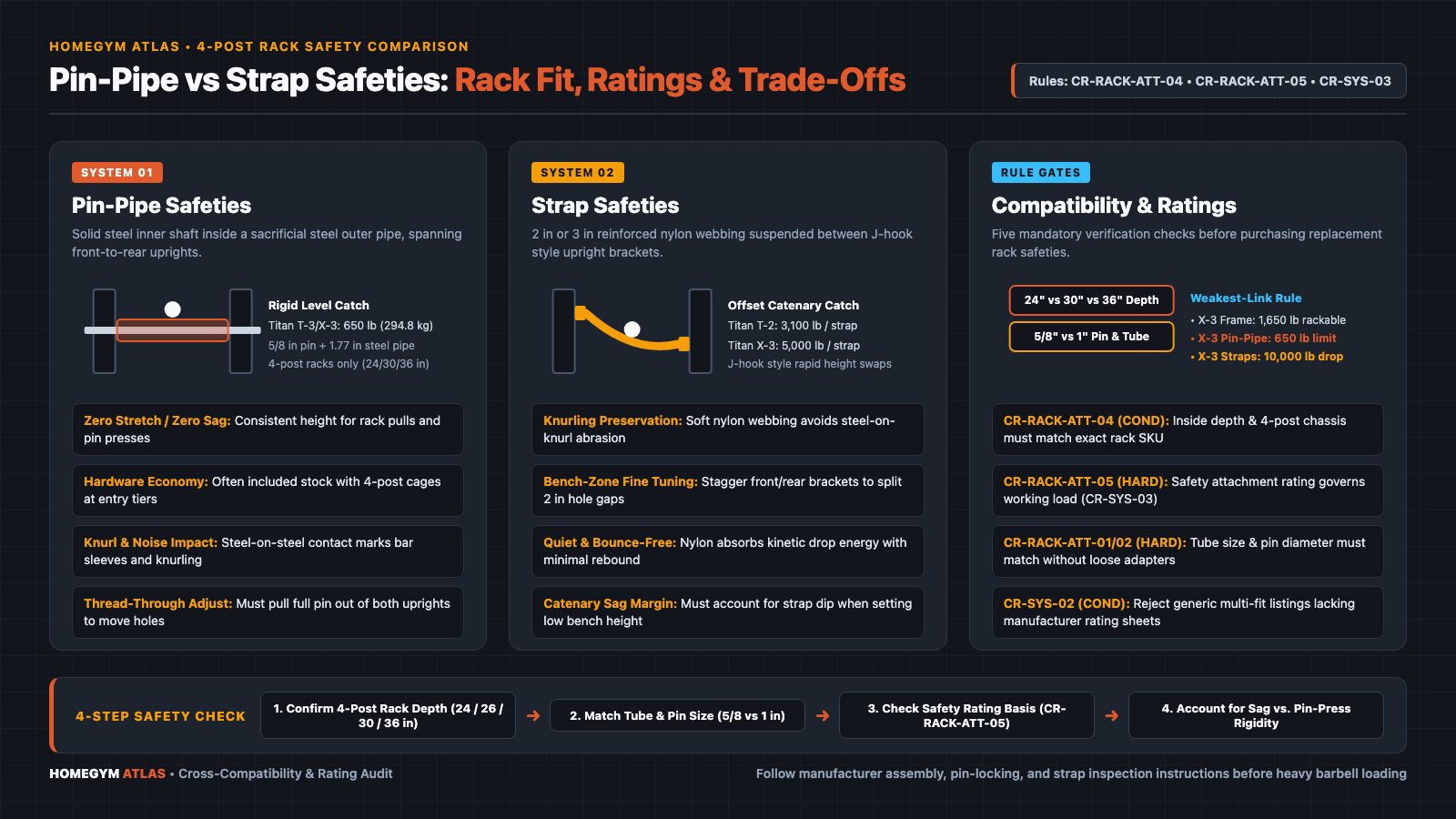
Before comparing nylon versus steel, every power rack safety upgrade must pass four structural compatibility gates. Unlike J-cups or plate horns that clamp onto a single upright, both pin-pipe and strap safeties bridge the gap between your front and rear uprights—making them far less forgiving of mismatched measurements.
1. Inside Rack Depth & 4-Post Configuration (CR-RACK-ATT-04)
Under rule CR-RACK-ATT-04, pin-pipe safeties and strap safeties require a 4-post power rack whose inside upright-to-upright span matches the attachment’s engineered length. A 2-post squat stand or wall-mounted folding rack has no rear working upright to anchor the back end of a pin or strap, so those frames must use cantilevered front spotter arms instead. Even within a single 4-post rack family, depth variations are strictly non-interchangeable:
- Flat-Foot vs. Bolt-Down Depth Splits: On Amazon US, Titan Fitness sells the X-3 Series Flat Foot Power Rack with a 30 in (76.2 cm) inside working depth, whereas X-3 Bolt-Down and T-3 Bolt-Down cages ship in 24 in (61.0 cm) or 36 in (91.4 cm) depths. Ordering a 30 in safety set for a 24 in or 36 in cage fails immediately.
- Entry Cage Depths: The Titan T-2 Series uses a 26 in (66.0 cm) inside depth, while direct-sale 3 x 3 in modular lines such as the REP PR-4000, REP PR-5000, Rogue Monster Lite, and Rogue Monster (all not sold on Amazon) offer 24 in, 30 in, or 41–43 in configurations that require matching depth-specific safeties.
- Why Length Tolerance Matters: A pin-pipe set cut for a 36 in rack leaves several inches of exposed pin protruding past a 24 in upright—creating an obstruction hazard in tight spaces—while a 24 in strap cannot reach across a 30 in bay at all.
2. Upright Tube Cross-Section & Pin Hardware Size (CR-RACK-ATT-01 & ATT-02)
As detailed in our power rack attachment compatibility guide, matching inside depth is useless if the upright tube width or pin diameter fails. For strap safeties, the steel J-hook brackets wrap around the upright face, so a 3 x 3 in (76.2 x 76.2 mm) bracket will rattle excessively on a 2 x 3 in (50.8 x 76.2 mm) or 2 x 2 in (50.8 x 50.8 mm) post (CR-RACK-ATT-01). Likewise, pin diameter is independent of tube size: a 3 x 3 in cage can use either 5/8 in (15.9 mm) pins (such as the Titan X-3, with ~11/16 in clearance holes) or 1 in (25.4 mm) pins (such as the Titan Series or direct-sale REP PR-5000). Check our 5/8 in vs 1 in rack hardware audit before buying; unapproved thin-wall sleeve converters do not earn a compatibility pass under rule CR-RACK-ATT-02.
3. Generic Multi-Fit Strap Claims (CR-RACK-ATT-03 & ISS-ATT-GENERIC-FIT-CLAIMS)
Marketplace listings often advertise third-party safety straps as “universal for 2×2, 2×3, and 3×3 racks” using slotted brackets and removable 5/8 in-to-1 in sleeve adapters. Under rule CR-RACK-ATT-03, generic multi-fit claims remain conditional unless the attachment maker explicitly names your exact rack model. Differences between true 3.00 in imperial tubing and ~75 mm metric tubing—or subtle crossmember bolt interference on 3×3 vs 2×3 power racks—can prevent a generic bracket from seating flush against the upright.
Manufacturer Load Ratings & The Weakest-Link Rule
One of the least understood facts in home gym planning is that a power rack’s headline frame rating does not automatically cover its safety attachments. Under rules CR-RACK-ATT-05 and CR-SYS-03, a barbell setup is governed by its lowest-rated load-bearing component—and on many 4-post cages, stock pin-pipe safeties sit far below the upright frame limit.
Consider Titan Fitness’s published specs for the 3 x 3 in 11-gauge X-3 Flat Foot Power Rack. Titan rates the X-3 rack itself to 1,650 lb (748.4 kg) rackable capacity (and 6,170 lb / 2,798.7 kg whole-rack static capacity). However, Titan’s standalone Pin and Pipe Safety Set for T-3 and X-3 racks—built with a 5/8 in (15.9 mm) solid steel pin inside a 1.77 in (45 mm) outer steel pipe—carries a manufacturer rating of 650 lb (294.8 kg) rackable capacity. While 650 lb exceeds what most home lifters squat or bench, heavy partial rack pulls or dynamic bailouts near that threshold hit the attachment’s limit long before the 11-gauge uprights flex.
By contrast, Titan Fitness rates its X-3 Series 3 in Safety Straps to 5,000 lb (2,268.0 kg) per strap and 10,000 lb (4,535.9 kg) combined dynamic drop capacity, and rates its 2 in wide T-2 Series Safety Straps to 3,100 lb (1,406.1 kg) per strap (6,200 lb / 2,812.3 kg combined). Direct-sale REP Fitness rates its PR-4000 and PR-5000 Strap Safeties 2.0 to 1,000 lb (453.6 kg) per pair and its 1000-Series straps to 700 lb (317.5 kg) per pair (REP PR-4000/PR-5000 straps are not sold on Amazon). Notice how rating bases vary across brands: Titan publishes high single-strap webbing break/drop ratings, while REP publishes working pair ratings aligned with its rack limits (CR-SYS-02).
Whenever an unbranded Amazon safety strap or spotter arm displays a high pound figure with zero manufacturer engineering sheet or rating basis, we could not trace that rating to a manufacturer document—treat it as unverified under CR-SYS-02 and never use it as a substitute for traceable brand-native hardware. Additionally, safeties are evaluated strictly by their design and rated catch capacity, never as guaranteeing injury prevention: follow the manufacturer’s assembly, pin-locking, and rack-anchoring instructions, and have a qualified professional confirm structural mounting if your manual specifies floor bolts.
Barbell Knurling, Offset Bench Precision & Pin-Press Rigidity
Once rack fit and load ratings pass, everyday training ergonomics separate pin-pipe safeties from strap safeties across three distinct areas: barbell finish wear, bench-press catch geometry, and dead-stop partial lifts.
Barbell Knurling & Coating Preservation
When a loaded 20 kg (~44.1 lb) Olympic barbell drops onto a pin-pipe safety, the full force concentrates on two narrow steel-on-steel contact points where the 28–29 mm shaft meets the 1.77 in (45 mm) outer pipe. Even when the outer pipe rotates slightly around the inner pin, repeated drops or aggressive rack pulls can flatten sharp volcano or mountain knurling and chip zinc, black-oxide, or Cerakote finishes. Strap safeties cradle the shaft across 2 in (50.8 mm) or 3 in (76.2 mm) of woven nylon webbing, distributing impact over a broader, non-metallic surface that keeps bar knurling intact and eliminates loud metallic rebound.
Splitting Coarse Hole Spacing in the Bench Zone (CR-RACK-ATT-06 & BENCH-01)
On racks with Westside 1 in (25.4 mm) hole spacing through the bench zone—such as the Titan X-3—finding a level pin-pipe setting just below your arched chest height is straightforward. On racks with uniform 2 in (50.8 mm) spacing (like the Titan T-3, Titan T-2, or direct-sale REP PR-5000) or 3 in (76.2 mm) spacing (like the REP PR-1100), one hole often sits slightly above your chest touch point while the next hole down sits too low (CR-RACK-BENCH-01).
Strap safeties solve this geometric limitation cleanly because each end hooks independently. By setting the front bracket one hole lower than the rear bracket—or vice versa—the midpoint of the strap splits the upright hole interval roughly in half (~1 in effective change on a 2 in grid). Staggering the front bracket lower than the rear bracket also introduces a gentle forward slope: if you fail a bench press and lower the bar onto the straps, gravity guides the barbell forward toward the uprights rather than allowing it to settle back over your neck or face. Pin-pipe safeties cannot be angled at different front/rear holes because the rigid pin must pass horizontally through parallel upright openings.
Why Pin-Pipe Safeties Still Win for Pin Squats, Pin Presses & Rack Pulls
Flexibility becomes a drawback when your programming relies on dead-stop partials starting from the safeties. During heavy rack pulls, pin bench presses, or Anderson squats, a nylon strap exhibits slight slack and catenary sag depending on how tightly the strap length matches the rack’s bay depth. Setting up under a bar resting in a curved strap trough shifts your starting height unevenly if the bar drifts slightly forward or backward along the webbing. Pin-pipe safeties provide a dead-flat, rigid steel reference height from front to back with zero deflection before the bar leaves the supports—making them the superior tool for repeatable partial-range strength work inside a 4-post power rack.
Adjustment Speed, Clearance & Long-Term Inspection
In day-to-day training—especially in multi-user home gyms switching rapidly between squats, overhead presses, and bench presses—adjustment speed heavily favors strap safeties. Moving a pin-pipe safety requires supporting the heavy steel outer pipe with one hand while pulling a 34 in+ solid inner pin completely clear of the front upright, sliding the pipe out, aligning both upright holes at the new elevation, and threading the pin back through. That horizontal withdrawal also demands clear space in front of or behind the rack so the long steel pin does not strike nearby drywall, plate trees, or cardio machines.
Modern strap safeties from Titan Fitness and direct-sale brands like REP Fitness (not sold on Amazon) use J-hook style upright brackets. You simply pull the locking hitch pin or twist the J-hook bracket out of the front upright, drop it into the target hole, and repeat on the rear upright—requiring almost zero clearance beyond the rack’s upright faces. On the maintenance side, steel pin-pipes require virtually zero upkeep beyond keeping the inner pin dry to prevent surface rust in humid garages. Reinforced nylon straps, by contrast, must be inspected regularly per manufacturer instructions for stitching wear, frayed edges, abrasion near the steel bracket loops, or moisture degradation, and replaced immediately if damage appears.
Final Verdict: Choose Pin-Pipe vs. Strap Safeties
Choose Pin-Pipe Safeties If…
- You regularly perform dead-stop pin squats, pin presses, or rack pulls requiring a flat, zero-sag steel reference height.
- Your working squat and bench loads stay comfortably within the safety set’s published rating (e.g., 650 lb / 294.8 kg on Titan T-3/X-3 pin-pipes).
- Your rack already includes pin-pipes or you want a Budget ($50–$100) zero-fray steel catch system.
- Your rack has Westside 1 in (25.4 mm) bench-zone spacing and ample front/rear clearance to withdraw long steel pins.
Choose Strap Safeties If…
- You want to protect precision barbell knurling and Cerakote, stainless, or zinc shaft finishes from steel-on-steel wear.
- Your power rack uses 2 in (50.8 mm) or 3 in (76.2 mm) spacing and you need offset front/rear heights for bench pressing.
- You train in a noise-conscious garage or basement and want quiet, bounce-free catches with fast J-hook height swaps.
- You want higher published drop ratings (3,100–5,000 lb per strap on Titan T-2/X-3 models) to avoid capping heavy rack loads.
Verified Amazon US Pin-Pipe & Strap Safety Picks
While flagship direct-sale 3 x 3 in modular safeties (REP PR-4000, REP PR-5000, Rogue Monster Lite, and Rogue Monster) are not sold on Amazon, Titan Fitness stocks brand-native pin-pipe sets and reinforced nylon safety straps directly on Amazon US with traceable depth specifications and load ratings.
1. Titan Fitness Pin and Pipe Safety Set (30 in Depth, X-3 Flat Foot) — Benchmark Rigid Catch

Verified Hardware & Specs: 30 in (76.2 cm) inside depth for Titan X-3 Flat Foot 3 x 3 in power racks | 5/8 in (15.9 mm) solid steel pin + 1.77 in (45 mm) outer steel pipe | Rated by Titan Fitness to 650 lb (294.8 kg) rackable capacity | ~14 lb (6.4 kg) pair weight | Price Tier: Budget ($50–$100)
Designed specifically for the 30 in working bay of Titan’s X-3 Flat Foot power rack, this pin-pipe set delivers a rock-solid horizontal steel shelf for rack pulls, pin presses, and squat bailouts without nylon stretch. Because Titan rates the X-3 frame higher than the pin-pipe set itself, factor the 650 lb (294.8 kg) safety limit into your heavy partial-lift planning (CR-RACK-ATT-05).
- Pros: Zero sag for dead-stop pin work; budget-friendly replacement cost; exact 30 in depth fit for X-3 Flat Foot cages.
- Cons: 650 lb (294.8 kg) rackable rating caps loads well below the X-3 rack’s 1,650 lb frame limit (CR-SYS-03); bare steel pipe marks bar knurling and requires horizontal pin-pull clearance.
2. Titan Fitness Pin and Pipe Safety Set (36 in Depth, T-3 & X-3 Bolt-Down) — Deep-Cage Steel Set

Verified Hardware & Specs: 36 in (91.4 cm) inside depth for Titan T-3 (2 x 3 in) and X-3 (3 x 3 in) Bolt-Down racks | 5/8 in (15.9 mm) solid steel pin + steel outer pipe | Rated by Titan Fitness to 650 lb (294.8 kg) rackable capacity | Price Tier: Budget ($50–$100)
Because pin-pipe safeties pass straight through the upright holes rather than wrapping the exterior tube profile, Titan’s 36 in bolt-down pin-pipe set fits both 2 x 3 in T-3 and 3 x 3 in X-3 deep bolt-down frames using 5/8 in (15.9 mm) hardware. It is a clean replacement set for deep-bay cages—just verify your cage is the 36 in bolt-down model rather than the 24 in or 30 in variant (CR-RACK-ATT-04).
- Pros: Cross-compatible between 36 in deep Titan T-3 and X-3 Bolt-Down racks using 5/8 in pins; rigid, maintenance-free steel pipes.
- Cons: Same 650 lb (294.8 kg) attachment rating ceiling as the 30 in set; long 36 in+ pins need extra room in front of or behind the cage during height changes.
3. Titan Fitness X-3 Series Safety Straps (30 in Depth, X-3 Flat Foot) — Top Heavy-Duty Strap Upgrade

Verified Hardware & Specs: 30 in (76.2 cm) inside depth for Titan X-3 Flat Foot 3 x 3 in racks | 5/8 in (15.9 mm) J-hook style 11-gauge brackets | 3 in (76.2 mm) wide reinforced nylon webbing | Rated by Titan Fitness to 5,000 lb (2,268.0 kg) per strap / 10,000 lb (4,535.9 kg) combined dynamic drop capacity | Price Tier: Mid-Range ($100–$250)
As the direct strap counterpart to the 30 in X-3 pin-pipe set, Titan’s X-3 Safety Straps replace slow thread-through steel pipes with quick J-hook brackets and wide 3 in reinforced nylon webbing. They preserve barbell knurling, eliminate metallic drop bounce, allow staggered front-to-rear angles, and lift the safety rating well beyond the X-3 rack’s 1,650 lb rackable capacity.
- Pros: 10,000 lb (4,535.9 kg) combined dynamic drop rating; 3 in wide webbing protects expensive bar finishes; rapid J-hook bracket height swaps.
- Cons: Built specifically for 3 x 3 in 30 in X-3 Flat Foot racks (will not fit 2 x 3 in T-3 or 24/36 in bolt-down bays); slight center sag requires careful height setup on pin presses.
4. Titan Fitness T-2 Series Safety Straps (26 in Depth, T-2 2×2) — Best Entry-Rack Strap Upgrade

Verified Hardware & Specs: 26 in (66.0 cm) inside depth for Titan T-2 2 x 2 in racks | J-hook style upright brackets | 2 in (50.8 mm) wide reinforced nylon webbing | Rated by Titan Fitness to 3,100 lb (1,406.1 kg) per strap / 6,200 lb (2,812.3 kg) combined drop capacity | Price Tier: Mid-Range ($100–$250)
Entry 2 x 2 in cages with 2 in (50.8 mm) uniform hole spacing—like the Titan T-2 Series—benefit the most from strap safeties during flat and incline bench pressing. Offsetting the front and rear J-hook brackets turns coarse 2 in hole increments into finer ~1 in effective catch adjustments while protecting your barbell shaft. Note that Titan’s own T-2 documentation has historically varied across revisions (ISS-RACK-SPEC-CONFLICT-TITAN), so confirm your rack generation with Titan before ordering.
- Pros: Solves 2 in hole-spacing bench gaps via offset mounting; traceable 3,100 lb (1,406.1 kg) per-strap rating from Titan; quieter, knurl-safe bar catches.
- Cons: Exclusive to 26 in depth 2 x 2 in T-2 racks (cannot fit 3 x 3 in cages or different 2 x 2 in brands); confirm T-2 revision hole/gauge specs with Titan support before purchase.
Compatibility Rules Appendix & Authoritative Citations
Every safety attachment verdict in this comparison was audited against the IronGym Lab compatibility framework. Never treat a safety pairing as compatible while any applicable HARD gate fails or lacks manufacturer confirmation:
- CR-RACK-ATT-04 (CONDITIONAL): Pin-pipe and strap safeties require a 4-post power rack matching the exact engineered inside depth (e.g., 24 in, 26 in, 30 in, or 36 in); half racks and squat stands require cantilevered spotter arms.
- CR-RACK-ATT-05 (HARD) & CR-SYS-03 (HARD): Safety attachments must meet or exceed your planned load independently of the rack frame’s headline rating—the lowest-rated component caps the setup.
- CR-RACK-ATT-01 & CR-RACK-ATT-02 (HARD): Upright tube cross-section (2 x 2, 2 x 3, or 3 x 3 in) and pin diameter (5/8 in vs. 1 in) must match the attachment’s specifications without unapproved sleeve adapters.
- CR-RACK-ATT-03 (CONDITIONAL) & CR-SYS-02 (CONDITIONAL): Generic multi-fit Amazon listings must be confirmed against your rack maker’s fit list, and marketplace-only capacity figures without manufacturer documentation are treated as unverified.
- CR-RACK-ATT-06 (SOFT) & CR-RACK-BENCH-01 (CONDITIONAL/SOFT): On racks with 2 in or 3 in spacing, strap safeties allow staggered front/rear heights to dial in bench-press catch elevation.
Official Manufacturer Citations:
- Titan Fitness Official Safety Attachments Catalog (T-2, T-3, X-3, TITAN Series) — Verified 650 lb rackable pin-pipe capacity, 3,100 lb/strap T-2 strap ratings, 5,000 lb/strap X-3 dynamic drop ratings, and 24/26/30/36 in depth specifications.
- Titan Fitness Official Power Rack Comparison Guide — Documented X-3 1,650 lb rackable / 6,170 lb frame capacity, ~11/16 in holes for 5/8 in pins, and Westside vs. 2 in hole spacing.
- REP Fitness Official Rack & Strap Safety Specifications — Reference pair ratings for direct-sale PR-4000/PR-5000 Strap Safeties 2.0 (1,000 lb) and 1000-Series Straps (700 lb) (PR-4000/PR-5000 not sold on Amazon).
- Rogue Fitness Official Rack Safety Equipment Reference — Reference specs for direct-only Monster Lite (5/8 in) and Monster (1 in) 3 in nylon safety straps and Schedule-80 pin-pipe sets (not sold on Amazon).
How We Audited This Guide
- Rack attachments, pulley stacks, safeties, rubber mats, and gym tiles were verified for true hole-spacing fit, 1:1 vs 2:1 pulley ratios, drop-rating limits, and off-gassing ventilation care.
- Every power rack, barbell, weight plate, bench, adjustable dumbbell, cardio machine, and flooring spec was cross-checked against official manufacturer manuals, CPSC notices, and live Amazon US listings.
- Recommendations were evaluated against our weighted vertical scoring rubrics and documented CR-* compatibility rules; we never invent load capacities, motor ratings, rubber thickness, or decibels.
Continue Your Audit
- Best Home Gym Flooring 2026: Mats and Tiles by Drop Profile
- Best Gym Flooring Tiles 2026: Rubber Interlocking Tiles Audited
- Best Lat Pulldown Attachments for Racks 2026: Fit Audited
Frequently Asked Questions: Pin-Pipe vs. Strap Safeties
Are strap safeties stronger than pin-pipe safeties?
Often yes on dynamic drop ratings, though capacities vary by brand. For example, Titan Fitness rates its X-3 Pin-Pipe Set to 650 lb (294.8 kg) rackable capacity, whereas Titan X-3 Safety Straps carry a 10,000 lb (4,535.9 kg) combined dynamic drop rating.
Can I use pin-pipe or strap safeties on a half rack or squat stand?
No—standard pin-pipe and strap safeties require a 4-post power rack with matching front and rear uprights at a specific inside depth (CR-RACK-ATT-04). Two-post squat stands and open-front half racks require cantilevered spotter arms instead.
Why do lifters offset strap safeties at different heights front to back?
Staggering the front and rear brackets creates intermediate catch heights on racks with coarse 2 in (50.8 mm) or 3 in (76.2 mm) hole spacing. Setting the front end one hole lower also encourages a failed bench bar to roll away from your neck.
Do pin-pipe safeties damage Olympic barbell knurling?
Repeatedly dropping a loaded 20 kg (~44.1 lb) bar onto bare or powder-coated steel pipes can flatten sharp knurling and scuff shaft coatings. Reinforced nylon strap safeties absorb drops across a wider soft surface, protecting bar finishes during failed squats or presses.
When should I choose pin-pipe safeties instead of strap safeties?
Choose pin-pipe safeties if you perform heavy rack pulls, pin squats, or dead-stop pin presses where nylon sag alters starting bar height, or if you want a low-cost, zero-stretch steel catch within the attachment’s published capacity rating.


