
Disclosure: As an Amazon Associate, IronGym Lab earns from qualifying purchases. If you buy through verified Amazon US links on this page, we may earn a commission at no extra cost to you. Direct-sale manufacturer lines discussed for hardware comparison are labeled as not sold on Amazon and carry zero affiliate links.
Choosing between 5/8 vs 1 inch rack hardware decides which J-cups, spotter arms, safety straps, lever arms, and plate horns will ever bolt onto your power rack. Under IronGym Lab compatibility rules, upright tube width and pin diameter are completely independent specifications: a 3 x 3 in (76.2 x 76.2 mm) cage can ship with either 5/8 in (15.9 mm) or 1 in (25.4 mm) hardware, and the two sizes never cross-fit safely. Neither standard is universally superior—5/8 in hardware unlocks 1 in (25.4 mm) Westside bench-zone spacing and the broadest home-gym attachment catalog, while 1 in hardware pairs with heavy commercial 3 x 3 in frames on 2 in (50.8 mm) centers as well as select entry 2 x 2 in racks.
If you are comparing frames from our best power racks for home gyms hub before buying add-ons, this technical comparison breaks down pin geometry, Westside versus uniform hole spacing, brand-specific cross-fit traps, and which verified Amazon US racks and attachments use each standard.
In This Hardware Comparison
- Quick Verdict: Winner by Lifter Use Case
- Side-by-Side Spec & Compatibility Table
- Pin Diameter vs. Tube Size: Why Cross-Fit Fails
- Westside 1-Inch vs. 2-Inch Uniform Hole Spacing
- Brand Geometry, Generic Listings & Direct-Sale Lines
- Capacity Basis & Manufacturer-First Installation
- Decision Summary: Choose 5/8 in vs. 1 in Hardware
- Verified Amazon US Racks & Attachments
- CR-* Rules, Citations & FAQs
Quick Verdict: 5/8 in vs. 1 in Hardware by Use Case
Because pin diameter interacts directly with hole spacing, attachment weight, and rack tube dimensions, there is no single universal winner. Match the hardware standard to your training priorities and budget tier below.
| Lifter & Home Gym Scenario | Recommended Standard | Technical Reason & Trade-Off |
|---|---|---|
| Bench-focused powerlifter wanting 1 in safety precision | 5/8 in (15.9 mm) Hardware | Allows Westside 1 in (25.4 mm) center-to-center holes through the bench zone without sacrificing steel webbing between holes. |
| Buyer wanting maximum third-party Amazon attachment variety | 5/8 in (15.9 mm) on 3×3 in | Fits the largest home-gym ecosystem (Titan X-3, PRx Profile PRO, and direct-only 5/8 in 3×3 ecosystems). |
| Heavy commercial-style modular rack & functional trainer builds | 1 in (25.4 mm) on 3×3 in | Uses thicker 1 in pins and heavier bracket plates on 2 in (50.8 mm) uniform centers; flagship 3×3 lines sit primarily direct-sale. |
| Shared-garage wall-folding rack in 11-gauge US steel | 5/8 in (15.9 mm) Hardware | Amazon-sold folding lines like Titan X-3 Folding and PRx Profile PRO standardize on 5/8 in pins for lighter everyday handling. |
| Entry-budget 4-post cage with brand-matched lat pulldown | 1 in Holes on 2×2 in | REP PR-1100 uses 1 in holes at 3 in spacing on 2×2 in 14-gauge steel—incompatible with 3×3 1 in attachments, but clean within REP’s 1000-series line. |
| Existing 2×3 in rack owner upgrading accessories | 5/8 in (15.9 mm) on 2×3 in | Matches Titan T-3 and PRx Profile ONE, though 3×3 5/8 in brackets will still fail the tube-width rule (CR-RACK-ATT-01). |
Side-by-Side Spec & Compatibility Comparison
The table below compares published hardware geometry, hole spacing limits, and sales-channel status across both standards. Where manufacturers publish a rating without specifying the component basis, or where direct-sale lines are not stocked on Amazon US, those conditions are noted explicitly.
| Specification / Audit Factor | 5/8 in (15.9 mm) Hardware | 1 in (25.4 mm) Hardware |
|---|---|---|
| Nominal Pin Diameter | 5/8 in (15.9 mm) | 1 in (25.4 mm) |
| Typical Cut Hole Diameter | ~11/16 in (17.5 mm) per Titan FAQ | ~1.03–1.06 in (26.2–26.9 mm) clearance cut |
| Common Upright Tube Sizes | 3 x 3 in (76.2 x 76.2 mm) & 2 x 3 in (50.8 x 76.2 mm) 11-gauge | 3 x 3 in (76.2 x 76.2 mm) 11-gauge; also entry 2 x 2 in (50.8 x 50.8 mm) |
| Bench-Zone Hole Spacing | Westside: 1 in (25.4 mm) bench zone, 2 in (50.8 mm) elsewhere | 2 in (50.8 mm) uniform on 3×3 racks; 3 in (76.2 mm) on REP PR-1100 |
| 1-Inch Step Workaround | Native on Westside uprights (no offset accessory required) | Requires brand-specific lowered/offset J-cups or adjustable safety straps |
| Cross-Fit Between Pin Sizes | Incompatible (HARD fail under CR-RACK-ATT-02) | Incompatible (HARD fail under CR-RACK-ATT-02) |
| Attachment Bracket Mass | Lighter pins and quicker single-hand repositioning | Heavier pins and brackets; tighter feel on machined 3×3 1 in systems |
| Representative Amazon-Sold Racks | Titan Fitness X-3 Flat Foot (3×3), Titan T-3 (2×3), PRx Profile PRO (3×3) | REP Fitness PR-1100 (2×2, 1 in holes); Titan T-2 (confirm revision with Titan) |
| Direct-Sale 3×3 Reference Lines | REP PR-4000, Rogue Monster Lite (not sold on Amazon) | REP PR-5000, Rogue Monster (not sold on Amazon) |
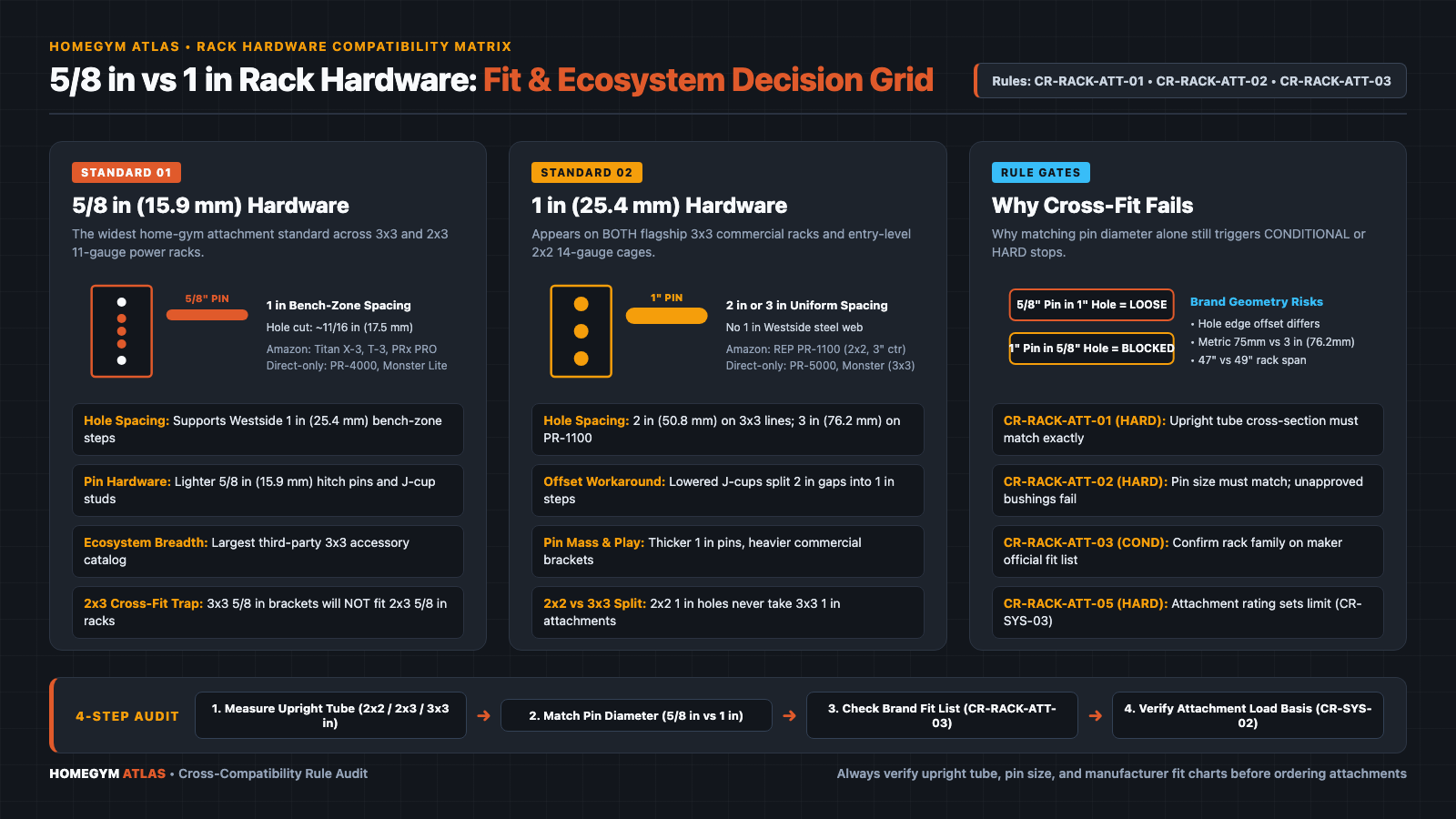
Pin Diameter vs. Tube Size: Why 5/8 in and 1 in Never Mix
The most expensive mistake home-gym builders make is assuming that “3×3 rack” equals universal attachment fit. Under compatibility rules CR-RACK-ATT-01 and CR-RACK-ATT-02, upright cross-section and pin diameter act as two separate hard gates that must both pass before you even evaluate brand geometry.
Why You Match by Pin Size—Not Caliper Hole Width
If you hold a tape measure over a 5/8 in rack’s upright, you will notice the laser-cut or punched hole actually measures closer to 11/16 in (~17.5 mm). That intentional ~1/16 in (1.6 mm) clearance margin prevents powder-coat buildup and weld distortion from jamming a 5/8 in (15.9 mm) pin. Titan Fitness documents this explicitly on its X-3 and T-3 support pages, noting ~11/16 in holes engineered for 5/8 in hardware. Similarly, a 1 in rack cuts holes slightly over 1 in (25.4 mm) so 1 in pins slide freely. Always verify the hardware pin size published in the rack’s specification sheet rather than rounding a ruler measurement.
Why Sleeve Bushings and Pin Adapters Do Not Earn a Clean Pass
Installing a 1 in (25.4 mm) pin attachment onto a 5/8 in (15.9 mm) rack fails physically at the door: the pin will not enter the hole. Going the opposite direction—sliding a 5/8 in J-cup or spotter arm into a 1 in hole—creates a 3/8 in (9.5 mm) diametral gap. Under load, the pin tilts, concentrates shear stress on the lip of the upright steel, and allows the bracket to rock downward. Although third-party sellers occasionally market thin-wall polymer or steel sleeve bushings to step a 1 in hole down to a 5/8 in pin, rule CR-RACK-ATT-02 treats unapproved adapters as a fail unless the rack manufacturer explicitly authorizes them for that specific attachment load.
Tube Size Splits Within Each Pin Standard
Even within the same pin size, upright tube dimensions remain a hard boundary. A 5/8 in spotter arm built for a 3 x 3 in (76.2 x 76.2 mm) Titan X-3 has a 3 in U-channel wrap that leaves an inch of dead air around a 2 x 3 in (50.8 x 76.2 mm) Titan T-3 upright—and a 2 x 3 in bracket will not straddle a 3 x 3 in post at all. Meanwhile, 1 in holes show up on both heavy 3 x 3 in commercial lines and budget 2 x 2 in (50.8 x 50.8 mm) cages like the REP PR-1100. A 2 x 2 in 1 in attachment cannot mount onto a 3 x 3 in 1 in upright. Review our detailed breakdown of 3×3 vs 2×3 power rack tube standards and our complete power rack attachment compatibility guide before ordering brackets across different frame lines.
Westside 1-Inch Spacing vs. 2-Inch Uniform Spacing
Hole diameter directly dictates how closely holes can be punched along a steel upright without compromising the metal web between them. This structural geometry creates the biggest daily usability difference between 5/8 in and 1 in power racks.
The Steel-Web Limit Behind Westside Spacing
Westside hole spacing places holes 1 in (25.4 mm) center-to-center through the middle bench-press and clean-pull zone (roughly chest to waist height) and 2 in (50.8 mm) center-to-center above and below. On a 5/8 in rack with ~11/16 in (0.6875 in) holes, spacing centers 1 in apart leaves roughly 5/16 in (0.3125 in / 7.9 mm) of solid 11-gauge steel webbing between adjacent holes. On a 1 in rack, holes measure roughly 1.03–1.06 in across—spacing them 1 in center-to-center is geometrically impossible because the holes would overlap and turn the upright face into a vertical slot.
How Spacing Affects Bench Safety Setup (CR-RACK-ATT-06 & CR-RACK-BENCH-01)
Because 1 in hardware racks almost universally run 2 in (50.8 mm) uniform spacing on 3 x 3 in uprights (or 3 in / 76.2 mm spacing on entry 2 x 2 in cages like the REP PR-1100), pin-and-pipe or spotter-arm heights move in coarser 2 in or 3 in jumps. Under rules CR-RACK-ATT-06 and CR-RACK-BENCH-01, a 2 in gap can occasionally leave a flat-bench lifter choosing between safeties that sit slightly above chest touch height (blocking full-range reps) or slightly below ribcage clearance.
Lifters on 1 in racks solve that 2 in step in three ways:
- Offset or Lowered J-Cups: Select 1 in ecosystems offer lowered J-cups whose saddle sits 1 in lower than the mounting pin, splitting a 2 in rack grid into effective 1 in barbell unrack increments.
- Adjustable Safety Straps: Nylon safety straps let you stagger the front upright pin one hole higher or lower than the rear upright pin, creating a slight slope that fine-tunes catch height right beneath your bench arch.
- Bench Pad Height Matching (CR-RACK-BENCH-03): Choosing a bench within standard 17–17.7 in (43.2–45.0 cm) pad geometry keeps your chest height aligned cleanly with standard hole grids.
Brand Geometry, Generic Listings & Direct-Sale Ecosystems
Passing both the tube check (CR-RACK-ATT-01) and pin check (CR-RACK-ATT-02) still does not guarantee an attachment drops cleanly into place. Rule CR-RACK-ATT-03 flags brand-specific geometry as a CONDITIONAL check—even between two 3 x 3 in, 11-gauge racks using the exact same pin size.
Imperial 3×3 in vs. Metric 75×75 mm & Direct-Only Benchmarks
Consider the two flagship direct-to-consumer lines that popularized this debate—both of which are not sold on Amazon:
- 5/8 in Direct-Only Pair: The REP PR-4000 (not sold on Amazon) and Rogue Monster Lite (not sold on Amazon) both use 3 x 3 in 11-gauge steel, 5/8 in pins, and Westside bench-zone spacing. However, REP builds the PR-4000 on ~75 x 75 mm (2.95 x 2.95 in) metric-sourced tubing with metric hole centers, whereas Rogue machines true 3.00 x 3.00 in (76.2 x 76.2 mm) imperial steel.
- 1 in Direct-Only Pair: The REP PR-5000 (not sold on Amazon) and Rogue Monster (not sold on Amazon) both use 3 x 3 in 11-gauge steel, 1 in hardware, and 2 in uniform hole spacing—yet differ slightly in tube width (75 mm vs. 3.00 in), hole spacing tolerance, and rack width (47 in vs. 49 in), meaning cross-member bars and dual-post attachments often fail to align across brands even when single-post J-cups slide in.
For a full brand-by-brand compatibility breakdown across those direct-sale ecosystems, see our dedicated guide on whether Rogue attachments fit REP racks. On Amazon US, Titan Fitness also carries an open documentation note (ISS-RACK-SPEC-CONFLICT-TITAN) on its entry 2 x 2 in Titan T-2 line, where Titan’s own chart and support pages have historically disagreed on gauge (12 vs. 14) and hole sizing—confirm your exact T-2 revision with Titan before ordering third-party pins.
How to Audit Generic “Fits 5/8 & 1 Inch” Amazon Attachments
When browsing Amazon US for spotter arms, dip bars, landmines, or weight horns, you will frequently see multi-fit listings titled “Fits 2×2 and 3×3 Power Racks with 5/8 in and 1 in Holes” (ISS-ATT-GENERIC-FIT-CLAIMS). Under IronGym Lab audit standards, treat those listings with three checks:
- Separate Variant vs. Dual-Slot Brackets: Confirm whether the seller ships a separate pin variant per hole size (like the Kipika 3×3 spotter arms audited below) or drills oversized/slotted sleeves intended to “cover” both sizes. Avoid single-pin designs that leave slack in 1 in holes.
- Verify Rack Configuration (CR-RACK-ATT-04): Pin-and-pipe or strap safeties require a 4-post cage of matching inside depth (such as 24 in, 30 in, or 36 in), whereas spotter arms fit open front uprights on half racks and folding racks.
- Verify Attachment Capacity Basis (CR-RACK-ATT-05): A 1,650 lb rack does not override a 500 lb dip bar or unverified marketplace spotter arm—the weakest rated component governs your setup limit (CR-SYS-03).
Capacity Transparency & Manufacturer-First Anchoring
Marketing copy often implies that 1 in hardware automatically doubles a rack’s safe load capacity over 5/8 in hardware. Manufacturer engineering sheets do not support that blanket claim. Both the Titan Fitness X-3 Flat Foot (5/8 in pins, rated by Titan to 1,650 lb / 748.4 kg rackable and 6,170 lb / 2,798.7 kg whole rack) and 5/8 in PRx Profile PRO (rated by PRx to 1,000 lb / 453.6 kg) already exceed realistic residential barbell loads—just as the 1 in-hole REP PR-1100 (2 x 2 in 14-gauge steel) tops out at 700 lb (317.5 kg) per REP Fitness because steel gauge, weld quality, and upright cross-section govern structural capacity alongside pin diameter.
Always verify two safety rules before loading heavy attachments (CR-SYS-02, CR-RACK-SPACE-05):
- Traceable Rating Basis: Distinguish rackable capacity (barbell weight on J-cups/safeties) from whole-frame static claims. If an Amazon attachment listing states a load limit with no manufacturer engineering sheet or rating method, we could not trace that rating to a manufacturer document—treat it conservatively.
- Manufacturer-First Anchoring: Cantilevered attachments like front spotter arms, lever arms, and dip bars shift the center of gravity outside the rack footprint. Follow the manufacturer’s assembly and anchoring instructions strictly—bolting into concrete slabs or structural wood studs/stringer boards where required—and have a qualified professional confirm mounting surfaces if you are unsure. Safeties are described strictly by their design and rated capacity, never as guaranteeing injury prevention.
Final Hardware Verdict: 5/8 in vs. 1 in
Choose 5/8-Inch Hardware If…
- You want native Westside 1 in (25.4 mm) bench-zone hole spacing for exact J-cup and safety placement.
- You are buying an Amazon-sold 11-gauge 3×3 or 2×3 rack like the Titan X-3 or PRx Profile PRO.
- You want the broadest third-party home-gym accessory catalog and lighter everyday pin swaps.
- You plan to load up to 1,000–1,650 lb (453.6–748.4 kg) within documented 11-gauge rack ratings.
Choose 1-Inch Hardware If…
- You are building inside a commercial-grade 3×3 1 in direct-sale ecosystem (such as REP PR-5000 or Rogue Monster, not sold on Amazon).
- You prefer thicker 1 in pins and heavier bracket plates with minimal play on machined 2 in (50.8 mm) uniform grids.
- You are okay adding lowered/offset J-cups or safety straps to split 2 in bench-zone steps.
- You are shopping an entry 2×2 1 in cage like the REP PR-1100 and sticking strictly to its matching 1000-series add-ons.
Verified Amazon US Racks & Attachments for 5/8 in vs. 1 in Hardware
While flagship direct-sale 3×3 racks (REP PR-4000, REP PR-5000, Rogue Monster Lite, Rogue Monster) are not sold on Amazon, the four verified Amazon US products below illustrate how 5/8 in and 1 in hardware ecosystems operate in real home-gym builds.
1. Titan Fitness X-3 Series Flat Foot Power Rack — Benchmark Amazon 3×3 (5/8 in Hardware)

Verified Hardware & Specs: 3 x 3 in (76.2 x 76.2 mm) 11-gauge steel | ~11/16 in (17.5 mm) holes for 5/8 in (15.9 mm) pins | Westside 1 in (25.4 mm) bench-zone spacing | Rated by Titan Fitness to 1,650 lb (748.4 kg) rackable / 6,170 lb (2,798.7 kg) whole rack | Flat-foot freestanding base | Price Tier: Mid-Range ($500–$1,500)
The Titan X-3 Flat Foot is the clearest Amazon-sold benchmark for the 5/8 in 3×3 standard. Its Westside bench-zone grid delivers fine 1 in J-cup and safety positioning out of the box, and its 11-gauge flat-foot chassis avoids mandatory concrete drilling while supporting Titan’s native X-3 attachment catalog.
- Pros: Traceable 1,650 lb (748.4 kg) rackable rating from Titan; Westside 1 in bench spacing; UHMW-lined J-cups and pin-pipe safeties included.
- Cons: 1-year standard Titan warranty is shorter than lifetime frame coverage from some brands; 42 in inside width and flat-foot side rails require checking bench-foot clearance (CR-RACK-BENCH-02); incompatible with 1 in attachments.
2. PRx Performance Profile PRO Squat Rack 3×3 — Best Wall-Folding 3×3 (5/8 in V2 Hardware)

Verified Hardware & Specs: 3 x 3 in (76.2 x 76.2 mm) 11-gauge US steel | 5/8 in (15.9 mm) V2 hardware with Westside 1 in (25.4 mm) bench-zone spacing | Rated by PRx Performance to 1,000 lb (453.6 kg) | Gas-shock vertical fold to 4 in (10.2 cm) off wall | Price Tier: Mid-Range ($500–$1,500)
Built for shared garages where cars park daily, the PRx Profile PRO brings 3 x 3 in 11-gauge uprights and 5/8 in V2 Westside hardware into a vertical-folding footprint. Because PRx updated earlier designs to V2 5/8 in pins, verify V2 compatibility before adding spotter arms or wall attachments (CR-RACK-ATT-03).
- Pros: Gas-shock vertical fold reclaims floor bay depth in seconds; US-made 3×3 11-gauge steel with Westside bench spacing; clear ceiling/stud instructions.
- Cons: Mandatory structural anchoring into wood studs or concrete per PRx manual (CR-RACK-SPACE-05); 89 in pull-up variants require 94–107 in overhead clearance; spotter arms sold separately.
3. REP Fitness PR-1100 Power Rack — Entry Amazon 2×2 Cage (1 in Holes)

Verified Hardware & Specs: 2 x 2 in (50.8 x 50.8 mm) 14-gauge steel | 1 in (25.4 mm) holes at 3 in (76.2 mm) uniform spacing | Rated by REP Fitness to 700 lb (317.5 kg) | 85 in H x 58.1 in W x 48.5 in D | Price Tier: Upper-Budget ($350–$500)
The Amazon-sold REP PR-1100 proves why 1 in hole diameter does not automatically equal commercial 3×3 cross-compatibility. Its 1 in holes run on 2 x 2 in 14-gauge uprights spaced 3 in apart—requiring REP 1000-series add-ons (CR-RACK-ATT-01, CR-RACK-ATT-03) and illustrating why tube size and pin diameter must always be verified together.
- Pros: Honest, manufacturer-backed 700 lb (317.5 kg) capacity rating; plastic-lined J-cups protect bar finishes (CR-BAR-RACK-02); clean upgrade path to REP’s 1000-series lat attachment.
- Cons: 3 in (76.2 mm) hole spacing creates coarse bench-zone adjustments (CR-RACK-ATT-06); 2×2 14-gauge frame cannot accept 3×3 1 in commercial attachments; 700 lb ceiling sits below 11-gauge racks.
4. Kipika Safety Spotter Arms for 3×3 Power Racks — Pin-Variant Attachment Example (5/8 in & 1 in Options)

Verified Hardware & Specs: Built for 3 x 3 in (76.2 x 76.2 mm) uprights | Offered in 5/8 in (15.9 mm) and 1 in (25.4 mm) hole variants | Rubber-padded top contact surface | Capacity basis: listing-only rating (verify attachment rating & fit list per CR-RACK-ATT-03 / CR-SYS-02) | Price Tier: Mid-Range ($100–$250)
Third-party attachments like Kipika’s 3×3 spotter arms show why buyers must double-check selector menus before checkout. Selecting the wrong pin variant triggers a HARD incompatibility (CR-RACK-ATT-02), and because third-party sellers do not always publish an engineering rating basis for every rack brand, confirm both exact upright clearance and load documentation before heavy drops.
- Pros: Dedicated 3×3 channel geometry with protective rubber bar pads; separate 5/8 in and 1 in configurations reduce universal-pin slop when matched accurately.
- Cons: Generic third-party fit claims remain conditional without rack-maker confirmation (CR-RACK-ATT-03); listing-only load numbers lack traceable engineering documentation (CR-SYS-02).
Compatibility Rules Appendix & Authoritative Sources
Every hardware recommendation in this comparison was audited against the IronGym Lab compatibility rule set. Remember that a setup is only marked compatible when every applicable HARD rule passes and missing manufacturer specifications are flagged as not yet verified:
- CR-RACK-ATT-01 (HARD): Attachment upright tube fit (2×2, 2×3, 3×3 in, or metric) must match the rack’s upright cross-section.
- CR-RACK-ATT-02 (HARD): Attachment pin size (5/8 in vs. 1 in) must match the rack’s hardware standard; unapproved sleeve bushings do not pass.
- CR-RACK-ATT-03 (CONDITIONAL): Even when tube and pin sizes match, confirm the attachment maker explicitly lists your exact rack line due to metric vs. imperial tolerances and hole-edge offsets.
- CR-RACK-ATT-04 & CR-RACK-ATT-05 (CONDITIONAL / HARD): Verify rack configuration requirements (4-post depth, top crossmember, or bolt-together joints) and ensure the attachment’s own rated capacity meets your planned load (CR-SYS-03).
- CR-RACK-ATT-06 (SOFT) & CR-SYS-02 (CONDITIONAL): Account for 2 in or 3 in spacing jumps on 1 in racks, and treat marketplace-only load ratings without manufacturer documentation as unverified.
Official Manufacturer Citations:
- Titan Fitness Official Power Rack Comparison Guide (T-2, T-3, X-3) — 3×3 and 2×3 11-gauge specifications, ~11/16 in hole / 5/8 in pin documentation, and 1,650 lb rackable X-3 rating.
- PRx Performance Profile PRO Official Specifications — 3×3 in 11-gauge steel, 5/8 in V2 hardware, Westside hole spacing, 1,000 lb rating, and ceiling/stud mounting tables.
- REP Fitness PR-1100 Official Product Page & REP Fitness Rack Comparison Resources — PR-1100 2×2 in 14-gauge 1 in hole specs (700 lb rating) and direct-only PR-4000 (5/8 in) vs. PR-5000 (1 in) documentation.
- Rogue Fitness Official Equipment Catalog — Direct-only Monster Lite (3×3, 5/8 in) and Monster (3×3, 1 in) upright hardware reference specifications (not sold on Amazon).
How We Audited This Guide
- Strength hardware was audited across upright tube dimensions (2x2, 2x3, 3x3 in), 5/8-in vs 1-in pin hardware, sleeve fit, rated vs rackable capacities, and bench pad height clearances.
- Every power rack, barbell, weight plate, bench, adjustable dumbbell, cardio machine, and flooring spec was cross-checked against official manufacturer manuals, CPSC notices, and live Amazon US listings.
- Recommendations were evaluated against our weighted vertical scoring rubrics and documented CR-* compatibility rules; we never invent load capacities, motor ratings, rubber thickness, or decibels.
Continue Your Audit
Frequently Asked Questions: 5/8 in vs. 1 in Rack Hardware
Can I use 5/8-inch attachments in a 1-inch power rack with adapter sleeves?
No—under rule CR-RACK-ATT-02, thin-wall sleeve adapters or bushings are not treated as a compatible pairing unless the rack manufacturer explicitly authorizes them for that load. Using an unapproved 5/8 in pin inside a 1 in hole risks bracket tilt and uneven shear stress.
Why don’t 1-inch power racks have 1-inch Westside hole spacing?
A 1-inch hardware rack punches holes slightly wider than 1 in (25.4 mm). Placing 1-inch holes 1 in center-to-center would remove all steel webbing between holes, turning the upright into a continuous slot. Instead, 1 in 3×3 racks use 2 in (50.8 mm) uniform hole spacing.
Are 1-inch rack attachments stronger than 5/8-inch attachments?
Pin diameter alone does not dictate rack capacity. While 1 in hardware dominates heavy commercial modular systems, 5/8 in 11-gauge 3×3 racks like the Titan Fitness X-3 carry official 1,650 lb (748.4 kg) rackable ratings, whereas entry 2×2 racks with 1 in holes can top out at 700 lb (317.5 kg).
Do Rogue Monster Lite or REP PR-4000 attachments fit all 5/8-inch 3×3 racks?
Not automatically. Even when upright tube size (3×3 in) and pin size (5/8 in) match, brand geometry differs between true 3.00 in imperial tubes and ~75 mm metric tubes, hole offsets, and 47 in vs. 49 in rack widths (CR-RACK-ATT-03). Always verify the attachment maker’s official fit list.
Why do Titan X-3 and T-3 specs list 11/16-inch holes for 5/8-inch pins?
Manufacturers cut rack holes slightly larger than the nominal pin diameter to leave clearance for powder coating and easy insertion. Titan’s ~11/16 in (17.5 mm) holes are specifically engineered to accept 5/8 in (15.9 mm) pins—always match attachments by pin diameter, not raw hole width.


