
Disclosure: As an Amazon Associate, IronGym Lab earns from qualifying purchases. If you buy through Amazon links on this page, we may earn a small commission at no extra cost to you.
Choosing between a 3×3 vs 2×3 power rack comes down to attachment ecosystem breadth, upright face orientation, and floor-anchoring requirements—not just headline weight capacity. Both 3 x 3 in (76.2 x 76.2 mm) and true 2 x 3 in (50.8 x 76.2 mm) frames routinely use identical 11-gauge steel (~0.120 in / 3.0 mm wall thickness) and 5/8 in (15.9 mm) hardware, meaning heavy home-gym lifters rarely bend either upright under normal barbell loads. Where buyers run into costly surprises is mixing rectangular 2×3 brackets with 3×3 posts, overlooking metric 50 x 70 mm marketplace tubing sold as “2×3,” or discovering that 3×3 racks split into incompatible 5/8 in and 1 in (25.4 mm) pin ecosystems.
In this technical comparison, we evaluate both tube standards using manufacturer spec sheets, installation manuals, and our CR-RACK-* cross-compatibility rules. Whether you are planning a full garage cage from our best power racks for home gyms pillar hub or deciding if third-party lever arms will slide onto your uprights, the verdict matrix below maps each tube profile to its ideal home-gym scenario.
Quick Verdict: 3×3 vs 2×3 Power Rack by Use Case
| Training Priority & Space | Recommended Tube Standard | Why It Wins | Primary Amazon US Contender |
|---|---|---|---|
| Maximum 3rd-Party Attachment Fit | 3 x 3 in (5/8 in or 1 in) | Square 4-way faces accept J-cups, spotter arms, and lever arms across major brands (confirm line per CR-RACK-ATT-03). | Titan Fitness X-3 Flat Foot |
| Freestanding Garage Powerlifting (No Concrete Bolts) | 3 x 3 in (11-Gauge, Flat-Foot) | 1,650 lb (748.4 kg) rackable rating and Westside 1 in bench-zone spacing without drilling into concrete. | Titan Fitness X-3 Flat Foot |
| Lower-Cost 11-Gauge Steel & Narrow Footprint | 2 x 3 in (11-Gauge, Bolt-Down) | Same 11-gauge wall thickness as flagship 3×3 racks in a slimmer, lighter frame when floor anchoring is allowed. | Titan Fitness T-3 Power Rack |
| Shared Garage Parking (Folding Wall Mount) | 3 x 3 in or 2 x 3 in Folding | 3×3 folding keeps full attachment cross-fit; 2×3 folding reduces wall protrusion weight on wood studs. | Titan Fitness X-3 Wall Folding |
| Built-In Dual Cable Crossover Under $1,000 | Metric 50 x 70 mm (“2×3” 14-Ga) | Integrates dual 2:1 pulleys in a mid-range tier, though thinner 14-gauge steel and 1 in holes limit cross-brand add-ons. | MAJOR FITNESS F22 |
In This Comparison
- Side-by-Side Spec & Compatibility Table
- 1. Tube Geometry, Face Orientation & the Metric 50×70 mm Trap
- 2. Pin Size Independence (5/8 in vs 1 in) & Attachment Fit
- 3. Steel Gauge, Rated vs. Rackable Capacity & Weakest-Link Limits
- 4. Hole Spacing, Bench Clearance & Barbell Span
- 5. Ceiling Obstructions, Anchoring Rules & Freight Logistics
- Side-by-Side Buyer Verdict: Choose 3×3 vs. 2×3
- Verified Amazon US 3×3 & 2×3 Power Rack Contenders
- Frequently Asked Questions
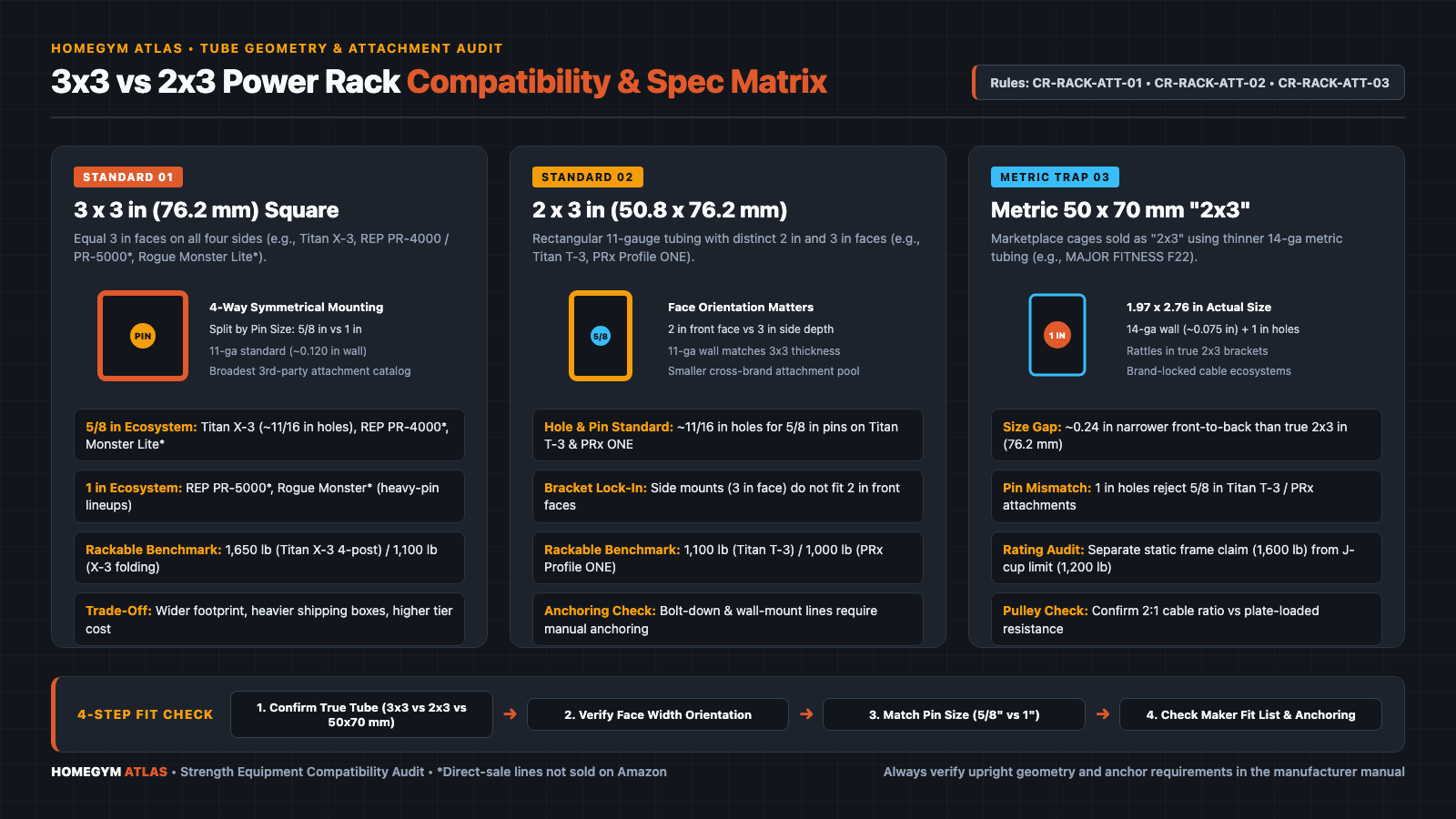
Side-by-Side Verified Spec & Compatibility Matrix
Comparing 3×3 and 2×3 uprights requires separating true US imperial 11-gauge lines from metric marketplace cages. The table below pairs verified Amazon US power racks alongside direct-sale reference lines—explicitly labeled not sold on Amazon per our channel audit—so you can trace exact tube geometry, pin size, hole spacing, and capacity basis side by side.
| Spec / Compatibility Field | 3×3 in (5/8 in Pins) | 3×3 in (1 in Pins) | 2×3 in (11-Ga Imperial) | 2×3 Nominal (Metric 50×70 mm) |
|---|---|---|---|---|
| Representative Models | Titan X-3 (Amazon); REP PR-4000 & Rogue Monster Lite (not sold on Amazon) | REP PR-5000 & Rogue Monster (not sold on Amazon) | Titan T-3 (Amazon); PRx Profile ONE (wall-mount) | MAJOR FITNESS F22 (Amazon) |
| Exact Upright Cross-Section | 3.0 x 3.0 in (76.2 x 76.2 mm) | 3.0 x 3.0 in (76.2 x 76.2 mm) | 2.0 x 3.0 in (50.8 x 76.2 mm) | 1.97 x 2.76 in (50 x 70 mm) |
| Steel Gauge | 11-gauge (~0.120 in / 3.0 mm) | 11-gauge (~0.120 in / 3.0 mm) | 11-gauge (~0.120 in / 3.0 mm) | 14-gauge (~0.075 in / 1.9 mm) on base F22 |
| Pin / Hole Standard | 5/8 in (15.9 mm) pins (~11/16 in holes on Titan) | 1 in (25.4 mm) pins | 5/8 in (15.9 mm) pins (~11/16 in holes on Titan) | 1 in (25.4 mm) holes |
| Bench-Zone Hole Spacing | Westside: 1 in (25.4 mm) bench zone, 2 in outside | 2 in (50.8 mm) uniform (1 in effective with offset J-cups) | 2 in uniform (T-3 FAQ / PRx ONE); newer 4-post T-3 uses Westside | 31–32 indexed cable/hook positions (no true Westside) |
| Published Rack Heights | 80 in / 90 in (Titan X-3); 80 in / 93 in (PR-4000) | 80 in / 93 in (PR-5000) | 82 in / 91 in (Titan T-3); 73 in / 89 in (PRx ONE) | 82.5 in (209.6 cm) fixed height |
| Rated Capacity & Basis | 1,650 lb (748.4 kg) rackable / 6,170 lb total (Titan X-3 4-post); 1,000 lb (REP PR-4000) | 1,000 lb (453.6 kg) rack rating (REP PR-5000, basis varies) | 1,100 lb (499.0 kg) rackable / 4,400 lb total (Titan T-3); 1,000 lb (PRx ONE) | 1,600 lb static frame listing; 1,200 lb J-hook/safety rating (brand spec) |
| Anchoring Requirement | Flat-foot freestanding or bolt-down (wall-mount requires stud/concrete anchoring) | Bolt-down or weighted rear extension per manual | Bolt-down 4-post (T-3) or wall-mount studs/concrete (PRx ONE) | Freestanding wide-base frame with integrated cable columns |
| Third-Party Attachment Pool | Largest cross-brand ecosystem (verify line per CR-RACK-ATT-03) | Broad premium ecosystem; incompatible with 5/8 in racks | Narrower brand-locked ecosystem (2 in front vs 3 in side) | Brand-locked; does not fit true 2×3 in (50.8 x 76.2 mm) brackets |
| Typical Rack Price Tier | Mid-Range to Premium ($500–$1,500+) | Premium ($1,200–$1,500+, direct-sale) | Entry to Mid-Range ($350–$1,000) | Mid-Range ($500–$1,000 with dual pulleys) |
1. Upright Tube Geometry, Face Orientation & the Metric 50×70 mm Trap
Under compatibility rule CR-RACK-ATT-01, an attachment’s bracket channel must match the rack’s upright tube dimensions—and that single geometric difference is why a 3 x 3 in (76.2 x 76.2 mm) rack behaves differently from a 2 x 3 in (50.8 x 76.2 mm) rack over a five-year upgrade cycle. Because a 3×3 upright is perfectly square, every face measures 3.0 in (76.2 mm) wide. Four-way hole patterns allow you to mount J-cups on the front face, bolt plate storage horns onto the sides, clamp a belt-squat kickstand laterally, or rotate a dip station to the outside of the cage using the exact same bracket geometry.
A true 2 x 3 in upright, by contrast, is rectangular and orientation-dependent. On lines like the Titan Fitness T-3 and the PRx Performance Profile ONE, the narrow 2 in (50.8 mm) face points forward toward the lifter while the wider 3 in (76.2 mm) face runs front-to-back along the sides. Consequently, any wraparound bracket—such as sandwich J-cups, monolifts, lever arms, or spotter arms—must be welded specifically for a 2 in front face and a 3 in side depth. You cannot spin a 2×3 J-cup 90 degrees onto the side of the upright, and a 3×3 attachment will leave a full 1.0 in (25.4 mm) gap of metal play on the front face, causing dangerous racking wobble and uneven shear stress on the pin.
The Metric 50 x 70 mm “2×3” Marketplace Trap
A critical pitfall on Amazon US involves racks advertised in bullet points as “2×3 steel” that are actually built from metric 50 x 70 mm (1.97 x 2.76 in) tubing. While 50 mm sits within 0.8 mm of 2 in, 70 mm is nearly a quarter-inch (0.24 in / 6.2 mm) shallower front-to-back than true imperial 3 in (76.2 mm) steel. For example, the popular MAJOR FITNESS F22 uses 50 x 70 mm 14-gauge uprights with 1 in (25.4 mm) holes. If you buy aftermarket Titan T-3 or PRx 2×3 attachments expecting a fit, the bracket’s rear return flange either will not seat tightly against the 70 mm depth or the 5/8 in pin will rattle inside the 1 in hole.
2. Pin Size Independence (5/8 in vs 1 in) & Brand Geometry Gates
The single most common mistake buyers make when shopping for 3×3 racks is assuming “all 3×3 attachments fit all 3×3 racks.” Under rule CR-RACK-ATT-02, upright tube size and pin diameter are completely independent specifications. The 3×3 standard splits into two incompatible hardware camps: 5/8 in (15.9 mm) pins and 1 in (25.4 mm) pins. You can review the exact mechanical trade-offs in our dedicated 5/8 in vs 1 in rack hardware comparison.
- 3×3 in with 5/8 in Hardware: Includes the Amazon-listed Titan Fitness X-3 Series (cut with
~11/16 inholes to accept 5/8 in pins) alongside direct-sale benchmarks like the REP PR-4000 and Rogue Monster Lite (both not sold on Amazon). This combination currently holds the widest selection of affordable third-party attachments on the US market. - 3×3 in with 1 in Hardware: Includes heavy-duty direct-sale lines like the REP PR-5000 and Rogue Monster (not sold on Amazon). A 1 in pin physically cannot fit into a 5/8 in upright hole, and placing a 5/8 in attachment pin into a 1 in hole creates a loose, rattling 3/8 in gap that is unsafe unless the rack manufacturer explicitly approves a structural bushing adapter.
- 2×3 in with 5/8 in Hardware: Both the Titan Fitness T-3 (
~11/16 inholes for 5/8 in pins) and PRx Profile ONE (5/8 inholes) standardize on 5/8 in pins. However, Titan’s own documentation notes hole-size conflicts on the smaller 2×2 Titan T-2 (ISS-RACK-SPEC-CONFLICT-TITAN), reinforcing why buyers should match by pin diameter rather than eyeballing hole clearance.
Even when both tube size (CR-RACK-ATT-01) and pin size (CR-RACK-ATT-02) align, rule CR-RACK-ATT-03 enforces a conditional third gate: confirm the attachment manufacturer explicitly lists your rack series by name. Upright corner radii, laser-cut hole offsets from the tube edge, and crossmember interference vary between brands. Listings on Amazon that advertise “fits Rogue / REP / Titan” without naming specific lines (ISS-ATT-GENERIC-FIT-CLAIMS) carry low fit certainty. For a deeper checklist covering J-cups, spotter arms, and cable brackets, see our power rack attachment compatibility guide.
3. Steel Gauge, Rated vs. Rackable Capacity & Weakest-Link Limits
Shoppers often assume a 3×3 rack is automatically stronger than a 2×3 rack because the post looks bulkier. Structurally, steel wall thickness (gauge, where a lower number equals thicker steel) matters just as much as outer cross-section. Both the Titan X-3 (3×3) and Titan T-3 (2×3) are fabricated from 11-gauge steel (~0.120 in / 3.0 mm wall thickness)—meaning a true 2×3 11-gauge upright has thicker steel walls than a budget 3×3 or 2×3 cage built from 14-gauge (~0.075 in / 1.9 mm) tubing.
However, when we audit manufacturer specifications under rules CR-RACK-SYS-01 and CR-RACK-SYS-02, comparing published capacities requires separating rackable capacity from static frame capacity:
- Titan Fitness X-3 (3×3 11-Gauge, 4-Post): Titan publishes a 1,650 lb (748.4 kg) rackable capacity and a 6,170 lb (2,798.7 kg) total rack capacity, whereas the X-3 Wall-Mounted Folding model carries a 1,100 lb (499.0 kg) rackable capacity per Titan’s rack comparison guide (and 1,000 lb / 453.6 kg on its Amazon listing).
- Titan Fitness T-3 (2×3 11-Gauge, 4-Post): Titan publishes a 1,100 lb (499.0 kg) rackable capacity and a 4,400 lb (1,995.8 kg) total rack capacity—more than double what almost any non-competitive home lifter squats or presses, though 550 lb (249.5 kg) below the 4-post X-3 rackable ceiling.
- Listing-Only Marketplace Claims (CR-SYS-02): Budget Amazon cages frequently print 1,500 lb to 2,400 lb frame numbers without stating whether that limit applies to J-cups, spotter safeties, or static compression across all four posts. Under rule CR-SYS-03 (weakest rated part), your usable working ceiling is governed by the lowest-rated component holding the bar—your J-cups, safeties (
CR-RACK-ATT-05), bench, or barbell—not a marketing frame headline.
If you want a side-by-side breakdown of how these two specific Titan lines compare across depth variants, crossmembers, and price tiers, read our full Titan T-3 vs X-3 comparison.
4. Hole Spacing, Bench Alignment & Barbell Clearance
Tube size also interacts with hole spacing, bench clearance, and safety systems (CR-RACK-ATT-04, CR-RACK-ATT-06, and CR-RACK-BENCH-01). Most 3×3 5/8 in racks—including the Titan X-3, REP PR-4000 (not sold on Amazon), and Rogue Monster Lite (not sold on Amazon)—feature Westside hole spacing: 1 in (25.4 mm) center-to-center holes through the bench and clean-pull zones, transitioning to 2 in (50.8 mm) spacing above and below. That 1 in granularity makes it dramatically easier to position pin-pipe or strap safeties just below your chest arch during flat bench pressing without blocking full bar touch.
By contrast, 2×3 lines show more variation across generations. The PRx Profile ONE uses 2 in (50.8 mm) hole spacing throughout its 2×3 uprights, and Titan’s support FAQ lists 2 in spacing on baseline T-3 charts while newer 4-post T-3 and space-saving listings incorporate Westside 1 in spacing through the bench zone—making it critical to verify the exact SKU chart before buying. On 2 in-spaced racks, lowered or offset J-cups can split the 2 in increment in half to fine-tune unrack height.
Do not overlook CR-RACK-BENCH-02 and CR-BAR-RACK-01 either. Freestanding 3×3 flat-foot racks like the Titan X-3 Flat Foot eliminate concrete drilling by extending wide steel base rails along the floor; confirm your flat or FID bench’s rear stabilizer feet clear the inside rack width (typically ~42 in / 106.7 cm inside width) without colliding with bottom gussets. Meanwhile, whether your uprights measure 2×3 or 3×3, full-width power racks span roughly 46 to 49 in across the outer uprights—meaning you need a full 7 ft (~86.6 in / 2,200 mm) men’s 20 kg (~44.1 lb) or women’s 15 kg (~33.1 lb) Olympic barbell with roughly ~51.6 in (1,310 mm) between inner collars, plus 24 to 36 in of unobstructed room width on each end to load plates (CR-RACK-SPACE-04).
5. Ceiling Obstructions, Anchoring Manuals & Freight Logistics
Before choosing between a 3×3 and 2×3 power rack, measure your lowest overhead obstruction—basement steel I-beams, HVAC ducts, or open garage-door tracks—rather than the drywall ceiling alone (CR-RACK-SPACE-01). Titan offers short and tall heights on both lines (80 in / 90 in on X-3; 82 in / 91 in on T-3), while the wall-mounted 2×3 PRx Profile ONE publishes explicit ceiling brackets of 78–91 in for its 73 in upright configuration and 94–107 in for the 89 in pull-up bar version.
Equally important is CR-RACK-SPACE-05: always follow the manufacturer’s assembly sequence and anchoring instructions strictly. Four-post bolt-down 2×3 frames like the standard Titan T-3 and all wall-mounted folding racks (Titan X-3 Folding, Titan T-3 Space Saving, PRx Profile ONE) require solid concrete slab bolts or structural 16 in / 24 in wood-stud anchoring as specified in their owner’s manuals—anchoring is never optional when the manual mandates it. If you rent your home, train over post-tensioned garage concrete you cannot drill, or are unsure about stud framing behind drywall, choose a flat-foot freestanding rack (like the Titan X-3 Flat Foot) or consult a qualified contractor before installation. Finally, remember CR-SYS-04: 3×3 11-gauge 4-post cages ship significantly heavier across multiple parcel or freight cartons than 2×3 frames, so check doorway and basement stair turns prior to delivery.
Side-by-Side Buyer Verdict: Choose 3×3 vs. 2×3
Choose a 3×3 Power Rack If…
- You want the largest long-term third-party attachment ecosystem (lever arms, monolifts, spotter arms, belt-squat attachments) on equal 4-way faces.
- You prefer a freestanding 11-gauge flat-foot cage (such as the Titan X-3 Flat Foot) with a 1,650 lb (748.4 kg) rackable rating and no concrete drilling.
- You prioritize Westside 1 in bench-zone hole spacing across nearly every flagship model in the category.
- You verify pin size upfront (
5/8 invs1 in) and have budget in the Mid-Range to Premium tiers ($500–$1,500+).
Choose a 2×3 Power Rack If…
- You want genuine 11-gauge steel strength (1,100 lb / 499.0 kg rackable on Titan T-3) at a lower price tier and slimmer upright profile.
- Your garage floor or wall permits bolt-down concrete anchoring or structural stud mounting per the manufacturer manual.
- Your training relies on core barbell essentials (J-cups, safeties, dip bar, plate horns) rather than universal cross-brand specialty attachments.
- You double-check true imperial
2 x 3 in (50.8 x 76.2 mm)dimensions to avoid metric50 x 70 mmbracket mismatches.
Verified Amazon US 3×3 & 2×3 Power Rack Contenders
While several well-known 3×3 racks—including the REP PR-4000, REP PR-5000, Rogue Monster Lite, and Rogue Monster—are not sold on Amazon (direct-sale only), Amazon US stocks verified 11-gauge 3×3 and 2×3 contenders from Titan Fitness alongside metric 50 x 70 mm cable-integrated cages. Each audited pick below includes verified specifications, compatibility notes, and at least two concrete trade-offs.
1. Titan Fitness X-3 Series Flat Foot Power Rack — Best Freestanding 3×3 11-Gauge Power Rack

Key Specs: 3 x 3 in (76.2 x 76.2 mm) 11-gauge steel uprights | ~11/16 in holes for 5/8 in (15.9 mm) pins; Westside 1 in bench-zone spacing | 1,650 lb (748.4 kg) rackable capacity / 6,170 lb (2,798.7 kg) total rack capacity per Titan Fitness | Flat-foot freestanding base | Skinny & fat pull-up bars included | Price Tier: Mid-Range ($500–$1,500)
For lifters who want commercial-grade 3×3 11-gauge uprights without bolting into a rental slab or post-tensioned garage floor, the Titan Fitness X-3 Series Flat Foot Power Rack is the benchmark Amazon US contender. Its square 3×3 posts and 5/8 in hardware standard unlock Titan’s broad X-3 accessory catalog alongside third-party 3×3 5/8 in attachments that explicitly list X-3 compatibility (CR-RACK-ATT-03). Westside 1 in hole spacing through the bench zone lets you dial in pin-pipe or strap safeties cleanly, and the dual skinny/fat pull-up bars add overhead grip variety out of the box.
Compatibility Check: Confirm your height variant (80 in vs 90 in) clears overhead garage-door tracks (CR-RACK-SPACE-01), and measure your bench’s rear base width against the flat-foot bottom rail gussets before ordering (CR-RACK-BENCH-02).
Pros
- True 3 x 3 in 11-gauge steel with 5/8 in pins and Westside 1 in bench-zone spacing
- Flat-foot base requires no concrete anchoring while carrying a 1,650 lb (748.4 kg) rackable rating
- Four-way upright holes support plate storage, lever arms, and dip bars on any post face
Cons
- Flat-foot floor rails can interfere with ultra-wide adjustable bench rear legs inside the cage
- Heavy multi-box shipping and higher cost tier than 2×3 frames; 1-year Titan manufacturer warranty
2. Titan Fitness T-3 Series Power Rack — Best Bolt-Down 2×3 11-Gauge Power Rack

Key Specs: 2 x 3 in (50.8 x 76.2 mm) 11-gauge steel uprights | ~11/16 in holes for 5/8 in (15.9 mm) pins | 1,100 lb (499.0 kg) rackable capacity / 4,400 lb (1,995.8 kg) total rack capacity per Titan Fitness | 82 in (208.3 cm) or 91 in (231.1 cm) family heights | Bolt-down base | Price Tier: Mid-Range ($500–$1,500)
The Titan Fitness T-3 Series Power Rack proves you do not need 3×3 uprights to get 11-gauge structural steel. Built from rectangular 2 x 3 in (50.8 x 76.2 mm) 11-gauge uprights with ~11/16 in holes for 5/8 in pins, the T-3 delivers a verified 1,100 lb (499.0 kg) rackable rating while trimming steel weight, shipping cost, and upright bulk compared with 3×3 cages. Because it leaves out flat-foot floor rails, your bench slides freely into position once the rack is bolted down per Titan’s manual.
Anchoring & Fit Alert: Bolt-down T-3 frames must be anchored to concrete or an approved lifting platform per Titan’s installation instructions (CR-RACK-SPACE-05). Verify whether your specific depth/height variant ships with Westside 1 in or 2 in spacing before buying.
Pros
- True 11-gauge wall thickness with a 1,100 lb (499.0 kg) rackable rating in a lower price bracket than 3×3 X-3 frames
- No flat-foot floor rails blocking bench legs when bolted down per manufacturer instructions
- ~42 in inside width accommodates full 7 ft (86.6 in) Olympic bars cleanly
Cons
- 2×3 upright orientation restricts third-party attachments compared with 3×3 5/8 in cages
- Requires permanent floor or platform anchoring; 1-year Titan manufacturer warranty
3. Titan Fitness X-3 Series Wall Mounted Folding Power Rack — Best 3×3 Space-Saving Folder

Key Specs: 3 x 3 in (76.2 x 76.2 mm) 11-gauge steel uprights | ~11/16 in holes for 5/8 in (15.9 mm) pins; Westside bench-zone spacing | 1,100 lb (499.0 kg) rackable per Titan folding spec (1,000 lb / 453.6 kg Amazon listing) | 80 in H x 21.5 in frame depth, folds to ~5 in off wall | Price Tier: Entry ($350–$500)
Shared garages that need to park a vehicle between workouts often default to 2×3 wall-mounted racks like the PRx Profile ONE, but the Titan X-3 Wall Mounted Folding Rack gives you full 3×3 11-gauge uprights and Westside bench-zone spacing in the same Under $500 tier. Its horizontal gate-hinge arms swing inward below low garage-door tracks, letting you run 3×3 5/8 in spotter arms and accessories without sacrificing half a garage bay.
Pros
- Full 3 x 3 in 11-gauge steel and Westside spacing in a compact wall-folding footprint
- Horizontal hinge fold clears overhead garage-door rails without upward ceiling sweep
Cons
- Must be anchored strictly to wood studs, stringers, or concrete per Titan’s manual; consult a contractor if unsure
- Manual hinge-pin teardown is slower than gas-shock folders; spotter arms sold separately
4. MAJOR FITNESS F22 Power Rack with Dual Pulley System — Best All-in-One Metric 50×70 mm Cage

Key Specs: 2 x 3 in nominal (50 x 70 mm / 1.97 x 2.76 in) 14-gauge steel uprights | 1 in (25.4 mm) upright holes | 1,600 lb (725.7 kg) static frame listing; 1,200 lb (544.3 kg) J-hook & safety bar spec; 300 lb (136.1 kg) per side on 2:1 dual cable pulleys | 68.9 in D x 55.5 in W x 82.5 in H | Price Tier: Mid-Range ($500–$1,000)
If your goal is an integrated dual-cable crossover inside a mid-range budget rather than cross-brand barbell attachment swapping, the MAJOR FITNESS F22 bundles plate-loaded 2:1 pulleys, storage horns, and starter attachments in one crate. However, our audit highlights why shoppers must read past the “2×3” marketing label: the F22 uses thinner 14-gauge metric 50 x 70 mm tubing paired with 1 in holes, meaning imperial Titan T-3 or PRx 2×3 attachments (5/8 in pins, 50.8 x 76.2 mm tube) will not fit properly.
Pros
- Integrates independent 2:1 dual-cable crossover pulleys and plate storage in a $500–$1,000 rack tier
- Lifetime residential structural frame warranty with 1-year parts coverage per brand terms
Cons
- Metric 50 x 70 mm tubing and 1 in holes prevent cross-compatibility with true 2×3 in (5/8 in) attachments
- Base F22 uses 14-gauge steel (~0.075 in) and separates 1,200 lb J-hook limits from its 1,600 lb static frame headline
Compatibility Rules Evaluated & Authoritative Sources
This comparison was audited without lab claims using IronGym Lab’s cross-compatibility rule engine and verified manufacturer documents. Applicable rule codes evaluated: CR-RACK-ATT-01 (upright tube match), CR-RACK-ATT-02 (pin diameter independence), CR-RACK-ATT-03 (brand fit-list confirmation), CR-RACK-ATT-04 (configuration requirements), CR-RACK-ATT-05 (attachment load ratings), CR-RACK-ATT-06 (hole spacing), CR-RACK-BENCH-01/02 (safety alignment and base clearance), CR-RACK-SPACE-01/04/05 (obstructions, bar loading width, and manufacturer-first anchoring), CR-RACK-SYS-01/02 (capacity basis), CR-BAR-RACK-01 (collar span), CR-ATT-01 (pulley ratio), and CR-SYS-02/03/04 (traceable ratings, weakest-link ceiling, and freight planning).
- Titan Fitness — X-3 Series Specifications (3×3 in, 11-Gauge, 1,650 lb Rackable)
- Titan Fitness — T-3 Series Specifications & Power Rack Comparison Guide (2×3 in, 11-Gauge)
- PRx Performance — Official Support, Ceiling Clearance & Profile ONE 2×3 Specifications
- MAJOR FITNESS — Official F22 Power Rack Specifications & Component Ratings
How We Audited This Guide
- Strength hardware was audited across upright tube dimensions (2x2, 2x3, 3x3 in), 5/8-in vs 1-in pin hardware, sleeve fit, rated vs rackable capacities, and bench pad height clearances.
- Every power rack, barbell, weight plate, bench, adjustable dumbbell, cardio machine, and flooring spec was cross-checked against official manufacturer manuals, CPSC notices, and live Amazon US listings.
- Recommendations were evaluated against our weighted vertical scoring rubrics and documented CR-* compatibility rules; we never invent load capacities, motor ratings, rubber thickness, or decibels.
Continue Your Audit
Frequently Asked Questions: 3×3 vs 2×3 Power Racks
Is a 3×3 power rack stronger than a 2×3 power rack?
Not automatically—steel gauge and rating basis matter just as much as outer tube dimensions. A 2×3 rack in 11-gauge steel (~0.120 in / 3.0 mm, like Titan T-3 at 1,100 lb rackable) has thicker walls than a 14-gauge 3×3 or metric 50×70 mm cage.
Do 3×3 power rack attachments fit a 2×3 power rack?
No—under rule CR-RACK-ATT-01, upright tube dimensions must match between rack and attachment. Sliding a 3×3 J-cup or spotter arm onto a 2 in front face leaves a 1 in gap, causing bracket play and unsafe pin shear under barbell loads.
Do all 3×3 attachments fit every 3×3 power rack?
No—3×3 racks split between 5/8 in (15.9 mm) and 1 in (25.4 mm) pin hardware. Even when tube and pin sizes match, corner radius and hole offset vary by brand, so always confirm the attachment maker explicitly lists your rack series (CR-RACK-ATT-03).
Why do some 2×3 racks on Amazon fail to fit Titan T-3 or PRx accessories?
Many marketplace “2×3” racks actually use metric 50 x 70 mm (1.97 x 2.76 in) tubing and 1 in holes. That ~0.24 in depth difference prevents true imperial 2×3 brackets (50.8 x 76.2 mm with 5/8 in pins) from seating tightly on the upright.
Which 3×3 and 2×3 power racks are not sold on Amazon US?
Several popular US rack lines are direct-to-consumer only and not sold on Amazon. Examples include Rogue Monster Lite, Rogue Monster, REP PR-4000, and REP PR-5000—we cite them purely as compatibility standards without affiliate links.


