
Dealing with a stubborn rubber gym mat smell right after unrolling new flooring or hauling heavy 3/4 in (19.1 mm) horse-stall sheets into a garage or basement comes down to two overlapping factors: manufacturing residue left on the rubber surface and trapped volatile organic compounds (VOCs) released as the material acclimates. Because industrial stall mats and recycled crumb tiles are built for durability rather than fragrance-free packaging, unstacking them inside a closed room concentrates that sulfur-and-tire aroma fast. Before you drag everything back to the curb or scrub the floor with harsh household chemicals that ruin polyurethane binders, follow a structured, manufacturer-first ventilation and wash workflow.
In our IronGym Lab accessories and flooring knowledge base, this odor pattern is tracked under issue card ISS-ATT-STALL-MAT-ODOR alongside subfloor compatibility rule CR-ATT-SPACE-01. Whether you are outfitting a full rack station from our power rack attachments and flooring hub or comparing home gym flooring options by drop profile, fixing the smell safely starts with identifying which rubber compound you bought and avoiding solvents that break down the mat.
Direct Answer: To clear a rubber gym mat smell safely, separate stacked mats immediately so air reaches both faces, dry-sweep loose factory grit, and scrub both sides with warm water and a small amount of mild dish soap or a neutral-pH rubber floor cleaner (pH 7 to 9). Rinse thoroughly with clean water so zero soap film remains, dry the mats 100% on both sides before laying them over a concrete slab or wood subfloor, and run cross-ventilation with open doors and box fans to exhaust off-gassing vapors outdoors. Never use bleach, pine oil, ammonia, petroleum solvents, or steam mops, which degrade rubber binders and lock in sticky residue.
Safety & Manufacturer Instruction Boundary (G-15 / G-16): Always follow your flooring manufacturer’s printed care and cleaning instructions before applying any liquid cleaner or sealer. Heavy 3/4 in (19.1 mm) by 4 × 6 ft (122 × 183 cm) horse-stall mats commonly weigh around 95 to 100 lb (43.1 to 45.4 kg) each; use two people and secure grip points when lifting, flipping, or hauling sheets indoors. Keep floor surfaces completely dry before resuming barbell lifts, and plug box fans or dehumidifiers directly into grounded 120 V receptacles according to each appliance manual without overloading extension cords. This guide addresses material care and indoor ventilation mechanics only and makes no medical or health diagnoses.
In This Troubleshooting & Maintenance Guide
- Why Rubber Gym Mats Smell: Chemistry & Material Differences
- Fast Symptom, Cause & Safe First-Check Matrix
- Six Maker-Approved Steps to Fix Rubber Gym Mat Smell (Lowest Risk First)
- Cleaners & Tools That Damage Rubber Flooring
- Room Type, Subfloor Moisture & Drop-Profile Context (CR-ATT-SPACE-01)
- Preventive Cleaning Schedule & Authoritative Citations
- Frequently Asked Questions
Why Rubber Gym Mats Smell: Chemistry & Material Differences
Not every gym mat smells for the same reason, and not every smell fades at the same pace. Recognizing what your floor is made of explains why an interlocking tile in a spare bedroom behaves very differently from a farm-store horse-stall sheet in a two-car garage.
1. Recycled Tire Crumb, Sulfur Vulcanization & Mold-Release Oils
Traditional 3/4 in (19.1 mm) horse-stall mats and many heavy-duty commercial rolls are manufactured from shredded post-consumer truck or auto tire rubber (styrene-butadiene rubber, or SBR). During production, factories re-vulcanize those granules under heat and pressure or bond them with polyurethane (PU) adhesives. Sulfur curing agents, vulcanization accelerators, and silicone or soapy mold-release sprays used to free hot mats from steel press plates remain on the outer skin and inside microscopic surface pores.
When dozens of mats are stacked tight on a pallet and shrink-wrapped for weeks in transit or parked in an unventilated barn yard, those volatile organic compounds have nowhere to escape. The moment you peel the top mat off the stack inside a warm basement, trapped vapors rush out at once—producing the sharp, tire-shop aroma documented across owner reports (ISS-ATT-STALL-MAT-ODOR).
2. Polyurethane Binder Off-Gassing vs. Virgin / EPDM Rubber
Indoor-grade rolled rubber and interlocking puzzle tiles—typically 5/16 in to 1/2 in (8 mm to 12.7 mm) thick—often combine recycled black SBR crumb with colored ethylene propylene diene monomer (EPDM) flecks held together by lower-odor polyurethane binders. Virgin vulcanized rubber mats skip recycled tire rubber altogether. While virgin and indoor-formulated tiles usually emit far less sulfur odor out of the carton, tight plastic shipping wraps still trap initial manufacturing scents until the surface breathes for 24 to 48 hours.
3. Trapped Subfloor Moisture, Sweat & Chemical Reactions
If a gym floor has been installed for months and suddenly develops a sour, musty, or sweet-chemical smell, fresh rubber off-gassing is rarely the culprit. Moisture wicking upward through an unsealed concrete slab, water pushed down into interlocking seams during wet mopping, or dried sweat and chalk left in textured grooves can create stale organic odors underneath or on top of the mat. Worse, wiping rubber with oil-based cleaners or harsh bleach can soften the polyurethane binder and trigger a persistent chemical smell that lingers far longer than the original factory rubber scent.
Fast Symptom, Cause & Safe First-Check Matrix
Before mixing a mop bucket or pulling up an entire room of flooring, match the exact odor profile and timing against the diagnostic matrix below. Separating initial VOC off-gassing from trapped subfloor dampness or cleaner residue prevents wasted effort.
| Observed Odor Symptom | Likely Underlying Cause / Rule Trigger | Immediate Safe Check | When to Stop & Change Approach |
|---|---|---|---|
| Sharp tire-shop or sulfur smell immediately after delivery | Trapped VOCs and mold-release residue from pallet stacking on recycled SBR stall mats (ISS-ATT-STALL-MAT-ODOR) | Unstack mats outside or in an open garage bay; inspect surface for oily film or factory dust before scrubbing | Do not install stacked mats straight into a windowless basement before initial airing and washing |
| Noticeable odor spikes on hot afternoons or in direct sun | Warmth increases vapor pressure inside rubber pores, accelerating off-gassing release | Measure room temperature and airflow; open garage doors/windows and position fans to exhaust air outdoors | If indoor room cannot be ventilated, move unanchored mats outside to air out first |
| Sour, damp, or mildew-like smell months after installation | Moisture trapped under mats from wet mopping, seam flooding, or damp concrete slab vapor | Lift one corner mat in a low spot; check underside and concrete slab for condensation, dark water rings, or dampness | Do not re-lay wet mats; dry both mat faces and slab completely and address slab moisture per building guidance |
| Sticky surface paired with strong pine, citrus, or chemical smell | Past cleaning with oil-based soaps, pine oil, bleach, or solvent degreasers attacking PU binders | Check cleaner labels used previously; feel surface for tackiness or black color transfer on a damp white cloth | Stop using solvent/oil cleaners immediately; rinse repeatedly with warm water and neutral-pH soap |
| Sweet plastic or mild gym-bag odor on interlocking foam or thin tiles | Sweat residue in seams, or closed-cell EVA foam absorbing surface grime (CR-ATT-SPACE-01) | Inspect tile joints for chalk/sweat buildup; verify tile material against maker care sheet | Replace foam tiles in heavy barbell drop zones with drop-suitable rubber per maker specs |
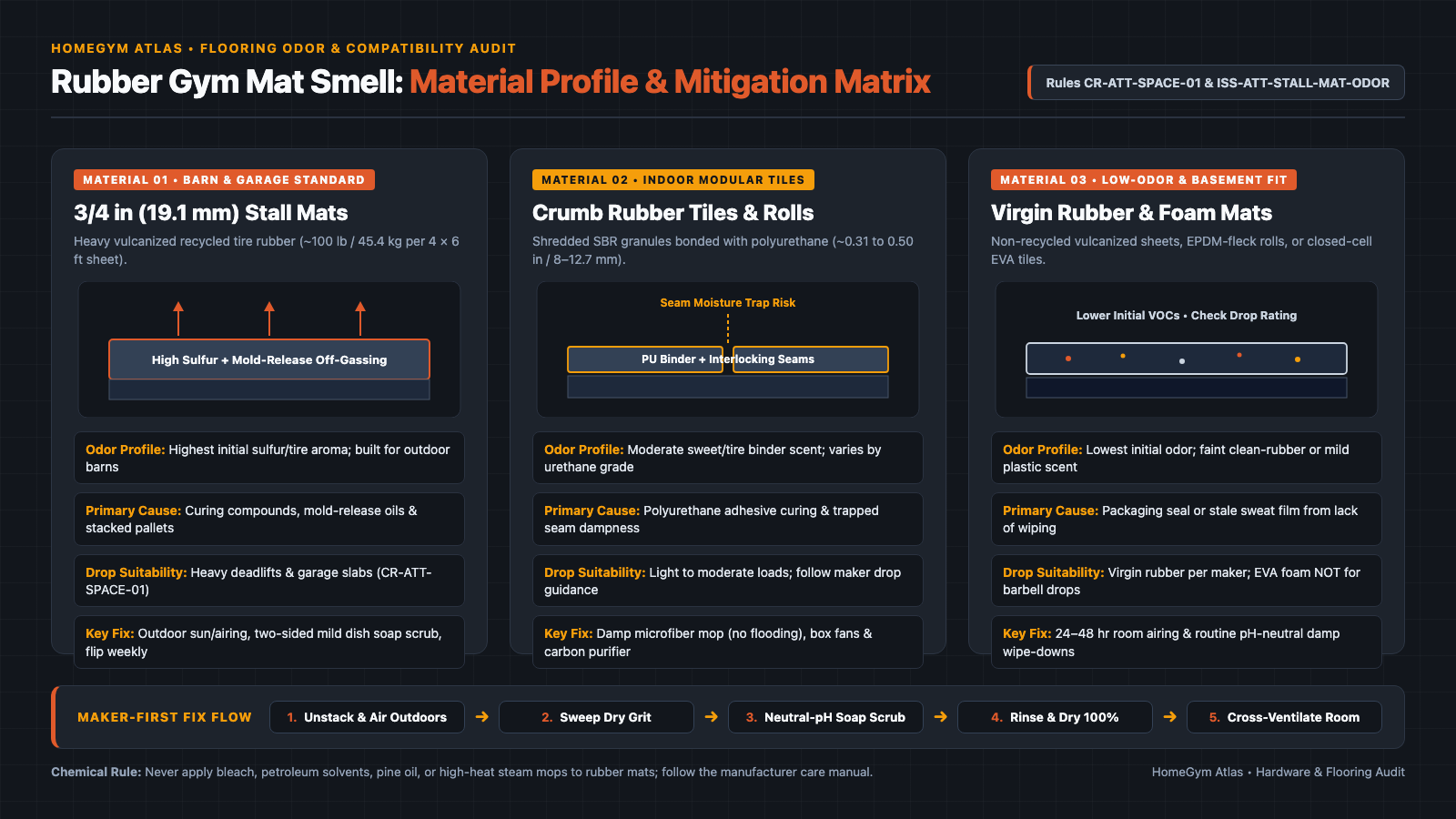
Six Maker-Approved Steps to Fix Rubber Gym Mat Smell (Lowest Risk First)
Manufacturer maintenance guides from commercial and residential rubber suppliers—including Ecore Athletic, Regupol, American Floor Mats, and Greatmats—converge on the same low-risk principle: physical ventilation and neutral-pH washing clear surface residues without harming vulcanized rubber or polyurethane binders. Work through these six steps in sequence.
Step 1: Unstack and Separate Mats Immediately
Never leave new rubber mats piled flat on top of each other inside your house or garage while waiting for the weekend to install them. Stacked 4 × 6 ft (122 × 183 cm) sheets lock manufacturing gases between the textured undersides and smooth tops, effectively pausing off-gassing on every interior layer. Unload the stack and lay each sheet flat in a single layer—ideally outdoors on a clean driveway or patio—or lean individual mats on edge with spacer blocks between them so air circulates across both faces.
Because a standard 3/4 in (19.1 mm) horse-stall mat weighs roughly 95 to 100 lb (43.1 to 45.4 kg) and flexes awkwardly when carried solo, use a two-person carry or mat-moving clamps/pliers as hardware-store handlers recommend. Watch for uneven ground when laying sheets outside so edges do not curl or take a set before installation.
Step 2: Dry-Sweep or Vacuum Loose Factory Grit First
Before adding a drop of water, sweep both sides of every mat with a soft-to-medium nylon bristle broom or vacuum using a hard-floor head (disable rotating carpet beater bars, which can scuff soft crumb surfaces). Manufacturers emphasize this dry step because rubber molding leaves behind fine dust, tire-crumb shavings, and warehouse grit. Mixing water directly into loose dust creates a gray slurry that packs deep into pebbly or diamond-plate surface patterns and traps odor.
Step 3: Wash Both Sides With Warm Water and Neutral-pH Soap
Once dry grit is gone, wash away the factory mold-release film using a mild, neutral-pH cleaner (generally pH 7 to 9). Commercial rubber makers supply dedicated neutral cleaners—such as Ecore’s E-Cleaner diluted around 2 to 4 fl oz per gal (roughly 15 to 30 mL per L) for routine soil, or stronger dilutions per label for initial cleaning—while residential mat suppliers routinely approve warm water mixed with a few drops of plain, mild liquid dish soap (without heavy moisturizers, dyes, or citrus oils).
- Mix a Light Suds Bucket: Combine warm tap water with a small squirt of mild dish soap or your manufacturer’s neutral rubber cleaner. Over-concentrating soap leaves a dull, tacky film that grabs chalk and shoe dirt later.
- Scrub Top and Bottom Faces: Work the solution across the surface with a stiff nylon deck brush or microfiber mop. If the mats are outdoors on a driveway, scrub the top face, rinse, flip the mat carefully, and scrub the ribbed or grooved underside where factory oil often pools.
- Spot-Check Pressure Washers Carefully: If you use a garden hose or low-pressure washer outdoors, keep the fan nozzle well back from the surface. High-pressure zero-degree tips can pit recycled crumb rubber granules and fray edges.
- Avoid Flooding Installed Indoor Tiles: If your interlocking rubber tiles or rolled mats are already laid inside a room, never flood the floor with a hose or dripping mop. Use a well-wrung damp microfiber mop so water cannot seep down through joints onto wood subfloors or concrete slabs.
Step 4: Rinse Clean and Dry 100% Before Laying Flat
Rinse every washed mat thoroughly with plain clean water (or go over an installed indoor floor with a second clean-water damp mop) to lift all surfactant residue. Then let both top and bottom surfaces air-dry completely before sliding mats together inside your gym.
Laying a damp 3/4 in (19.1 mm) rubber mat onto concrete or plywood is one of the fastest ways to trade a factory rubber smell for a lingering mildew odor. Stand washed mats on edge in breezy shade or prop them across clean wood blocks outdoors until every channel on the underside feels bone-dry to the touch.
Step 5: Maximize Cross-Ventilation and Exhaust Airflow
According to U.S. Environmental Protection Agency (EPA) indoor air guidance, indoor concentrations of volatile organic compounds regularly exceed outdoor levels when emission sources sit in poorly ventilated rooms, and increasing outdoor air exchange is the primary way to dilute airborne vapors. Washing removes surface oils, but sustained airflow clears the gases slowly diffusing out of the rubber core.
- Outdoor Airing First (Highest Impact): When weather permits, leave washed mats outside for several days, flipping them once so sunlight and wind hit both faces. Note that prolonged intense UV exposure over many weeks can fade colored EPDM flecks or dry out thin mats, so limit outdoor sun exposure to the initial airing window rather than permanent outdoor storage.
- Directional Box Fans Indoors: If mats are already laid in a garage or basement, open opposite windows or doors and aim one box fan outward at an exterior opening to exhaust room air while drawing fresh air in from the opposite side. Circulating air in a sealed room with all windows shut merely stirs vapors around without lowering room concentration.
- Activated Carbon Filtration for Windowless Spaces: In interior basement rooms with limited window openings, running an air purifier equipped with a substantial activated-carbon pellet bed alongside a dehumidifier helps adsorb airborne VOC molecules and keep relative humidity balanced—while still pairing with periodic door-open air exchanges.
Step 6: Check Realistic Off-Gassing Timelines and When to Escalate
Even after a thorough outdoor scrub, recycled tire-rubber stall mats rarely lose 100% of their scent overnight. According to community reports, not officially confirmed as a universal manufacturer timeline, heavy 3/4 in (19.1 mm) stall mats often drop from overpowering to mild within one to two weeks of outdoor airing and washing, while enclosed spaces can retain a faint rubber note for several weeks to a few months depending on room temperature and ventilation volume.
Stop and contact the manufacturer or retailer if a mat emits an unusually acrid solvent odor that does not diminish at all after two weeks of continuous ventilation, leaves persistent oily black residue on hands and shoes after washing, or arrives with crumbling granules—those signs point to an uncured batch or improper storage rather than normal rubber off-gassing.
Cleaners & Tools That Damage Rubber Flooring
Homeowners trying to erase a rubber gym mat smell in a single afternoon frequently reach for strong disinfectants, scented oils, or household degreasers. Across manufacturer care manuals from Ecore, Regupol, and Rubber-Cal, those shortcuts are the #1 cause of ruined surfaces and voided warranties.
| Prohibited Product or Method | Chemical or Physical Reaction on Rubber | Maker-Approved Alternative |
|---|---|---|
| Petroleum solvents, paint thinners, WD-40, acetone | Dissolves or softens polyurethane binders and swells rubber, creating a sticky surface and permanent chemical odor | Spot-clean scuffs with warm water and a diluted neutral-pH cleaner (pH 7 to 9) |
| Pine oil, Murphy’s Oil Soap, citrus oil cleaners | Leaves oil residue that attacks synthetic rubber polymers, ruins traction, and traps new grime | Plain mild liquid dish soap (two to four drops per gallon of warm water) followed by clean rinse |
| Undiluted bleach, ammonia, strong acids | Dries out and embrittles elastomers, bleaches colored EPDM flecks, and causes cracking | For sweat sanitation, use only a maker-approved quaternary neutral disinfectant per label dwell and rinse rules |
| High-heat steam mops | Forces hot moisture into tile seams and beneath mat edges, softening adhesives and feeding subfloor mildew | Well-wrung damp microfiber mop with lukewarm water |
| Unapproved acrylic waxes or glossy sealers | Creates a slick film that reduces traction and peels under dropped weights or rack feet | Leave mat matte unless applying the flooring maker’s own factory-approved finish system |
| Heavy baking-soda pastes left on damp rubber | Alkaline grit can lodge inside porous crumb texture, leave white chalk haze, and dull the finish | Dry-sweep or vacuum with a soft floor brush; deodorize air with cross-ventilation and activated carbon |
What about a weak white-vinegar wipe? While some residential mat guides mention a dilute water-and-vinegar wipe (for instance, 1 part distilled white vinegar to 3 or 4 parts water) followed by a clean-water rinse to cut surface smells, several commercial rubber manufacturers strictly prefer neutral-pH cleaners (pH 7 to 9) over acidic solutions for routine care. Always check your brand’s care sheet first—or stick with plain mild dish soap and clean water, which is universally safe across SBR, EPDM, and virgin rubber.
Room Type, Subfloor Moisture & Drop-Profile Context (CR-ATT-SPACE-01)
Troubleshooting a rubber gym mat smell also requires checking whether the mat matches your room and lifting style under IronGym Lab rules CR-ATT-SPACE-01 (flooring suitability by drop profile and subfloor) and CR-PLATE-ATT-01 (bumper plates and drop surfaces).
- Concrete Garage Slabs (Best Match for 3/4 in Stall Mats): Unfinished garages offer direct roll-up door ventilation for initial off-gassing and concrete support for deadlifts or bumper-plate drops per manufacturer instructions. Still, check concrete moisture before locking down tight seams—newly poured slabs or damp garages without vapor barriers can trap condensation underneath heavy mats.
- Low-Ventilation Basements & Spare Bedrooms: Enclosed indoor rooms amplify recycled tire odors because air exchange is limited. If you have not purchased flooring yet for a spare room or finished basement, compare horse stall mats vs. interlocking rubber tiles and review our audited gym flooring tiles guide—virgin rubber or indoor-certified vulcanized tiles often require far less airing than barn-grade stall mats.
- Wood-Joist Upper Floors & Apartments: Never install EVA foam puzzle tiles expecting them to handle heavy barbell drops; manufacturers restrict foam tiles to bodyweight or light equipment use. On wood-framed upper floors, deadlifts and overhead drops require a purpose-built platform or multi-layer system rather than thin mats alone—always check building rules and consult a qualified professional before placing heavy loads on framed floors, and remember that no mat eliminates all structural impact noise or guarantees subfloor protection.
- Power Rack Anchoring Over Mats: If you own a bolt-down power rack, avoid loosely tightening concrete anchors on top of compressible 3/4 in (19.1 mm) rubber mats unless your rack manual permits it; follow the rack manufacturer’s anchoring instructions and cut mat inlays around steel footplates when required.
Preventive Cleaning Schedule & Authoritative Citations
Once the initial off-gassing clears, keeping rubber gym mats odor-free takes minimal effort when sweat, magnesium carbonate chalk, and outdoor grit stay off the surface and water stays out of seams.
| Maintenance Interval | Recommended Action | Tools & Solution |
|---|---|---|
| After Sweaty Sessions | Wipe pooled sweat and wipe chalk spills from seams before moisture dries into grooves | Dry or barely damp microfiber towel |
| Weekly | Dry-sweep or vacuum grit, hair, and lifting chalk so abrasive dust does not grind into rubber pores | Soft nylon broom or vacuum on bare-floor setting (no beater bar) |
| Bi-Weekly to Monthly | Damp-mop surface with warm water and diluted neutral-pH cleaner; follow with clean-water damp pass and fan dry | Microfiber flat mop + neutral-pH rubber cleaner (pH 7 to 9) or mild dish soap |
| Every 6 Months (Damp Garages / Basements) | Lift an edge mat near exterior walls or control joints to verify underside and subfloor remain dry and mildew-free | Visual moisture check; box fan drying if dampness appears |
Official Manufacturer & Environmental Citations
- U.S. Environmental Protection Agency (EPA) — Volatile Organic Compounds’ Impact on Indoor Air Quality: Documents indoor VOC accumulation behavior and why ventilation with outdoor air reduces airborne concentrations.
- U.S. EPA — Improving Indoor Air Quality: Covers source control, natural cross-ventilation, and mechanical exhaust strategies for enclosed spaces.
- American Floor Mats — Rubber Gym Flooring Specifications & Care: Details non-porous rubber construction, initial airing, neutral-pH mopping, and avoiding harsh solvents.
- Greatmats — Heavy-Duty Horse Stall Mat Specifications & Cleaning Guidance: Covers 3/4 in (19.1 mm) vulcanized stall mat handling, unstacked airing, and mild soap scrubbing.
- Ecore Athletic — Vulcanized Composition Rubber Maintenance Guidelines: Establishes neutral-pH cleaner dilution practices, wet extraction, and prohibition against petroleum solvents and unapproved coatings.
How We Audited This Guide
- Rack attachments, pulley stacks, safeties, rubber mats, and gym tiles were verified for true hole-spacing fit, 1:1 vs 2:1 pulley ratios, drop-rating limits, and off-gassing ventilation care.
- Every power rack, barbell, weight plate, bench, adjustable dumbbell, cardio machine, and flooring spec was cross-checked against official manufacturer manuals, CPSC notices, and live Amazon US listings.
- Recommendations were evaluated against our weighted vertical scoring rubrics and documented CR-* compatibility rules; we never invent load capacities, motor ratings, rubber thickness, or decibels.
Continue Your Audit
Frequently Asked Questions
How long does a new rubber gym mat smell last?
Timeline varies by rubber compound, temperature, and room airflow. According to community reports, not officially confirmed by every maker, heavy recycled horse-stall mats drop sharply after one to two weeks of outdoor airing and soap-and-water scrubbing, while faint indoor rubber notes can linger longer in closed basements.
Does scrubbing with Dawn dish soap damage rubber gym mats?
No—diluting a small amount of mild liquid dish soap (without heavy moisturizers or citrus oils) in warm water is widely approved by rubber mat suppliers for lifting factory mold-release oils. Just rinse thoroughly with clean water afterward so soap film does not attract dirt or turn slick.
Can I leave horse stall mats outside in direct sunlight to stop the smell?
Short-term outdoor airing for a few days—flipping mats so both sides breathe—helps clear surface VOCs quickly. However, avoid leaving indoor gym rolls or colored EPDM tiles baking in intense sun for weeks, because prolonged UV exposure can fade colors and dry out rubber surfaces over time.
Why do my rubber gym mats smell musty months after installation?
A musty or sour odor appearing months later usually indicates moisture trapped beneath the mats rather than new rubber off-gassing. Wet mopping too aggressively, sweat pooling at tile seams, or concrete slab dampness can breed mildew underneath; lift a corner mat to check and dry both surfaces completely.
Should I use bleach, Pine-Sol, or a steam mop to deodorize rubber mats?
No. Rubber flooring manufacturers warn against bleach, pine oil, oil soaps, petroleum solvents, and high-heat steam mops. Harsh chemicals and oils degrade polyurethane binders and leave tacky, smelly residue, while steam forces moisture into tile seams. Stick to dry sweeping and damp neutral-pH mopping.


