
Disclosure: As an Amazon Associate, IronGym Lab earns from qualifying purchases. If you buy through verified Amazon US links on this page, we may earn a commission at no extra cost to you. Agricultural 4 × 6 ft straight-edge horse stall sheets sold at farm supply retailers are referenced for technical context only, explicitly labeled as not sold on Amazon Prime, and carry zero affiliate links.
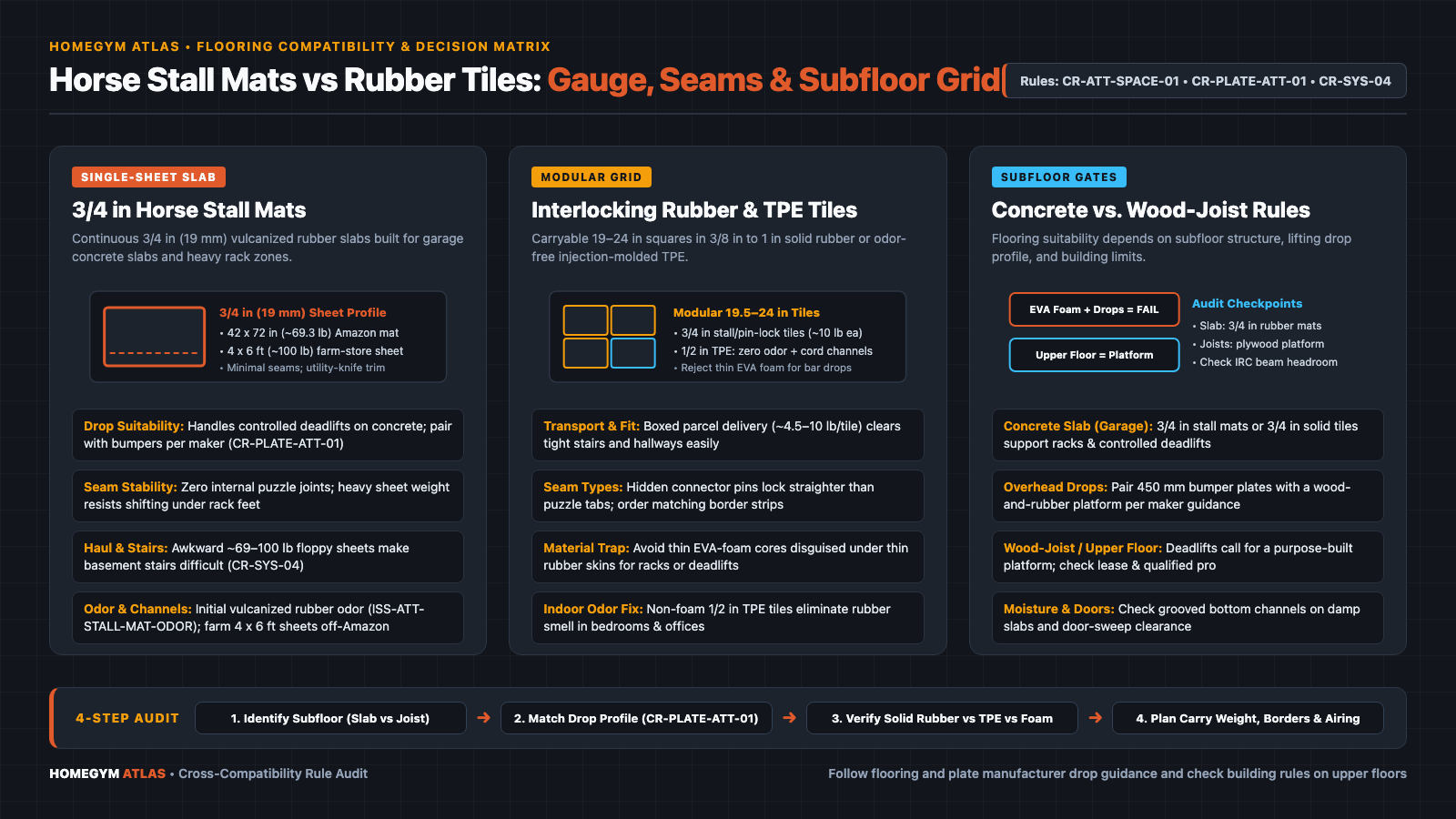
Debating horse stall mats vs rubber tiles comes down to three physical trade-offs: sheet density versus stair-friendly carry weight, continuous lifting seams versus modular room trimming, and upfront off-gassing odor versus indoor air quality. A true horse stall mat is a continuous 3/4 in (19 mm) slab of heavy vulcanized rubber—typically 42 × 72 in (3.5 × 6 ft) on Amazon US parcel mats or 4 × 6 ft (48 × 72 in) at agricultural supply stores (not sold on Amazon as standard Prime stock)—built to stay planted under power racks and controlled barbell work. Interlocking rubber tiles split flooring into manageable 19 × 19 in to 24 × 24 in squares ranging from 3/8 in to 1 in thick, alongside non-foam thermoplastic elastomer (TPE) tiles designed to eliminate tire odor indoors.
Neither format wins every home gym layout. If you are outfitting a concrete-slab garage around a heavy rack from our best power rack attachments hub, thick single-sheet mats eliminate internal puzzle seams where plate edges or bench feet can catch. Conversely, if you haul flooring down narrow basement stairs, outfit an irregular spare bedroom, or want zero recycled tire smell, modular solid rubber or TPE tiles install with far less physical strain. For broader product-by-product rankings across all floor types, see our best home gym flooring guide.
In This Flooring Comparison
- Quick Verdict: Horse Stall Mats vs. Rubber Tiles by Room & Drop Profile
- Side-by-Side Spec & Compatibility Comparison
- Thickness, Drop Suitability & Subfloor Rules (CR-ATT-SPACE-01 & CR-PLATE-ATT-01)
- Seam Stability, Borders, Cutting & Slab Moisture
- Carry Weight, Stair Access & Indoor Odor (CR-SYS-04 & ISS-ATT-STALL-MAT-ODOR)
- Final Verdict: Choose Horse Stall Mats vs. Interlocking Tiles
- Verified Amazon US Stall Mat & Rubber Tile Contenders
- CR-* Rules Appendix, Authoritative Sources & FAQs
Quick Verdict: Horse Stall Mats vs. Rubber Tiles by Room & Drop Profile
Under IronGym Lab compatibility logic, flooring selection is never one-size-fits-all because thickness, edge joinery, and subfloor framing dictate performance. Match your lifting room and barbell drop profile to the recommended flooring class below.
| Home Gym Scenario | Recommended Flooring Format | Technical Basis & Compatibility Trade-Off |
|---|---|---|
| Garage concrete slab with power rack & controlled deadlifts | 3/4 in Horse Stall Mats (Single Sheet) | Continuous 3/4 in (19 mm) vulcanized rubber removes internal puzzle joints; ~69.3 lb to ~100 lb sheets anchor reliably under rack bases. |
| Basement gym with narrow stairs & heavy lifting zone | 3/4 in Modular Stall or Pin-Lock Rubber Tiles | Delivers full 3/4 in (19 mm) impact support in ~9–10 lb squares that one person can carry down stairs without bending floppy slabs. |
| Odor-sensitive spare bedroom or finished basement | 1/2 in Injection-Molded TPE Interlocking Tiles | Eliminates recycled tire sulfur odor immediately while avoiding EVA foam compression under racks, benches, and treadmills. |
| Olympic lifts (snatch, clean & jerk) with overhead drops | Bumper Plates + Purpose-Built Platform | Satisfies CR-PLATE-ATT-01 and CR-ATT-SPACE-01 by pairing 17.72 in (450 mm) bumpers with a plywood-and-rubber platform. |
| Full 10 × 12 ft rack, bench & cardio room (no heavy drops) | 3/8 in Vulcanized Rubber Interlocking Kit | Clears interior door sweeps more easily than 3/4 in mats while supporting static rack loads better than soft EVA foam. |
| Upper-floor apartment or wood-joist room | Purpose-Built Platform + Building/Pro Check | Follow CR-ATT-SPACE-01: check lease and building rules first; deadlifts require a layered platform and professional evaluation for heavy drops. |
Side-by-Side Spec & Compatibility Comparison
To prevent apples-to-oranges comparisons, the matrix below separates true 3/4 in horse stall mat sheets (both Amazon-shipped 42 × 72 in utility sheets and farm-store 4 × 6 ft slabs) from 3/4 in solid rubber interlocking tiles and 1/2 in non-foam TPE / 3/8 in vulcanized tiles. Unpublished durometer or single-tile weights are marked clearly rather than estimated.
| Specification / Audit Criterion | 3/4 in Horse Stall Mat Sheet | 3/4 in Interlocking Rubber Tiles | 1/2 in TPE & 3/8 in Rubber Tiles |
|---|---|---|---|
| Core Material | 100% solid vulcanized rubber (non-foam) | 100% vulcanized or recycled SBR/EPDM rubber | Injection-molded solid TPE or 100% vulcanized rubber |
| Published Thickness | 3/4 in (0.75 in / ~19 mm) | 3/4 in (0.75 in / ~19–19.1 mm) | 3/8 in (~9.5 mm) to 1/2 in (~12.7 mm) |
| Piece Dimensions & Weight | 42 × 72 in (~69.3 lb) on Amazon; 4 × 6 ft (~100 lb) farm store | 19.5 × 19.5 in (~10 lb) or 24 × 24 in (~9–10+ lb) | 19 × 19 in (2.5 sq ft) or 24 × 24 in (4 sq ft); easy parcel handling |
| Seam & Edge Geometry | Zero internal seams; straight edges butt together | Puzzle teeth (separate border tiles) or recessed connector pins | Water-jet puzzle tabs with border strips or straight edge trim |
| Drop Suitability (CR-PLATE-ATT-01) | Controlled deadlifts on concrete; add platform for overhead drops | Controlled deadlifts on concrete; add platform for overhead drops | Controlled lifts, racks & cardio; NOT intended for heavy bar drops |
| Door-Sweep Clearance | High 3/4 in step-up; often blocks inward-swinging interior doors | High 3/4 in step-up; requires edge clearance planning | Low 3/8–1/2 in profile fits more finished room doors |
| Initial Odor Profile (ISS) | Strong vulcanized rubber scent initially; requires airing out | Noticeable tire/vulcanized odor on recycled SBR/rubber | BASELAYER TPE is odor-free; 3/8 in vulcanized rubber still needs airing |
| Amazon US Availability | MSI 42 × 72 in on Amazon; farm 4 × 6 ft sheets not sold on Amazon Prime | Sold per tile or multi-pack on Amazon US | Sold in 12-packs and full 10 × 12 ft kits on Amazon US |
Thickness, Drop Suitability & Subfloor Rules (CR-ATT-SPACE-01 & CR-PLATE-ATT-01)
The primary engineering reason lifters compare horse stall mats vs rubber tiles is impact load transfer into the subfloor beneath. Under IronGym Lab rule CR-ATT-SPACE-01 (CONDITIONAL / SOFT), flooring suitability depends on two variables working together: your lifting drop profile (no drops, controlled deadlift lowering, or overhead weightlifting drops) and your structural floor type (ground-level concrete slab versus wood-joist upper floor).
Concrete Slabs vs. Wood-Joist Upper Floors
On a poured concrete garage or basement slab, a full 3/4 in (19 mm) solid vulcanized rubber stall mat—or an equally thick 3/4 in solid rubber interlocking tile—provides dense, non-compressing footing for squats, benching, and controlled deadlifts. Under rule CR-PLATE-ATT-01 (SOFT), if you drop weights from lockout or overhead, always load drop-rated 17.72 in (450 mm) Olympic bumper plates onto drop-suitable flooring as both the plate and flooring manufacturers instruct, rather than dropping cast-iron plates onto thin rubber.
On a wood-framed room or upper-floor apartment, rubber thickness alone is not a structural fix. As CR-ATT-SPACE-01 specifies, deadlifts on a wood-joist floor call for a purpose-built layered lifting platform (typically two staggered sheets of 3/4 in plywood topped with a hardwood center and 3/4 in rubber drop wings), while overhead barbell drops on upper floors are generally discouraged without professional evaluation. Never assume any mat or tile eliminates vibration to downstairs neighbors or guarantees zero subfloor damage—check lease and building rules first, follow manufacturer weight-drop restrictions, and consult a qualified structural professional for upper-floor heavy barbell plans. See our dedicated home gym flooring for a second floor guide for upper-story setup rules. When layering a platform in a basement, also verify overhead clearance against the International Residential Code (IRC Section R305) habitable ceiling height of 7 ft (84 in) and 6 ft 4 in (76 in) beam/duct clearances so standing overhead presses and power rack uprights still fit.
The Marketplace Trap: Foam-Core “Rubber Top” Tiles & Plastic Barn Mats
When shopping Amazon US for rubber tiles, two deceptive product classes frequently show up under “horse stall mat” and “rubber tile” searches:
- Rubber-Top EVA Foam Hybrids: Many 0.56 in to 0.8 in interlocking tiles glue a thin ~1–2 mm EPDM rubber veneer over a compressible closed-cell EVA foam base. While fine for stretching, kettlebells, and bodyweight mats, soft EVA cores compress under 800–1,000 lb loaded power racks and transmit concentrated barbell impact directly into concrete or hardwood.
- Rigid Plastic Stable Grids & Thin 0.4 in Mats: Multi-piece polypropylene barn grids (such as 4 × 8 ft plastic stable mats) and thin 0.4 in (10 mm) stall sheets lack the elastomeric shock absorption and shoe traction needed under heavy barbell stations. Always verify solid rubber or solid non-foam TPE composition before placing heavy iron on top (CR-SYS-02).
Seam Stability, Borders, Cutting & Slab Moisture
Once material density and 3/4 in thickness are matched, daily livability comes down to how your floor sections meet at the seams and sit against walls and concrete.
Continuous Slabs vs. Puzzle Teeth vs. Hidden Connector Pins
Horse stall mats minimize seams by covering 21 to 24 sq ft per piece. One 42 × 72 in sheet gives you an uninterrupted lifting strip with zero interlocking joints underneath your squat stance or bench legs. Where two straight-edge stall mats meet, heavy sheet weight (~69.3 lb to ~100 lb) keeps joints mostly closed, though aggressive sled pushes or unlevel garage slabs can create slight gaps unless taped underneath with heavy-duty seam tape or framed by baseboards.
Interlocking tiles introduce many more linear feet of seam, and seam engineering varies sharply across models:
- Water-Jet Puzzle Tabs (e.g., American Floor Mats Stall Tiles): Precision puzzle teeth resist lateral separation under heavy benches, but exposed zigzag tabs at room edges require buying matching border tiles (such as ASIN
B08V9346DP) or trimming tabs flush with a straightedge and sharp utility blade. - Hidden Pin Connectors (e.g., Rubber-Cal Eco-Sport): Straight-edge 19.5 × 19.5 in tiles join internally using recessed plastic connector pins, creating clean straight seams without jigsaw outlines that collect chalk dust—at the trade-off of slower installation across large rooms.
Explore more joinery styles and 100% rubber interlocking kits in our best gym flooring tiles roundup.
Concrete Moisture, Trimming & Door-Sweep Clearance
Solid rubber sheets and non-porous tiles block surface spills, yet garage and basement concrete slabs naturally breathe vapor upward. Utility mats with grooved underside channels—like the MSI Utility Rubber Flooring Mat—encourage sub-mat airflow rather than trapping standing condensation flat against concrete. Also measure every interior door sweep before choosing 3/4 in flooring: a 3/4 in (19 mm) mat raises floor height enough to jam standard interior basement or spare-room doors unless doors are undercut or trimmed, whereas 3/8 in (9.5 mm) or 1/2 in (12.7 mm) tiles clear more existing door thresholds cleanly.
Carry Weight, Stair Access & Indoor Odor (CR-SYS-04 & ISS-ATT-STALL-MAT-ODOR)
Physical logistics often decide the horse stall mats vs rubber tiles debate before you ever load a barbell. Under IronGym Lab delivery rule CR-SYS-04 (INFO), check both single-piece weight and your building’s access path before ordering.
Hauling ~100 lb Sheets vs. Boxed Modular Tiles
Traditional 4 × 6 ft (48 × 72 in) agricultural horse stall mats (not sold on Amazon via standard Prime parcel) weigh roughly 95 to 100 lb (~43–45 kg) per limp, flexible sheet. Carrying multiple 4 × 6 ft sheets out of a pickup bed and around tight basement stairwell turns is an awkward two-person job. Even Amazon’s slightly narrower 42 × 72 in MSI Utility Mat weighs approximately 69.3 lb (~31.4 kg) per roll or sheet—manageable solo on flat garage concrete, yet still bulky through narrow hallways.
By contrast, 3/4 in modular rubber tiles pack identical 19 mm rubber density into roughly 9 to 10+ lb (~4–4.5 kg) squares shipped in boxed parcels, allowing one lifter to carry tiles effortlessly up apartment stairs or down basement steps. Just remember that multi-box tile kits for a 10 × 12 ft room often arrive across staggered parcel deliveries.
Rubber Off-Gassing Odor & Cardio Cord Management (CR-CARDIO-ATT-01)
A well-documented open issue on rubber stall flooring is initial off-gassing (ISS-ATT-STALL-MAT-ODOR). According to community reports, not officially confirmed identically across every rubber batch, freshly molded vulcanized and recycled SBR tire-rubber mats often emit a strong sulfur or tire scent for days or weeks when placed directly inside unventilated bedrooms or closed basements. Follow the flooring manufacturer’s airing and mild-soap washing instructions outdoors before indoor installation whenever odor sensitivity matters.
If your gym occupies a spare bedroom, home office, or closed lower level where zero rubber odor is non-negotiable, solid Thermoplastic Elastomer (TPE) interlocking tiles—such as the Made-in-USA BASELAYER Performance Series—offer a non-foam, odor-free middle ground. TPE resists crushing under racks and cardio decks (CR-CARDIO-ATT-01) and adds integrated underside cord channels for treadmill or fan cords—though always follow your treadmill manual’s dedicated 120 V NEMA 5-15 / 5-20 receptacle instructions, avoid pinching power cords under heavy legs, and have a licensed electrician confirm outlet and GFCI compatibility rather than modifying wiring (G-15).
Final Verdict: Choose Horse Stall Mats vs. Interlocking Tiles
Choose Horse Stall Mats If…
- You lift in a ground-level garage on a concrete slab with easy flat-bay delivery access (CR-SYS-04).
- You want zero internal puzzle seams beneath squat stances, power rack uprights, and adjustable bench legs.
- You need continuous 3/4 in (19 mm) vulcanized rubber drop wings flanking a DIY deadlift platform (CR-ATT-SPACE-01).
- You can ventilate your garage bay outdoors while initial vulcanized rubber odor dissipates (ISS-ATT-STALL-MAT-ODOR).
Choose Rubber or TPE Tiles If…
- You must carry flooring up apartment stairs or down narrow basement turns without wrestling ~70–100 lb rubber slabs.
- You want 3/4 in solid rubber impact support in ~10 lb pin-locked squares with clean straight seams and written warranty coverage.
- You train in an enclosed spare bedroom or office requiring odor-free, non-foam 1/2 in TPE tiles with cord routing channels.
- You need cleaner perimeter trimming around closets, columns, and interior doors with lower 3/8 in–1/2 in clearance.
Verified Amazon US Stall Mat & Rubber Tile Contenders
Traditional 4 × 6 ft (~100 lb) straight-edge agricultural horse stall mats sold by regional farm supply stores are not sold on Amazon under standard Prime fulfillment due to freight weight and bulk. However, the four verified Amazon US contenders below cover the exact spectrum from seam-free 3/4 in vulcanized rubber utility sheets to 3/4 in modular stall tiles, pin-lock recycled rubber tiles, and odor-free indoor TPE tiles.
1. MSI Utility Rubber Flooring Mat (42 × 72 in, 3/4 in Thick) — Best Seam-Free Amazon Stall Sheet

Verified Specs: 3/4 in (0.75 in / ~19 mm) heavy-duty vulcanized rubber (PVC-free, BPA-free, latex-free) | 42 × 72 in (3.5 × 6 ft) covering 21 sq ft | ~69.3 lb (~31.4 kg) single sheet | Textured top & grooved bottom airflow channels | Price Tier: Mid-Range ($80–$150 per mat)
The MSI Utility Rubber Flooring Mat delivers true 3/4 in vulcanized horse-stall rubber thickness through standard Amazon parcel shipping without requiring a farm-store pickup truck. Its seam-free 21 sq ft slab lays flat beneath adjustable benches, half racks, or deadlift drop wings, while underside grooves allow trapped slab moisture to breathe.
- Pros: Zero internal puzzle seams across a 3.5 × 6 ft lifting strip; full 3/4 in (19 mm) vulcanized rubber supports heavy concrete-slab rack and deadlift work; grooved bottom channels aid moisture airflow; ~69.3 lb sheet is easier for one person to position than ~100 lb 4 × 6 ft mats.
- Cons: 42 in width is 6 in narrower than 48 in (4 ft) farm-store stall mats—two placed side-by-side total 84 in, slightly short of an 86.6 in Olympic bar’s outer sleeve tips; ~69.3 lb parcel handling can show transit scuffs (CR-SYS-04), and initial vulcanized rubber scent benefits from outdoor airing (ISS-ATT-STALL-MAT-ODOR).
2. American Floor Mats Heavy Duty Stall Tiles (3/4 in Thick, Center Tile) — Modular 3/4 in Stall Rubber

Verified Specs: 100% genuine vulcanized rubber (Made in USA; zero foam filler) | 3/4 in (0.75 in / ~19 mm) thick | 24 × 24 in (610 × 610 mm) covering 4 sq ft per tile | Water-jet interlocking edges | Price Tier: Modular Per-Tile ($25–$50 per 4 sq ft tile)
Bridging the gap between stall mats and modular flooring, American Floor Mats slices genuine 3/4 in Made-in-USA vulcanized stall rubber into carryable 24 × 24 in interlocking tiles. Lifters in finished basements or walk-out cellars get identical 19 mm slab support under power racks and controlled deadlifts without hauling 70–100 lb rubber sheets down stairs.
- Pros: True 3/4 in (19 mm) solid vulcanized rubber resists rack-foot denting; modular 4 sq ft squares clear tight basement turns easily; water-jet cut edges lock tighter than economy foam puzzle tabs.
- Cons: Sold as individual Center Tiles—you must calculate perimeter edges and order matching 3/4 in Border Tiles separately for clean walls; new vulcanized rubber carries noticeable off-gassing odor indoors initially (ISS-ATT-STALL-MAT-ODOR), and full-room 3/4 in builds scale higher in cost than 3/8 in kits.
3. Rubber-Cal “Eco-Sport” Interlocking Tiles (3/4 × 19.5 × 19.5 in) — Best Pin-Lock 3/4 in Rubber Tile

Verified Specs: Recycled SBR tire rubber with EPDM color fleck options (~60 Shore A hardness) | 3/4 in (0.75 in / ~19.1 mm) thick | 19.5 × 19.5 in (~2.64 sq ft per tile) | ~10 lb (~4.5 kg) per tile | Hidden plastic connector pins | 3-Year Limited Warranty | Price Tier: Mid-to-Upper Range ($100–$350+ by pack)
Rubber-Cal’s Eco-Sport series pairs stall-mat 3/4 in depth with hidden connector pins instead of exposed puzzle teeth. Each ~10 lb tile anchors firmly under heavy benches and squat racks while maintaining straight, clean seam lines and offering a documented 3-year limited US manufacturer warranty.
- Pros: Full 3/4 in (19.1 mm) recycled rubber with published ~60 Shore A durometer and ~10 lb per-tile mass; concealed pin joinery eliminates zigzag puzzle edges; backed by Rubber-Cal’s written 3-year limited warranty.
- Cons: Smaller 19.5 × 19.5 in footprint covers ~2.64 sq ft per tile, requiring more pieces and pin assembly time than 24 × 24 in tiles; recycled SBR rubber emits initial tire scent indoors until aired out (ISS-ATT-STALL-MAT-ODOR).
4. BASELAYER Performance Series Interlocking Floor Tiles (1/2 in TPE) — Best Odor-Free Indoor Tile

Verified Specs: Injection-molded Thermoplastic Elastomer (TPE, non-foam; Made in USA) | 1/2 in (0.50 in / ~12.7 mm) thick | 19 × 19 in (2.5 sq ft per tile) | Zero rubber odor & underside power-cord routing channels | Lifetime Limited Warranty | Price Tier: Mid-Range ($100–$250 per pack)
When heavy vulcanized stall mat smell rules out indoor rubber, BASELAYER’s Performance Series substitutes solid injection-molded TPE for both recycled tire rubber and spongy EVA foam. It holds firm under heavy power racks, adjustable benches, and cardio machines (CR-CARDIO-ATT-01) while routing treadmill cords cleanly beneath integrated underside channels.
- Pros: Completely odor-free non-foam TPE ready for closed bedrooms and basements out of the box; firm support resists rack-foot crushing; built-in underside cord channels and Lifetime Limited Warranty (with registration).
- Cons: 1/2 in (12.7 mm) profile offers less impact cushion than 3/4 in solid rubber mats for heavy barbell drops—pair with a dedicated deadlift mat or platform if dropping heavy weights (CR-ATT-SPACE-01); higher per-square-foot cost than budget EVA-core tiles, and confirm you select the firmer Performance line rather than softer Core/Balance variants.
Compatibility Rules Appendix & Authoritative Sources
Every recommendation in this horse stall mats vs rubber tiles comparison applies the IronGym Lab cross-compatibility rule catalog rather than relying on marketplace marketing claims:
- CR-ATT-SPACE-01 (CONDITIONAL / SOFT): Match flooring material and thickness to lifting drop profile and subfloor framing; use 3/4 in rubber or a layered plywood-and-rubber platform for deadlifts and drops, check building rules on upper floors, and consult a qualified professional before heavy upper-floor drops.
- CR-PLATE-ATT-01 (SOFT): Barbell drops require drop-rated 17.72 in (450 mm) bumper plates paired with drop-suitable mats or a platform as instructed by both plate and flooring manufacturers.
- CR-CARDIO-ATT-01 (SOFT): Cardio machine manuals frequently recommend a dense non-compressing equipment mat or solid TPE/rubber tile beneath decks; follow manual 120 V outlet rules and have a licensed electrician confirm circuits.
- CR-SYS-02 & CR-SYS-04 (CONDITIONAL / INFO): Treat anonymous marketplace foam-core tiles omitting core density and warranty documentation conservatively, and verify heavy sheet weight (~69.3 lb to ~100 lb) against stairs and doorways before ordering.
Authoritative Non-Affiliate Citations:
- American Floor Mats Official Horse Stall & Gym Tile Specifications — Published 100% genuine vulcanized rubber construction, 24 × 24 in interlocking tile dimensions, and 3/8 in vs. 3/4 in thickness profiles.
- Rubber-Cal Official Eco-Sport Interlocking Tile Specifications — Published 3/4 in × 19.5 × 19.5 in (~2.64 sq ft) geometry, ~60 Shore A hardness, ~10 lb per-tile weight, pin-connector joinery, and 3-year limited warranty terms.
- BASELAYER Labs Performance Series TPE Flooring Specifications — Made-in-USA 1/2 in injection-molded Thermoplastic Elastomer (non-foam) specs, odor-free formulation, underside cord channels, and Lifetime Limited Warranty terms.
- International Code Council (IRC Section R305) Ceiling Height Standards — Standard 7 ft (84 in) minimum basement habitable ceiling height and 6 ft 4 in (76 in) beam/duct clearance baseline when stacking deadlift platforms.
How We Audited This Guide
- Rack attachments, pulley stacks, safeties, rubber mats, and gym tiles were verified for true hole-spacing fit, 1:1 vs 2:1 pulley ratios, drop-rating limits, and off-gassing ventilation care.
- Every power rack, barbell, weight plate, bench, adjustable dumbbell, cardio machine, and flooring spec was cross-checked against official manufacturer manuals, CPSC notices, and live Amazon US listings.
- Recommendations were evaluated against our weighted vertical scoring rubrics and documented CR-* compatibility rules; we never invent load capacities, motor ratings, rubber thickness, or decibels.
Continue Your Audit
Frequently Asked Questions: Horse Stall Mats vs. Rubber Tiles
Are 3/4 in rubber tiles as durable as horse stall mats?
Yes, when the tiles are made from 100% solid vulcanized or recycled rubber at a full 3/4 in (19 mm) thickness rather than rubber-top EVA foam. Solid 3/4 in interlocking tiles support racks and controlled deadlifts similarly, though tiles add internal seams that slabs avoid.
Why do horse stall mats smell like rubber, and how do you fix it?
According to community reports, not officially confirmed across every batch, new vulcanized and recycled tire rubber off-gasses sulfur compounds indoors (ISS-ATT-STALL-MAT-ODOR). Air mats outdoors out of direct sun and wash with mild soap per maker instructions, or pick odor-free TPE tiles.
Can I put horse stall mats or rubber tiles on a second-floor wood subfloor?
Light rack and dumbbell setups can sit on dense rubber tiles, but deadlifts on wood-joist floors call for a layered plywood-and-rubber platform under rule CR-ATT-SPACE-01. Always verify lease limits and consult a qualified professional before dropping heavy weights on upper stories.
Are foam-core rubber-top interlocking tiles safe under a power rack?
No. Tiles pairing a thin rubber skin with a soft EVA foam core compress unevenly under heavy power racks, weight benches, and dropped barbells. Stick to 100% solid vulcanized rubber, solid recycled rubber, or non-foam injection-molded TPE tiles for barbell stations.
Are 4 x 6 ft horse stall mats sold on Amazon US?
Standard ~100 lb 4 × 6 ft straight-edge agricultural stall mats are typically stocked by farm supply stores and are generally not sold on Amazon Prime due to parcel weight limits. On Amazon US, look for 42 × 72 in 3/4 in utility mats or 3/4 in modular stall tiles.


