
Disclosure: As an Amazon Associate, IronGym Lab earns from qualifying purchases. If you buy through verified Amazon US links on this page, we may earn a small commission at no extra cost to you.
When builders ask how thick should home gym flooring be, the right number is never a single universal millimeter count—it depends on your barbell drop profile, material density, and underlying subfloor. Laying soft 3/4 in foam tiles under a power rack crushes immediately, whereas hauling 1 in rubber mats into an indoor cardio room creates door-clearance headaches for zero functional gain. Inside our power rack attachments and gym flooring hub, flooring thickness is evaluated as a structural interface alongside plate type, rack anchoring, and room height.
Quick Answer — Home Gym Flooring Thickness by Drop Profile:
Choose 1/4 in to 3/8 in (6.4 to 9.5 mm) solid rubber or 1/2 in (12.7 mm) non-foam TPE for cardio machines, benches, and non-drop racks. Step up to 3/4 in (19.1 mm) vulcanized or recycled rubber on concrete slabs for controlled deadlift lowering. For overhead barbell drops or wood-joist floors, build a 1.5 to 2.25 in (38.1 to 57.2 mm) plywood-and-rubber platform with bumper plates (CR-ATT-SPACE-01, CR-PLATE-ATT-01).
In This Flooring Thickness Guide
- 1. Thickness Tiers Explained: 1/4 in Rolls to 2.25 in Platforms
- 2. Flooring Thickness Decision Matrix by Subfloor & Drop Profile
- 3. Why Compound Density Matters More Than Foam Thickness
- 4. Subfloors, Cardio Mats, Rack Anchoring & Ceiling Clearances
- 5. Myth vs. Engineering Reality: Common Thickness Mistakes
- 6. Verified Amazon US Flooring Picks Across Every Thickness Tier
- 7. 6-Step Sizing Checklist, Compatibility Rules & Sources
- 8. Frequently Asked Questions: Home Gym Flooring Thickness
1. Thickness Tiers Explained: 1/4 in Rolls to 2.25 in Platforms
Home gym flooring sits in five practical thickness brackets. Under IronGym Lab compatibility rule CR-ATT-SPACE-01 (CONDITIONAL / SOFT), thickness only works when paired with the right compound and subfloor construction—concrete slab on grade versus wood-joist residential framing. Before comparing individual mats in our best home gym flooring guide, match your training habits to the five thickness bands below:
1/4 in (6.4 mm) — Cardio Equipment, Bodyweight & Light Dumbbell Bays
At 1/4 in (6.4 mm)—often rounded to 6 mm or 8 mm (~5/16 in) on rolled commercial rubber—solid recycled SBR or vulcanized mats add a crisp, non-compressible wear skin over bare concrete, basement vinyl, or garage slabs. This thickness is built for treadmills, indoor cycling bikes, rowing machines, stretching, bodyweight circuits, and light-to-moderate dumbbell sets returned to a rack rather than dropped. Because 1/4 in rolls sit low to the subfloor, they keep transition edges shallow and slip cleanly underneath interior room doors.
3/8 in (9.5 mm) to 1/2 in (12.7 mm) — Non-Drop Power Racks, Benches & Multi-Use Rooms
Stepping up to 3/8 in (9.5 mm) solid rubber or 1/2 in (12.7 mm) injection-molded TPE gives enough structural cushion to support loaded power racks, adjustable weight benches, selectorized dumbbells, and heavier dumbbell stands without crushing under concentrated steel feet. Within this bracket, lifters still control bars down onto safeties or set deadlifts down gently rather than dropping loaded sleeves from waist or shoulder height. The 3/8 to 1/2 in range is the sweet spot for finished basements and spare rooms where full 3/4 in stall mats feel overly bulky or block swinging door clearances.
3/4 in (19.1 mm) — The Garage Standard for Racks & Controlled Deadlifts
A 3/4 in (19.1 mm) dense rubber mat—popularized by 4 × 6 ft (1.22 × 1.83 m) agricultural horse-stall mats weighing roughly 95 to 100 lb (43.1 to 45.4 kg) each, as well as modular 19.5 to 24 in heavy-duty rubber tiles—is the benchmark thickness for concrete-slab garage gyms. At 3/4 in, vulcanized or high-density recycled SBR rubber spreads downward contact force from heavy squat racks and controlled deadlift touchdowns using a 20 kg (~44.1 lb) Olympic barbell loaded with 450 mm (~17.72 in) bumper plates. For a deeper comparison between heavy sheets and interlocking formats, read our horse stall mats vs rubber tiles breakdown.
1 in (25.4 mm) Solid Rubber — Dedicated Dumbbell Zones & Extra Cushion
Moving from 3/4 in to 1 in (25.4 mm) high-density rubber tiles adds 6.3 mm of extra cushion, most helpful in localized concrete-slab dumbbell stations or compact outdoor/garage bays. Because 1 in tiles create a noticeable step-up trip edge if laid as an island, either run them wall-to-wall, add beveled transition ramps, or keep them strictly beneath designated heavy-dumbbell bays. Remember that extra thickness does not replace a plywood core when dropping heavy barbells on wood framing.
1.5 in to 2.25 in (38.1 to 57.2 mm) — Layered Lifting Platforms for Overhead Drops
When your programming includes snatches, clean and jerks, or waist-to-shoulder barbell drops, even 3/4 in rubber alone over bare concrete or wood joists eventually transfers sharp impact spikes into the slab or floor sheathing. A purpose-built lifting platform stacks one or two sheets of 3/4 in (19.1 mm) exterior plywood or MDF underneath a 3/4 in (19.1 mm) rubber drop layer—producing a 1.5 in (38.1 mm) two-layer deck or a 2.25 in (57.2 mm) three-layer deck. The rigid plywood core disperses point shock laterally across a wide area while the 3/4 in rubber drop wings absorb surface contact from bumper plates.
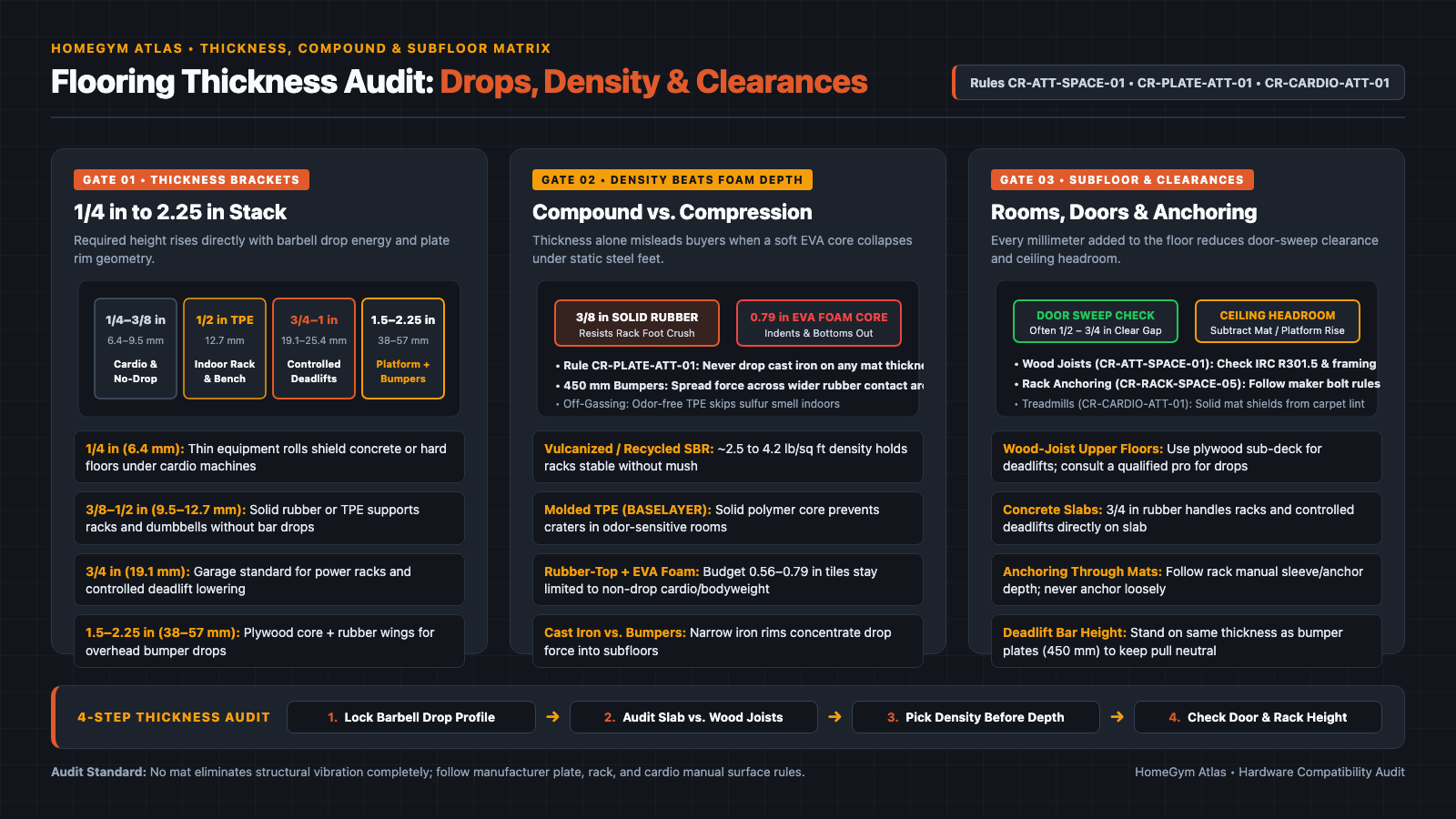
2. Flooring Thickness Decision Matrix by Subfloor & Drop Profile
Use the decision table below to match your real training drop profile (user.drop_profile) against your building’s floor structure (space.floor_type) before purchasing mats or tiles.
| Training & Drop Profile | Concrete Slab (Garage / Basement) | Wood-Joist Floor (Main / Upper Story) | Material & Critical Compatibility Caveat |
|---|---|---|---|
| Cardio Machines Only (Treadmill, Rower, Bike) | 1/4 in to 3/8 in (6.4–9.5 mm) solid rubber roll or equipment mat | 1/4 in to 1/2 in (6.4–12.7 mm) rubber, PVC mat, or TPE tile + wood/LVP barrier | Check treadmill manual surface guidance (CR-CARDIO-ATT-01); avoid deep carpet lint under motorized hoods. |
| Bodyweight, Mobility & Light Kettlebells | 3/8 in to 0.56 in (9.5–14.2 mm) rubber or rubber-top EVA hybrid | 0.56 in (14.2 mm) EPDM-top EVA or 1/2 in TPE tile | Keep strictly non-drop; soft EVA foam cores permanently indent under racks or heavy benches. |
| Power Rack, Bench & Controlled Lifts (No Drops) | 3/8 in to 3/4 in (9.5–19.1 mm) solid rubber or 1/2 in TPE | 3/8 in solid rubber or 1/2 in TPE (+ 3/4 in plywood sub-deck over carpet) | Avoid foam cores under rack uprights; follow rack maker bolt-down rules (CR-RACK-SPACE-05). |
| Controlled Deadlift Lowering (Bar Returns to Floor) | 3/4 in (19.1 mm) vulcanized or recycled SBR rubber | 1.5 in+ platform (3/4 in plywood base + 3/4 in rubber) across joists | Use 450 mm (~17.72 in) rubber bumpers; never drop cast iron onto mats (CR-PLATE-ATT-01). |
| Overhead Weightlifting & Waist-Height Drops | 1.5 in to 2.25 in (38.1–57.2 mm) plywood-core platform + 3/4 in rubber | Generally discouraged without engineered platform & qualified structural check | Consult building rules and a qualified professional; no mat guarantees subfloor immunity (CR-ATT-SPACE-01). |
3. Why Compound Density Matters More Than Foam Thickness
One of the most expensive mistakes on Amazon happens when buyers shop by headline inch or millimeter thickness alone. Listing titles routinely advertise 0.56 in (14.2 mm), 0.79 in (20 mm), or even 1 in (25.4 mm) “thick gym flooring” that actually consists of an EVA foam puzzle base with a thin 1 to 2 mm rubber wear skin bonded on top.
Thickness without density fails under strength hardware for three mechanical reasons:
- Static Point-Load Crushing: A loaded power rack or flat bench resting on four 2 × 2 in or 3 × 3 in steel feet concentrates hundreds of pounds onto tiny surface areas. Closed-cell EVA foam compresses flat under sustained pressure, creating permanent divots and causing rack uprights to lean slightly out of plumb. By contrast, solid 3/8 in (9.5 mm) vulcanized rubber or 1/2 in (12.7 mm) injection-molded TPE maintains uniform support despite being thinner on paper.
- Foot & Squat Instability: Squatting or pressing heavy loads on thick, spongy foam introduces heel compressions that shift ankle balance mid-rep. Dense vulcanized rubber, recycled SBR/EPDM granules, and rigid TPE keep lifting shoes planted firmly while still shielding bare concrete underneath.
- Plate Rim & Impact Bottoming Out: Under rule CR-PLATE-ATT-01 (SOFT), dropping even moderate loads onto EVA-core tiles compresses the foam immediately down to the subfloor, transferring concentrated force from plate rims straight into concrete or wood sheathing.
Material chemistry also governs indoor air quality. Recycled SBR tire rubber and freshly vulcanized stall mats frequently emit a noticeable sulfur or tire odor indoors (ISS-ATT-STALL-MAT-ODOR)—especially at 3/4 in thickness inside unventilated rooms. Follow the manufacturer’s airing guidance (washing with mild soap, rinsing, and airing outdoors in shade) or choose odorless injection-molded TPE tiles when flooring enclosed bedrooms or basements.
4. Subfloors, Cardio Mats, Rack Anchoring & Ceiling Clearances
Every millimeter you add to the floor ripples through the rest of your home gym compatibility checks. Before locking in a mat thickness, audit these four room and hardware interactions:
1. Concrete Slab vs. Wood-Joist Upper Floors (IRC R301.5)
Concrete garage and basement slabs handle heavy 3/4 in (19.1 mm) rubber mats easily because the slab transfers loads straight into compacted earth. On wood-framed main floors or upper stories, International Residential Code (IRC) Table R301.5 sets minimum uniformly distributed live-load baselines at 30 psf (~146 kg/m²) for sleeping areas and 40 psf (~195 kg/m²) for living rooms. Thick 3/4 in rubber mats themselves weigh roughly 4 to 4.2 lb per sq ft (~19.5 to 20.5 kg/m²)—meaning 100 sq ft adds ~400+ lb of dead load before equipment arrives. Review our dedicated home gym flooring on a second floor checklist before placing heavy rubber mats or deadlift platforms on wood joists, and consult a qualified contractor or structural engineer for heavy setups.
2. Protecting Hardwood & LVP Finishes (NWFA Guidance)
If your home gym sits over sealed hardwood or luxury vinyl plank (LVP), thickness alone does not stop chemical staining. Per care guidance from the National Wood Flooring Association (NWFA), plasticizers inside synthetic rubber, latex, or PVC mats can migrate into polyurethane finishes or vinyl wear layers under static weight and heat, leaving yellow or dark grid marks. Check your floor maker’s instructions, vacuum grit clean, and lay a breathable non-staining barrier (such as untreated felt or builder/rosin paper) beneath rubber mats.
3. Cardio Equipment Surface Rules & Door-Sweep Clearances
Under rule CR-CARDIO-ATT-01 (SOFT), motorized treadmill manuals frequently recommend a dedicated equipment mat and warn against operating directly over plush carpet, where carpet lint and static buildup can affect drive-motor airflow. A continuous 1/4 in (6.4 mm) rubber roll, 3/8 in (9.5 mm) rubber tile bay, or 1/2 in (12.7 mm) TPE floor provides a lint-free, flat surface. Just measure the bottom clearance of inward-swinging room and closet doors first: many interior doors sit only 1/2 to 3/4 in (12.7 to 19.1 mm) above finished flooring, meaning 3/8 in or 1/4 in flooring clears the swing while 3/4 in mats require stopping short of the door arc.
4. Rack Anchoring, Ceiling Headroom & Deadlift Bar Height
Thick mats change three barbell-zone measurements simultaneously:
- Power Rack Anchoring (CR-RACK-SPACE-05): If your rack manual specifies floor bolting (common on compact 2-post squat stands and wall-mount racks), follow the manufacturer’s concrete-anchor hardware instructions closely. Bolting loosely over soft foam allows compression and wobble; bolt-down racks typically require solid rubber or cutting/shimming per the rack maker’s guidance—have a qualified installer confirm if unsure.
- Basement Ceiling Clearance (CR-RACK-SPACE-01 / R305): Under IRC Section R305, habitable basement ceilings typically target a 7 ft (84 in / 213.4 cm) minimum, with structural beams lower. Adding a 2.25 in (57.2 mm) lifting platform reduces effective headroom by over 2 in—enough to turn an 80 in power rack plus pull-up bar clearance into a tight squeeze.
- Deadlift Pull Height Consistency: Standard 450 mm (~17.72 in) bumper plates elevate an Olympic bar centerline to ~8.86 in (225 mm) when lifter and plates rest on the same plane. If you place 3/4 in rubber only under the plates while standing barefoot or on concrete between them, you artificially create a 3/4 in deficit pull. Keep your standing surface and plate landing wings at matching height.
5. Myth vs. Engineering Reality: Home Gym Flooring Thickness Myths
- Myth: “3/4 in or 0.79 in rubber-top EVA foam mats match 3/4 in horse stall mats.”
Engineering Reality: Foam-backed tiles measure thick on a ruler, yet the soft EVA core compresses under static rack uprights and barbell impact (CR-ATT-SPACE-01). Solid 3/8 in vulcanized rubber outperforms 0.79 in foam-core mats for heavy racks. - Myth: “Thick 1 in rubber mats make it safe to drop cast-iron weight plates.”
Engineering Reality: UnderCR-PLATE-ATT-01, cast-iron and calibrated steel plates are not drop plates. Their narrow steel rims concentrate force into small contact patches regardless of mat thickness—use 450 mm rubber or urethane bumpers for dropped lifts. - Myth: “Double-stacking two 3/4 in rubber mats is better than building a plywood-core platform.”
Engineering Reality: Stacking two soft rubber sheets creates excessive bar bounce and foot squish without spreading concentrated plate impact laterally. A rigid 3/4 in plywood sub-base beneath a single 3/4 in rubber top layer distributes load far more cleanly. - Myth: “Thick 3/4 in or 1 in flooring eliminates noise and guarantees zero subfloor damage.”
Engineering Reality: Dense rubber dampens surface clatter, but no mat eliminates low-frequency structural vibration through wood joists or guarantees absolute concrete immunity (G-16,CR-CARDIO-SPACE-04). Control rep descents and follow building rules. - Myth: “Thin 1/4 in rolled rubber is useless for a real home gym.”
Engineering Reality: For cardio machines, adjustable benches, stretching, and controlled dumbbell training without drops, 1/4 in dense recycled rubber provides a durable, seam-free surface that clears interior doors effortlessly.
6. Verified Amazon US Flooring Picks Across Every Thickness Tier
To illustrate how each thickness bracket translates into real Amazon US hardware, we audited four verified options spanning 1/4 in, 3/8 in, 1/2 in, and 3/4 in profiles. Note that traditional 4 × 6 ft (~100 lb) straight-edge agricultural stall sheets and custom commercial rolls sold direct by farm or specialty flooring retailers are not sold on Amazon through standard Prime fulfillment.
1. IncStores 1/4 in Tough Rubber Roll — Best 1/4 in Seamless Cardio & No-Drop Floor

Verified Specs: Material: Recycled SBR tire rubber bound with polyurethane (color EPDM fleck options) | Thickness: 1/4 in (0.25 in / ~6.4 mm) | Format: Continuous rolled rubber (4 ft standard width across selectable lengths) | Warranty: 5-year limited manufacturer warranty | Budget Tier: Mid-Range ($100–$250 tier depending on roll length)
If your setup focuses on treadmills, rowing machines, spin bikes, benches, and controlled dumbbells—without dropping loaded barbells—IncStores / FlooringInc 1/4 in Tough Rubber Rolls deliver a continuous, seam-free surface at a fraction of stall-mat bulk. The 1/4 in height clears almost every interior door sweep while creating a solid, lint-free cardio platform under rule CR-CARDIO-ATT-01.
- Thickness Pros: Zero puzzle seams across 4 ft widths; trims cleanly with a straightedge and utility knife; 5-year limited manufacturer warranty; glides under low interior doors.
- Thickness Cons: 1/4 in depth is not suited for barbell deadlift lowering or heavy drops on concrete (
CR-ATT-SPACE-01); heavy continuous rolls (~96 lb per 4 × 10 ft roll class) require two people on stairs and initial airing for recycled rubber scent (ISS-ATT-STALL-MAT-ODOR).
2. Matter Flex 100% Recycled Rubber Mats (3/8 in, 16 Sq Ft) — Best 3/8 in Modular Rubber

Verified Specs: Material: 100% recycled post-consumer rubber with red EPDM flecks (Made in USA) | Thickness: 3/8 in (0.375 in / ~9.5 mm) | Tile Size: 24 × 24 in (610 × 610 mm), 4 tiles = 16 sq ft per pack | Format: Interlocking Center, Side (border), and Corner variants | Budget Tier: Mid-Range ($80–$160 per 4-pack)
Stepping up to 3/8 in (9.5 mm) solid recycled rubber hits the sweet spot for non-drop power racks, flat/FID weight benches, and full-room garage bays where rolling out 100 lb rubber sheets is impractical. Because Matter Flex uses dense solid rubber rather than EVA foam, rack uprights stay steady and red EPDM flecks disguise chalk and dust cleanly.
- Thickness Pros: Dense 3/8 in rubber resists permanent indentation under heavy static equipment; modular 24 × 24 in squares install fast around odd room walls; dedicated Side and Corner tiles eliminate jagged puzzle edges.
- Thickness Cons: Still reserved for controlled, non-drop lifting rather than heavy deadlift drops on slab concrete (
CR-ATT-SPACE-01); confirm your Amazon pack selection matches Side (B0G887R9PW), Center, or Corner tiles before checkout.
3. BASELAYER Performance Series Interlocking Tiles (1/2 in TPE) — Best 1/2 in Odor-Free Indoor Tile

Verified Specs: Material: Injection-molded Thermoplastic Elastomer (TPE, Made in USA; non-foam) | Thickness: 1/2 in (0.50 in / 12.7 mm) | Tile Size: 19 × 19 in (483 × 483 mm), 2.5 sq ft per tile | Features: Zero rubber odor (GREENGUARD Gold Certified) + integrated underside cord channels | Warranty: Lifetime Limited Warranty (registration required) | Budget Tier: Mid-Range ($100–$250 by pack)
At 1/2 in (12.7 mm), BASELAYER Performance Series solves the indoor bedroom and finished-basement dilemma: you get firm, non-foam load support for power racks, weight benches, and cardio machines with zero recycled-tire smell. Built-in underside routing channels also tuck treadmill or fan power cords safely beneath the tiles.
- Thickness Pros: Rigid non-foam 1/2 in TPE avoids EVA dimpling under racks and heavy benches; zero indoor off-gassing (solves
ISS-ATT-STALL-MAT-ODOR); backed by a Lifetime Limited Warranty in the original room. - Thickness Cons: 1/2 in thickness is suited to non-drop strength setups and controlled lowering rather than repeated overhead drops (
CR-ATT-SPACE-01); higher cost per square foot than budget rubber or EVA-foam tiles, and you must verify the firmer Performance variant rather than Core or Balance.
4. Rubber-Cal “Eco-Sport” Interlocking Tiles (3/4 in) — Best 3/4 in Heavy-Duty Deadlift Tile

Verified Specs: Material: Recycled SBR tire rubber blended with colored EPDM flecks | Thickness: 3/4 in (0.75 in / 19.1 mm) | Tile Size: 19.5 × 19.5 in (495 × 495 mm), ~2.64 sq ft per tile | Weight: ~10 lb (~4.5 kg) per tile with hidden plastic pin connectors | Warranty: 3-year limited manufacturer warranty | Budget Tier: Mid-to-Upper Range ($100–$350+ by pack)
When your garage or basement concrete slab sees regular heavy squats and controlled barbell deadlifts, Rubber-Cal Eco-Sport 3/4 in tiles deliver true stall-mat thickness (~10 lb per square tile, ~3.8 lb/sq ft density) in a straight-edge pin-lock grid. Internal connector pins hide puzzle seams while keeping heavy tiles planted without floor adhesives.
- Thickness Pros: Full 3/4 in (19.1 mm) dense rubber handles heavy power racks and controlled deadlifts with 450 mm bumper plates; straight pin-locked joints reduce edge curling; documented 3-year US warranty.
- Thickness Cons: Smaller ~2.64 sq ft tiles require pin-insertion assembly time and careful pack-count math; recycled SBR rubber requires initial outdoor ventilation before enclosed indoor use (
ISS-ATT-STALL-MAT-ODOR); overhead drops still call for a plywood-and-rubber platform (CR-ATT-SPACE-01).
7. 6-Step Sizing Checklist, Compatibility Rules & Sources
Verify these six thickness checks before ordering mats or building a lifting platform:
- Define Your Maximum Drop Height First: Non-drop cardio and bench spaces work cleanly at 1/4 to 1/2 in; controlled deadlifts on concrete step up to 3/4 in; overhead drops call for a 1.5 to 2.25 in layered platform (
CR-ATT-SPACE-01). - Audit Subfloor Structure & Building Rules: Concrete slabs support 3/4 in rubber directly; wood-joist upper floors call for lease checks, plywood load-distribution bases, and qualified professional verification for heavy drops.
- Reject Foam Cores Under Heavy Iron: Verify solid vulcanized rubber, recycled SBR, or non-foam TPE under racks and benches instead of compressible EVA-core puzzle tiles.
- Pair Drop Profiles with Bumper Plates: Use 450 mm (~17.72 in) rubber or urethane bumper plates whenever a loaded barbell contacts the floor—never drop cast-iron plates onto any mat thickness (
CR-PLATE-ATT-01). - Measure Door Sweeps, Ceilings & Anchors: Confirm inward door clearance against 3/8 in, 1/2 in, or 3/4 in height, subtract platform rise from low basement beams (
CR-RACK-SPACE-01), and follow rack manual bolting instructions (CR-RACK-SPACE-05). - Check Odor Tolerance & Finish Barriers: Choose odor-free TPE for unventilated rooms, air SBR rubber outdoors first (
ISS-ATT-STALL-MAT-ODOR), and place a breathable felt or builder-paper barrier over hardwood or LVP.
Compatibility Rules Appendix: CR-ATT-SPACE-01 (flooring material and thickness matched to subfloor framing and drop profile), CR-PLATE-ATT-01 (bumper plates vs. non-drop cast-iron plates on drop-suitable flooring), CR-CARDIO-ATT-01 (equipment mat surface rules under cardio manuals), CR-CARDIO-SPACE-04 (upper-floor placement and structural vibration limits), CR-RACK-SPACE-01 (ceiling obstruction height minus platform/mat rise), CR-RACK-SPACE-05 (manufacturer-first rack anchoring compliance), CR-SYS-02 (traceable manufacturer specifications and warranty terms), and CR-SYS-04 (heavy mat roll/tile freight and stairway delivery logistics).
Authoritative Non-Affiliate Sources Cited:
- International Code Council — IRC Table R301.5 & Section R305 — Residential floor live-load minimums (30 psf sleeping / 40 psf living areas) and habitable basement ceiling clearance baselines.
- National Wood Flooring Association (NWFA) — Surface finish protection guidance covering plasticizer migration from rubber/PVC mats and breathable underlayment barriers.
- IncStores / FlooringInc Tough Rubber Roll Specifications — 1/4 in (6.4 mm) polyurethane-bound recycled SBR rubber specs and 5-year limited warranty coverage.
- BASELAYER Labs Performance Series Official Specifications — 1/2 in (12.7 mm) non-foam TPE composition, GREENGUARD Gold odor-free rating, cord channels, and Lifetime Limited Warranty.
- Rubber-Cal Eco-Sport Interlocking Tile Specifications — 3/4 in (19.1 mm) x 19.5 x 19.5 in tile weight (~10 lb), pin-connector locking, and 3-year limited warranty terms.
How We Audited This Guide
- Rack attachments, pulley stacks, safeties, rubber mats, and gym tiles were verified for true hole-spacing fit, 1:1 vs 2:1 pulley ratios, drop-rating limits, and off-gassing ventilation care.
- Every power rack, barbell, weight plate, bench, adjustable dumbbell, cardio machine, and flooring spec was cross-checked against official manufacturer manuals, CPSC notices, and live Amazon US listings.
- Recommendations were evaluated against our weighted vertical scoring rubrics and documented CR-* compatibility rules; we never invent load capacities, motor ratings, rubber thickness, or decibels.
Continue Your Audit
8. Frequently Asked Questions: Home Gym Flooring Thickness
Is 3/8 inch rubber flooring thick enough for a home gym?
Yes, solid 3/8 in (9.5 mm) vulcanized or recycled rubber is thick enough for non-drop power racks, benches, dumbbells, and cardio machines on concrete or solid wood subfloors. For controlled deadlifts or barbell drops, step up to 3/4 in (19.1 mm) rubber or a layered lifting platform.
Is 3/4 inch flooring always better than 1/2 inch flooring?
Not always. While 3/4 in (19.1 mm) rubber absorbs heavier controlled deadlift contact on concrete slabs, 1/2 in (12.7 mm) non-foam TPE or 3/8 in rubber clears tight interior doors easier, adds far less dead weight on upper wood joists, and works cleanly for non-drop training.
How thick should a deadlift platform be for dropping weights?
A standard DIY or commercial lifting platform measures 1.5 in to 2.25 in (38.1 to 57.2 mm) thick total—combining one or two layers of 3/4 in plywood for load dispersion with 3/4 in dense rubber drop wings paired with 450 mm bumper plates.
Can you use 1/2 inch or 3/4 inch foam tiles instead of rubber mats?
No. Soft EVA foam tiles—even at 0.79 in or 1 in thickness—compress permanently beneath loaded power rack uprights, weight bench legs, and dropped barbell sleeves. Reserve foam-core tiles for bodyweight mobility, stretching, or light non-drop cardio spaces.
What thickness mat should go under a treadmill or rower?
A dense 1/4 in (6.4 mm) rubber roll, 3/8 in solid rubber tile, or 1/2 in TPE panel works well under treadmills, rowers, and bikes. Always confirm your machine manual’s floor-surface rule, especially avoiding deep carpet lint exposure beneath motorized treadmill hoods.


