
Disclosure: As an Amazon Associate, IronGym Lab earns from qualifying purchases. If you buy through verified Amazon US links on this page, we may earn a small commission at no extra cost to you.
Selecting home gym flooring for second floor rooms requires a completely different checklist than carpeting a basement or lining a concrete garage bay. Above ground level, every mat you haul upstairs adds dead weight onto wood joists, sits directly atop finished hardwood, luxury vinyl plank (LVP), or padded carpet, and shares structural framing with rooms below. Inside our power rack attachments and gym flooring hub, upper-story subfloor framing and drop limits are evaluated before thickness or surface texture.
Quick Answer — What to Check Before Laying Second-Floor Gym Flooring:
Verify lease or HOA rules and confirm wood-joist framing before bringing heavy racks or barbells upstairs (CR-ATT-SPACE-01). Choose modular 19 to 24 in tiles—such as odorless 1/2 in (12.7 mm) TPE or 3/8 in (9.5 mm) solid rubber—add a breathable non-staining barrier over hardwood or LVP, keep lifts controlled without overhead drops, and remember no mat eliminates structural thuds downstairs.
In This Second-Floor Flooring Guide
- 1. Wood-Joist Structure, IRC Live Loads & Drop Profiles
- 2. Second-Floor Subfloor & Flooring Decision Table
- 3. Protecting Hardwood, LVP, Door Clearances & Carpet
- 4. Acoustic Reality, Off-Gassing Odor & Stairway Access
- 5. Myth vs. Engineering Reality: Upper-Floor Traps to Avoid
- 6. Verified Amazon US Flooring Picks for Second-Floor Setups
- 7. Pre-Order Audit Checklist, Compatibility Appendix, Sources & FAQs
1. Wood-Joist Structure, IRC Live Loads & Drop Profiles
A ground-level residential garage typically pours a slab-on-grade concrete floor roughly 4 in (102 mm) thick directly over compacted earth. By contrast, most second-floor bedrooms, spare offices, bonus rooms above garages, and low-rise apartments are built on dimensional lumber or engineered I-joist framing spaced 16 in or 24 in (40.6 or 61.0 cm) on center, topped by 3/4 in (19.1 mm) plywood or OSB subfloor sheathing. Even in mid-rise apartments with concrete deck slabs, vibration and impact noise still radiate downward through structural columns and ceilings.
How Residential Live-Load Code Baselines Work (IRC Section R301.5)
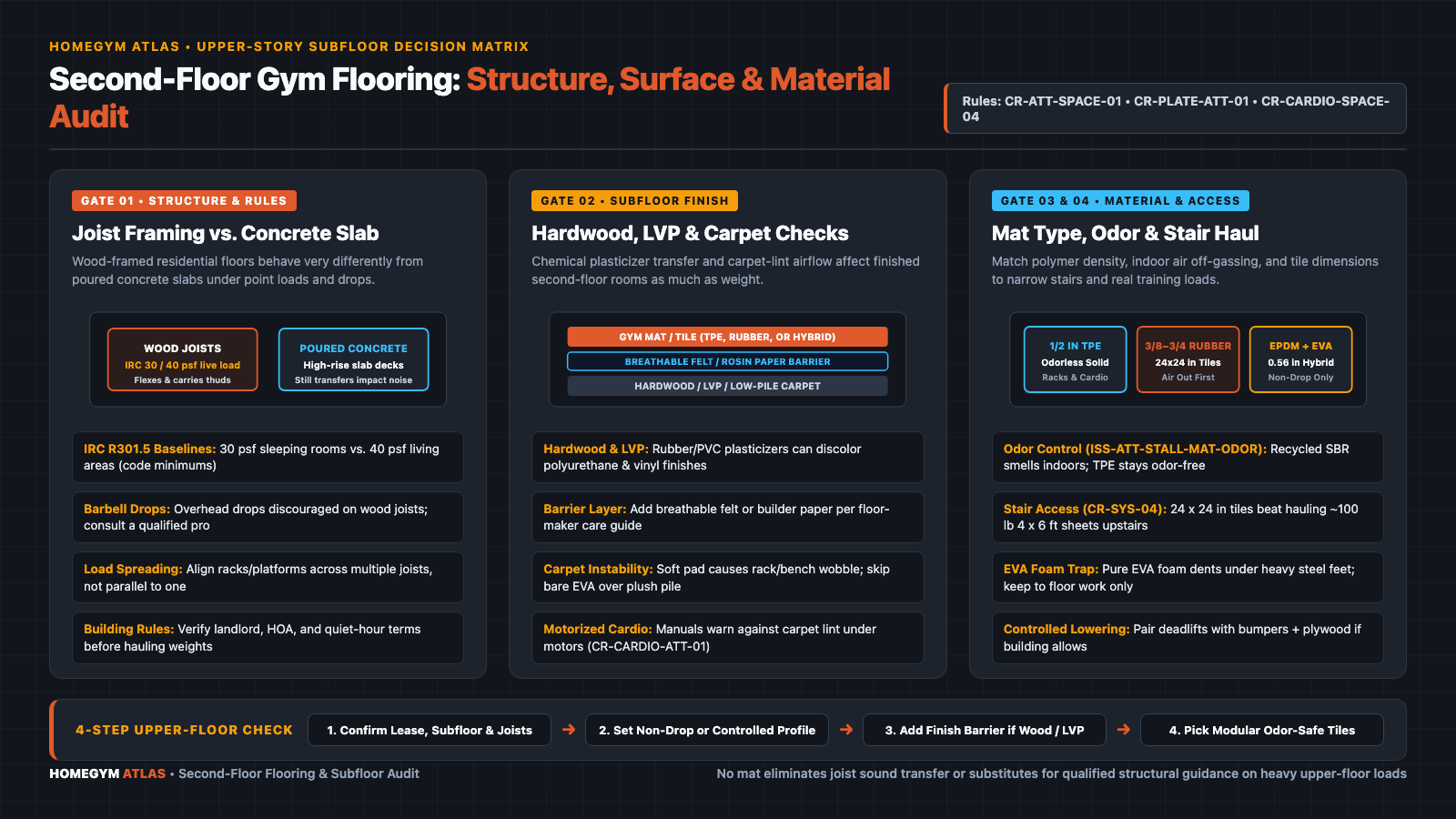
Under International Residential Code (IRC) Table R301.5, minimum uniformly distributed live loads for residential floors are specified at 30 psf (~146 kg/m²) for sleeping areas (bedrooms) and 40 psf (~195 kg/m²) for living areas such as hallways, living rooms, and dens. Those figures represent minimum code design baselines for evenly spread household loads—not a green light to concentrate heavy steel equipment in a small corner or drop loaded barbells.
Every piece of flooring and equipment imposes three distinct load types on upper-story framing:
- Dead Load (Flooring Weight): Thick 3/4 in (19.1 mm) rubber horse-stall mats weigh roughly 4 to 4.2 lb per sq ft (~19.5 to 20.5 kg/m²), meaning a 10 × 10 ft (100 sq ft / 9.3 m²) mat layer alone adds ~400 to 420 lb (181.4 to 190.5 kg) of permanent static weight before you carry a single weight plate upstairs. Lighter 3/8 in (9.5 mm) rubber, 1/2 in (12.7 mm) TPE, or 0.56 in (14.2 mm) composite tiles keep dead load noticeably lower.
- Concentrated Point Load (Racks & Benches): Four power rack uprights or adjustable bench feet focus combined rack, barbell, and lifter mass onto tiny square-inch contact patches. Placing a 3/4 in (19.1 mm) exterior plywood base sheet underneath dense rubber spreads concentrated rack or dumbbell-stand feet across multiple joists—always orient long platforms or equipment rails perpendicular across joists rather than parallel along a single beam.
- Dynamic Impact Load (Dropped Weights): Setting a 20 kg (~44.1 lb) Olympic barbell loaded with plates down under strict control produces far lower peak force than dropping it from waist or overhead height. No DIY mat or consumer tile certifies your specific building structure for heavy impacts—follow building rules and have a qualified contractor or structural engineer inspect framing before placing heavy racks, plate stacks, or lifting platforms on upper floors.
Matching Your Drop Profile Under CR-ATT-SPACE-01 & CR-PLATE-ATT-01
IronGym Lab compatibility rule CR-ATT-SPACE-01 (CONDITIONAL / SOFT) evaluates flooring by pairing your subfloor structure with your real user.drop_profile. Across wood-joist upper floors, training profiles split cleanly into three tiers:
- Non-Drop Training (Dumbbells, Benches, Cables & Low-Impact Cardio): Selector-style adjustable dumbbells (which manufacturers instruct owners not to drop under rule
CR-DB-02), flat or FID benches, air rowers, and indoor cycling bikes generate minimal impact spikes. Dense 1/2 in (12.7 mm) TPE, 3/8 in (9.5 mm) solid rubber, or 0.56 in (14.2 mm) EPDM-top tiles fit this profile cleanly while keeping stair carry manageable. - Controlled Deadlift Lowering (No Dropping): Returning a loaded barbell to the floor under full muscular control still risks concentrated sleeve or plate contact if a bar touches down unevenly. Under rules
CR-ATT-SPACE-01andCR-PLATE-ATT-01, upper-floor controlled deadlifts call for 450 mm (~17.72 in) rubber bumper plates over at least a 3/4 in (19.1 mm) rubber layer paired with a rigid 3/4 in plywood load-spreading sub-base—provided your lease, building rules, and floor framing allow barbell work. - Overhead & Waist-Height Barbell Drops: Under our knowledge model (
02g-km-att.md§2.7.c3), overhead drops on wood-joist upper floors are generally discouraged without a purpose-built platform and verification from a qualified structural professional. Never drop cast-iron or calibrated steel plates onto thin mats—their narrow rims chip floors and lack any manufacturer drop rating (CR-PLATE-ATT-01).
2. Second-Floor Subfloor & Flooring Decision Table
Before browsing broader garage options in our best home gym flooring audit, map your exact upper-floor room conditions against the decision matrix below. Every compatibility pairing assumes building and lease rules permit home fitness equipment.
| Upper-Floor Scenario | Subfloor & Framing Profile | Recommended Flooring Spec | Critical Caveat & Rule |
|---|---|---|---|
| Spare Bedroom: Adjustable Dumbbells, Bench & Rower | Wood joists (30 psf sleeping-area code baseline); hardwood, LVP, or low-pile carpet | 1/2 in (12.7 mm) odorless TPE or 3/8 in (9.5 mm) solid rubber interlocking tiles + felt/paper barrier on wood/LVP | Do not drop selectorized dumbbells (CR-DB-02); non-foam density prevents bench foot sink. |
| Upstairs Office / Cardio Corner: Bike or Walking Pad | Wood joists over living space; finished wood, tile, or carpet | 0.25–0.56 in (6.4–14.2 mm) EPDM-top or dense PVC mat sized past all stabilizers | Motorized treadmill manuals prohibit carpet lint exposure (CR-CARDIO-ATT-01); check HOA quiet rules (CR-CARDIO-SPACE-04). |
| Controlled Barbell & Rack Zone (Where Permitted) | Wood joists (verify load & layout across multiple joists) or concrete condo slab | 3/4 in (19.1 mm) exterior plywood base + 3/4 in modular rubber tiles + barrier layer | Never promise floor-damage immunity or silence downstairs; verify framing with a qualified pro (CR-ATT-SPACE-01). |
| Plush Bedroom Carpet & Heavy Pad | Soft tack-strip carpet + thick foam pad over wood subfloor | 3/4 in exterior plywood deck topped with 3/8 in or 1/2 in rubber/TPE tiles | Loose rubber or EVA puzzle mats alone shift and sink over plush carpet pads, destabilizing racks and benches. |
| Bodyweight, Yoga & Light Kettlebells Only | Wood joists or concrete apartment deck | 0.56 in (14.2 mm) dual-layer EPDM top + EVA foam tiles | Keep strictly to non-drop conditioning; EVA cores indent permanently under loaded racks or heavy benches. |
3. Protecting Hardwood, LVP, Door Clearances & Carpet
In a garage, mats sit directly on bare concrete. On a second floor, you are usually laying gym tiles over finished residential surfaces—sealed oak hardwood, engineered wood, luxury vinyl plank (LVP), laminate, ceramic tile, or wall-to-wall carpet. Ignoring surface chemistry and door hardware leads to expensive security-deposit deductions or floor refinishing bills even if you never drop a plate.
Hardwood & LVP Plasticizer Migration (NWFA Care Guidance)
According to wood flooring trade standards such as those published by the National Wood Flooring Association (NWFA), synthetic rubber, latex, and PVC mats often contain chemical plasticizers added for flexibility. Under sustained equipment pressure, warm sunlight, and trapped moisture, those compounds can migrate out of the underside of a gym mat and react chemically with polyurethane hardwood coatings or LVP wear layers.
- What Plasticizer Staining Looks Like: It appears as permanent yellowing, amber hazing, darkened grid marks, or softened tacky spots matching the mat perimeter—damage that normal floor cleaners cannot wipe off and that often requires sanding and refinishing hardwood or replacing vinyl planks.
- How to Install a Safe Barrier Layer: Before laying rubber or PVC mats on finished hardwood, engineered wood, or LVP, check your flooring manufacturer’s care bulletin. Vacuum all sand and grit completely clean so trapped dust does not scratch finishes under shifting tiles, confirm freshly coated wood has fully cured, and place a breathable, non-staining buffer—such as untreated natural felt underlayment or heavy builder/rosin paper—between the finish and the mat.
- Spill & Moisture Trapping: Interlocking puzzle seams are not waterproof seals. Sweat, water-bottle spills, and wet mopping seep between tile joints and sit hidden against wood or laminate underneath. Wipe spills promptly and lift perimeter tiles periodically to verify the subfloor stays dry.
Carpet Stability, Motorized Cardio & Door-Sweep Clearances
Bedroom carpet introduces two distinct failure modes. First, compressible carpet padding underneath thin EVA foam or narrow rubber strips allows bench legs and squat-stand uprights to rock during heavy sets. If you cannot pull up carpet, laying a floating sub-deck of interlocking 3/4 in (19.1 mm) tongue-and-groove plywood topped with dense rubber or TPE tiles restores firm footing across the training footprint.
Second, under rule CR-CARDIO-ATT-01 (SOFT), motorized treadmill manuals commonly warn against running directly on carpet because static electricity builds up and carpet fibers are drawn into the drive motor hood. Always use a continuous, non-porous equipment mat or solid rubber/TPE island beneath motorized cardio—or choose non-motorized machines such as an air rower or spin bike as outlined in our apartment home gym setup plan.
Finally, measure the gap beneath inward-swinging bedroom and closet doors before ordering thick flooring. Standard interior doors often clear the finished floor by 1/2 in to 3/4 in (12.7 to 19.1 mm)—meaning 3/8 in (9.5 mm) or 1/2 in (12.7 mm) tiles frequently clear a swinging door, whereas 3/4 in (19.1 mm) stall mats or a 2.25 in (57.2 mm) layered platform must stay clear of the door arc.
4. Acoustic Reality, Off-Gassing Odor & Stairway Access
Three practical realities separate successful second-floor builds from regretted purchases: honest expectations around downstairs noise, indoor air quality in enclosed bedrooms, and how you will actually carry boxes up stairs.
- Noise & Vibration Reality (CR-CARDIO-SPACE-04 / G-16): Dense rubber mats, TPE tiles, and padded risers help absorb high-frequency surface clatter (such as clinking dumbbell handles or sneaker footsteps), yet no mat eliminates low-frequency structural vibration through wood joists. Footfalls on a treadmill, heavy deadlift touchdowns, and jumping drills still resonate through floor joists into rooms below. Always check lease quiet hours, coordinate workout times with downstairs occupants, and control every rep to the floor.
- Off-Gassing Odor in Bedrooms (ISS-ATT-STALL-MAT-ODOR): Recycled SBR tire rubber and freshly vulcanized stall mats commonly emit a persistent sulfur or tire odor indoors, especially in unventilated upstairs bedrooms with warm HVAC airflow. Follow the manufacturer’s airing guidance—scrubbing with mild soap, rinsing, and airing outdoors in shade before bringing tiles inside—or step into odor-free injection-molded TPE tiles such as BASELAYER Performance Series.
- Stairway Delivery & Return Logistics (CR-SYS-04): Standard 4 × 6 ft (1.22 × 1.83 m) farm-store horse-stall mats weigh roughly 95 to 100+ lb (43.1 to 45.4+ kg) per floppy sheet and are awkward to bend around narrow 90-degree apartment stair landings. Modular 19 × 19 in (483 × 483 mm) or 24 × 24 in (610 × 610 mm) interlocking tiles ship in manageable boxes that one person can carry upstairs safely. If you still want a dedicated deadlift zone, review our how to build a deadlift platform guide to plan cut dimensions and hardware before carrying plywood up stairs.
5. Myth vs. Engineering Reality: Second-Floor Flooring Traps
- Myth: “Thick EVA foam puzzle mats cushion heavy barbells and protect wood subfloors.”
Engineering Reality: Soft closed-cell EVA foam bottoms out immediately under concentrated steel feet and barbell sleeves (CR-ATT-SPACE-01). Heavy bench legs punch permanent craters into bare foam, and spongy footing undermines stability during squats or presses. - Myth: “Adding 3/4 in rubber mats turns a wood-framed bedroom into a drop-safe weightlifting deck.”
Engineering Reality: Rubber mats protect surface wear layers—they do not increase structural joist span ratings. Under IRC Table R301.5, sleeping rooms are designed to 30 psf (40 psf living areas), and overhead barbell drops remain discouraged on wood joists without qualified structural verification (CR-ATT-SPACE-01). - Myth: “Rubber flooring will completely silence workouts for downstairs neighbors.”
Engineering Reality: Mats muffle surface rattle, not structural joist thuds (CR-CARDIO-SPACE-04). Never rely on flooring marketing claiming silent upper-floor running or lifting—only quiet, non-impact movement and controlled rep lowering keep structure-borne noise low. - Myth: “Black recycled rubber tiles can go straight onto polyurethane hardwood or LVP.”
Engineering Reality: Plasticizer migration from rubber or PVC backing can permanently yellow or soften finished wood and vinyl plank surfaces (NWFA care guidance). Use a breathable non-staining barrier layer where your floor maker instructs.
6. Verified Amazon US Flooring Picks for Second-Floor Setups
These four verified Amazon US flooring options cover distinct second-floor constraints—odor-free indoor bedrooms, thin solid rubber for tight door clearances, stair-friendly 3/4 in modular tiles for controlled platforms, and lightweight EPDM-top hybrid mats for non-drop cardio rooms. Note that oversized 4 × 6 ft straight-edge farm-store stall mats and direct-sale custom rubber rolls are generally not sold through standard Amazon US Prime fulfillment.
1. BASELAYER Performance Series Interlocking Tiles (1/2 in TPE) — Best for Odor-Sensitive Bedrooms

Verified Specs: Material: Injection-molded Thermoplastic Elastomer (TPE, Made in USA; non-foam) | Thickness: 1/2 in (12.7 mm) | Tile Size: 19 × 19 in (483 × 483 mm), 2.5 sq ft per tile | Air Quality & Features: Zero rubber odor (GREENGUARD Gold Certified) + integrated underside power-cord routing channels | Warranty: Lifetime Limited Warranty (original room, registration required) | Budget Tier: Mid-Range ($100–$250 by pack)
For an upstairs bedroom, home office, or apartment where sulfur off-gassing is unacceptable, BASELAYER Performance Series solves both indoor air quality and point-load stability. Because it uses dense injection-molded TPE rather than compressible EVA foam, power rack uprights, adjustable benches, rowers, and dumbbell stands stay level without sinking—while built-in underside channels route treadmill or fan cords cleanly out of walkways.
- Second-Floor Pros: Completely odorless indoors (eliminates
ISS-ATT-STALL-MAT-ODOR); rigid non-foam core resists rack indentation; manageable 19 × 19 in tiles carry upstairs effortlessly; backed by a written Lifetime Limited Warranty. - Second-Floor Cons: Higher per-square-foot investment than hybrid foam tiles; 1/2 in thickness is suited to non-drop setups and controlled lifting rather than overhead drops (
CR-ATT-SPACE-01); confirm the listing selects the firmer Performance line rather than softer Core or Balance lines.
2. Matter Flex 100% Recycled Rubber Mats (3/8 in, Made in USA) — Best Low-Profile Solid Rubber

Verified Specs: Material: 100% recycled post-consumer rubber with red EPDM flecks (Made in USA) | Thickness: 3/8 in (0.375 in / ~9.5 mm) | Tile Size: 24 × 24 in (610 × 610 mm), 4 tiles = 16 sq ft per pack | Format: Interlocking Side (border), Center, and Corner variants | Budget Tier: Mid-Range ($100–$250 scaling by pack)
When interior bedroom or closet doors sit only 1/2 in above the floor, 3/4 in stall tiles block the door swing. Matter Flex delivers genuine 3/8 in solid recycled rubber in 24 × 24 in interlocking tiles—keeping total floor dead load lighter than 3/4 in mats while still giving racks, benches, and dumbbells a non-compressing rubber base.
- Second-Floor Pros: Slim 3/8 in profile clears most interior door sweeps; 100% solid rubber avoids foam compression; 16 sq ft 4-packs haul easily up stairs; dedicated border/corner variants build crisp room edges.
- Second-Floor Cons: 3/8 in rubber is strictly for controlled non-drop training (
CR-ATT-SPACE-01); recycled rubber may need airing out before bedroom placement (ISS-ATT-STALL-MAT-ODOR); verify you are ordering the exact Side, Center, or Corner pack your layout requires (B0G887R9PWis the Side 4-tile pack).
3. American Floor Mats Heavy Duty Stall Tiles (3/4 in Center Tile) — Best Stair-Friendly 3/4 in Rubber

Verified Specs: Material: 100% genuine US-sourced vulcanized rubber (zero foam filler) | Thickness: 3/4 in (0.75 in / 19.1 mm) | Tile Size: 24 × 24 in (610 × 610 mm), 4 sq ft per single center tile | Format: Interlocking Center, Border, and Corner tiles | Budget Tier: Mid-Range (modular per-tile pricing scales with zone size)
If your building rules and framing permit controlled barbell deadlifts on a localized plywood load-spreading platform, wrestling a ~100 lb 4 × 6 ft sheet up narrow apartment stairs is miserable. American Floor Mats cuts genuine 3/4 in vulcanized stall rubber into 24 × 24 in interlocking tiles so one person can carry individual squares upstairs and top a plywood deck without heavy sheet bending.
- Second-Floor Pros: Full 3/4 in (19.1 mm) vulcanized rubber density handles controlled deadlift lowering with bumper plates over plywood; 24 × 24 in squares navigate tight stairwells easily; easy-to-clean non-porous top.
- Second-Floor Cons: Adds high dead weight (~4+ lb/sq ft class) so verify joist load limits first; fresh vulcanized rubber carries noticeable odor indoors until washed and aired out (
ISS-ATT-STALL-MAT-ODOR); sold as single center tiles (B08V8H6JF2), so order matching border/corner tiles separately if straight outer edges are needed.
4. SUPERJARE 0.56 in Rubber-Top Gym Flooring (48 Sq Ft) — Best Lightweight Non-Drop Hybrid

Verified Specs: Material: Dual-layer textured EPDM rubber wear surface bonded to high-density EVA foam base | Thickness: 0.56 in (14.2 mm) | Coverage: 48 sq ft (twelve 24 × 24 in tiles + detachable border strips) | Weight: Minimal dead weight (~2.5 lb / 1.1 kg per tile class) | Budget Tier: Budget-to-Mid ($100–$250 tier by kit size)
When your second-floor space focuses strictly on mobility, kettlebells, bodyweight conditioning, stretching, or compact cardio machines—with zero barbell drops and minimal extra dead weight on older joists—SUPERJARE’s dual-layer EPDM-top tiles upgrade far beyond bare EVA foam. The rubber top resists sneaker abrasion and light equipment scuffs while keeping the full 48 sq ft box light enough to carry upstairs in one trip.
- Second-Floor Pros: Adds virtually negligible dead load to old wood joists; EPDM top skin prevents shoe tearing common on bare EVA puzzle foam; includes straight border strips for clean bedroom corners.
- Second-Floor Cons: Not rated for barbell drops or heavy squat racks—the EVA foam lower core compresses permanently under heavy point loads (
CR-ATT-SPACE-01); seams are not waterproof over hardwood unless spills are wiped immediately.
7. 6-Step Second-Floor Audit Checklist, Rules Appendix & Sources
Run through these six checks before ordering flooring for any upper-story room:
- Confirm Lease, HOA & Quiet-Hour Rules: Check weight limits, flooring restrictions, and quiet-hour clauses before bringing barbells, racks, or motorized treadmills upstairs (
CR-CARDIO-SPACE-04). - Verify Joist Framing & Load Orientation: Determine joist direction and keep heavy racks or benches aligned perpendicular across multiple joists; consult a qualified contractor or structural engineer for heavy plate inventories or platforms (
CR-ATT-SPACE-01). - Lock Your Drop Profile to Non-Drop or Controlled Only: Reserve overhead drops for ground-level concrete slabs; pair any permitted upper-floor deadlifts with bumper plates and a plywood-plus-rubber platform (
CR-PLATE-ATT-01). - Audit Existing Floor Finish & Add a Barrier: Vacuum grit thoroughly and place a breathable non-staining barrier (felt or builder paper) over polyurethane hardwood or LVP to avoid plasticizer migration staining.
- Check Interior Door Clearance & Stair Turns: Measure door-sweep clearance against 3/8 in, 1/2 in, or 3/4 in tile height, and choose 19–24 in modular tiles over ~100 lb 4 × 6 ft sheets for stairways (
CR-SYS-04). - Match Air Quality & Material Density: Choose odor-free TPE (
BASELAYER) for enclosed bedrooms, or scrub and air out recycled rubber outdoors first (ISS-ATT-STALL-MAT-ODOR).
Compatibility Rules Referenced: CR-ATT-SPACE-01 (flooring material and thickness matched to subfloor type and drop profile), CR-PLATE-ATT-01 (bumper plates vs. non-drop cast iron plates on drop-suitable surfaces), CR-CARDIO-SPACE-04 (upper-floor placement, delivery, and structural noise considerations), CR-CARDIO-ATT-01 (equipment mat shielding over carpet), CR-SYS-02 (manufacturer spec and warranty traceability), and CR-SYS-04 (heavy box stair access and delivery planning).
Authoritative Non-Affiliate Sources Cited:
- International Code Council — IRC Section R301.5 / Table R301.5 — Minimum uniformly distributed residential floor live-load baselines (30 psf for sleeping rooms; 40 psf for living areas).
- National Wood Flooring Association (NWFA) — Wood finish care guidance covering rubber/PVC plasticizer migration, finish curing, and breathable non-staining barriers.
- BASELAYER Labs Official Performance Series Specifications — 1/2 in (12.7 mm) injection-molded TPE composition, GREENGUARD Gold odor-free certification, cord channels, and Lifetime Limited Warranty terms.
- American Floor Mats Official Stall Tile Specifications — US-made 100% vulcanized rubber specs across 3/8 in and 3/4 in interlocking 24 × 24 in tiles vs. straight-edge stall sheets.
Continue Your Audit
Frequently Asked Questions: Second-Floor Home Gym Flooring
Can you put 3/4 inch horse stall mats on a second floor?
Yes, provided your building rules and framing allow the ~4 lb per sq ft dead weight, though carrying ~100 lb 4 x 6 ft sheets up stairs is difficult. Modular 24 x 24 in 3/4 in tiles carry upstairs easily, and placing plywood beneath spreads concentrated loads across joists.
Does gym flooring stop noise for downstairs neighbors on a wood-joist floor?
No gym mat eliminates structural noise completely. Dense TPE or rubber tiles dampen surface clatter from footsteps or dumbbell handles, yet low-frequency thuds from running or heavy deadlifts still travel through wood joists into the ceiling below. Controlled movement and quiet hours matter most.
Will rubber or PVC gym mats ruin second-floor hardwood or LVP?
They can discolor or soften polyurethane hardwood finishes and luxury vinyl plank (LVP) over time due to chemical plasticizer migration. Always follow your floor maker’s care bulletin, clean grit underneath first, and place a breathable non-staining felt or builder-paper barrier beneath mats.
Are interlocking EVA foam puzzle mats good enough for a second-floor home gym?
Bare EVA foam mats work only for bodyweight stretching, yoga, and light dumbbells. Under power racks, weight benches, or barbells, soft EVA foam compresses permanently, bottoming out quickly (CR-ATT-SPACE-01). Choose non-foam 1/2 in TPE or solid 3/8 in rubber for strength equipment.
What is the best odor-free gym flooring for an upstairs bedroom?
Injection-molded Thermoplastic Elastomer (TPE) tiles like BASELAYER Performance Series (1/2 in) provide rigid, non-foam equipment support with zero recycled-tire sulfur odor indoors. If you choose recycled or vulcanized rubber mats, scrub and air them outdoors in shade before bringing them inside.


