
Disclosure: As an Amazon Associate, IronGym Lab earns from qualifying purchases. If you buy through verified Amazon US links in this blueprint, we may earn a small commission at no extra cost to you. Direct-sale equipment lines mentioned for sizing context are explicitly labeled as not sold on Amazon and carry zero affiliate links.
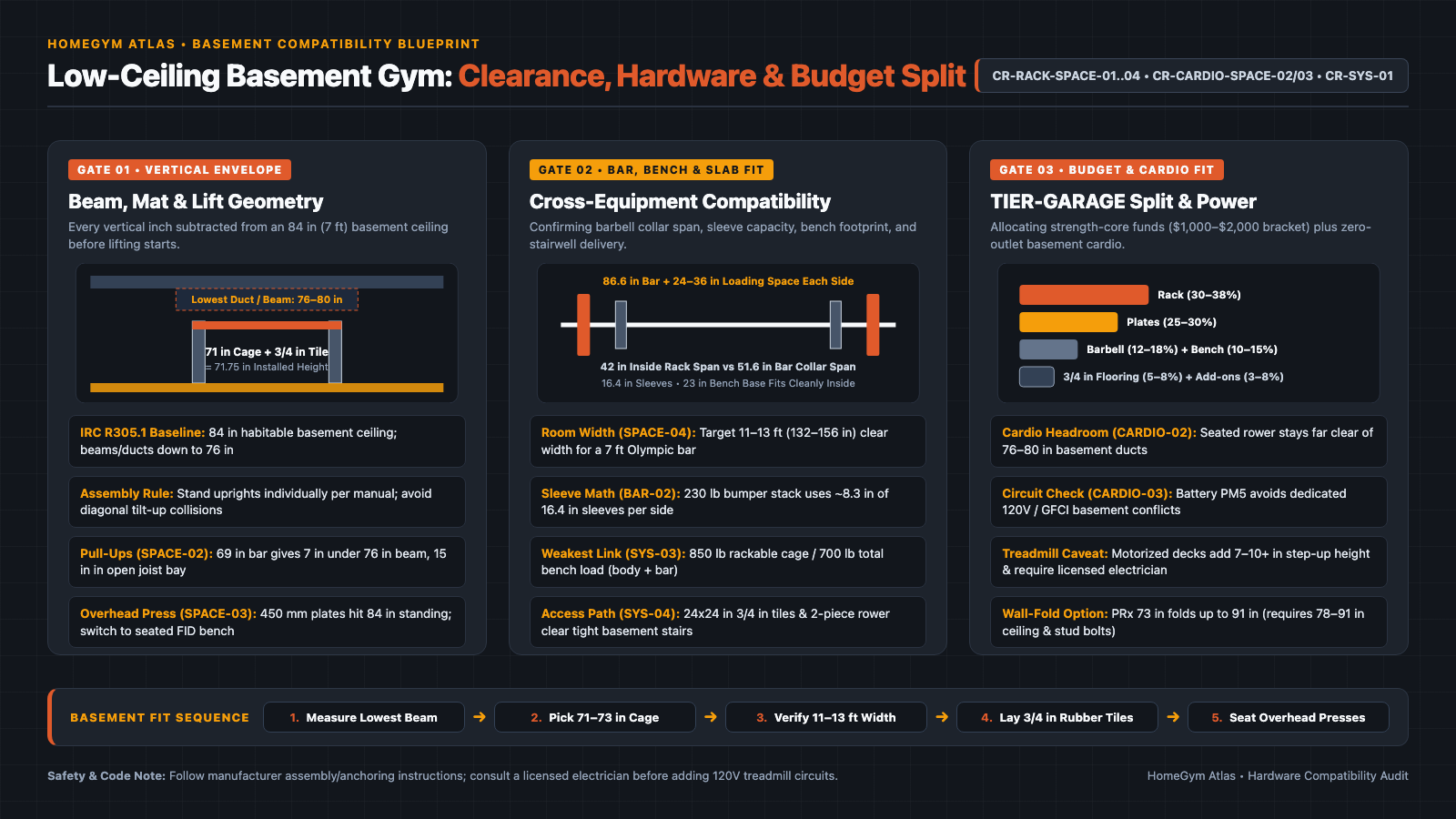
Building a basement home gym low ceiling setup comes down to hard physical geometry rather than guesswork: your tallest upright frame, barbell collar span, rubber flooring thickness, and stairwell access path all have to clear the tightest bottleneck in the room before you bolt a single steel post together. Under International Residential Code (IRC) Section R305.1, habitable basements must maintain a 7-foot (84 in / 213.4 cm) minimum finished ceiling while permitting structural beams, girders, and HVAC ducts to drop down to 6 ft 4 in (76 in / 193.0 cm)—a projection that immediately disqualifies standard 82 to 93 in garage racks.
This fit-checked blueprint pairs seven verified Amazon US components into one cohesive basement strength and conditioning system mapped to our complete home gym setup guide. Assuming a typical low-ceiling concrete-slab basement (76 to 84 in lowest obstruction, standard residential 120V NEMA 5-15 outlets with likely GFCI protection, and narrow indoor stairs), every pairing below has been cross-verified against IronGym Lab hardware, capacity, sleeve-loading, and clearance rules.
Blueprint Summary & Budget Allocation (Strength Core: $1,000–$2,000 Garage-Tier Bracket)
Primary Envelope: Clears beams down to 76 in (193.0 cm) using a 71 in short 4-post cage over 3/4 in (19 mm) vulcanized rubber tiles (71.75 in installed height) inside a minimum 11 to 13 ft wide bay.
Strength-Core Budget Split (CR-SYS-01 Planning Guide): Short Power Rack (30–38%) • Olympic Bumper Plates (25–30%) • 20 kg Olympic Barbell (12–18%) • Adjustable FID Bench (10–15%) • Modular 3/4 in Rubber Tiles (5–8%) • Future Cable/Storage Add-Ons (3–8%). Low-clearance rowing cardio is budgeted separately in the mid-range cardio tier.
In This Basement Blueprint
- Complete Basement Gym Kit Parts List
- Step 1: Vertical Clearance, Short Cages & Folding Racks
- Step 2: Room Width, Barbell Span & Bumper Sleeve Math
- Step 3: Bench Fit, Weakest-Link Limits & Modular Slab Tiles
- Step 4: Low-Ceiling Cardio, Headroom & 120V GFCI Reality
- Basement Safety, Anchoring & Electrical Checklist
- Verified Amazon US Equipment Breakdown (7 Picks)
- Compatibility Rules Appendix, Sources & FAQs
Complete Basement Home Gym Kit Parts List
Rather than piecing together mismatched cages and thick mats that force returns up steep basement stairs, this seven-item parts list balances every role in the room—prioritizing a freestanding short power cage with traceable manufacturer ratings, a full-length 7 ft bar with generous sleeve length, low-odor virgin rubber bumpers, an incline-capable bench for seated overhead work, stairwell-friendly 24 x 24 in rubber tiles, and a zero-outlet rowing option.
| System Role | Verified Amazon Pick | Key Compatibility Spec | Budget Share / Tier | Amazon Link |
|---|---|---|---|---|
| Primary Short Power Cage | Titan Fitness T-2 Series Short Power Rack | 71 in H; 2×2 steel; 850 lb rackable rating; UHMW J-cups & pin-pipe safeties | 30–38% (Entry Rack Tier) | Check Amazon |
| Wall-Fold Alternative | PRx Performance Profile PRO 73″ Folding Rack | 73 in working H (folds to ~91 in; 78–91 in ceiling); 3×3 11-ga; 5/8 in pins | Mid-Range Rack Alternative | Check Amazon |
| Olympic Barbell | Synergee Regional Olympic Barbell (20 kg) | ~44.1 lb; 28 mm shaft; 52 in shaft span; 16.4 in sleeves; 1,500 lb rating | 12–18% (Mid-Range Bar) | Check Amazon |
| Olympic Weight Plates | Fringe Sport Bumper Plate Set (230 lb) | 2 in stainless insert; 450 mm dia; ~8.3 in sleeve stack/side; low-odor rubber | 25–30% (Virgin Bumpers) | Check Amazon |
| Adjustable FID Bench | REP Adjustable Weight Bench AB-3100 | 23 in rear base width; 16.75 in pad height; 700 lb total load; 0°–90° back | 10–15% (Mid-Range Bench) | Check Amazon |
| Basement Slab Flooring | American Floor Mats 3/4 in Stall Tiles | 24 x 24 in (4 sq ft/tile); 3/4 in vulcanized rubber; ~9–10+ lb/tile | 5–8% (Core Flooring) | Check Amazon |
| Low-Ceiling Cardio Add-On | Concept2 RowErg (PM5 Monitor) | 96 x 24 in (108 x 48 in use); 2-piece split; 500 lb Concept2 / 300 lb EN; battery | Cardio Add-On (Mid Tier) | Check Amazon |
Step 1: Vertical Clearance, Short Cages & Wall-Folding Traps
Every low-ceiling basement gym starts with rule CR-RACK-SPACE-01 (HARD): rack.height_in + 1 <= space.min_obstruction_in. The critical error most homeowners make is measuring to the drywall between joists instead of measuring beneath the lowest steel I-beam, ductwork trunk, copper plumbing line, or recessed light fixture sitting directly over the lifting bay. For deeper background on frame heights across brands, cross-check our power rack ceiling height clearance guide and our roundup of audited squat racks for low ceilings.
Why the 71-Inch Titan T-2 Short Wins Under 76–84 in Obstructions
Standing 71 in (180.3 cm) tall, the Titan Fitness T-2 Series Short Power Rack is purpose-built for basements where full-height 82 to 93 in cages cannot stand upright. When placed on top of 3/4 in (19 mm) American Floor Mats rubber stall tiles, installed rack height rises to 71.75 in (182.2 cm)—still clearing an IRC-minimum 76 in (193.0 cm) structural beam by more than 4 inches.
- Assembly tilt-up warning (ISS-RACK-HEIGHT-VS-ASSEMBLY): Do not bolt an entire 71 in x 30 in side frame flat on the basement floor and tip it upward beneath a 74 to 76 in beam, because the diagonal corner sweep exceeds 77 inches. Stand each upright post vertically and bolt top crossmembers in place strictly following Titan’s assembly sequence.
- Pull-up headroom reality (CR-RACK-SPACE-02): The T-2 Short positions its 1.25 in skinny pull-up bar at 69 in (175.3 cm). Under an 84 in open joist bay, 15 inches remain above the bar for strict chin-over-bar pull-ups with knees tucked; directly under a 76 in beam, only 7 inches remain—tight enough that you should orient the front pull-up bar between joists rather than beneath ductwork.
- Standing overhead press ceiling limit (CR-RACK-SPACE-03): Standard 450 mm (~17.72 in) Olympic plates extend ~8.86 in (225 mm) above your grip. For most lifters, standing overhead barbell presses with full-diameter plates strike an 84 in basement ceiling. Instead of cutting lifts short, lock the REP AB-3100 backrest to 75° or 90° inside or just ahead of the rack for full-range seated overhead pressing.
- T-2 revision verification (ISS-RACK-SPEC-CONFLICT-TITAN): Titan’s historical product pages list 14-gauge steel on Amazon while referencing 12/14-gauge and varying pin dimensions across older T-2 generations. Measure or confirm your frame’s exact pin diameter with Titan support before buying aftermarket 2×2 attachments (CR-RACK-ATT-02, CR-RACK-ATT-03).
When to Swap to a 73-Inch Wall-Mount Folding Rack (and Direct-Sale Context)
If your basement doubles as a family rec room or laundry corridor and you have 78 to 91 in (198.1 to 231.1 cm) of clear ceiling height at the wall, the PRx Performance Profile PRO 73″ Folding Squat Rack upgrades you to 3×3 in 11-gauge US steel with 5/8 in hardware, Westside 1 in bench-zone spacing, and a 1,000 lb (453.6 kg) manufacturer rating. However, PRx’s gas-shock mechanism pivots upward to stow flush against the wall, raising peak height to roughly 91 in in standard mounting—so ceilings between 78 and 90 in require PRx’s modified bracket height, and rooms under 78 in fail the fold-up check. You must also anchor it into solid 16 or 24 in on-center wood studs or masonry strictly per PRx’s manual (CR-RACK-SPACE-05), and add compatible 5/8 in spotter arms for solo barbell catches. For more compact fold-away layouts, see our small-space home gym folding blueprint.
Buyers comparing off-Amazon direct-sale catalogs often look at 80-inch short configurations of the REP PR-4000, REP PR-5000, or Rogue Monster Lite racks. Those lines are not sold on Amazon (zero Amazon affiliate links apply) and still require 82+ inches of unobstructed vertical clearance plus floor-to-joist margin, making the 71 in Titan T-2 Short the more reliable fit for true sub-80 in basement beams.
Step 2: Room Width, Barbell Span & Bumper Sleeve Math
Overhead clearance is only half of a basement fit check. Under rule CR-RACK-SPACE-04 (HARD/SOFT), you also need sufficient wall-to-wall width for a full-length 7-foot Olympic bar plus room to slide plates onto both sleeves without scraping foundation walls or basement support columns.
- Why a full 7 ft bar is non-negotiable (CR-BAR-RACK-01): The Titan T-2 Short has an outside upright width of 46 in (116.8 cm) and an overall width of 50 in (127.0 cm). Short 5 ft or 6 ft technique bars frequently fail to span J-cups set 46 in apart. The Synergee Regional Olympic Barbell (20 kg / ~44.1 lb) measures 86.36 to 86.75 in overall with a 52 in shaft (~51.6 in inner-collar span), clearing the T-2’s J-cups cleanly with room for your hands outside the uprights.
- Minimum room width calculation (CR-RACK-SPACE-04): Adding editorial loading clearance of 24 to 36 in (61.0 to 91.4 cm) on each end of an ~86.6 in bar yields a target clear bay width of 135 to 159 in (11 ft 3 in to 13 ft 3 in). If a basement lally column sits near one side, offset the rack so the bar sleeve clears the pole during deadlifts and squats.
- Tensile PSI vs. rated load separation (CR-PLATE-BAR-04): Synergee publishes both a 190,000 PSI steel tensile strength and a separate 1,500 lb (680.4 kg) static bar rating for its 28 mm shaft. Never convert tensile PSI into pound capacity—treat 190,000 PSI strictly as steel yield resilience and 1,500 lb as the manufacturer’s load limit. Also remember a true 20 kg bar weighs ~44.1 lb, not 45 lb (CR-PLATE-SYS-01).
- Sleeve stack math with low-odor bumpers (CR-PLATE-BAR-01 / CR-PLATE-BAR-02): Pairing the bar with the Fringe Sport 230 lb Bumper Weight Plate Set matches 2 in (~50.4 mm) stainless steel center holes onto ~50 mm Olympic sleeves. Each side holds one 45 lb (~2.9 in), 35 lb (~2.35–2.4 in), 25 lb (~1.85–1.9 in), and 10 lb (~1.0–1.1 in) plate—totaling roughly 8.3 in of sleeve stack out of the Synergee bar’s 16.4 in loadable sleeve length. Even after subtracting 2 in for a clamp collar, 6.1 in of unused sleeve remains for future pairs of 45 lb bumpers or change plates.
Step 3: Bench Fit, Weakest-Link Limits & Modular Slab Tiles
With the rack, bar, and plates matched, two indoor basement hurdles remain: confirming your bench clears the rack’s lower side frames and finding rubber flooring dense enough for concrete slabs that still fits down narrow interior stairs.
In-Rack Bench Geometry & Weakest-Link Capacity (CR-SYS-03)
The REP Adjustable Weight Bench AB-3100 uses a 23 in (58.4 cm) wide rear stabilizer and a 50.5 in (128.3 cm) overall length, fitting cleanly inside the Titan T-2 Short’s 42 in inside upright width without colliding with the rack’s outer floor rails (CR-RACK-BENCH-02). At a 16.75 in (42.5 cm) loaded pad height, it sits squarely in the IPF-style 16.5 to 17.7 in height reference range (CR-RACK-BENCH-03), while its 6-position back ladder (0° to 90°) unlocks seated dumbbell and barbell shoulder pressing beneath 76 to 84 in beams.
Two compatibility nuances apply before you lift heavy:
- 2-inch hole spacing steps (CR-RACK-BENCH-01 / CR-RACK-ATT-06): Unlike 1 in Westside racks, the T-2 Short spaces holes every 2 inches. Position pin-pipe safeties carefully before loaded sets so the barbell rests comfortably below your chest press depth; if a hole falls slightly high or low, adjusting bench pad placement or using thin rubber mat shims under the bench is preferable to raising safeties too far.
- Weakest-link capacity governs the setup (CR-SYS-03 / CR-BENCH-SYS-01): Although the barbell is rated to 1,500 lb and the T-2 Short is rated to 850 lb rackable, the REP AB-3100 is rated by REP Fitness to 700 lb (317.5 kg) total load—which includes your body weight plus the barbell and plates. A 200 lb lifter pressing inside this setup has a manufacturer-rated combined ceiling of 500 lb on the bar for bench movements, while squats inside the T-2 Short remain governed by the cage’s 850 lb rackable rating.
Why 24 x 24 in Vulcanized Stall Tiles Beat 100 lb Sheets on Basement Stairs
Standard agricultural 4 x 6 ft horse-stall mats weigh roughly 100 lb each and flex awkwardly around tight 90-degree basement stairwell landings (CR-SYS-04). By contrast, American Floor Mats Heavy Duty Stall Tiles ship as interlocking 24 x 24 in (4 sq ft) slabs of 3/4 in (19 mm) 100% genuine vulcanized rubber weighing roughly 9 to 10+ lb per tile. One person can carry an entire 8 x 10 ft or 10 x 12 ft basement floor down narrow stairs in manageable stacks.
Avoid compressible 1/2 in or 3/4 in EVA foam puzzle mats beneath a loaded 4-post rack: soft foam compresses unevenly under steel rails and can introduce rack lean (CR-ATT-SPACE-01). Pairing solid 3/4 in vulcanized rubber tiles with Fringe Sport’s low-odor virgin rubber bumpers keeps controlled deadlift lowering tidy on concrete slabs. If you ever intend to drop loaded barbells from shoulder or overhead height, add a dedicated layered wood-and-rubber lifting platform per plate and flooring manufacturer guidance (CR-PLATE-ATT-01)—keeping in mind that a 1.5 to 2.25 in platform subtracts directly from your ceiling clearance.
Step 4: Low-Ceiling Cardio, Headroom & 120V GFCI Reality
Many homeowners budget a motorized treadmill into a basement gym only to hit two late-stage roadblocks: vertical headroom and residential GFCI electrical codes.
- Treadmill step-up headroom failure (CR-CARDIO-SPACE-02): Under our treadmill space and headroom requirements rules, required ceiling height equals user stature plus the deck’s maximum step-up height at incline plus running stride bounce. Because many motorized decks sit 7 to 10 in off the floor flat and climb several inches higher at 10–15% incline, a 5 ft 11 in or 6 ft runner easily nears or clips an 80 to 84 in basement ceiling.
- 120V circuit & basement GFCI conflict (CR-CARDIO-SPACE-03): Most motorized treadmills require a dedicated grounded 120V circuit (NEMA 5-15 15 A or NEMA 5-20 20 A depending on model) and prohibit extension cords. However, residential electrical codes commonly require GFCI protection in unfinished basements, whereas several treadmill manuals explicitly advise against GFCI outlets due to motor inrush nuisance trips. Never force a 5-20P plug into a 5-15R outlet with an adapter, never defeat or disable GFCI protection, and consult both the machine manufacturer and a licensed electrician before adding or modifying basement circuits.
- Connected subscription disclosure (CR-CARDIO-SYS-02): If you do install a connected treadmill, bike, or streaming rower in a taller basement bay, factor in ongoing paid monthly memberships—such as iFIT (NordicTrack/ProForm), Peloton All-Access, or Hydrow—which gate interactive classes, leaderboards, or auto-adjust controls behind recurring fees.
To eliminate both ceiling collisions and electrical headaches in a low basement, this blueprint specifies the Concept2 RowErg (PM5 Monitor). Seated rowing keeps your head far below 76 in ducts, its 57 lb (standard legs) frame splits quickly into two compact halves (25 x 33 x 54 in) to clear tight basement turns (CR-SYS-04), and its 96 x 24 in footprint (108 x 48 in recommended in-use area per Concept2, CR-CARDIO-SPACE-05) operates completely off two D-cell batteries with zero 120V wall outlet or paid subscription required.
Basement Safety, Anchoring & Electrical Checklist (Manufacturer-First Rules)
- Assembly & Anchoring (CR-RACK-SPACE-05): Follow the manufacturer’s assembly sequence and anchoring instructions verbatim. Freestanding 4-post cages like the Titan T-2 Short should sit level on solid rubber with plate horns ballasted; wall-mounted folding racks (PRx Profile PRO 73″) require mandatory structural mounting into studs or concrete—consult a qualified installer if your wall framing is irregular or covered by basement foundation insulation.
- 120V Circuits & Dehumidification: Keep basement relative humidity controlled to minimize surface oxidation on raw steel or chrome sleeves. If adding a motorized cardio machine later, have a licensed electrician verify dedicated 15 A / 20 A circuit capacity and local GFCI code compliance—never attempt DIY branch wiring or use plug adapters.
- Safeties & Concrete Slab Care: Set rack safeties and bench ratings strictly within published manufacturer limits (850 lb rackable on T-2 Short; 700 lb combined body + load on AB-3100). Use bumper plates on 3/4 in vulcanized rubber for controlled lowering, and add a wood-center platform if overhead drops are planned.
Verified Amazon US Equipment Breakdown (7 Blueprint Picks)
1. Primary Short Power Cage: Titan Fitness T-2 Series Short Power Rack (71 in)

Key Specs: 71 in (180.3 cm) H x 50 in W x 57 in D (46 in outside upright span; 42 in inside width) | 2 x 2 in steel (14-gauge on Amazon; Titan docs note 12/14-ga variations) | 2 in hole spacing | 850 lb (385.6 kg) rackable / 2,200 lb whole rack per Titan Fitness | Includes pin-pipe safeties, UHMW-lined J-cups, 69 in pull-up bar, 2 weight horns | Entry Rack Tier (30–38% Kit Share)
The Titan T-2 Short is the backbone of this low-ceiling basement build because it packs enclosed four-post barbell safeties and UHMW-lined J-cups into a 71-inch frame that clears 76 in structural beams even atop 3/4 in stall tiles. Because it stands freestanding without wall bolts, it works equally well in finished drywall basements, unfinished concrete foundation rooms, and rentals. Just assemble each upright vertically rather than tilting pre-built side frames up from the floor, and verify your T-2 revision’s pin diameter with Titan before ordering add-on attachments.
2. Wall-Mount Folding Alternative: PRx Performance Profile PRO 73″ Folding Squat Rack

Key Specs: 73 in (185.4 cm) working H (~91 in folded upward; PRx specifies 78–91 in ceiling height) | 26.75 in D x 52 in W unfolded (~4 in folded off wall) | 3 x 3 in 11-gauge US steel | 5/8 in hardware, Westside 1 in bench-zone spacing | 1,000 lb (453.6 kg) manufacturer rating | Mandatory stud/concrete wall anchoring | Mid-Range Rack Tier
Choose the PRx Profile PRO 73″ over the Titan T-2 Short only if your basement has at least 78 to 91 inches of ceiling height and you need to fold the rack flat against a framed wood-stud wall to reclaim floor space. Its 3×3 in 11-gauge steel and Westside 1 in bench-zone hole pattern step up attachment rigidity and J-cup micro-adjustment, while gas shocks make vertical stowing effortless—provided you verify PRx’s modified bracket height chart for ceilings under 91 in and budget separately for 5/8 in spotter arms.
3. Multipurpose Olympic Barbell: Synergee Regional Barbell (20 kg / ~44.1 lb)
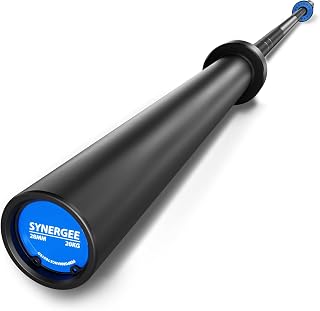
Key Specs: 20 kg (~44.1 lb) men’s bar (15 kg / ~33.1 lb option available) | 86.36–86.75 in overall length | 52 in shaft (~51.6 in collar span) | 28 mm shaft diameter | 16.4 in (41.7 cm) loadable 50 mm Olympic sleeves | 10 needle bearings | 190,000 PSI tensile strength / 1,500 lb (680.4 kg) Synergee static rating | 12–18% Kit Share
The Synergee Regional 20 kg bar checks every technical box for a basement setup: full 52 in shaft length spans the Titan T-2 Short’s 46 in outer uprights cleanly (CR-BAR-RACK-01), 16.4 in loadable sleeves provide plenty of room for thick bumper plates plus collars (CR-PLATE-BAR-02), and the Hard Chrome finish helps resist humidity common in below-grade rooms. Both tensile strength (190,000 PSI) and static capacity (1,500 lb) are clearly published separately by Synergee.
4. Olympic Weight Plates: Fringe Sport Bumper Weight Plate Set (230 lb)

Key Specs: 230 lb set (pairs of 45, 35, 25, 10 lb) | 2 in (~50.4 mm) stainless steel center insert | 450 mm (~17.72 in) IWF diameter | Published thickness: ~2.9 in (45 lb), ~2.35–2.4 in (35 lb), ~1.85–1.9 in (25 lb), ~1.0–1.1 in (10 lb) | Low-odor virgin rubber | ±1% stated tolerance | 25–30% Kit Share
Basement rooms with limited cross-ventilation magnify rubber off-gassing, making Fringe Sport’s low-odor virgin rubber compound and tight ±1% weight tolerance well worth prioritizing over smelly recycled crumb bumpers. Because Fringe Sport publishes plate thicknesses, we can verify sleeve math cleanly: loading one of each plate per side consumes ~8.3 in of the Synergee bar’s 16.4 in sleeve, leaving ample room for clamp collars and future 45 lb plate pairs. Note that 10 lb bumpers should not be dropped alone on a loaded bar.
5. Adjustable FID Bench: REP Adjustable Weight Bench AB-3100

Key Specs: 700 lb (317.5 kg) total load rating (body weight + lifted weight) per REP Fitness | 16.75 in (42.5 cm) loaded pad height | 50.5 in L x 23 in rear base width | 34.75 in L x 11.75 in W back pad (~1.7 in seat gap) | 6 back angles (0°, 30°, 45°, 60°, 75°, 90°), 3 seat angles | 70 lb unit weight | 10–15% Kit Share
In a low-ceiling basement, an adjustable bench is functionally mandatory rather than optional because it moves overhead barbell and dumbbell pressing into a seated 75° or 90° posture beneath 76–84 in joists (CR-RACK-SPACE-03). The REP AB-3100 keeps its rear stabilizer to 23 inches wide—sliding straight through the Titan T-2 Short’s 42 in upright span—and uses a closed ladder track with rear wheels for effortless repositioning between flat barbell pressing inside the cage and seated shoulder work.
6. Basement Slab Flooring: American Floor Mats Heavy Duty Stall Tiles (3/4 in)

Key Specs: 3/4 in (0.75 in / ~19 mm) thickness | 24 x 24 in (610 x 610 mm) interlocking center tiles (4 sq ft per tile) | 100% genuine vulcanized rubber (Made in USA, zero foam filler) | ~9–10+ lb per tile | 5–8% Core Flooring Share
These 2 x 2 ft modular tiles solve the biggest logistical headache of basement gym builds: getting real 3/4-inch vulcanized rubber down tight interior stairs without wrestling 100 lb 4 x 6 ft sheets around drywall corners. Solid vulcanized rubber resists compression under a loaded power rack far better than soft EVA foam puzzle mats, while keeping installed rack height predictable at +0.75 in. Note that new vulcanized rubber can carry a noticeable rubber scent initially—air out tiles per the manufacturer’s instructions if basement ventilation is limited.
7. Zero-Outlet Basement Cardio: Concept2 RowErg (PM5 Monitor)

Key Specs: 96 x 24 in assembled (108 x 48 in recommended use zone per Concept2) | Splits into 2 pieces (25 x 33 x 54 in) | 57 lb (14 in standard legs) / 68 lb (20 in tall legs) | 500 lb (226.8 kg) Concept2 max user rating; 300 lb (136.1 kg) EN 20957-7 rating | 2 D-cell battery PM5 monitor (zero 120V AC outlet) | Bluetooth FTMS & ANT+ FE-C | Mid-Range Cardio Add-On
The Concept2 RowErg is the cleanest cardio complement for a low-ceiling basement because seated rowing clears 76 in overhead beams effortlessly, its 57 lb frame separates in seconds to pass through narrow basement turns, and its battery-powered PM5 console removes every 120V dedicated-circuit and GFCI nuisance-trip obstacle. With zero mandatory monthly subscription fees and native Bluetooth FTMS / ANT+ support, it delivers commercial-grade conditioning hardware that fits almost any basement layout.
How We Audited This Guide
- Room setups, upgrade roadmaps, and Amazon listing red-flag audits enforce system-wide CR-* clearances, manufacturer-first anchoring instructions, and strict off-Amazon brand disclosures.
- Every power rack, barbell, weight plate, bench, adjustable dumbbell, cardio machine, and flooring spec was cross-checked against official manufacturer manuals, CPSC notices, and live Amazon US listings.
- Recommendations were evaluated against our weighted vertical scoring rubrics and documented CR-* compatibility rules; we never invent load capacities, motor ratings, rubber thickness, or decibels.
Compatibility Rules Appendix, Sources & FAQs
Verified Compatibility Rule Log (Setup Validation Summary):
- CR-RACK-SPACE-01 / 02 / 03 / 04 / 05: 71 in Titan T-2 Short + 0.75 in rubber tile (71.75 in total) passes under 76–84 in beams when assembled upright per manual; 69 in pull-up bar needs open joist headroom; standing OHP replaced by seated 75°–90° AB-3100 pressing; 11–13 ft room width accommodates 86.6 in bar loading; PRx 73″ alternative requires 78–91 in ceiling and stud/concrete anchoring.
- CR-BAR-RACK-01 / CR-PLATE-BAR-01 / 02 / 04 / CR-PLATE-SYS-01: Synergee Regional 20 kg (~44.1 lb) bar’s 52 in shaft spans T-2’s 46 in outer uprights; 2 in stainless bumper holes match ~50 mm sleeves; 230 lb Fringe set uses ~8.3 in of 16.4 in sleeves per side; 190,000 PSI tensile strength kept strictly separate from 1,500 lb static rating.
- CR-RACK-BENCH-01 / 02 / 03 / CR-BENCH-SYS-01 / CR-SYS-03: REP AB-3100 (23 in rear base, 16.75 in pad height) clears T-2’s 42 in inside span; 2 in rack hole spacing noted as SOFT caveat; weakest-link limit is 850 lb rackable (squats) and 700 lb combined body + load (bench pressing).
- CR-ATT-SPACE-01 / CR-PLATE-ATT-01 / CR-SYS-04: 24 x 24 in 3/4 in vulcanized rubber tiles carry easily down basement stairs and support controlled lowering on concrete; add a wood-center platform for repeated overhead drops.
- CR-CARDIO-SPACE-02 / 03 / 05 / CR-CARDIO-SYS-01 / 02: Concept2 RowErg eliminates treadmill step-up headroom conflicts and 120V GFCI circuit issues, fits in 108 x 48 in use space, carries 500 lb Concept2 / 300 lb EN 20957-7 ratings, and requires zero ongoing subscription.
Authoritative Non-Affiliate Sources Cited:
- International Code Council — IRC Section R305.1 Ceiling Height — 7 ft (84 in) minimum habitable ceiling height and 6 ft 4 in (76 in) beam/duct projection rule.
- Titan Fitness Official Power Rack Comparison Guide — Published T-2 Short 71 in height, 850 lb rackable / 2,200 lb whole-rack ratings, and 2×2 dimensions.
- PRx Performance Official Folding Squat Rack Specifications — 73 in upright fold ceiling height chart (78–91 in) and structural stud/concrete mounting rules.
- Concept2 Official RowErg Specifications — 96 x 24 in assembled / 108 x 48 in use space, 500 lb Concept2 vs. 300 lb EN 20957-7 max user weight, and PM5 battery console.
- American Floor Mats Official Horse Stall Tile Specifications — 100% genuine vulcanized rubber 24 x 24 in modular tile construction in 3/4 in thickness.
Frequently Asked Questions: Low-Ceiling Basement Home Gyms
Can I put a full 4-post power rack in a basement with a 76 to 84-inch ceiling?
Yes, by selecting a short 71-inch power rack like the Titan T-2 Short over 3/4-inch vulcanized rubber tiles (71.75 inches total). Assemble the uprights vertically per the manufacturer’s instructions rather than tilting pre-assembled side frames upward beneath low beams or ducts.
How do I perform shoulder overhead presses in a low-ceiling basement?
Because 450 mm Olympic plates extend ~8.86 inches above your grip, standing presses hit most 84-inch basement ceilings. Use an adjustable FID bench such as the REP AB-3100 set to 75° or 90° inside your rack for full-range seated barbell and dumbbell pressing.
How wide does my basement bay need to be for a 7-foot Olympic barbell?
Plan for 11 to 13 feet (132 to 156 inches) of clear room width. A standard 20 kg (~44.1 lb) Olympic bar measures ~86.6 inches end-to-end, leaving 24 to 36 inches per side to load 2-inch plates safely without hitting walls or lally columns.
Why use 24 x 24-inch rubber tiles instead of 4 x 6-foot stall mats or EVA foam?
Standard 4 x 6-foot stall mats weigh ~100 lb and struggle around tight basement stair turns, while soft EVA foam compresses unevenly under heavy power racks. Interlocking 24 x 24-inch 3/4-inch vulcanized rubber tiles carry down stairs easily while providing rigid concrete-slab support.
Why is a rowing machine better than a motorized treadmill for a low-ceiling basement?
Motorized treadmill decks add 7 to 10+ inches of step-up height plus incline lift—causing tall runners to brush 80–84 inch ceilings—and often conflict with basement GFCI outlets. A battery-powered Concept2 RowErg keeps you seated low and needs zero 120V wiring.


