
Disclosure: As an Amazon Associate, IronGym Lab earns from qualifying purchases. If you buy through verified Amazon US links on this page, we may earn a small commission at no extra cost to you. Direct-sale manufacturer lines referenced for ceiling-height comparison are labeled as not sold on Amazon and carry zero affiliate links.
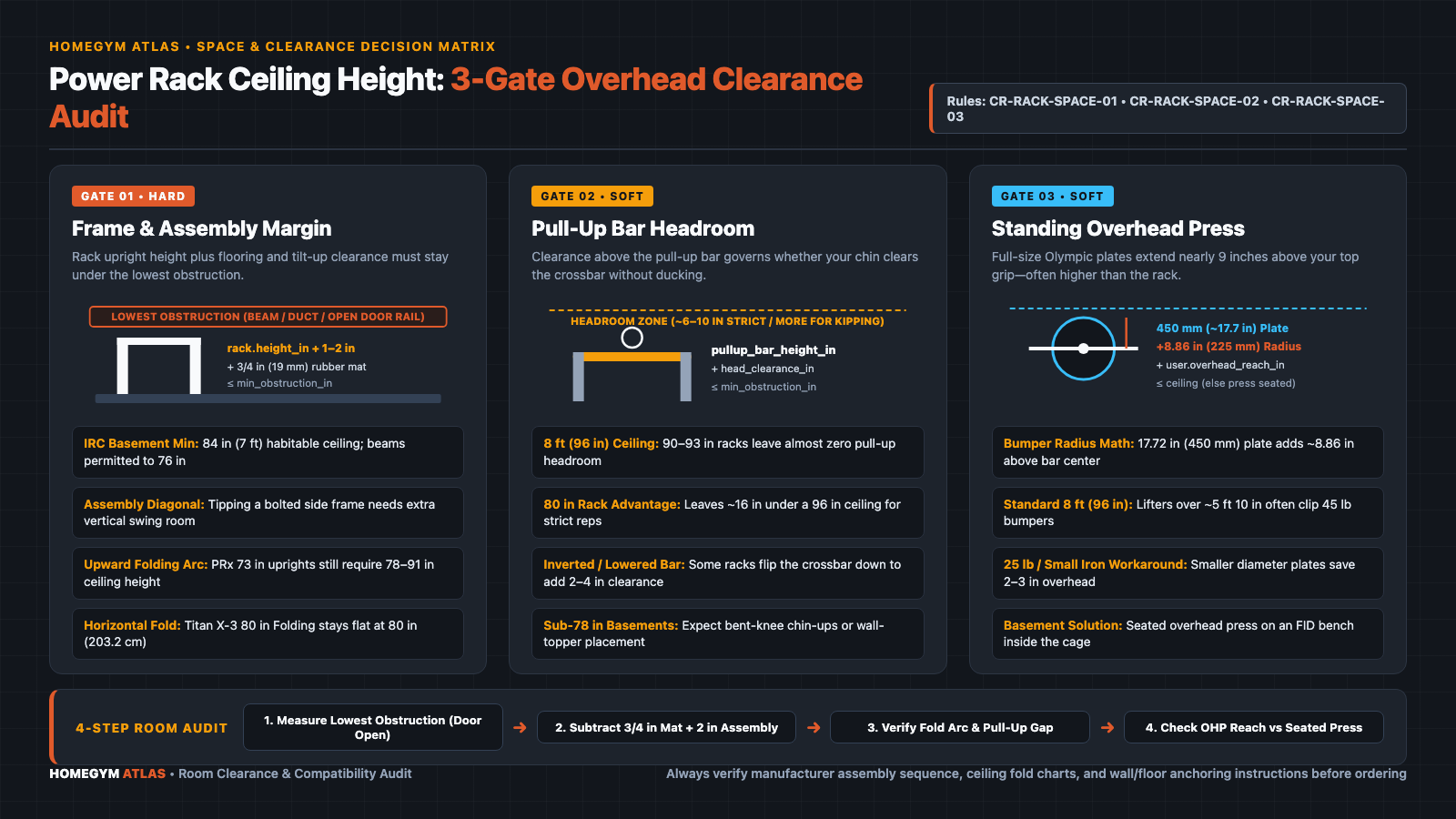
Getting power rack ceiling height right before you order steel uprights prevents three costly garage and basement mistakes: frames that cannot stand upright beneath joists or open garage-door tracks, pull-up bars pinned flush against drywall, and barbell overhead presses that clip ceiling beams. Under our best power rack for home gym compatibility rules, overhead clearance is always the first hard gate before tube gauge, pin diameter, or price tier.
Quick Answer — How Much Power Rack Ceiling Height Do You Need?
Allow at least 1 to 2 in (2.5 to 5.1 cm) above your rack’s published upright height—plus 3/4 in (19 mm) if setting the frame on rubber stall mats—below the lowest beam, duct, or open garage-door rail. Standard 80 to 84 in (203.2 to 213.4 cm) racks fit 8-foot (96 in / 243.8 cm) rooms, while 7-foot (84 in) basements usually need 71 to 73 in (180.3 to 185.4 cm) cages. For strict chin-over-bar pull-ups, budget roughly 6 to 10 in (15.2 to 25.4 cm) above the crossbar.
In This Ceiling Clearance Guide
The Three Ceiling Clearance Rules Every Home Gym Must Pass
Most buyers check only one number: the height listed in a rack’s product title versus the drywall height printed on a home floor plan. In real basements and residential garages, three distinct vertical checks govern whether a rack stands cleanly, assembles without damaging joists, and supports pull-ups and overhead lifts.
1. Standing Frame, Flooring & Assembly Margin (CR-RACK-SPACE-01)
Under IronGym Lab compatibility rule CR-RACK-SPACE-01 (HARD), your rack must satisfy rack.height_in + 1 <= space.min_obstruction_in as a bare minimum—and practically 2 in (5.1 cm) or more once hardware and assembly sequence are factored in. Notice the critical variable: lowest overhead obstruction, not finished ceiling height.
- Basement beams, ducts, and recessed fixtures: Under International Residential Code (IRC) Section R305.1, habitable basements must maintain a 7-foot (84 in / 213.4 cm) ceiling minimum, while structural beams, girders, and HVAC ducts are permitted to project down to 6 ft 4 in (76 in / 193.0 cm). Measure directly beneath the lowest joist, pipe, or ductwork inside your intended rack footprint.
- Garage door tracks and openers: Typical two-car US garages offer 96 to 120 in (8 to 10 ft / 243.8 to 304.8 cm) at the drywall, but sectional overhead doors drop metal rails, torsion bars, and motor units 12 to 20 inches lower when raised. Always measure your rack bay with the garage door fully open.
- Rubber flooring stack-up (CR-ATT-SPACE-01): Standard 4 x 6 ft (121.9 x 182.9 cm) horse-stall rubber mats measure 3/4 in (19 mm) thick. Putting a rack on top of stall mats or a 2-to-3-layer lifting platform adds 0.75 to 2.25 in (1.9 to 5.7 cm) directly to the rack’s effective installed height.
- Assembly tilt-up diagonal (ISS-RACK-HEIGHT-VS-ASSEMBLY): Even if an 83 in (210.8 cm) cage clears an 84 in ceiling standing plumb, bolting two uprights and side crossmembers together flat on the floor and tilting the side frame upward requires diagonal clearance equal to the hypotenuse of the upright height and rack depth. Follow the manufacturer’s assembly sequence—standing individual uprights vertically before bolting top crossmembers avoids diagonal ceiling collisions.
2. Pull-Up Bar Headroom (CR-RACK-SPACE-02)
Passing the frame-height gate does not guarantee usable pull-ups. Compatibility rule CR-RACK-SPACE-02 (SOFT) evaluates rack.pullup_bar_height_in + user.head_clearance_in <= space.min_obstruction_in. For strict chin-over-bar pull-ups, lifters generally need roughly 6 to 10 in (15.2 to 25.4 cm) of clear airspace above the top surface of the pull-up bar so the crown of the head does not strike ceiling joists or drywall. Kipping or butterfly pull-ups require substantially more upward momentum space.
This is where 8-foot (96 in / 243.8 cm) ceilings trap buyers who default to tall racks. On a 93 in (236.2 cm) rack—such as the tall configurations of the direct-only REP PR-4000 or PR-5000 (not sold on Amazon)—a top-mounted pull-up bar positioned near 90 to 92 in leaves only 4 to 6 in beneath an 8-foot ceiling. Dropping to an 80 in (203.2 cm) or 82.5 in (209.6 cm) rack restores roughly 13 to 16 in of overhead headroom, while inverted or lowered pull-up crossmembers reclaim another 2 to 4 in where supported by the rack design.
3. Standing Overhead Press & Plate Radius Clearance (CR-RACK-SPACE-03)
Even when a 71-inch or 80-inch rack fits with room to spare, standing barbell overhead presses (strict press, push press, or jerk) frequently require the highest ceiling in the gym. Under rule CR-RACK-SPACE-03 (SOFT), overhead clearance equals user.overhead_reach_in + plate.radius_in <= space.min_obstruction_in.
Standard full-size Olympic bumper plates and 45 lb (20.4 kg) cast-iron plates conform to the 450 mm (~17.72 in) diameter standard (STD-PLATE-DIA-450MM). Because the barbell shaft passes through the 2 in (~50.4–51 mm) center hole, exactly half that diameter—~8.86 in (225 mm)—extends vertically above your knuckles at lockout. Add your standing reach to the top of a locked-out bar (commonly around 80 to 88 in for average-height lifters, depending on stature and arm length) plus ~8.9 in of plate radius, and standing overhead presses with full-size 45 lb plates often brush or exceed a 96 in (8 ft) ceiling.
When standing overhead press math exceeds your room’s lowest obstruction, you have three clean solutions: press seated on an adjustable FID bench inside the rack, step into a taller open bay between garage-door rails if floor layout allows, or load smaller-diameter 25 lb iron plates (verify plate diameter with the manufacturer) for standing work.
Power Rack Ceiling Height Sizing Table by Room Class
Use the decision matrix below to match your room’s lowest obstruction—after subtracting 3/4 in (19 mm) if you install rubber stall mats—against verified upright height classes, pull-up usability, and overhead pressing constraints.
| Lowest Obstruction (Above Mats) | Recommended Rack Height | Pull-Up & Overhead Press Reality | Compatible Rack Class & Critical Caveat |
|---|---|---|---|
| Under 75 in (under 190.5 cm) Extreme low beams / ducts | 60–66 in (152.4–167.6 cm) | No overhead pull-up bar; standing OHP blocked; press seated on a flat or FID bench. | Telescoping connected or independent squat stands; audit capacity basis carefully (CR-SYS-02) and check bar collar span (CR-BAR-RACK-01). |
| 76–80 in (193.0–203.2 cm) IRC basement beam minimum | 71–73 in (180.3–185.4 cm) | Strict pull-ups require bent knees or lower crossbar; seated overhead pressing recommended. | Short 4-post cages (e.g., Titan T-2 71 in option) or short squat stands; confirm assembly upright-by-upright clearance (CR-RACK-SPACE-01). |
| 81–85 in (205.7–215.9 cm) Standard 7 ft (84 in) basement | 71–80 in (180.3–203.2 cm) | Tight pull-up headroom on 78–80 in bars (chin/joist check); seated OHP for most lifters. | Short 71–73 in cages, 80 in horizontal-folding racks (Titan X-3), or 80 in 3×3 racks (direct-only REP PR-4000/5000, not sold on Amazon). |
| 86–95 in (218.4–241.3 cm) Low garage under open rails | 80–84 in (203.2–213.4 cm) | Strict pull-ups workable under 88–95 in ceilings on 78–82 in crossbars; standing OHP with 450 mm plates tight for taller lifters. | 80–84 in full cages, 82.5 in dual-pulley racks (MAJOR FITNESS F22), and PRx Profile ONE no-bar 73 in (needs 78–91 in ceiling). |
| 96–107 in (243.8–271.8 cm) Standard 8 ft (96 in) room | 80–93 in (203.2–236.2 cm) | 80–84 in racks give 12–16 in pull-up headroom; 90–93 in racks choke pull-ups at 96 in; standing OHP varies by lifter height. | Virtually any 80–84 in rack fits comfortably; PRx Profile ONE with pull-up bar (89 in) specifies 94–107 in ceiling height. |
| 108+ in (274.3+ cm) 9 to 10 ft+ open garage | 90–93+ in (228.6–236.2+ cm) | Full strict and dynamic pull-up headroom; standing overhead press with full 450 mm bumpers unobstructed for most lifters. | Tall 90–93 in commercial cages (Titan T-3 91 in, direct-only REP PR-4000/5000 93 in, not sold on Amazon) and tall smith/cable stations. |
If your basement ceiling sits right around 80 to 84 in, browse our dedicated best squat racks for low ceilings audit for side-by-side reviews of sub-80-inch cages and stands, or check our basement home gym low ceiling build blueprint for full room layouts combining short racks, benches, and flooring.
Wall-Mount Folding Racks, Assembly Sequence & Room Width
Two common ceiling traps trip up buyers outside freestanding 4-post cages: vertical fold arcs on wall-mounted racks and horizontal barbell loading width inside narrow basement bays.
Upward-Folding vs. Inward-Folding Wall Racks
Not all folding racks fold in the same plane. Understanding how the uprights stow is essential under CR-RACK-SPACE-01 and CR-RACK-SPACE-05:
- Vertical gas-shock upward fold (PRx Profile ONE / Profile PRO): Because the uprights pivot upward along the wall to clear floor space, the frame rises significantly higher while stowed than when standing in use. Per PRx Performance’s official ceiling height table, the Profile ONE with 73 in (185.4 cm) uprights and no pull-up bar requires a 78 to 91 in (198.1 to 231.1 cm) ceiling, whereas the 89 in (226.1 cm) configuration with pull-up bar requires a 94 to 107 in (238.8 to 271.8 cm) ceiling. See our full PRx Profile ONE review for mounting bracket details.
- Horizontal inward-swinging fold (Titan Fitness X-3 Wall Mounted Folding): Hinged side arms swing horizontally inward toward the wall like double doors. An 80 in (203.2 cm) upright stays exactly 80 in tall whether open or folded, making horizontal folders far easier to position beneath low garage-door tracks or basement bulkheads.
- Mandatory structural anchoring (CR-RACK-SPACE-05): Wall-mounted folding racks depend on wall attachment to carry tipping and racking forces. Follow the manufacturer’s installation instructions strictly regarding 16 in or 24 in on-center wood studs, structural ledger boards, or concrete masonry, confirm lease permissions before drilling, and consult a qualified installer if you are uncertain about wall framing behind drywall.
Room Width & Depth Still Matter (CR-RACK-SPACE-04)
Even when vertical height clears cleanly, basement alcoves and single-car garage bays frequently fail horizontal clearance under rule CR-RACK-SPACE-04 (HARD / SOFT). A standard men’s 20 kg (~44.1 lb) Olympic barbell measures roughly 86.6 in (2,200 mm / ~7.2 ft) end to end. Editorial home-gym planning convention recommends 24 to 36 in (61.0 to 91.4 cm) beyond each sleeve tip so you can slide 45 lb plates on and off without scraping walls—putting comfortable room width near 135 to 159 in (11.2 to 13.2 ft). Plan front-to-back room depth for the rack footprint plus flat/incline bench overhang and a clear loading walkway.
Myth vs. Engineering Reality: Ceiling Clearance Misconceptions
Buyer Alert — 4 Common Power Rack Ceiling Height Myths
- Myth 1: “An 84-inch rack fits under an 84-inch basement ceiling.”
Reality: Zero clearance fails CR-RACK-SPACE-01. Even 1/4 in of floor slope, a 3/4 in (19 mm) rubber mat, or bolting a top crossmember from above makes an 84 in frame impossible to stand upright in an 84 in space. - Myth 2: “A 73-inch folding rack only needs 75 inches of ceiling height.”
Reality: Upward-pivoting wall racks swing well above their working upright height when stowed. PRx specifies 78 to 91 in for its 73 in no-bar Profile ONE; below 78 in, upward folding jams into the ceiling. - Myth 3: “All 3×3 or 2×3 racks share universal upright heights and attachment fit.”
Reality: Upright height does not change tube or pin rules—verify both upright size and pin diameter (5/8 in vs 1 in) plus brand geometry before ordering drop-down pull-up bars or spotter arms, and check capacity ratings with their basis (CR-SYS-02). - Myth 4: “Short power racks cannot hold serious barbell weight.”
Reality: Frame height alone does not dictate capacity. Titan’s 71 in T-2 Short carries a published 850 lb rackable rating, and short 80 in 3×3 11-gauge cages carry 1,000+ lb manufacturer ratings—always compare the manufacturer’s published rating basis and safety-catch specifications rather than upright height.
Verified Amazon US Racks Across Key Ceiling Height Tiers
The four Amazon-sold power racks below illustrate how different frame heights, upright profiles, and folding mechanisms map to real basement and garage ceiling heights. Direct-sale reference lines like the REP Fitness PR-4000 / PR-5000 (offered in 80 in and 93 in uprights, rated to 1,000 lb by REP) and Rogue Monster Lite / Monster series are not sold on Amazon and carry zero affiliate links below.
1. Titan Fitness T-2 Series Power Rack — Dual-Height Choice (71 in Short vs. 83 in Standard)

Verified Specs & Ceiling Fit: 2 x 2 in (50.8 x 50.8 mm) 14-gauge steel (note: Titan pages show historical 12/14-gauge differences) | Heights: 83 in (210.8 cm) standard or 71 in (180.3 cm) short option | Rated Capacity: 1,000 lb (453.6 kg) Amazon listing / 850 lb (385.6 kg) rackable per Titan comparison chart | Included: Pin-and-pipe safeties, J-hooks, 1.25 in pull-up bar | Price Tier: Entry ($100–$500)
The Titan T-2 directly solves the 7-foot basement dilemma by offering the same enclosed 4-post cage architecture in both a 71 in short version (fits 76–84 in ceilings with assembly clearance) and an 83 in standard version (requires 85–86+ in ceilings above mats). Because Titan’s own documentation has differed across T-2 revisions on steel gauge and pin/hole diameter, confirm your exact revision’s pin size with Titan support before ordering aftermarket accessories.
- Pros: Freestanding 4-post enclosed safety cage; 71 in option clears low IRC basement beams while keeping full pin-and-pipe containment and traceable Titan capacity specs.
- Cons: 2 x 2 in uprights have a smaller attachment ecosystem than 3 x 3 in racks; 71 in short model lowers pull-up bar height so taller lifters must bend knees.
2. Titan Fitness X-3 Series Wall Mounted Folding Rack — Fixed 80 in Height, Zero Upward Sweep

Verified Specs & Ceiling Fit: 3 x 3 in (76.2 x 76.2 mm) 11-gauge steel | ~11/16 in holes for 5/8 in (15.9 mm) hardware, Westside 1 in bench-zone spacing | Dimensions: 80 in H x 21.5 in D (203.2 x 54.6 cm), folds flat horizontally | Rated Capacity: 1,000 lb (453.6 kg) configuration rating | Price Tier: Entry ($100–$500)
If your garage bay sits beneath an 84 to 92 in open door rail or duct, the Titan X-3 Wall Mounted Folding Rack delivers commercial-grade 3 x 3 in 11-gauge steel and Westside hole spacing without any vertical fold arc. Because its arms fold horizontally inward, total height never exceeds 80 in (203.2 cm) plus mat thickness—ideal for 82 to 90 in rooms where upward-pivoting racks collide with overhead obstructions.
- Pros: True 3 x 3 in 11-gauge uprights with 5/8 in Westside hardware; horizontal fold preserves fixed 80 in clearance under garage rails.
- Cons: Requires structural anchoring into wood studs or concrete strictly per Titan’s manual (CR-RACK-SPACE-05); safety spotter arms are sold separately.
3. PRx Performance Murphy Foldable Squat Rack — Upward-Folding Space Saver (Check Arc Ceiling Chart)

Verified Specs & Ceiling Fit: Wall-mounted upward-folding squat rack | Profile: 22 in D x 22 in W footprint profile, 119 lb (54.0 kg) unit weight | Rated Capacity: 1,000 lb (453.6 kg) manufacturer-stated rating | Included: J-cups and space-saving pull-up bar | Price Tier: Mid-Range ($500–$1,500)
PRx’s upward-folding designs stow against the wall in seconds, reclaiming floor depth for parked vehicles. However, buyers must audit PRx’s official ceiling chart carefully: per PRx support specifications, 73 in uprights without a pull-up bar still need 78 to 91 in ceilings for fold clearance, while 89 in pull-up-bar configurations require 94 to 107 in ceilings. Confirm your wall height and stud spacing against the specific PRx manual before mounting.
- Pros: Effortless vertical fold frees floor depth for multi-use garages; established US brand with clear ceiling-height installation tables and 1,000 lb rating.
- Cons: Upward stow arc rules out sub-78 in ceilings (and pull-up configurations require 94+ in); mandatory stud or concrete anchoring per PRx instructions; spotter arms sold separately.
4. MAJOR FITNESS F22 Power Rack with Dual Pulley System — 82.5 in All-in-One Benchmark

Verified Specs & Ceiling Fit: 2 x 3 in (50 x 70 mm) 14-gauge steel | Dimensions: 82.5 in H x 55.5 in W x 68.9 in D (209.6 x 141.0 x 175.0 cm) | Listed Capacity: 1,600 lb (725.7 kg) static listing figure (confirm J-hook/safety basis in manual per CR-SYS-02) | Cable System: Independent dual-pulley crossover | Price Tier: Mid-Range ($500–$1,500)
Cable-integrated cages like the MAJOR FITNESS F22 show why 84 in (7 ft) basements can be deceptive. Standing 82.5 in (209.6 cm) tall with overhead pulley routing, the F22 leaves only 1.5 in under a 84 in ceiling—and drops to 0.75 in on 3/4 in stall mats—making assembly margin tight and ruling out sub-82 in beams completely. In an 8-foot (96 in) garage or spare room, however, its 82.5 in profile leaves 13.5 in of pull-up headroom above the frame.
- Pros: Combines a 2 x 3 in cage and dual-pulley functional trainer in an 82.5 in height that clears standard 8-foot (96 in) ceilings with pull-up margin.
- Cons: Too tall for low basement beams and tight under 84 in ceilings with rubber flooring; 1,600 lb static listing capacity should be verified per component in the owner’s manual (CR-SYS-02).
Compatibility Rules Appendix & Authoritative Citations
Every power rack ceiling height recommendation in this explainer aligns with the following IronGym Lab compatibility rules and non-affiliate building or manufacturer sources:
- CR-RACK-SPACE-01 (HARD): Rack height plus assembly margin (minimum 1 to 2 in, plus upright-by-upright assembly verification) must fit under the lowest room obstruction over the footprint.
- CR-RACK-SPACE-02 (SOFT): Pull-up bar height plus lifter head clearance (~6 to 10 in for strict reps) must stay below the lowest overhead obstruction.
- CR-RACK-SPACE-03 (SOFT): Standing overhead press requires user reach plus full-plate radius (~8.86 in / 225 mm for 450 mm Olympic plates) under the obstruction; otherwise switch to seated pressing.
- CR-RACK-SPACE-04 & CR-RACK-SPACE-05 (HARD/CONDITIONAL): Plan room width for an 86.6 in Olympic bar plus plate-loading clearance, and follow manufacturer floor or wall anchoring instructions strictly.
- CR-ATT-SPACE-01, CR-SYS-02 & CR-SYS-03: Subtract 3/4 in (19 mm) rubber mat height from ceiling headroom, verify capacity ratings with basis and source, and remember the weakest-rated component governs setup limits.
Authoritative Non-Affiliate Sources Cited:
- International Code Council — IRC Section R305.1 Ceiling Height — 7 ft (84 in) minimum habitable ceiling height and lower basement beam/duct projection tolerances.
- Titan Fitness Official Power Rack Comparison Guide — Published T-2 (71 / 83 in), T-3 (82 / 91 in), and X-3 (80 / 90 in) heights, tube sizes, and rackable ratings.
- PRx Performance Official Ceiling Height & Mounting Documentation — Profile ONE 73 in (78–91 in ceiling) and 89 in pull-up (94–107 in ceiling) fold clearance tables.
- REP Fitness Official Rack Specifications — Direct-sale PR-4000 and PR-5000 80 in vs. 93 in upright height comparison reference (not sold on Amazon).
How We Audited This Guide
- Strength hardware was audited across upright tube dimensions (2x2, 2x3, 3x3 in), 5/8-in vs 1-in pin hardware, sleeve fit, rated vs rackable capacities, and bench pad height clearances.
- Every power rack, barbell, weight plate, bench, adjustable dumbbell, cardio machine, and flooring spec was cross-checked against official manufacturer manuals, CPSC notices, and live Amazon US listings.
- Recommendations were evaluated against our weighted vertical scoring rubrics and documented CR-* compatibility rules; we never invent load capacities, motor ratings, rubber thickness, or decibels.
Continue Your Audit
Frequently Asked Questions: Power Rack Ceiling Height
Can I fit an 80-inch power rack in a 7-foot (84-inch) basement ceiling?
Yes, provided the lowest beam, duct, or fixture directly over the rack stays at or above 82 to 83 inches—and remember to subtract 3/4 inch if placing rubber stall mats underneath. Assemble uprights individually per the manufacturer manual rather than tilting pre-assembled side frames.
How much ceiling height do I need for pull-ups on a power rack?
Under rule CR-RACK-SPACE-02, allow roughly 6 to 10 inches of clear space above the pull-up bar for strict chin-over-bar reps, and more for dynamic kipping styles. An 80-inch rack works comfortably under a 96-inch (8-foot) ceiling, whereas 90-to-93-inch racks leave minimal headroom.
Why can’t I standing overhead press in an 8-foot (96-inch) ceiling room?
Full-size 450 mm (17.72 in) Olympic plates extend roughly 8.86 inches above the barbell grip. Once a lifter’s standing lockout reach exceeds roughly 86 to 87 inches, the top edge of 45 lb bumpers strikes a 96-inch ceiling, making seated pressing on a bench the practical workaround.
How much ceiling clearance does a wall-mounted folding rack need?
It depends on fold direction. Horizontal inward folders like the 80-inch Titan X-3 Wall Folding stay fixed at 80 inches tall. Upward-pivoting racks like the 73-inch PRx Profile ONE swing higher when stowed, requiring 78 to 91 inches without a pull-up bar or 94 to 107 inches with one.
What is the minimum ceiling height for a full 4-post power rack?
Short 4-post cages such as the 71-inch Titan Fitness T-2 Short require roughly 73 to 74 inches of unobstructed clearance (or 74 to 75 inches over 3/4-inch stall mats). Spaces under 72 inches typically require adjustable connected or independent squat stands.


