
Disclosure: As an Amazon Associate, IronGym Lab earns from qualifying purchases. If you buy through verified Amazon US links on this page, we may earn a small commission at no extra cost to you. Direct-to-consumer equipment lines referenced for budget comparison are explicitly labeled as not sold on Amazon and carry zero affiliate links.
Determining how much does a home gym cost starts with separating headline bundle prices from structural compatibility. A basic dumbbell-and-bench corner can be assembled inside a few hundred dollars, whereas a full-featured garage strength bay with a heavy-gauge power cage, Olympic barbell, bumper plates, rubber flooring, and cable attachments spans several thousand dollars. Under our home gym setup guide architecture, budget planning works only when every dollar follows physical load-bearing requirements rather than tempting marketplace shortcuts.
Quick Answer — How Much Does a Home Gym Cost?
A barbell strength core ranges from $250–$500 (TIER-BUDGET) and $500–$1,000 (TIER-STARTER) to $1,000–$2,000 (TIER-GARAGE), $2,000–$3,500 (TIER-MIDRANGE), and $3,500–$6,000+ (TIER-PREMIUM/ELITE). Adjustable dumbbells ($100–$600+) and cardio machines ($50–$2,500+) add separate budgets alongside rubber mats and electrical prep.
In This Home Gym Cost Breakdown
- The 6 Strength-Core Budget Tiers ($250 to $6,000+)
- Budget Allocation Math by Component (CR-SYS-01)
- Dumbbell-Only & Cardio Machine Budget Add-Ons
- Hidden Infrastructure & Ownership Costs
- Myth vs. Engineering Reality: Cost & Spec Traps
- Verified Amazon US Hardware Anchors by Cost Tier
- Compatibility Rules Appendix & Citations
- Frequently Asked Questions
The Six Strength-Core Home Gym Budget Tiers ($250 to $6,000+)
To answer how much a home gym costs without misleading shoppers, IronGym Lab separates whole-room budgets into six strength-core tiers covering the primary load-bearing skeleton: rack, barbell, weight plates, bench, flooring, and foundational rack attachments. Adjustable dumbbells and standalone cardio machines operate on independent component ladders because not every lifter wants a motorized treadmill or a selectorized dumbbell pair inside the same room.
Across the US Amazon marketplace, these six brackets reflect verified equipment pricing tiers rather than arbitrary estimates:
- TIER-BUDGET ($250–$500 — Entry Minimalist): Built around connected or independent squat stands, an entry 7-foot (86–87 in) 2-inch Olympic barbell, a starter cast-iron plate pairing, a simple flat bench, and one or two 3/4 in (19 mm) rubber mats. At this entry floor, capacity traceability (
CR-SYS-02) is the primary gate—many low-cost stands require anchoring or spotter arms per the manufacturer’s manual. - TIER-STARTER ($500–$1,000 — Enclosed Starter Cage): Upgrades squat stands to a full 4-post entry power cage (such as a 12/14-gauge 2 x 2 in frame), pairs it with a 20 kg (~44.1 lb) class Olympic barbell, starter iron or entry bumper plates, a flat or foldable flat-incline-decline (FID) bench, and initial slab protection. For a complete line-item walkthrough, read our garage gym under $1,000 build blueprint.
- TIER-GARAGE ($1,000–$2,000 — Garage Essentials): The largest home gym buyer segment. Stepping above $1,000 shifts steel framing from 14-gauge light cages to thicker 2 x 3 in or 3 x 3 in 11-gauge racks with broader attachment ecosystems, adds virgin rubber bumper plates alongside fractional change plates, upgrades to an ASTM-rated or heavy-frame FID bench, and funds wider 3/4 in (19 mm) rubber mat coverage. Explore the full parts list in our garage gym under $2,000 guide.
- TIER-MIDRANGE ($2,000–$3,500 — Serious Home Gym): Unlocks 3 x 3 in (76.2 x 76.2 mm) 11-gauge racks featuring 1-inch Westside hole spacing through the bench press zone (or space-saving wall-mount folding frames), higher-tensile barbells with bronze bushings, fuller 260 to 370+ lb bumper sets, heavy FID benches, and two to three OEM-matched attachments (spotter arms, dip bars, landmine). See our home gym under $3,500 blueprint for exact attachment compatibility rules.
- TIER-PREMIUM ($3,500–$6,000 — Cable & Dual-Bar Ecosystem): Adds dual-pulley functional trainer stations or rack-integrated cable towers, a second specialty or stiff powerlifting barbell, full plate inventories, and dedicated multi-layer lifting platforms—requiring freight delivery planning (
CR-SYS-04) and larger bay clearances. - TIER-ELITE ($6,000+ — No-Compromise All-in-One Bay): Combines commercial-style all-in-one cable/Smith/rack trainers, specialty bars (safety squat, trap/hex, curl), full plate storage, and complete room flooring. Buyers cross-shopping direct-to-consumer lines in the midrange-to-elite brackets should note that popular ecosystems like Rogue Monster Lite, Rogue Monster, Rogue Ohio Bar, Rogue Echo Bumpers, REP PR-4000, REP PR-5000, REP Colorado Bar, REP AB-3000/AB-5200/BlackWing, and the legacy Fitness Reality 810XLT are not sold on Amazon; they belong solely in direct-order comparisons.
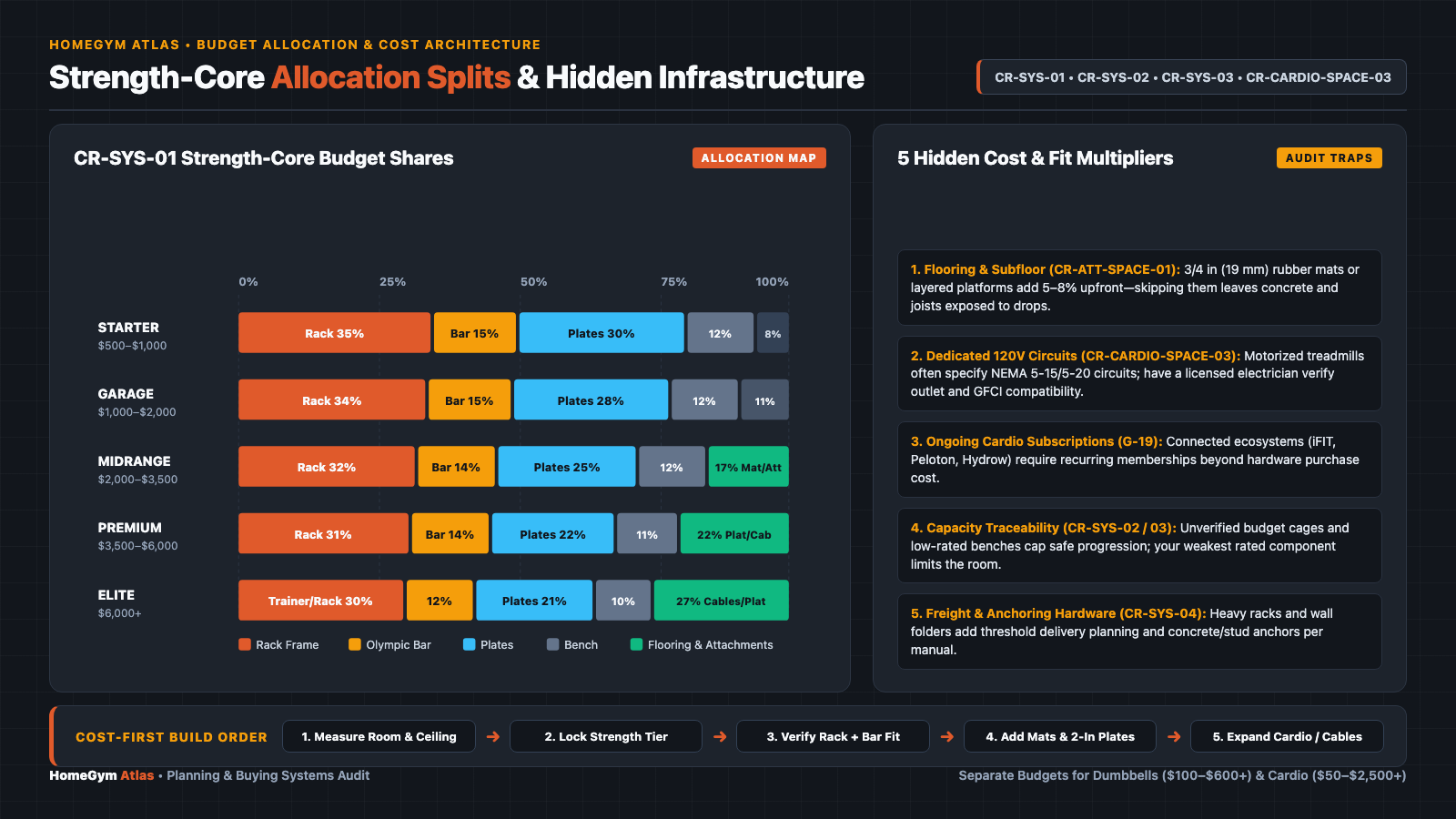
How to Split Your Budget by Component (CR-SYS-01 & CR-SYS-03)
How you divide money inside a budget tier matters just as much as the dollar ceiling itself. Under IronGym Lab rule CR-SYS-01 (SOFT), a balanced strength-core build directs the largest shares toward the power rack (25–40%), barbell (10–18%), and weight plates (18–35%), leaving proportionate allocations for the bench (8–15%), flooring (5–8%), and rack attachments (0–20%).
Two engineering rules govern this allocation math:
- Plates expand effortlessly; structural frames do not: Iron and bumper plates are the easiest components to buy incrementally over time as your working weights rise. Never cut your rack budget into an unverified marketplace cage just to buy an extra pair of 45 lb (20.4 kg) plates on day one.
- Weakest-Link Capacity Governs the Room (CR-SYS-03 HARD): Your setup’s safe operating ceiling equals its lowest-rated load-bearing component across rack uprights, J-cups, safeties, barbell, and bench (subtracting user bodyweight from the bench rating under
CR-BENCH-SYS-01). Pairing a 1,000 lb rack with a 500 lb bench or an unverified 300 lb bar caps the entire system at the weakest part.
| Budget Tier & Range | Rack (+ Safeties) | Barbell & Plates | Bench, Flooring & Add-Ons | Steel, Compatibility & Space Reality |
|---|---|---|---|---|
| TIER-BUDGET $250–$500 | 30–40% | 12–18% bar 25–35% plates | 10–15% bench 5–8% mats 0–5% add-ons | Uses Starter shares (±5 pts per CR-SYS-01). Squat stands or basic frames; verify J-cup/catch basis (CR-SYS-02) and collar span (CR-BAR-RACK-01). |
| TIER-STARTER $500–$1,000 | 30–40% | 12–18% bar 25–35% plates | 10–15% bench 5–8% mats 0–5% add-ons | 4-post 12/14-gauge cage (2 x 2 in uprights), full 20 kg (~44.1 lb) class bar, starter cast iron or bumper set, and 3/4 in mat. |
| TIER-GARAGE $1,000–$2,000 | 30–38% | 12–18% bar 25–30% plates | 10–15% bench 5–8% mats 3–8% add-ons | 2 x 3 in or 3 x 3 in 11-gauge racks (5/8 in pins), virgin rubber bumpers + change plates, sturdy FID bench, and stall mats. |
| TIER-MIDRANGE $2,000–$3,500 | 30–35% | 12–16% bar 22–28% plates | 10–14% bench 5–8% mats 6–12% add-ons | 3 x 3 in Westside bench-zone spacing or wall-mount folding frames, 16+ in sleeve bars, heavy FID bench, and 2–3 attachments. |
| TIER-PREMIUM $3,500–$6,000 | 28–35% | 12–15% bar 20–25% plates | 10–13% bench 5–8% mats 8–15% add-ons | Rack + dual-pulley functional trainer, dual barbells, full bumper stack, and deadlift platform; plan freight access (CR-SYS-04). |
| TIER-ELITE $6,000+ | 25–35% | 10–15% bar 18–25% plates | 8–12% bench 5–8% mats 10–20% cables | All-in-one trainer ecosystem, specialty bars (trap/cambered/SSB), full plate inventory, and dedicated room electrical/floor prep. |
Notice how plate shares step down from 25–35% in starter rooms to 18–25% in premium rooms even as total poundage grows: structural steel frames, pulley towers, and multi-angle benches absorb larger absolute dollar chunks at higher tiers. If you are deciding which components belong on day one versus month six, cross-check our home gym essentials checklist so you sequence purchases without duplicate spending.
Dumbbell-Only & Cardio Machine Budget Add-Ons
Not every home gym starts with a power rack and barbell. Upper-floor apartments, spare bedrooms under 10 ft wide (where an 86.6 in / 2,200 mm Olympic bar cannot load plates comfortably under CR-RACK-SPACE-04), and conditioning-focused rooms rely on adjustable dumbbells and dedicated cardio machines. Budget these two categories on separate component tiers:
Adjustable Dumbbell Component Tiers ($100 to $600+)
- TIER-DB-ENTRY ($100–$300): Spin-lock plate-loaded handles or entry dial-style sets capped near 25 to 52.5 lb (11.3 to 23.8 kg) per hand. Always check Amazon titles carefully—some budget listings price a single dumbbell rather than a matched pair, doubling the true pair cost.
- TIER-DB-MID ($300–$600): Established selectorized pairs reaching 50 to 55 lb (22.7 to 24.9 kg) with quick dial, pin, or rail changes and 2.5 to 5 lb increment jumps. Pair these with a compact FID bench and dense mat for a complete apartment setup.
- TIER-DB-PREMIUM ($600+): Heavy selectorized sets expanding to 80, 90, or 100+ lb (36.3 to 45.4+ kg) per hand, plus dedicated storage stands (
CR-DB-ATT-01). Remember that mechanical selectorized dumbbells carry strict manufacturer no-drop rules—dropping selector cages onto concrete or tiles voids warranties and damages internal cams.
Cardio Machine Component Tiers ($50 to $2,500+)
- TIER-CARDIO-BUDGET ($50–$300): Under-desk walking pads, compact folding treadmills, light magnetic rowers, and basic upright bikes. Audit manufacturer max user weight ratings (
CR-CARDIO-SYS-01) and motor duty limits closely—many ultra-budget pads exclude running speeds entirely. - TIER-CARDIO-ENTRY ($300–$1,000): Entry home treadmills, magnetic/water rowers, and non-connected indoor cycling bikes. Check belt deck dimensions and step-up height against ceiling clearance (
CR-CARDIO-SPACE-02). - TIER-CARDIO-MID ($1,000–$2,500): Commercial-grade air rowers like the Concept2 RowErg (96 x 24 in / 243.8 x 61.0 cm assembled, 108 x 48 in / 9 x 4 ft recommended in-use footprint, rated to 500 lb / 226.8 kg by Concept2 and 300 lb / 136.1 kg under EN 20957-7), full-size folding treadmills, and connected spin bikes.
- TIER-CARDIO-PREMIUM ($2,500+): Heavy-duty slat/commercial-style treadmills, motorized incline trainers, and touchscreen rowers—which often trigger dedicated 20-amp electrical requirements, threshold delivery surcharges, and multi-year membership outlays.
Five Hidden Costs That Blow Up Home Gym Budgets
First-time builders routinely price only the rack, bar, and plates, then hit unexpected expenses once boxes arrive. Factor these five infrastructure multipliers into your total budget before checking out:
1. 3/4-Inch Rubber Flooring & Subfloor Protection (CR-ATT-SPACE-01)
Unprotected concrete garage slabs chip easily when iron plates touch down, while thin interlocking EVA foam puzzle tiles compress under heavy rack feet and shift laterally under squats. Budget 5–8% of your build for true 3/4 in (19 mm) dense vulcanized rubber mats (commonly sold in 4 x 6 ft / 121.9 x 182.9 cm sheets covering 24 sq ft each). In upper-floor rooms or spaces built over wood framing, check building rules and consult a qualified professional regarding floor-loading limits before installing heavy iron stacks or deadlift platforms.
2. 120V Dedicated Electrical Circuits & GFCI Conflicts (CR-CARDIO-SPACE-03)
Motorized treadmills are the #1 surprise electrical cost in garage and basement gyms. Most treadmill owner’s manuals specify a dedicated grounded 120V circuit—either 15 A (NEMA 5-15) or 20 A (NEMA 5-20 T-slot) depending on motor draw—and explicitly prohibit extension cords or multi-outlet strips. Critically, a 20 A NEMA 5-20P plug will not fit a standard 15 A NEMA 5-15R receptacle. Furthermore, residential building codes commonly mandate GFCI protection in garages and basements, yet high-inrush treadmill motor controllers can trigger nuisance GFCI trips, and some manufacturer manuals instruct owners not to use GFCI outlets. Never attempt DIY wiring modifications; budget for a licensed electrician to inspect your panel, verify manual amperage requirements, and install a compliant dedicated circuit if needed. Alternatively, non-motorized options such as battery-powered air rowers (Concept2 RowErg), air bikes, or manual curved treadmills require zero wall circuits.
3. Ongoing Cardio Memberships & Offline Locks (G-19, CR-CARDIO-SYS-02)
Before comparing hardware stickers on connected cardio machines, check recurring software fees. Interactive platforms—including iFIT (used on NordicTrack and ProForm machines), Peloton (All-Access membership), and Hydrow—depend on an ongoing paid subscription for instructor-led classes, live leaderboards, automated trainer resistance/incline control, and full console tracking. Without an active membership, those screens typically fall back to basic manual start/stop modes. Factor ongoing subscription commitments over your expected ownership horizon rather than treating the initial hardware invoice as your total cardio cost.
4. Anchoring Hardware, Wall Ledger Boards & Ceiling Checks (CR-RACK-SPACE-01 / 05)
Wall-mount folding racks, narrow-base half racks, and bolt-down squat stands often ship without masonry sleeve anchors, wood lag bolts, or 2 x 6 / 2 x 8 structural stringer boards needed for 16 in or 24 in on-center stud spacing. Follow the manufacturer’s assembly and anchoring instructions strictly—never treat required wall or floor anchoring as optional—and confirm lease permissions or hire a qualified installer if you are uncertain about stud framing or concrete slab conditions. Also verify lowest overhead obstructions (basement beams, HVAC ducts under International Code Council IRC R305.1, or open garage door tracks) with 3/4 in mat height included so you do not incur return-shipping fees on an 84 in or 91 in rack.
5. Multi-Box Freight Delivery & Used-Market Recall Audits (CR-SYS-04, G-24)
Power racks, functional trainers, and heavy treadmills often ship via LTL curbside freight or heavy multi-carton parcel deliveries weighing 150 to 400+ lb, where inside room-of-choice placement or basement stair carries may incur extra mover fees. Meanwhile, shoppers trying to cut costs on secondhand bikes or racks must check official U.S. Consumer Product Safety Commission (CPSC) recall notices first—for example, under the May 2023 CPSC recall notice for original Peloton Bikes (model PL01), the seat post can break during use, and owners must follow official CPSC/Peloton instructions for the free replacement seat post before riding.
Myth vs. Engineering Reality: Five Costly Budgeting Myths
Buyer Alert — 5 Home Gym Cost & Specification Misconceptions
- Myth 1: “A marketplace cage claiming 2,000 lb capacity gives the same strength as a 1,000 lb 11-gauge rack for half the cost.”
Engineering Reality (CR-SYS-02): Many unbranded budget cages list inflated static totals without an identifiable manufacturer engineering document or safety-catch rating basis. If we cannot trace a rating to a manufacturer document, treat it as unverified and compare steel gauge (11-gauge vs 14-gauge), weld/bolt joints, and catch-pin specs directly. - Myth 2: “Barbell tensile strength (e.g., 190,000 PSI) tells you how many pounds the bar holds.”
Engineering Reality (CR-PLATE-BAR-04): Tensile strength measures steel alloy resistance to pulling apart in pounds per square inch (PSI)—never convert PSI into pound capacity. Load capacity is a separate manufacturer-published rating, and many premium bars publish tensile strength only. - Myth 3: “Saving money on a 1-inch standard bar and plates works fine inside an Olympic setup.”
Engineering Reality (CR-PLATE-BAR-01): 1-inch standard plates cannot fit 2-inch (~50 mm) Olympic bar sleeves, and 5-foot or 6-foot bars often lack the ~51.5 in (1,308 mm) inner collar span required to rest safely on standard 47–49 in rack J-cups (CR-BAR-RACK-01). Buying 1-inch gear forces a complete system replacement later. - Myth 4: “All 20 kg Olympic barbells weigh 45 lb exact, and any bumper plate stacks cleanly on any sleeve.”
Engineering Reality (CR-PLATE-SYS-01 / CR-PLATE-BAR-02): A 20 kg bar equals approximately 44.1 lb (not 45 lb exact), and wide recycled-rubber bumper plates consume 15 to 16.4 in bar sleeves far faster than slim cast-iron plates—leaving too little room for heavy deadlift loads plus clamp collars if sleeve math is ignored. - Myth 5: “Any 3 x 3 in attachment fits any 3 x 3 in rack, so you can buy the cheapest frame and mix accessories freely.”
Engineering Reality (CR-RACK-ATT-01 / 02 / 03): Tube size and pin diameter are independent—3 x 3 in racks ship with either 5/8 in (15.9 mm) or 1 in (25.4 mm) pins, and brand hole offsets vary. Generic “universal” fit claims remain unconfirmed unless the maker explicitly lists your rack line.
Verified Amazon US Hardware Anchors by Cost Tier
The four verified Amazon US components below anchor the core cost slices—entry 4-post cage, mid-tier 11-gauge space-saver rack, full-length 20 kg / 45 lb Olympic barbell, and foldable FID weight bench—so you can see exactly what each allocation share buys on Amazon US.
1. CAP Barbell FM-905WH-7 Full Cage Power Rack — Entry Cage Floor Benchmark

Cost Tier & Verified Specs: Entry Cage Tier ($100–$500; anchors TIER-BUDGET / TIER-STARTER 30–40% rack slice) | Tubing: 12- and 14-gauge steel | Footprint & Height: 47.2 in D x 43.3 in W x 84 in H (119.9 x 110.0 x 213.4 cm) | Rated Capacity: 500 lb (226.8 kg) bar catches / 750 lb (340.2 kg) pull-up bar per CAP Barbell published specification
The CAP FM-905WH-7 illustrates what an entry-tier enclosed rack delivers cleanly—and where its cost ceiling sits. Rather than hiding behind inflated marketplace numbers, CAP publishes distinct catch (500 lb) and pull-up bar (750 lb) ratings, making it straightforward to apply weakest-link sizing (CR-SYS-03) under an 8-foot (96 in) garage ceiling. Note that its lighter 12/14-gauge frame and narrow footprint limit third-party attachment compatibility compared with 3 x 3 in 11-gauge cages.
- Pros: Transparent manufacturer capacity ratings separated by bar catches vs. pull-up bar; low entry cost leaves room in a sub-$1,000 build for a full Olympic barbell and plates.
- Cons: 500 lb catch rating caps heavy intermediate squat progression; 84 in (213.4 cm) upright height requires 86+ in clearance above 3/4 in mats and rules out 7-foot (84 in) basements.
2. Titan Fitness T-3 Series Space Saving Power Rack (91″ x 24″) — 11-Gauge Upgrade Benchmark

Cost Tier & Verified Specs: Entry-to-Mid Rack Tier ($100–$500 rack frame; core anchor for TIER-GARAGE builds) | Tubing & Hardware: 2 x 3 in (50.8 x 76.2 mm) 11-gauge steel, 11/16 in holes for 5/8 in (15.9 mm) pins, Westside 1 in bench-zone spacing | Height & Depth: 91 in H x 24 in D (231.1 x 61.0 cm) | Rated Capacity: 1,000 lb (453.6 kg) configuration rating per Titan Fitness
Stepping into the TIER-GARAGE ($1,000–$2,000) bracket moves you into heavy 11-gauge structural steel without sacrificing garage parking depth. Titan’s T-3 Space Saving half-rack shrinks front-to-back projection to 24 in while adding 1-inch Westside spacing through the bench and clean-pull zones (CR-RACK-BENCH-01). However, it triggers two mandatory room checks: a 91 in frame demands 93+ in of clear overhead space (CR-RACK-SPACE-01), and wall/floor anchoring must be installed strictly per Titan’s manual (CR-RACK-SPACE-05).
- Pros: 11-gauge steel with 5/8 in Westside bench-zone hole spacing and 1,000 lb manufacturer rating in a shallow 24 in wall footprint.
- Cons: 91 in (231.1 cm) upright height eliminates 7-foot basements and low garage tracks; mandatory structural wall/floor mounting rules out drill-restricted rentals; 2 x 3 in attachments require line-specific verification (
CR-RACK-ATT-03).
3. Iron Crush 7ft Olympic Barbell (45 lb) — 12–18% Barbell Allocation Benchmark

Cost Tier & Verified Specs: Entry Barbell Tier (Under $150; fits the 12–18% barbell share across TIER-BUDGET and TIER-STARTER) | Length & Mass: 87 in (221.0 cm / ~7.2 ft) / 45 lb (20.4 kg) | Shaft: 28 mm chrome, 1.2 mm dual knurl marks, no center knurl | Sleeves: 2 in (~50 mm) Olympic with 16.14 in (41.0 cm) loadable length | Published Ratings: 750 lb (340.2 kg) static capacity; 170,000 PSI tensile strength
This full-length 45 lb Olympic barbell demonstrates why spending inside the 12–18% barbell slice beats buying short 5- or 6-foot bars. Its 87 in total length spans full-width power cages cleanly (CR-BAR-RACK-01), its 16.14 in (41.0 cm) loadable sleeves hold substantial plate stacks (CR-PLATE-BAR-02), and its manufacturer publishes both a 750 lb static limit and 170,000 PSI tensile figure separately (CR-PLATE-BAR-04).
- Pros: Full 16.14 in loadable 2-inch sleeves and 28 mm multipurpose shaft diameter at an accessible starter-tier outlay.
- Cons: Chrome plating can show flaking under heavy rack contact over time, and the lack of a center knurl provides less shirt grip during heavy low-bar back squats.
4. FLYBIRD WB5 Foldable Adjustable Weight Bench — 10–15% Bench Allocation Benchmark

Cost Tier & Verified Specs: Budget FID Bench Tier (Under $200; matches the 10–15% bench share) | Dimensions & Mass: 46 in D x 13 in W x 48.5 in H (116.8 x 33.0 x 123.2 cm); 28.5 lb (12.9 kg) | Adjustability: 90° to -30° FID backrest positions with 30 in (76.2 cm) backrest | Rated Capacity: 800 lb (362.9 kg) ASTM-certified static rating
For buyers splitting a compact room or dumbbell-plus-rack budget, the FLYBIRD WB5 delivers full flat-incline-decline versatility inside a 13-inch base width that clears narrow power rack uprights (CR-RACK-BENCH-02) and folds flat for closet or wall storage. Remember under CR-BENCH-SYS-01 to subtract your own body weight from a bench’s combined static rating when planning heavy barbell or dumbbell presses.
- Pros: ASTM-certified 800 lb static rating, wide 90° to -30° FID adjustment range, and compact folding footprint for spare bedrooms and small garages.
- Cons: Lighter 28.5 lb frame feels less anchored under maximal barbell bench setups than heavy 70+ lb 11-gauge flat benches, and higher flat pad height shifts rack J-cup settings (
CR-RACK-BENCH-03).
Compatibility Rules Appendix & Authoritative Citations
Every home gym cost tier and allocation recommendation in this guide is governed by the following IronGym Lab cross-compatibility rules and non-affiliate manufacturer or regulatory sources:
- CR-SYS-01 (SOFT — Budget Allocation): Strength-core setups allocate 25–40% to the rack, 10–18% to the barbell, 18–35% to weight plates, 8–15% to the bench, 5–8% to flooring, and 0–20% to attachments within a ±5-point planning guide; dumbbells and cardio are budgeted separately.
- CR-SYS-02 (CONDITIONAL — Capacity Traceability): Every load-bearing rating must trace to an identifiable manufacturer document with its rating basis (frame vs. rackable vs. J-cup/catch); listing-only marketplace figures are treated as unverified.
- CR-SYS-03 (HARD — Weakest-Link Limit): A setup’s working load limit equals its lowest-rated load-bearing part across rack catches, safeties, barbell, and bench (net of user bodyweight).
- CR-PLATE-BAR-01 / 04 & CR-RACK-SPACE-01 / 05: Match 2-inch Olympic sleeves to 2-inch plate bores, keep tensile PSI separate from pound capacity, check lowest overhead obstructions above 3/4 in (19 mm) mats, and follow manufacturer anchoring manuals strictly.
- CR-CARDIO-SPACE-03 & CR-CARDIO-SYS-02: Confirm 120V NEMA 5-15 / 5-20 circuits and GFCI guidance with the machine manual and a licensed electrician, and budget ongoing iFIT, Peloton, or Hydrow subscriptions separately.
Authoritative Non-Affiliate Sources Cited:
- International Code Council — IRC Section R305.1 — Residential basement 7-foot (84 in) minimum habitable ceiling height and structural beam/duct projection tolerances.
- CAP Barbell Official Product Specifications — Published FM-905WH-7 500 lb bar-catch and 750 lb pull-up bar ratings.
- Titan Fitness Official Power Rack Specifications — T-3 Space Saving 2 x 3 in 11-gauge construction, 5/8 in Westside hardware, and 1,000 lb configuration specifications.
- Concept2 RowErg Official Specifications — Assembled vs. in-use space dimensions, non-motorized PM5 design, and dual 500 lb / EN 20957-7 300 lb user ratings.
- U.S. Consumer Product Safety Commission (CPSC) — Official May 2023 Peloton original Bike (PL01) seat-post recall notice for secondhand buyer verification.
How We Audited This Guide
- Room setups, upgrade roadmaps, and Amazon listing red-flag audits enforce system-wide CR-* clearances, manufacturer-first anchoring instructions, and strict off-Amazon brand disclosures.
- Every power rack, barbell, weight plate, bench, adjustable dumbbell, cardio machine, and flooring spec was cross-checked against official manufacturer manuals, CPSC notices, and live Amazon US listings.
- Recommendations were evaluated against our weighted vertical scoring rubrics and documented CR-* compatibility rules; we never invent load capacities, motor ratings, rubber thickness, or decibels.
Frequently Asked Questions: How Much Does a Home Gym Cost?
What is a realistic budget for a complete garage home gym?
Most lifters land in the $1,000–$2,000 TIER-GARAGE bracket for a heavy 11-gauge power rack, full 20 kg (~44.1 lb) Olympic barbell, bumper plate set, adjustable bench, and 3/4 in (19 mm) rubber mats. Entry 4-post starter builds work inside $500–$1,000 if you start with basic plates.
Can you build a safe home gym for under $500?
Yes, inside the $250–$500 TIER-BUDGET range using connected squat stands or an adjustable dumbbell pair with a compact bench. Verify manufacturer capacity ratings rather than unverified marketplace claims, confirm barbell collar span across stands, and follow anchoring instructions strictly where required.
How much should I spend on a power rack versus weight plates?
Under rule CR-SYS-01, allocate 28–40% of your strength-core budget to the rack and 18–35% to plates. Never buy extra plates by downgrading to an unverified cage—plates are easy to add later, whereas a weak rack caps your entire room’s load rating.
What hidden costs do home gym buyers overlook most often?
The five biggest budget surprises are 3/4 in (19 mm) vulcanized rubber stall mats, dedicated 120V NEMA 5-15/5-20 electrical circuits installed by a licensed electrician for motorized treadmills, recurring iFIT/Peloton/Hydrow cardio memberships, required wall/floor anchoring hardware, and heavy freight delivery fees.
Why are some popular rack brands not listed in Amazon cost breakdowns?
Several prominent direct-to-consumer lines—including Rogue Monster Lite, Rogue Monster, Rogue Ohio Bar, REP PR-4000, REP PR-5000, REP Colorado Bar, and the legacy Fitness Reality 810XLT—are not sold on Amazon. We label them clearly as direct-sale benchmarks without affiliate links.


