
Disclosure: As an Amazon Associate, IronGym Lab earns from qualifying purchases. If you buy through verified Amazon US links on this page, we may earn a small commission at no extra cost to you. Direct-to-consumer lines referenced for specification context are explicitly labeled as not sold on Amazon and carry zero affiliate links.
Building a functional home training space starts with geometry, load limits, and hardware compatibility—not impulse-buying a barbell bundle on sale. This home gym setup guide walks you through the exact planning sequence we use across IronGym Lab blueprints: measure your room envelope first, split your budget across core equipment tiers without starving load-bearing steel, verify every barbell-to-rack and bench-to-upright dimension, and check anchoring and 120V electrical rules before freight arrives on your driveway.
Whether you are clearing one bay of a two-car garage, working beneath low basement joists, or building a quiet upper-floor apartment corner, every hardware decision chains into the next. Following our hardware audit and compatibility methodology prevents the three most expensive beginner mistakes: ordering a rack taller than your lowest overhead obstruction, pairing mismatched 1 in standard and 2 in Olympic plates, or letting a low-rated bench or unverified cage cap the capacity of your entire room.
Blueprint Summary & Budget Allocation (CR-SYS-01):
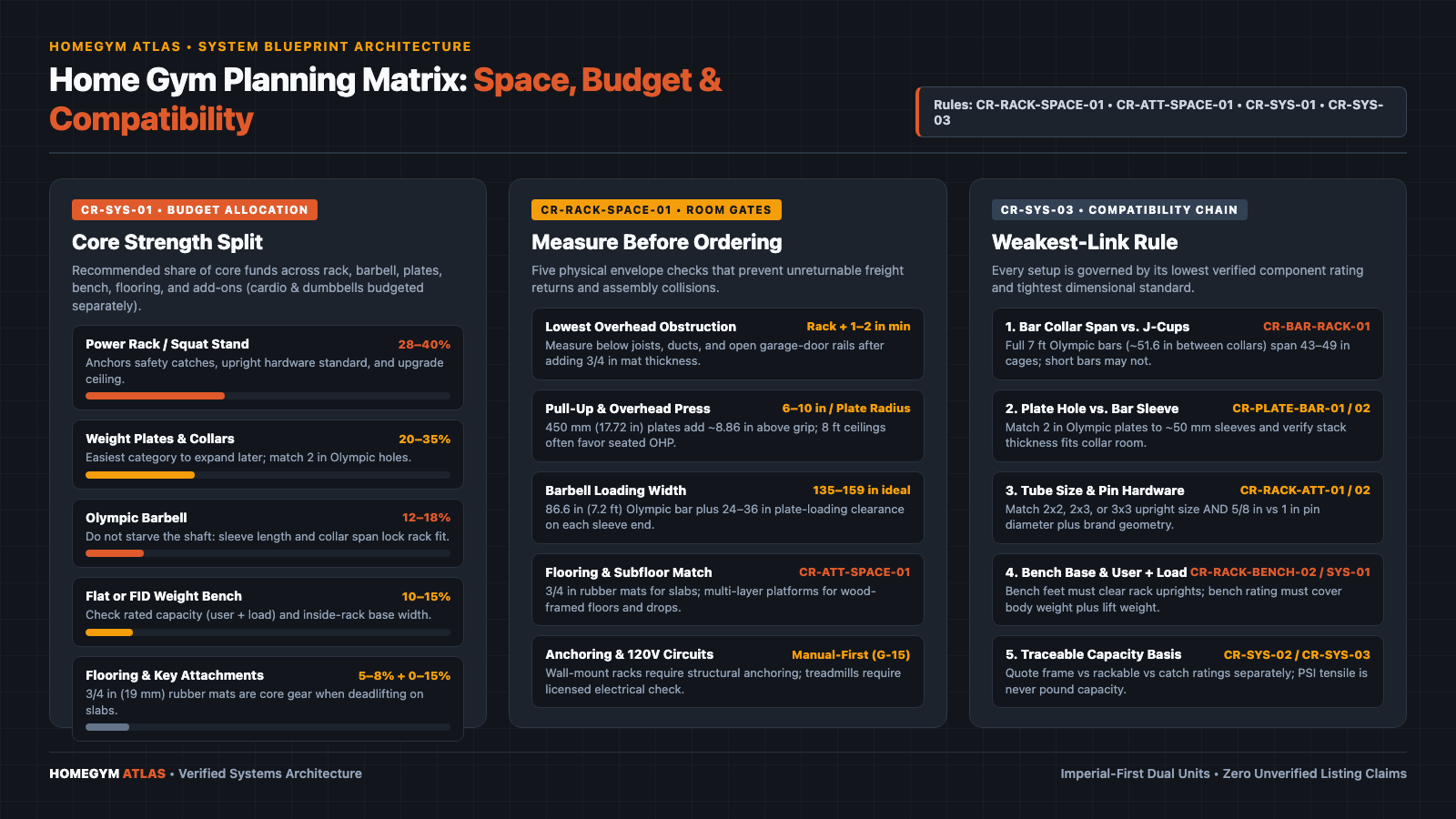
Size the room before choosing gear: allow at least 1 to 2 in (2.5 to 5.1 cm) above rack height (after subtracting 3/4 in / 19 mm for rubber mats) and 135 to 159 in (342.9 to 403.9 cm) of room width for an 86.6 in Olympic bar plus plate-loading clearance. For core strength setups, allocate roughly 28–40% to the rack, 12–18% to the barbell, 20–35% to plates, 10–15% to the bench, 5–8% to flooring, and 0–15% to key attachments—budgeting adjustable dumbbells and cardio machines separately. Explore our home gym cost tiers breakdown for full tier trade-offs.
In This Setup Blueprint
- Step 1: Measure Your Room Envelope & Floor Structure
- Step 2: Allocate Budget Tiers Without Starving Core Steel
- Step 3: Complete Core Kit Parts List (Verified Amazon US Picks)
- Step 4: Component Compatibility & Weakest-Link Audit
- Step 5: Staged Home Gym Upgrade Roadmap
- Mandatory Anchoring, Electrical & Floor-Load Safety Checklist
- Verified Amazon US Blueprint Picks (8 Multi-Category SKUs)
- Frequently Asked Questions & Sources
Step 1: Measure Your Room Envelope & Floor Structure (SPACE Rules)
Space constraints eliminate incompatible equipment faster than budget limits. Under IronGym Lab compatibility logic, room checks always execute first because a power rack or rowing machine that fails physical clearance renders every downstream hardware match irrelevant. Use the four typical North American room assumptions below to identify your limiting dimension before shopping.
| Room Profile (Assumed Preset) | Typical Ceiling & Obstructions | Floor & Receptacle Assumptions | Primary Equipment & Layout Constraints |
|---|---|---|---|
| Two-Car Garage (Concrete Slab) SPACE-GARAGE-SLAB-2CAR | Assuming a typical 96–120 in (243.8–304.8 cm) ceiling minus open garage-door tracks and opener rails. | Concrete slab; standard NEMA 5-15 (15 A) outlets, commonly GFCI-protected per local code. | Measure with the garage door open (CR-RACK-SPACE-01); plan 3/4 in (19 mm) rubber mats (CR-ATT-SPACE-01) and resolve treadmill GFCI conflicts with a licensed electrician. |
| Low-Ceiling Basement SPACE-BASEMENT-LOW | Assuming a typical 84–96 in (213.4–243.8 cm) ceiling; structural beams and HVAC ducts may project lower. | Concrete slab; watch moisture and basement stair/door access paths (CR-SYS-04). | Short 71–84 in racks or half racks; seated overhead pressing instead of standing 450 mm plate lockouts (CR-RACK-SPACE-03); upright-by-upright assembly. |
| Ground-Floor Spare Bedroom SPACE-SPARE-BEDROOM | Assuming a typical 96 in (243.8 cm) drywall ceiling with standard household lighting/fans. | Wood subfloor or slab (verify); carpet common; NEMA 5-15 outlets; moderate household noise. | Room width for an 86.6 in (7.2 ft) Olympic bar plus loading space (CR-RACK-SPACE-04) and non-carpet placement under treadmills if manual prohibits carpet. |
| Upper-Floor Apartment / Condo SPACE-APARTMENT-UPPER | Assuming a typical 96 in (243.8 cm) ceiling; stair or elevator delivery limits (CR-SYS-04). | Wood or concrete framing unknown; shared neighbors below; lease restricts wall/floor drilling. | Prioritize adjustable dumbbells, foldable bench, dense mats, and low-noise air rower/cycle; avoid heavy barbell drops and unapproved wall anchors (CR-RACK-SPACE-05). |
Three Non-Negotiable Room Measurements
- Lowest overhead obstruction minus flooring (CR-RACK-SPACE-01 & CR-ATT-SPACE-01): Measure from the floor to the lowest beam, ductwork, pendant light, or raised garage-door rail—never just the drywall corner. Under International Residential Code (IRC) Section R305.1, habitable basements have a 7 ft (84 in / 213.4 cm) ceiling minimum, while beams and ducts can project lower. Subtract 3/4 in (19 mm) if your rack sits on standard horse-stall rubber mats, then leave at least 1 to 2 in (2.5 to 5.1 cm) above the rack’s published height. Also budget 6 to 10 in (15.2 to 25.4 cm) above any top pull-up bar for strict chin-over-bar clearance (
CR-RACK-SPACE-02). For tight basements, see our basement home gym low ceiling build guide. - Barbell loading width and standing press clearance (CR-RACK-SPACE-03 & CR-RACK-SPACE-04): A standard men’s 20 kg (~44.1 lb) Olympic bar measures roughly 86.6 in (220.0 cm / ~7.2 ft) end to end. Editorial planning convention calls for 24 to 36 in (61.0 to 91.4 cm) beyond both sleeve tips for comfortable plate loading—requiring roughly 135 to 159 in (342.9 to 403.9 cm) of clear room width—plus front-to-back depth for bench overhang and walking around loaded sleeves. Remember that full-size 450 mm (17.72 in) Olympic plates extend roughly 8.86 in (22.5 cm) above your knuckles at lockout, often pushing standing overhead presses into 8-foot (96 in) ceilings.
- Cardio footprint, clearance zones, and upper-floor reality (CR-CARDIO-SPACE-01 & CR-CARDIO-SPACE-05): Never plan cardio placement using only the folded or boxed length. Motorized treadmills require substantial rear and side clearance zones per the owner’s manual (commonly ~78.7 in / 2 m behind and ~19.7 in / 0.5 m per side under ASTM F2115 guidance—verify your specific manual) plus step-up height margin at maximum incline (
CR-CARDIO-SPACE-02). Rowers such as the Concept2 RowErg occupy 96 x 24 in (8 x 2 ft / 243.8 x 61.0 cm) assembled and require roughly 108 x 48 in (9 x 4 ft / 274.3 x 121.9 cm) in use. If you live above neighbors, start with our apartment home gym setup plan rather than forcing heavy iron onto shared framing.
Step 2: Allocate Budget Tiers Without Starving Core Steel (CR-SYS-01)
Rather than hunting one cheap bundle, divide your strength-core budget proportionally across the rack, barbell, plates, bench, flooring, and attachments. Weight plates are the easiest category to expand incrementally later; by contrast, a flimsy rack frame or short-sleeve bar permanently caps progression across your entire setup (CR-SYS-03). The table below follows our audited US market tier brackets.
| Budget Tier (Strength Core) | Rack (+ Safeties) | Barbell & Plates | Bench, Flooring & Add-Ons | Representative Build Focus & Blueprint Link |
|---|---|---|---|---|
| TIER-BUDGET $250–$500 | 30–40% | 12–18% bar 25–35% plates | 10–15% bench 5–8% mats 0–5% add-ons | Squat stands or entry 7 ft rack with traceable catch ratings, starter Olympic bar, basic iron plate pair, flat bench, and initial rubber mat coverage. |
| TIER-STARTER $500–$1,000 | 30–40% | 12–18% bar 25–35% plates | 10–15% bench 5–8% mats 0–5% add-ons | Enclosed 4-post entry cage (e.g., CAP FM-905WH-7 or REP PR-1100), full 45 lb Olympic barbell, starter iron or bumper set, FID bench, and stall mats. See garage gym under $1,000. |
| TIER-GARAGE $1,000–$2,000 | 30–38% | 12–18% bar 25–30% plates | 10–15% bench 5–8% mats 3–8% add-ons | 2×3 or 3×3 11-gauge steel rack (e.g., Titan T-3 or X-3), dedicated 28–28.5 mm multipurpose bar, bumper + change plate set, sturdy FID bench, and full bay mats. See garage gym under $2,000. |
| TIER-MIDRANGE $2,000–$3,500 | 30–35% | 12–16% bar 22–28% plates | 10–14% bench 5–8% mats 6–12% add-ons | 3×3 11-gauge rack with Westside bench-zone spacing or gas-shock wall fold, higher-tensile bar, fuller plate inventory, heavy FID bench, and 2–3 rack attachments. |
| TIER-PREMIUM / ELITE $3,500–$6,000+ | 25–35% | 10–15% bar 18–25% plates | 8–13% bench 5–8% mats 8–20% cables | Integrated rack + functional trainer or all-in-one cable trainer (e.g., REP Arcadia / Altitude, Major Fitness Drone, RitFit M2), dual barbells, full bumper set, and dedicated lifting platform. |
Note that adjustable dumbbells and dedicated cardio equipment (air rowers, indoor bikes, or treadmills) are budgeted separately from the barbell core shares above. Never shrink your rack allocation just to afford extra 45 lb plates if doing so forces you onto a marketplace cage whose capacity rating cannot be traced to a manufacturer document (CR-SYS-02).
Step 3: Complete Core Kit Parts List (Verified Amazon US Picks)
The parts list below maps every core equipment role in a versatile home gym to a verified, active Amazon US listing from our product catalog. Together, these selections illustrate both garage barbell builds and compact apartment-friendly alternatives, with zero excluded direct-sale SKUs.
| System Role | Verified Amazon Pick | Key Compatibility Spec | Budget Tier | Amazon Link |
|---|---|---|---|---|
| Full Cage Rack (8 ft Ceiling) | CAP Barbell FM-905WH-7 Full Cage | 84 in H x 47.2 in D x 43.3 in W; 500 lb catch / 750 lb pull-up rating | Entry ($100–$500) | Check on Amazon |
| 11-Gauge Space-Saver Rack | Titan Fitness T-3 Space Saving (91″ x 24″) | 2 x 3 in 11-gauge; 5/8 in pins (11/16 in holes); 1,000 lb rated; wall anchor | Entry ($100–$500) | Check on Amazon |
| Olympic Barbell | Iron Crush 7ft Olympic Barbell (45 lb) | 87 in L; 28 mm shaft; 16.14 in loadable 2 in sleeves; 750 lb / 170,000 PSI | Entry (Under $150) | Check on Amazon |
| Olympic Weight Plates | Amazon Basics 2-Inch Cast Iron Plate (45 lb) | 2 in Olympic center hole; recycled cast iron; slim sleeve stack (no drops) | Entry (Under $100) | Check on Amazon |
| Adjustable FID Bench | FLYBIRD WB5 Foldable Weight Bench | 800 lb ASTM-certified rating; 13 in W x 46 in D; 90° to -30° FID angles | Entry (Under $200) | Check on Amazon |
| Adjustable Dumbbells | BowFlex Results Series 552 (Pair) | 5–52.5 lb per hand (15 settings); 2.5 lb early steps; no-drop rule | Mid-Range ($300–$600) | Check on Amazon |
| Gym Flooring (Garage Slab) | American Floor Mats 3/4 in Stall Mat (4′ x 6′) | 3/4 in (19 mm) dense rubber; 48 x 72 in (24 sq ft per sheet) | Entry-to-Mid ($100–$300) | Check on Amazon |
| Non-Motorized Cardio | Concept2 RowErg (PM5 Monitor) | 96 x 24 in assembled (9 x 4 ft use); 500 lb Concept2 limit; zero 120V/sub | Mid-Range ($500–$1,000+) | Check on Amazon |
Step 4: Component Compatibility & Weakest-Link Audit (CR-* Chain)
Buying components from different manufacturers works smoothly on Amazon US only when every physical interface passes its governing compatibility rule. Below is the exact engineering audit connecting racks, attachments, barbells, plates, benches, dumbbells, flooring, and cardio.
1. Power Rack Tube Size, Pin Diameter & Weakest-Link Capacity (CR-RACK-ATT-01/02, CR-SYS-02/03)
Start by separating upright tube dimensions (2 x 2 in, 2 x 3 in, or 3 x 3 in) from hardware pin size (5/8 in vs. 1 in). Both are independent requirements under CR-RACK-ATT-01 and CR-RACK-ATT-02: a 3 x 3 in rack using 5/8 in pins will not accept 1 in accessories, and vice versa. For example, the Titan Fitness T-3 Space Saving rack pairs 2 x 3 in 11-gauge tubing with ~11/16 in holes cut specifically for 5/8 in hardware—always match accessories by pin size and confirm that the attachment maker explicitly lists your rack line (CR-RACK-ATT-03) rather than relying on generic “fits all 2×3 or 3×3” marketplace claims.
Equally important, compare capacity basis rather than chasing headline marketing numbers (CR-RACK-SYS-02). Manufacturers publish ratings on different bases: static frame total, per-pair J-cup catch rating, safety-pin catch rating, pull-up bar limit, or “rackable” barbell capacity. Under CR-SYS-03 (HARD), your setup’s working limit equals its lowest-rated load-bearing component across the rack catches, safeties, barbell, and bench. For our full multi-tier comparison of Amazon cages, read our best power rack for home gym guide. Note that popular direct-to-consumer lines—including Rogue Monster Lite, Rogue Monster, REP PR-4000, REP PR-5000, REP PR-4100, REP SR-4000, and the unlisted Fitness Reality 810XLT—are not sold on Amazon and appear in our guides only as non-affiliated reference benchmarks.
2. Barbell Collar Span, Sleeve Standard & PSI vs. Load Limits (CR-BAR-RACK-01, CR-PLATE-BAR-01/02/04)
A rack and barbell must pass three checks together:
- Inner-collar span vs. J-cup span (CR-BAR-RACK-01): Standard men’s 20 kg (~44.1 lb) and women’s 15 kg (~33.1 lb) Olympic bars measure roughly 51.6 in (1,310 mm) between their inner sleeve collars, allowing them to rest cleanly inside standard 43 to 49 in wide cages such as the CAP FM-905WH-7 (43.3 in outer width) or Titan T-3. Short 5 ft or 6 ft technique bars often have narrower collar spans and fail this HARD gate.
- Plate hole standard & loadable sleeve stack (CR-PLATE-BAR-01 & CR-PLATE-BAR-02): Olympic plates carry a 2 in (~50.4–51 mm) center hole designed strictly for ~50 mm Olympic sleeves—never load 2 in plates onto a 1 in standard bar, and 1 in standard plates will not slide onto Olympic sleeves at all. Check usable sleeve length after subtracting clamp collar width (typically 0.5–2 in): the Iron Crush 7 ft bar gives 16.14 in (41.0 cm) of loadable sleeve per side, giving thin cast-iron plates plenty of room whereas thick recycled-rubber bumpers fill sleeves much faster.
- Tensile PSI is never a pound capacity (CR-PLATE-BAR-04): Many specialty and direct-sale bars (such as the direct-only Rogue Ohio Bar and REP Colorado Bar, not sold on Amazon) publish steel tensile strength in PSI (e.g., 190,000 PSI) without a static pound rating. Never convert PSI into a pound limit. The Iron Crush barbell publishes both 170,000 PSI tensile strength and an explicit 750 lb (340.2 kg) rated capacity, making weakest-link planning straightforward. Also keep unit math clean: a 20 kg bar weighs ~44.1 lb, not 45 lb (
CR-PLATE-SYS-01).
3. Bench Base Width, Safety Height & Combined Load (CR-RACK-BENCH-01/02, CR-BENCH-SYS-01)
When bench pressing inside a cage, check two clearances before ordering: first, confirm the bench’s rear base width clears both the rack’s inside upright width and any flat-foot bottom gussets (CR-RACK-BENCH-02). With a 13 in (33.0 cm) frame width, the FLYBIRD WB5 slides cleanly inside 43 in+ racks without colliding with side crossmembers. Second, remember that bench ratings must cover your body weight plus the total barbell or dumbbell load you press or row (CR-BENCH-SYS-01)—so an 800 lb (362.9 kg) ASTM-certified bench supports a 220 lb lifter pressing up to 580 lb, whereas a 500 lb entry bench caps that same lifter at 280 lb on the bar. Tighter 1 in Westside hole spacing (as found in the Titan T-3 bench zone) makes it easier to position safety catches just below your chest arch height (CR-RACK-BENCH-01).
4. Flooring Drop Profiles, Dumbbells & Cardio Subscriptions (CR-ATT-SPACE-01, CR-DB-02, CR-CARDIO-SYS-02)
Every non-barbell piece carries its own usage and ownership rules:
- Cast iron vs. bumpers & rubber thickness (CR-PLATE-ATT-01 & CR-ATT-SPACE-01): Cast-iron plates like the Amazon Basics 45 lb grip plate are not engineered for overhead drops. Even with controlled deadlift lowering on a concrete garage slab, use 3/4 in (19 mm) dense rubber stall mats (such as American Floor Mats 4 x 6 ft sheets) rather than soft EVA puzzle foam; on wood-framed upper floors, heavy deadlifts call for a multi-layer wood-and-rubber platform and landlord/building approval.
- Adjustable dumbbells & federal recall verification (CR-DB-02 & G-24): Selector-style adjustable dumbbells save massive space, but BowFlex owner’s manuals explicitly prohibit dropping them. Furthermore, buyers must distinguish legacy units from current production: on June 5, 2025, the U.S. CPSC and Johnson Health Tech Trading announced a recall covering roughly 3.84 million legacy BowFlex SelectTech 552 and 1090 dumbbells due to weight plates detaching from handles during use (owners should verify serial numbers at bowflex.com/recalls for replacement/voucher remedies). The redesigned Results Series 552 (ASIN
B0FRNG2N5H) reflects post-recall production sold new today. - Cardio subscriptions & recall notices (CR-CARDIO-SYS-02 & G-24): Connected machines such as NordicTrack treadmills (iFIT), Peloton bikes/treads (Peloton All-Access), and Hydrow rowers (Hydrow membership) gate interactive classes, streaming routes, or tracking profiles behind ongoing paid memberships—confirm which manual modes still run without a subscription before buying. If buying or owning a used original Peloton Bike (model PL01), check the May 2023 CPSC/Peloton recall notice regarding seat posts that can break during use; the official remedy is a free replacement seat post from Peloton. By contrast, the Concept2 RowErg requires zero ongoing membership and runs its PM5 monitor on batteries.
Step 5: Staged Home Gym Upgrade Roadmap
You do not need to buy an entire room in one shipment. Staging your build prevents rushed purchases and keeps every upgrade compatible with the steel you already own:
- Phase 1 — Floor & Measurement Foundation: Clear the bay, verify lowest overhead obstructions with garage doors open, inspect 120V receptacles if motorized cardio is planned, and lay 3/4 in (19 mm) rubber stall mats (letting new rubber air out per maker guidance).
- Phase 2 — Core Barbell Quartet: Install your power rack (confirming tube size and pin hardware before committing), pair one 45 lb (or 20 kg / ~44.1 lb) 2 in Olympic barbell, start with 160–260 lb of plates + collars, and add an inside-rack flat or FID bench rated for your body weight plus target load.
- Phase 3 — Progression Plates, Dumbbells & Rack Attachments: Add 2.5 lb and 5 lb change plates, additional 45 lb pairs, or adjustable dumbbells for unilateral hypertrophy work, plus rack-matched attachments (dip bars, landmine, or cable pulley kits verified against upright tube and pin diameter).
- Phase 4 — Dedicated Conditioning & Freight Logistics (CR-SYS-04): Add an air rower, indoor cycle, or dedicated-circuit treadmill last, verifying doorway turns, stair clearances, and curbside vs. room-of-choice freight delivery before checkout.
Mandatory Safety, Anchoring & Electrical Checklist (Manufacturer-First Rules)
- Structural Anchoring & Assembly: Always follow the manufacturer’s assembly sequence and anchoring instructions. Wall-mount folding or space-saving racks (such as the Titan T-3 Space Saving rack) MUST be anchored into approved wood studs, ledger boards, or concrete masonry as specified in the manual—never treat required anchoring as optional, confirm lease rules if renting, and consult a qualified installer if framing behind drywall is uncertain.
- 120V Treadmill Circuits & GFCI Rules: Motorized treadmills typically specify a dedicated grounded 120V circuit (15 A
NEMA 5-15or 20 ANEMA 5-20depending on the manual). ANEMA 5-20Pplug will not fit a5-15Routlet—never use a 15A-to-20A plug adapter, never run extension cords or power strips when prohibited by the manual, and never attempt DIY wiring or defeat GFCI protection. Because some treadmill manuals (such as Sole F80) prohibit GFCI outlets while local residential codes commonly require GFCI in garages and basements, have the manufacturer and a licensed electrician confirm your panel and receptacle setup. - Floor Loading & Safe Equipment Boundaries: Check building rules before placing heavy iron or cardio machines on upper wood-framed floors, and consult a qualified structural professional for concentrated drops. Use rack safeties strictly within their published manufacturer ratings and design limits—never treat safeties or flooring as absolute protection guarantees.
Verified Amazon US Blueprint Picks (All 7 Core Roles)
Each verified Amazon US item below anchors a distinct role in the setup blueprint above, audited for spec transparency, dimensional compatibility, and honest trade-offs.
1. CAP Barbell FM-905WH-7 Full Cage Power Rack (Starter 8 ft Ceiling Cage)

Verified Specs: 12- and 14-gauge steel tubing | Dimensions: 47.2 in D x 43.3 in W x 84 in H (119.9 x 110.0 x 213.4 cm) | Rated Capacity: 500 lb (226.8 kg) bar catches / 750 lb (340.2 kg) pull-up bar per CAP spec | Budget Tier: Entry ($100–$500)
For TIER-BUDGET and TIER-STARTER garages with standard 8-foot (96 in) ceilings, the CAP FM-905WH-7 provides a freestanding 4-post enclosure with transparent component ratings rather than vague multi-thousand-pound claims. Its 43.3 in outer width comfortably accepts full 7 ft Olympic barbells (~51.6 in collar span).
- Pros: Freestanding 4-post footprint clears 8-foot (96 in) ceilings with 3/4 in mats; explicit bar-catch (500 lb) and pull-up (750 lb) ratings clarify real working limits.
- Cons: 500 lb catch ceiling limits advanced heavy powerlifters over time; 12/14-gauge frame lacks the broad third-party attachment ecosystem of 3 x 3 in 11-gauge racks.
2. Titan Fitness T-3 Series Space Saving Power Rack (91″ x 24″, 11-Gauge)

Verified Specs: 2 x 3 in (50.8 x 76.2 mm) 11-gauge steel uprights | Hardware: 11/16 in holes for 5/8 in (15.9 mm) pins with Westside bench-zone spacing | Dimensions: 91 in H x 24 in D (231.1 x 61.0 cm) | Rated Capacity: 1,000 lb (453.6 kg) | Budget Tier: Entry ($100–$500)
When a tall two-car garage needs real 11-gauge structural steel without sacrificing parking depth, Titan’s 24-inch-deep T-3 Space Saving rack delivers Westside 1-inch bench-zone spacing in a wall-mounted footprint. Because it stands 91 in tall, verify at least 93+ in of unobstructed height above your mats (CR-RACK-SPACE-01) and anchor strictly per Titan’s manual (CR-RACK-SPACE-05).
- Pros: True 11-gauge 2 x 3 in steel and Westside bench-zone hole spacing at a compact 24 in depth; 1,000 lb manufacturer rating supports serious progression.
- Cons: 91 in height blocks low 7–8 ft basements and leaves tight pull-up headroom under 96 in ceilings; requires structural wall/floor mounting and uses 2 x 3 in attachments rather than 3 x 3 in.
3. Iron Crush 7ft Olympic Barbell (45 lb, 28 mm Shaft, 750-lb Capacity)

Verified Specs: 87 in (221.0 cm) length / 45 lb (20.4 kg) | 28 mm shaft | 2 in Olympic sleeves (16.14 in / 41.0 cm loadable) | Rated Capacity: 750 lb (340.2 kg); 170,000 PSI tensile strength | Chrome finish, dual knurl marks, no center knurl | Budget Tier: Entry (Under $150)
Unlike undersized 35 lb starter bars, the Iron Crush 7ft Olympic Barbell provides full 45 lb (20.4 kg) competition-style bar weight, a true 28 mm grip diameter, and generous 16.14-inch loadable sleeves that accommodate thick bumper stacks alongside lock collars (CR-PLATE-BAR-02).
- Pros: Publishes both a 750 lb load rating and 170,000 PSI tensile figure; full 16.14 in sleeves and dual knurl markings fit both power and conditioning work.
- Cons: Chrome finish can feel slicker with sweaty hands than bare steel or black zinc; lacks a center knurl for heavy high-bar squats.
4. Amazon Basics 2-Inch Olympic Cast Iron Grip Weight Plate (45 lb Single)

Verified Specs: 45 lb (20.4 kg) single (2.5 to 45 lb options available) | Center Hole: 2 in Olympic | Material: Recycled cast iron with opposing grip slots | Drop Guidance: Controlled lowering only (not drop-rated) | Budget Tier: Entry (Under $100 per plate)
Cast-iron grip plates pack maximum weight onto your 16.14 in barbell sleeves without burning space the way wide recycled-rubber bumpers do (CR-PLATE-BAR-02). Dual opposing grip slots also make loading 45 lb (20.4 kg) plates onto J-cup height uprights far easier to handle.
- Pros: Slimmer profile fits higher total poundage on short or standard sleeves; dual grip slots simplify carrying and loading from plate trees.
- Cons: Not drop-rated—avoid dropping from overhead or lockout (
CR-PLATE-ATT-01); sold individually, so always double-check quantity in cart.
5. FLYBIRD WB5 Foldable Adjustable Weight Bench (800LB ASTM-Certified)

Verified Specs: Rated Capacity: 800 lb (362.9 kg) ASTM-certified (combined user + load) | Footprint: 46 in D x 13 in W x 48.5 in H (116.8 x 33.0 x 123.2 cm) | Unit Weight: 28.5 lb (12.9 kg) | Angles: 90° to -30° FID positions with 30 in (76.2 cm) backrest | Budget Tier: Entry (Under $200)
A narrow 13-inch base lets the FLYBIRD WB5 wheel smoothly between 4-post rack uprights (CR-RACK-BENCH-02), while its folding pin design tucks neatly into spare bedrooms or closets when floor space must do double duty.
- Pros: 800 lb ASTM-certified combined capacity outclasses many sub-$200 folding benches; folds compactly at 28.5 lb for multi-use rooms.
- Cons: Lightweight 28.5 lb frame has more lateral feel under heavy barbell leg drive than 75–100+ lb commercial flat/FID benches; padding is narrower for broad-shouldered lifters.
6. BowFlex Results Series 552 SelectTech Adjustable Dumbbells (Pair)
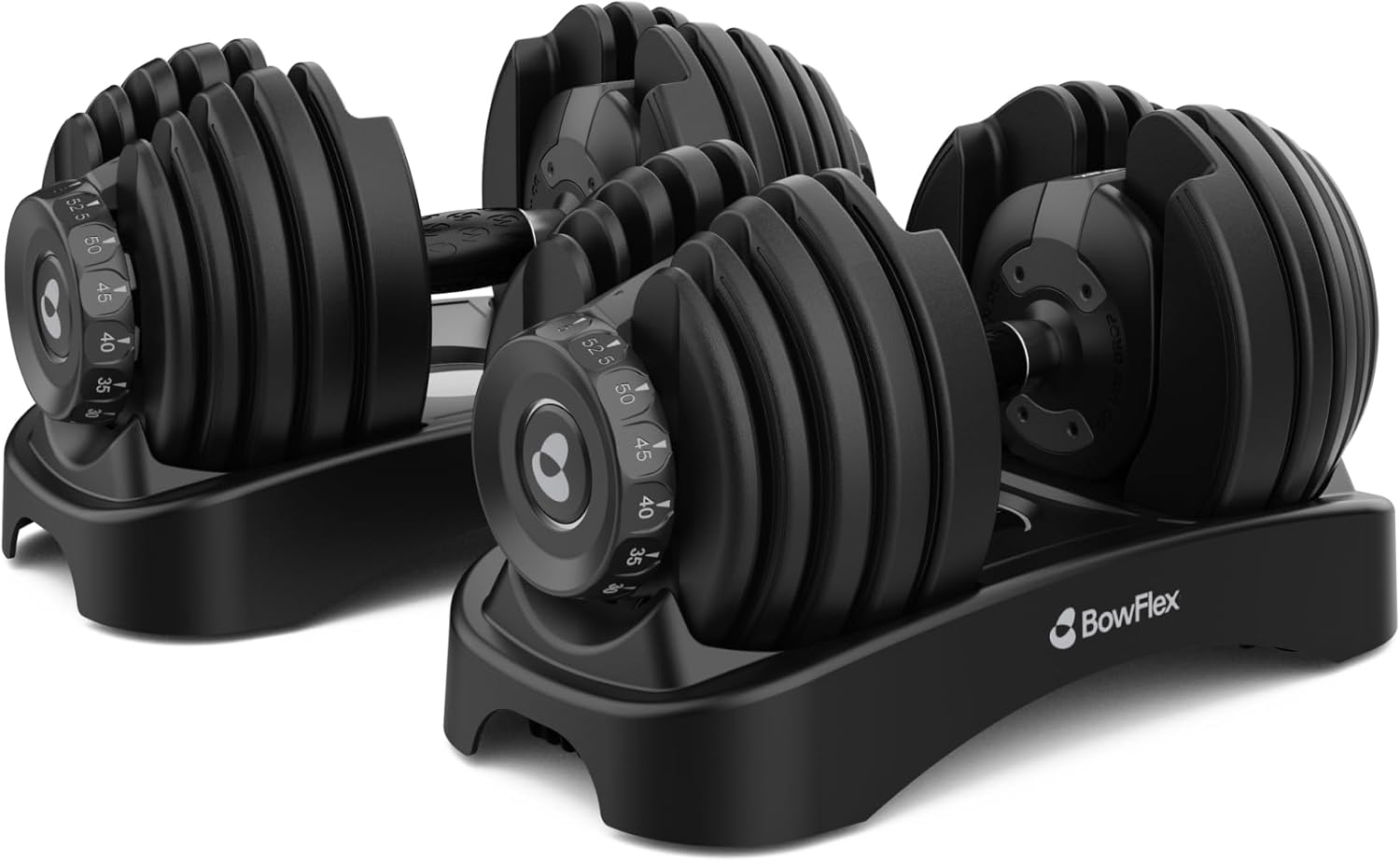
Verified Specs: 5 to 52.5 lb (2.3 to 23.8 kg) per hand | 15 settings (2.5 lb steps to 25 lb; 5 lb steps to 50 lb; 2.5 lb to 52.5 lb) | Dimensions: 16.9 in L x 8.3 in W x 9.0 in H (42.9 x 21.1 x 22.9 cm) | Handling Rule: Do not drop | Budget Tier: Mid-Range ($300–$600)
For apartment dwellers and accessory-focused garage setups, the redesigned Results Series 552 matched pair replaces 15 pairs of fixed dumbbells in two floor trays with fine 2.5 lb progression up to 25 lb. Always buy current Results Series production new rather than uninspected legacy pre-May 2025 units covered by the June 5, 2025 CPSC recall.
- Pros: Fine 2.5 lb increments through 25 lb support controlled lateral raises and curls; tiny footprint fits tight bedrooms and upper-floor condos.
- Cons: Permanently capped at 52.5 lb with no expansion kit (
CR-DB-01); constant 16.9 in spindle length even at 5 lb; strictly prohibited from dropping (CR-DB-02).
7. American Floor Mats Heavy Duty Stall Mat (3/4″ Thick, 4′ x 6′ Solid Black)

Verified Specs: Heavy-duty dense rubber | Thickness: 3/4 in (0.75 in / 19 mm) | Footprint: 48 x 72 in (121.9 x 182.9 cm; 24 sq ft per sheet) | Budget Tier: Entry-to-Mid ($100–$300 by coverage area)
Two 4 x 6 ft (48 sq ft total) 3/4 in rubber mats create a stable 8 x 6 ft or 12 x 4 ft foundation underneath a full power rack and bench on a concrete garage slab (CR-ATT-SPACE-01). Remember to subtract 3/4 in from your room’s vertical clearance before selecting upright height (CR-RACK-SPACE-01).
- Pros: True 3/4 in dense rubber resists rack-foot indentation far better than thin 3/8 in mats or compressible EVA foam puzzle tiles; seamless 24 sq ft sheet footprint.
- Cons: Heavy single-sheet format is awkward to haul down narrow basement stairs; new heavy rubber mats commonly emit initial odor and should be aired out per maker guidance.
8. Concept2 RowErg Indoor Rowing Machine (PM5 Monitor)

Verified Specs: Air flywheel (10-level damper) | Footprint: 96 x 24 in (8 x 2 ft / 243.8 x 61.0 cm) assembled; 108 x 48 in (9 x 4 ft) recommended in-use | Weight: 57 lb (25.9 kg) standard legs | Max User Weight: 500 lb (226.8 kg) per Concept2 / 300 lb (136.1 kg) under EN 20957-7 | Power: Battery-powered PM5 (zero 120V circuit / zero mandatory membership) | Budget Tier: Mid-Range ($500–$1,000+)
When a garage lacks a dedicated 120V cardio circuit—or an upper-floor apartment needs low-impact conditioning without a heavy motorized treadmill—the Concept2 RowErg plugs straight into the corner, splits into two pieces for vertical storage, and pairs with 40+ Bluetooth/ANT+ apps without mandatory fees.
- Pros: Zero wall outlet or GFCI conflict; zero recurring membership required; 500 lb manufacturer user rating and repeatable PM5 split tracking.
- Cons: Requires 9 x 4 ft of open floor length during active rowing strokes (
CR-CARDIO-SPACE-05); air flywheel creates noticeable fan airflow noise in quiet shared rooms.
How We Audited This Guide
- Room setups, upgrade roadmaps, and Amazon listing red-flag audits enforce system-wide CR-* clearances, manufacturer-first anchoring instructions, and strict off-Amazon brand disclosures.
- Every power rack, barbell, weight plate, bench, adjustable dumbbell, cardio machine, and flooring spec was cross-checked against official manufacturer manuals, CPSC notices, and live Amazon US listings.
- Recommendations were evaluated against our weighted vertical scoring rubrics and documented CR-* compatibility rules; we never invent load capacities, motor ratings, rubber thickness, or decibels.
Frequently Asked Questions: Home Gym Setup Guide
How much space do I need for a basic barbell home gym?
Plan roughly 135 to 159 in (11.2 to 13.2 ft) of width so an 86.6 in Olympic bar has 24 to 36 in of plate-loading room at both ends, at least 8 to 10 ft of depth for a cage and bench overhang, and 1 to 2 in above rack height after subtracting 3/4 in mats.
What should I buy first when starting a home gym on a budget?
Lay dense 3/4 in rubber flooring first if you lift on concrete, then prioritize a capacity-verified power rack or squat stand, a full-length 2 in Olympic barbell, and an inside-rack bench. Plates are easiest to add later, whereas a weak rack or 1 in bar caps your whole setup.
Can I put a power rack and barbell in an upper-floor apartment?
Upper-floor wood framing, noise rules, and lease drilling restrictions usually rule out heavy barbell drops and wall-mounted racks. Most apartment setups perform better with selector adjustable dumbbells, a folding FID bench, dense protective mats, and a non-impact air rower or indoor bike.
Do I need a dedicated electrical outlet for a home gym treadmill?
Most motorized treadmill manuals require a dedicated grounded 120V circuit (15 A or 20 A depending on the model) and prohibit extension cords or power strips. Because some manuals advise against GFCI outlets required by garage codes, consult the manufacturer and a licensed electrician before plugging in.
How do I make sure rack attachments and weight plates fit together?
Match weight plates strictly by center-hole standard (2 in Olympic plates on ~50 mm Olympic sleeves) and confirm sleeve length clears your target plate stack plus collars. For rack attachments, match upright dimensions (2×2, 2×3, or 3×3), pin diameter (5/8 in vs. 1 in), and manufacturer fit lists.
Authoritative Non-Affiliate Sources Cited:
- International Code Council (IRC Section R305.1) — Habitable residential and basement ceiling minimum height and beam projection standards.
- U.S. Consumer Product Safety Commission (CPSC) — Official June 5, 2025 BowFlex SelectTech 552/1090 recall notice and May 2023 Peloton Bike PL01 seat-post recall notice.
- Titan Fitness Official Specifications — Published T-3 2 x 3 in 11-gauge upright dimensions, ~11/16 in holes for 5/8 in pins, and configuration ratings.
- Concept2 Official RowErg Manual & Specs — 96 x 24 in assembled footprint, 108 x 48 in in-use floor zone, 500 lb Concept2 / 300 lb EN 20957-7 limits, and PM5 specs.
- BowFlex Official Recall & SelectTech Documentation — Serial-number recall check portal and Results Series 552 non-drop operating requirements.


