On This Page
Understanding how to prevent rust in garage gym environments starts with managing moisture before liquid condensation ever touches bare steel or cast iron. Unlike climate-controlled spare bedrooms, a typical residential two-car garage sits on an uninsulated concrete slab behind an imperfectly sealed overhead door. Overnight temperature drops cool heavy 44.1 lb (20 kg) Olympic barbells, 11-gauge steel rack uprights, and iron weight plates below the morning dew point, turning humid air and trapped lifting chalk into rapid surface oxidation.
Preventing corrosion across your strength core—barbells, power racks, attachments, and plates—requires pairing environmental humidity control with finish-specific mechanical care. If you are still designing your room layout, floor protection, or moisture-resistant equipment mix, review our complete home gym setup blueprint before finalizing where your rack and barbell storage sit relative to garage doors and slab joints.
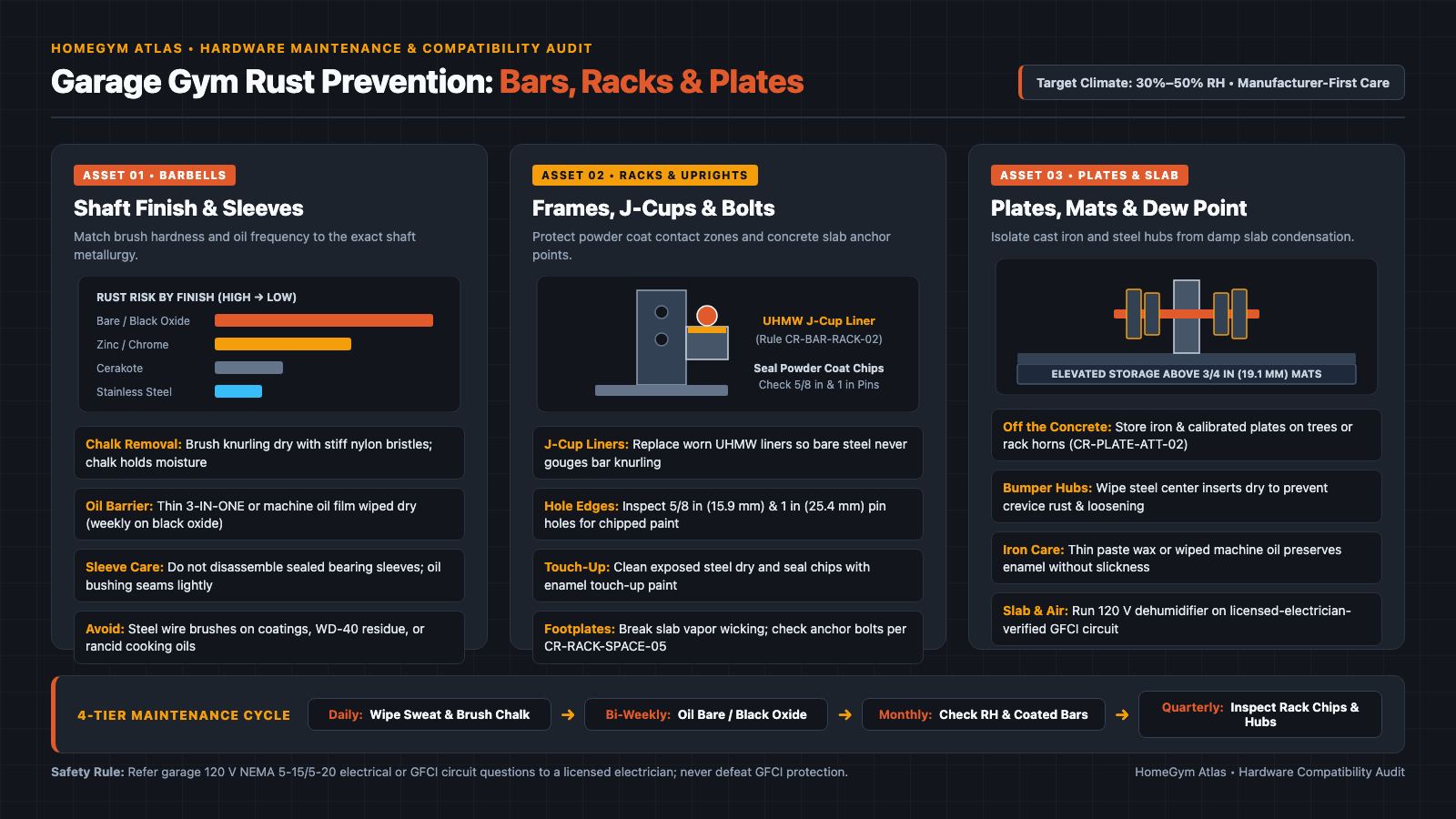
Direct Answer: To stop rust in a garage gym, keep indoor relative humidity (RH) between 30% and 50%—never above 60% per U.S. Environmental Protection Agency (EPA) moisture guidance—using garage-door weather sealing, air circulation, and a properly sized dehumidifier. Wipe sweat from barbell shafts with a dry microfiber towel after each session, brush chalk out of knurling using a stiff nylon bristle brush (never steel wire on coated bars), and apply a thin wiped-dry film of light machine oil such as 3-IN-ONE Multi-Purpose Oil based on shaft finish. Keep cast-iron plates off bare concrete slabs on elevated trees or dry 3/4 in (19.1 mm) rubber mats, seal chipped rack powder coat promptly, and inspect UHMW J-cup liners so bare steel contacts do not score bar finishes.
Safety & Manufacturer-First Maintenance Alert: Follow each equipment manufacturer’s care and disassembly instructions strictly. Never open or disassemble precision needle-bearing barbell sleeves unless the maker’s manual explicitly authorizes it, as improper snap-ring removal can void warranties or misalign internal races. When plugging a dehumidifier or space fan into a garage 120 V NEMA 5-15 or NEMA 5-20 receptacle, follow the appliance manual’s prohibition on unapproved extension cords and respect local Ground-Fault Circuit-Interrupter (GFCI) electrical code; never defeat or disable a GFCI breaker or use a 15A-to-20A adapter, and have a licensed electrician confirm circuit capacity if nuisance tripping occurs. Finally, wipe every drop of excess oil off barbell shafts and plate rims before lifting so grip friction remains consistent.
Symptom & Cause Triage: Why Garage Gym Steel Rusts
Steel and cast iron do not oxidize evenly across an entire garage. Instead, rust concentrates wherever liquid water, hygroscopic salt, or abraded bare metal meet oxygen. Under our garage room profile (SPACE-GARAGE-SLAB-2CAR), concrete slabs, uninsulated bay doors, and high-thermal-mass steel combine to create distinct corrosion failure modes. Use the triage table below to diagnose active rust symptoms and run the lowest-risk immediate check.
| Observed Rust Symptom | Underlying Cause / Rule Trigger | Immediate Safe Check |
|---|---|---|
| Uniform orange haze across barbell shaft & sleeves overnight | Dew-point flash condensation: warm humid air hits cold 44.1 lb (20 kg) steel below dew point (SPACE-GARAGE-SLAB-2CAR) | Close garage doors during warm humid fronts; check hygrometer RH against ambient temperature; dry bar immediately with microfiber and apply light oil. |
| Brown/orange spots packed inside barbell knurling | Hygroscopic magnesium carbonate chalk and salty sweat held inside knurl valleys | Dry-brush knurling lengthwise with a stiff nylon bristle brush; apply light 3-IN-ONE oil to displace trapped moisture and wipe completely dry. |
| Gritty or sluggish Olympic sleeve rotation | Moisture intrusion or dried lubricant inside bushing or bearing sleeve assembly | Stand bar vertically per OEM guidance; check manufacturer manual before applying 2–3 drops of light oil at the sleeve seam; never force sealed bearings open. |
| Finish flaking & rust rings on shaft rack-contact zones | Bare-steel J-cups scouring protective zinc, black oxide, or Cerakote (CR-BAR-RACK-02) | Inspect J-cups for missing or worn-through UHMW plastic liners; replace liners per rack maker before racking freshly oiled bars. |
| Rust creeping from rack footplates & lower upright holes | Moisture wicking from unsealed concrete slab and chipped powder coat at 5/8 in or 1 in holes (CR-RACK-SPACE-05) | Check slab dampness around anchor bolts; inspect under mat edges for trapped condensation; seal exposed steel chips with enamel touch-up paint. |
| Orange scale on cast-iron plates or bumper steel hubs | Plates resting flat on damp concrete or wet plate hubs stacked tight on horns (CR-PLATE-ATT-02, CR-ATT-SPACE-01) | Lift plates off bare concrete onto dry 3/4 in (19.1 mm) rubber mats or elevated trees; separate damp bumpers so center steel hubs dry completely. |
Step 1: Control Garage Humidity & Dew-Point Condensation
Wiping oil onto a barbell helps, but oiling alone cannot outpace a damp garage that swings through dew-point condensation three mornings a week. Corrosion is an electrochemical reaction requiring three ingredients: iron/steel, oxygen, and liquid water acting as an electrolyte. Eliminate liquid moisture in the air and on the concrete floor, and every maintenance step that follows becomes dramatically easier.
Target the 30%–50% Relative Humidity Window
According to the U.S. Environmental Protection Agency (EPA), indoor relative humidity should stay below 60%, with an ideal target range between 30% and 50% RH. Place an inexpensive digital hygrometer at barbell storage height—roughly 36 to 48 in (91 to 122 cm) above the concrete slab—and another near floor level if you store cast-iron plates low to the ground. Relative humidity above 55% to 60% allows microscopic moisture films to settle inside porous bare steel, black oxide conversion coatings, and cast-iron grain structures.
Preventing “Sweating Steel” at the Dew Point
Even in moderate climates, garage lifters frequently trigger flash rust without realizing it. Steel has high thermal mass and warms up slowly compared to air. Suppose overnight temperatures chill your garage to 45 °F (7.2 °C), and at 9:00 AM a warm, rain-soaked breeze at 68 °F (20 °C) and 75% RH blows in when you crack the bay door. At 68 °F and 75% RH, the air’s dew point sits near 60 °F (15.6 °C). Because your 45 °F (7.2 °C) barbell shaft and power rack uprights sit well below 60 °F, water vapor condenses directly onto the steel as visible droplets within minutes.
- Manage Garage Door Openings: Keep overhead doors closed during humid morning warmups, heavy rainstorms, or snowmelt unless active cross-ventilation matches indoor and outdoor temperatures.
- Seal the Perimeter Envelope: Replace cracked rubber bottom astragal seals on the garage door, install side-jamb vinyl weather stripping, and seal gaps around exterior utility penetrations so humid outside air cannot infiltrate continuously.
- Do Not Park Wet Vehicles Beside Exposed Steel: Rainwater, road brine, and melting snow dripping off a car raise garage vapor load sharply and introduce corrosive chloride salts onto nearby rack bases and floor-stored plates.
- Use Oscillating Air Circulation: Stagnant air pockets trap moisture against walls and inside barbell racks. Running an oscillating garage fan breaks up boundary layers so steel surfaces track ambient room temperature more closely.
Dehumidifier Placement & 120 V Electrical Safety
In humid coastal, southern, or basement-adjacent garages, sealing the door is rarely enough on its own—an active compressor dehumidifier (or low-temperature desiccant unit in winter climates below 50 °F / 10 °C) is required to hold RH under 50%. Route the continuous drain hose to a utility sink or floor drain per the appliance manual so the condensate bucket does not shut the unit off mid-week.
Pay strict attention to electrical rules in a garage workspace. Under typical U.S. residential electrical code, garage 120 V NEMA 5-15 (15 A) or NEMA 5-20 (20 A) receptacles require GFCI protection, while many appliance and motorized cardio manuals (a frequent point of conflict noted in our CR-CARDIO-SPACE-03 protocol) prohibit extension cords and power strips. Plug your dehumidifier directly into an approved wall receptacle, never defeat or disable GFCI protection, never force a 20 A plug into a 15 A receptacle with an adapter, and have a licensed electrician confirm your garage circuit load if you share power with motorized cardio machines or space heaters.
Step 2: Maintain Barbells According to Shaft Finish & Sleeve Type
An Olympic barbell—typically 86.6 in (2,200 mm) long, 44.1 lb (20 kg) for men’s bars or 79.1 in (2,010 mm) and 33.1 lb (15 kg) for women’s bars, with ~50 mm (~1.96 in) sleeves and 25 to 29 mm shafts—has the most vulnerable surface in your gym because its diamond-cut knurling exposes fresh microscopic steel peaks and traps hand moisture. Treating a Cerakote shaft with abrasive steel wool destroys the finish, whereas treating bare steel like stainless steel leads to rapid pitting.
Barbell Finish Maintenance Matrix
Identify your exact barbell shaft and sleeve coating before selecting brushes or oils. Both direct-sale benchmarks such as the Rogue Ohio Bar (not sold on Amazon) and REP Colorado Bar (not sold on Amazon), as well as Amazon-listed multipurpose bars from REP Fitness and CAP, rely on the same seven metallurgical finish categories below.
| Barbell Shaft Finish | Corrosion Resistance | Recommended Garage Care Cadence | Approved Cleaning & Protection Method |
|---|---|---|---|
| Bare / Raw Steel | Lowest (oxidizes rapidly in humid garages) | Wipe dry after every session; oil every 1–2 weeks | Stiff nylon brush + thin coat of 3-IN-ONE Multi-Purpose Oil or light machine oil; wipe thoroughly dry. |
| Black Oxide | Low (porous conversion finish, holds oil well) | Brush chalk after use; oil every 2–4 weeks | Nylon brush only (avoid metal brushes that strip oxide) + light 3-IN-ONE oil worked into knurling and wiped dry. |
| Bright Zinc / Black Zinc | Moderate (zinc sacrifices slowly; black zinc patinates) | Brush chalk weekly; oil every 4–8 weeks | Dry nylon brush; mild alcohol-free soap and water wipe if heavily soiled, dried completely, followed by thin machine oil. |
| E-Coat (Electrophoretic) | Moderate to High (uniform thin epoxy coating) | Brush chalk weekly; inspect contact points monthly | Nylon brush and damp microfiber wipe; light oil only on unpainted sleeve seams or scratched rack-contact bands. |
| Hard Chrome | High (unless chipped at rack zones) | Brush chalk after heavy use; oil every 2–3 months | Nylon brush + mild soap-and-water wipe; dry immediately and buff lightly with oiled cloth on wear spots. |
| Cerakote (Ceramic Polymer) | Very High (acts as sealed barrier coating) | Brush chalk after use; quarterly wash | Nylon or plastic bristle brush only; mild dish soap and water wipe, dried completely. Avoid wire brushes and harsh solvents. |
| Stainless Steel | Highest raw-alloy resistance (not rust-proof) | Wipe sweat after use; light oil every 2–3 months in humid garages | Nylon brush to remove chalk and salt; occasional thin 3-IN-ONE oil wipe to passivate against coastal salt or high humidity. |
The Lowest-Risk Routine Cleaning Sequence (Nylon Brush + Light Oil)
Both Rogue Fitness and REP Fitness publish remarkably consistent routine barbell maintenance protocols built around three simple steps. Note that magnesium carbonate lifting chalk is strongly hygroscopic—it pulls water vapor straight out of humid garage air and holds it directly against the steel inside your knurl pattern.
- Dry-Brush Chalk & Skin Debris Immediately: After chalk-heavy deadlift or squat sessions, take 30 seconds to run a stiff nylon or plastic bristle brush along the knurling grain. Never use brass or steel wire brushes on black oxide, zinc, chrome, or Cerakote bars, as metal bristles permanently scratch coatings and round off knurl peaks.
- Wipe Sweat Salts Off the Shaft & Sleeves: Perspiration leaves sodium chloride behind after water evaporates, accelerating pitting even on stainless steel. Wipe the shaft, inner collars, and loadable sleeves with a clean, dry microfiber towel before racking the bar.
- Apply a Thin Barrier of 3-IN-ONE Oil (When Finish Requires): Apply several drops of silicone-free 3-IN-ONE Multi-Purpose Oil (primarily hydrotreated naphthenic oil) directly onto a lint-free microfiber cloth or into the bristles of your nylon brush. Work the oil gently into the knurl valleys and smooth sleeve surfaces, let it sit for 2 to 3 minutes so it penetrates microscopic pores, and then buff thoroughly with a second clean, dry towel until no greasy residue remains on your hands.
What to Avoid on Barbell Steel: Skip standard WD-40 Multi-Use Product as a long-term rust protectant—it is primarily a light solvent and water-displacing cleaner that flashes off and can draw dust into sleeve seams. Never apply cooking, olive, or vegetable oils to gym equipment, because organic oils polymerize into a sticky, rancid film that traps chalk and corrodes steel.
Sleeve Spin, Bushings, Bearings & J-Cup Liner Protection
Garage humidity does not stop at the outside of a barbell sleeve; moist air migrates into the gap between the collar shoulder and the shaft. If sleeve rotation grows stiff or squeaks, check your manufacturer’s manual before grabbing snap-ring pliers. REP Fitness explicitly advises owners not to disassemble barbell sleeves unless following brand-specific maintenance documentation, and Rogue Fitness separates user-serviceable bushing bars from precision bearing bars that require careful handling.
For routine bushing-sleeve lubrication without disassembly, stand the barbell vertically on a protective rubber mat (properly stabilized so it cannot tip), apply 2 to 3 drops of light machine oil or 3-IN-ONE oil into the seam where the sleeve meets the inner collar, lay the bar horizontally, spin the sleeves for 60 to 90 seconds to distribute the film, and wipe away every trace of drip oil from the shaft.
Finally, address the physical contact point between your bar and rack. Under compatibility rule CR-BAR-RACK-02, unlined steel J-cups grind bare metal against barbell shafts every time you re-rack a loaded bar, scraping off zinc, black oxide, or Cerakote right where sweaty hands and shoulder racks meet the bar. Confirm that your rack’s J-cups and spotter arms have intact Ultra-High-Molecular-Weight (UHMW) polyethylene liners—if a liner has worn down to exposed steel bolts or brackets, replace the liner immediately.
Step 3: Protect Power Racks, Hardware & Guide Rods
Most modern 2×2 in, 2×3 in, and 3×3 in steel power racks ship with a baked electrostatic powder coat designed to seal structural steel tubing against indoor humidity. In a garage, rack corrosion rarely starts in the middle of a clean upright—it starts at high-wear mechanical interfaces and slab-level moisture bridges.
- Touch Up Chipped Powder Coat at Pin Holes: Inserting and removing 5/8 in (15.9 mm) or 1 in (25.4 mm) J-cup pins, safety pins, and band pegs (
CR-RACK-ATT-01,CR-RACK-ATT-02) inevitably chips powder coat around laser-cut upright holes. Once bare carbon steel is exposed, humid garage air creeps underneath adjacent paint edges and bubbles the finish. Every quarter, clean any chipped edges with isopropyl alcohol, let dry completely, and dab matching matte-black or rust-inhibitive enamel touch-up paint into the raw rim. - Dry & Lightly Wax Raw Guide Rods on Cables & Smith Machines: Functional trainers, rack-mounted lat pulldowns, and Smith machines rely on un-powder-coated chrome or polished steel guide rods for smooth linear travel. Wipe guide rods clean monthly with a dry lint-free cloth and apply a manufacturer-approved silicone-based dry lubricant or thin machine oil per the owner’s manual—avoiding sticky heavy greases that glue airborne garage sawdust and lint onto linear bushings.
- Inspect Concrete Footplates & Anchor Hardware: Under rule
CR-RACK-SPACE-05, bolt-down power racks and wall-mount folding racks must follow the manufacturer’s anchoring instructions. Because concrete slabs are porous and wick ground moisture upward via vapor pressure, inspect floor-anchor nuts, washers, and baseplate weld seams quarterly. If your slab sweats seasonally, sealing bare concrete before rack installation or cutting 3/4 in (19.1 mm) stall mats cleanly around steel footplates prevents damp rubber from trapping standing water against painted weld toes.
When building an economical starter room—such as a garage gym under $1,000—paying close attention to J-cup liners and baseplate dryness preserves entry-tier 14-gauge or 12-gauge frames just as effectively as heavy-duty 11-gauge steel uprights.
Step 4: Safeguard Weight Plates, Storage Horns & Dumbbells
Weight plates sit closest to the coldest, dampest surface in any garage: the concrete floor. Even in garages that feel dry at chest height, air within the bottom 6 in (15.2 cm) of the slab frequently crosses the dew point overnight.
Cast-Iron, Calibrated Steel & Bumper Plate Rules
- Break Bare Concrete Contact Immediately: Never stack cast-iron plates, calibrated steel discs, or rubber bumpers directly on unsealed garage concrete. Concrete pulls moisture out of the ground and wicks it straight into plate faces, peeling enamel and rusting center bores. Store plates vertically on a steel plate tree, horizontal toaster rack, or rack-mounted storage horns verified for diameter and length under rule
CR-PLATE-ATT-02, or rest them on dry 3/4 in (19.1 mm) vulcanized rubber stall mats or a sealed wood deadlift platform (CR-ATT-SPACE-01). - Protect Bumper Plate Steel Center Inserts: Virgin-rubber and crumb-rubber bumpers resist exterior corrosion, yet their 2 in (~50.4–51 mm) center hubs are usually stamped or machined steel (or brass). Trapping dampness inside the hub bore creates crevice rust that stains Olympic sleeves and can contribute to hub loosening over time (
ISS-PLATE-INSERT-LOOSENING). Wipe bumper hubs dry after outdoor workouts or humid mornings, and leave slight breathing room on storage horns rather than clamping wet rubber faces tight together. - Wax or Lightly Oil Cast Iron Without Making Grips Slick: For raw cast-iron or machined steel plates, apply a thin coat of carnauba paste wax or a barely damp oiled microfiber cloth across flat faces and hub bores, then buff dry. Paste wax cures to a dry, non-greasy moisture barrier that keeps plate rims safe to handle during loading.
Adjustable Dumbbells & Kettlebells
Selectorized adjustable dumbbells contain internal steel locking cams, spring pins, or notched plate tabs inside plastic or metal cradles. Never spray aerosol oils or penetrating solvents blindly into a selector dial mechanism, as excess oil attracts lint and can degrade plastic selector gears or cause plates to stick. Instead, lift the dumbbell out of its cradle monthly, wipe exposed steel handles and plate tabs with a dry cloth (using a touch of paste wax or lightly oiled rag on bare knurled handles only), and verify the tray base stays dry on a dedicated stand (CR-DB-ATT-01) away from damp slab puddles.
Step 5: Safe Surface-Rust Removal (If Oxidation Already Started)
If you already see orange oxidation on garage gear, escalate from the mildest non-abrasive method upward. Stopping early preserves knurling sharpness and manufacturer coatings.
- Level 1 — Fresh Flash Rust (Oil + Nylon Brush): Coat the affected barbell shaft or plate bore lightly with 3-IN-ONE Multi-Purpose Oil, let it soak for 10 to 15 minutes, and scrub firmly with a stiff nylon bristle brush. Most early orange surface bloom lifts cleanly into the oil and wipes away onto a microfiber towel without altering any finish.
- Level 2 — Stubborn Surface Scale on Bare Steel or Black Oxide Only: If oil and nylon bristles leave dark orange spots on raw steel or heavy black oxide, switch to a non-scratch gray or white nylon abrasive pad (such as fine Scotch-Brite) saturated with light machine oil, scrubbing gently lengthwise with the shaft. Do not use abrasive pads, sandpaper, or stainless-steel wire wheels on Cerakote, bright zinc, or hard chrome—abrasives permanently dull or strip plated finishes.
- Level 3 — Removable Cast-Iron Plates & Unplated Hardware (Chelation Soak): For heavily rusted cast-iron weight plates or removable rack bolts, soak parts in a neutral rust-chelating bath (such as Evapo-Rust) or a mild household white-vinegar soak per product directions, scrub with a nylon brush, rinse thoroughly with clean water (neutralizing acid soaks promptly), dry immediately with clean towels and forced warm air, and seal at once with rust-inhibitive enamel paint, paste wax, or light oil so flash rust does not reappear within minutes.
- When to Stop & Replace Hardware: If rust has caused deep structural pitting across a 28.5 mm or 29 mm barbell shaft, seized a welded bearing sleeve solid, corroded load-bearing structural rack welds, or compromised concrete anchor bolts and safety pins, stop loading that component and contact the manufacturer’s customer support team or a qualified equipment technician for replacement.
Garage Gym Rust-Prevention Maintenance Schedule
Consistent 30-second habits eliminate 90% of deep rust restoration work. Adapt the cadence below to your local climate—coastal and Gulf Coast garages generally sit near the shorter interval end, while arid mountain garages can stretch oiling intervals comfortably.
| Interval | Target Equipment | Action Required |
|---|---|---|
| After Every Session | Barbells, dumbbell handles, bumper hubs | Wipe sweat off shafts and collars with a dry microfiber towel; dry-brush lifting chalk out of knurling with a stiff nylon brush. |
| Every 2–4 Weeks | Bare steel & black oxide bars; hygrometer | Apply thin 3-IN-ONE oil film to shaft, work into knurling with nylon brush, buff completely dry; verify garage RH stays within 30%–50%. |
| Monthly | Zinc/chrome bars, cable guide rods, plate trees | Clean coated bars and wipe cable guide rods dry; empty or inspect dehumidifier drain line; verify plates remain elevated off concrete. |
| Quarterly (Every 90 Days) | Power rack frame, J-cups, anchor bolts, sleeves | Inspect UHMW J-cup liners (CR-BAR-RACK-02), touch up chipped powder coat at pin holes, check sleeve spin, and inspect floor anchors (CR-RACK-SPACE-05). |
| Seasonal Transitions | Garage doors, weather seals, slab edges | Inspect bottom door astragal seals before spring humidity and fall cold snaps to block sudden dew-point condensation events. |
Want to verify how we evaluate steel coatings, rack hardware compatibility, and room-environment constraints across all IronGym Lab guides? Read our editorial standards on the About IronGym Lab page, or send a specific garage-climate or hardware question through our reader contact desk.
Official Manufacturer & Building-Science Citations
- U.S. Environmental Protection Agency (EPA) — Mold and Moisture Control Guidance — Indoor relative humidity target range of 30%–50% RH (below 60% RH ceiling), hygrometer monitoring, and condensation identification.
- REP Fitness Official Barbell Care & Maintenance Guide — Finish-specific maintenance intervals (bare steel, black oxide, zinc, Cerakote, stainless steel), nylon brush cleaning, 3-IN-ONE oil application, and sleeve-disassembly restrictions.
- Rogue Fitness Barbell Care & Maintenance Guidelines — Plastic/nylon bristle knurl cleaning, 3-IN-ONE oil barrier wipe-down protocol, and coating-preservation warnings against steel wire brushes.
- 3-IN-ONE Multi-Purpose Oil Official Product & Technical Specifications — Silicone-free naphthenic oil rust-barrier formulation, steel/iron compatibility, and safe ventilation handling guidance.
How We Audited This Guide
- Room setups, upgrade roadmaps, and Amazon listing red-flag audits enforce system-wide CR-* clearances, manufacturer-first anchoring instructions, and strict off-Amazon brand disclosures.
- Every power rack, barbell, weight plate, bench, adjustable dumbbell, cardio machine, and flooring spec was cross-checked against official manufacturer manuals, CPSC notices, and live Amazon US listings.
- Recommendations were evaluated against our weighted vertical scoring rubrics and documented CR-* compatibility rules; we never invent load capacities, motor ratings, rubber thickness, or decibels.
Continue Your Audit
- Garage Gym Under $2,000 2026: Essentials Build, Fit-Checked
- Home Gym Under $3,500 2026: Serious Build With Attachments
- Basement Home Gym With a Low Ceiling 2026: Fit-Checked Build
Frequently Asked Questions
What humidity level prevents rust in a garage gym?
Keep garage relative humidity between 30% and 50% RH, and never above 60% RH per EPA indoor moisture guidance. Below 50% RH, bare steel and cast iron rarely accumulate the microscopic surface water film needed for active electrochemical oxidation, provided steel stays warmer than the dew point.
Is WD-40 good for preventing rust on a barbell?
Standard WD-40 Multi-Purpose Product works better as a short-term water displacer and light rust solvent than as a lasting barbell protectant. Manufacturers such as REP Fitness and Rogue Fitness recommend silicone-free 3-IN-ONE Multi-Purpose Oil or light machine oil wiped dry instead, because it leaves a cleaner, longer-lasting barrier.
Does stainless steel rust in a humid garage gym?
Stainless steel resists rust far better than bare steel, black oxide, or zinc, but it is corrosion-resistant rather than completely rust-proof. Left coated in salty sweat, damp chalk, or coastal air above 60% RH, stainless shafts can still develop light surface discoloration unless wiped dry and oiled periodically.
Can I use a wire or brass brush on my barbell knurling?
Avoid steel or brass wire brushes on Cerakote, zinc, chrome, or black oxide barbells, because metal bristles scratch coatings and expose raw steel underneath. Stick to a stiff nylon or plastic bristle brush for routine chalk and oil cleaning; reserve mild non-scratch nylon pads strictly for raw bare steel.
Why do weight plates rust on garage floors even when the air feels dry?
Unsealed concrete slabs wick ground moisture upward and hold lower temperatures than overhead garage air. When cast-iron plates sit flat on bare concrete, trapped vapor condenses between the slab and metal face. Storing plates on elevated trees, rack horns, or dry 3/4 in (19.1 mm) rubber mats eliminates that contact bridge.


