
Disclosure: As an Amazon Associate, IronGym Lab earns from qualifying purchases. If you buy through verified Amazon US links on this page, we may earn a small commission at no extra cost to you. Direct-to-consumer equipment lines referenced for hardware-standard comparison are explicitly labeled as not sold on Amazon and carry zero affiliate links.
Building a reliable training room fails most often at the shopping cart, not during the workout. A disciplined home gym essentials checklist prevents the two costliest errors home buyers make: purchasing mismatched hardware standards (such as 1 in standard plates alongside 2 in Olympic sleeves) or blowing the budget on extras before verifying ceiling height, barbell loading width, and load-bearing frame ratings. Before comparing individual SKUs in our pillar home gym setup guide, walk through the exact engineering sequence below so every dollar lands on compatible, expandable gear.
Quick Answer — What Should You Buy First for a Home Gym?
Measure room clearance and 120V circuits first, then buy your strength core in order: 3/4 in (19 mm) rubber flooring, a traceably rated power rack (or adjustable dumbbells for tight apartments), a 20 kg (~44.1 lb) Olympic barbell, 2 in-hole plates, and a rated bench. Under rule CR-SYS-01, put roughly 60–75% of core funds into steel, bar, and plates before accessories.
In This Home Gym Essentials Checklist
- Phase 0: Room Envelope, Floor Structure & Electrical Gates
- Phases 1–4 Buying Order Matrix: What to Buy First
- Budget Allocation (CR-SYS-01) & Weakest-Link Limits (CR-SYS-03)
- Separate Track: Adjustable Dumbbells vs. Cardio Machines
- Myth vs. Engineering Reality: 5 Checklist Traps
- Verified Amazon US Starter Core Picks (4 Audited Components)
- Compatibility Rules Appendix & Authoritative Citations
- Frequently Asked Questions
Phase 0: Room Envelope, Floor Structure & Electrical Gates
Every hardware checklist begins with a tape measure because physical room geometry overrides brand preference and budget tier. Under IronGym Lab compatibility workflow, space and utility gates execute before any product comparison—a rack that hits a ceiling joist or a treadmill that demands an unavailable 20 A circuit stops the build cold.
1. Ceiling Obstructions, Flooring Stack & Barbell Width
- Measure the lowest overhead obstruction (CR-RACK-SPACE-01): Ignore the drywall corner height and measure straight down from the lowest structural beam, HVAC duct, light fixture, or raised sectional garage-door track with the door fully open. Under International Residential Code (IRC) Section R305.1, habitable basements must maintain a 7 ft (84 in / 213.4 cm) ceiling minimum, while beams and girders can project as low as 76 in (193.0 cm). Subtract 3/4 in (19 mm) if you lay rubber stall mats beneath the frame (CR-ATT-SPACE-01), then keep at least 1 to 2 in (2.5 to 5.1 cm) of assembly clearance above the rack’s upright height—plus roughly 6 to 10 in (15.2 to 25.4 cm) above any top crossbar for strict chin-over-bar pull-ups (CR-RACK-SPACE-02).
- Account for standing overhead press arc (CR-RACK-SPACE-03): Full-size Olympic bumper plates and standard 45 lb cast-iron plates measure 450 mm (~17.72 in) in diameter (STD-PLATE-DIA-450MM), placing roughly 8.86 in (22.5 cm) of plate radius above your knuckles at lockout. In an 8-foot (96 in / 243.8 cm) room, taller lifters often hit ceiling joists during standing overhead presses and should plan seated pressing inside the rack instead.
- Verify horizontal bar-loading width (CR-RACK-SPACE-04): A full-length 20 kg (~44.1 lb) men’s Olympic barbell spans roughly 86.6 in (2,200 mm / ~7.2 ft) end to end. Planning convention calls for 24 to 36 in (61.0 to 91.4 cm) beyond each sleeve tip so you can slide plates on safely without grazing walls—putting comfortable room width at 135 to 159 in (342.9 to 403.9 cm).
2. Anchoring Rules, Upper-Floor Subfloors & 120V Circuits
- Manufacturer-first anchoring and floor loading (CR-RACK-SPACE-05): Follow the manufacturer’s assembly and anchoring instructions strictly. Wall-mounted folding racks require structural attachment into wood studs, ledger boards, or concrete masonry exactly as specified by the maker—never treat required anchoring as optional, and verify lease permissions before drilling. On upper-floor apartments or wood-joist framing, consult the building owner or a qualified structural professional before placing heavy concentrated loads or dropping barbells, and confirm delivery paths such as stairs, tight hallways, and elevators (CR-SYS-04).
- Dedicated 120V circuits and GFCI caveats (CR-CARDIO-SPACE-03): Most motorized US treadmills plug into standard 120 V nominal grounded receptacles—either NEMA 5-15 (15 A) or NEMA 5-20 (20 A T-slot)—and owner’s manuals commonly require a dedicated circuit while prohibiting extension cords and power strips. Because a NEMA 5-20P plug physically will not fit a 5-15R receptacle and several treadmill manuals advise against GFCI outlets in spaces where residential electrical codes require GFCI protection (garages and unfinished basements), have a licensed electrician confirm your receptacle, breaker rating, and code requirements before ordering motorized cardio. Never attempt DIY wiring modifications, never use unapproved plug adapters, and never bypass protective breakers.
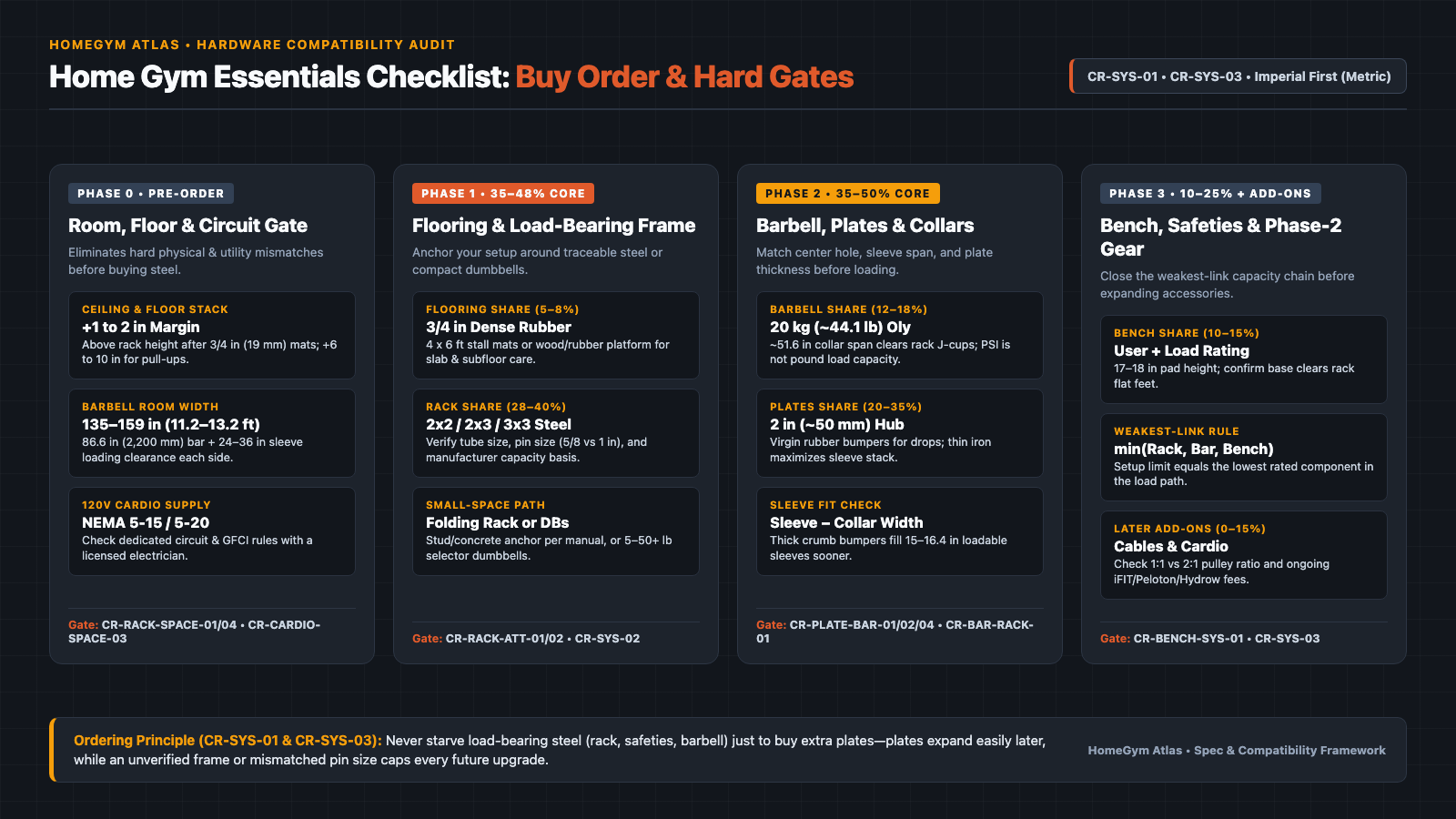
Phases 1–4 Buying Order Matrix: What to Buy First
Once your room clears Phase 0, buy components from the floor upward and from fixed hardware standards outward. Purchasing plates before choosing a barbell risks mismatched center holes; buying attachments before locking in your rack’s upright tube and pin diameter creates immediate fit failures.
| Buying Phase | Essential Category | Target Hardware Standard | Compatible Room & Path | Critical Rule & Buyer Caveat |
|---|---|---|---|---|
| Phase 1 Foundation | Gym Flooring / Platform | ~3/4 in (19 mm) dense rubber stall mats (typically 4 x 6 ft / 121.9 x 182.9 cm) or multi-layer wood/rubber lifting platform. | Garage concrete slabs, basement concrete, or wood-framed floors (confirm building load limits). | CR-ATT-SPACE-01: Avoid soft EVA foam tiles under racks or dropped barbells; air new rubber mats per maker guidance for odor. |
| Phase 2 Primary Frame | Power Rack, Folding Rack, or Squat Stands (or Adjustable Dumbbells) | 2 x 2 in, 2 x 3 in, or 3 x 3 in steel uprights; verify 5/8 in (15.9 mm) vs. 1 in (25.4 mm) pin hardware and Westside (1 in) vs. 2 in hole spacing. | Full 4-post cage for enclosed safeties; wall folding rack for 1-car garages; 5–50+ lb adjustable dumbbells for upper-floor apartments. | CR-SYS-02 / CR-RACK-ATT-01..02: Confirm manufacturer-traceable load rating and basis (frame vs. rackable vs. safety catch). |
| Phase 3 Bar & Collars | Olympic Barbell & Collars | 20 kg (~44.1 lb) men’s bar (~86.6 in long, ~51.6 in inner-collar span, 28–29 mm shaft) or 15 kg (~33.1 lb) women’s bar (~79.1 in, 25 mm shaft) with ~50 mm (2 in) sleeves. | All standard 43–49 in wide racks (check collar span on wide racks); short bars (5–6 ft) often fail J-cup span checks. | CR-BAR-RACK-01 / CR-PLATE-BAR-04: Never convert tensile PSI into pound capacity; budget ~1.5–2 in per sleeve for clamp collars. |
| Phase 4 Load & Support | 2-Inch Weight Plates & Weight Bench | Olympic 2 in (~50.4–51 mm) center holes; virgin rubber bumpers for drops or thinner cast iron for dense sleeve loading; flat or FID bench (~17–18 in pad height). | Pairs with any 2 in Olympic sleeve; confirm bench base clears flat-foot rack crossmembers inside cage. | CR-PLATE-BAR-01..02 / CR-BENCH-SYS-01: Bench rating must cover user body weight plus lifted load; check plate thickness before loading heavy. |
| Phase 5 Optional Add-Ons | Attachments & Cardio | Line-matched J-cups, spotter arms, plate-loaded or stack lat towers (disclose 1:1 vs. 2:1 pulley ratio); non-motorized air rower or dedicated-circuit treadmill. | Wait until core strength habits stabilize; verify 9 x 4 ft rower space or ~78.7 in (2 m) rear treadmill safety zone. | CR-RACK-ATT-03 / CR-CARDIO-SYS-02: Never buy generic “fits Rogue/REP/Titan” hardware blindly; disclose iFIT, Peloton, or Hydrow subscriptions. |
If your starting budget sits firmly in the entry bracket, compare our complete component breakdown in the home gym under $500 starter blueprint to see how squat stands, an entry Olympic bar, starter plates, and a flat bench balance within strict cost boundaries without sacrificing safety traceability.
Budget Allocation (CR-SYS-01) & Weakest-Link Limits (CR-SYS-03)
Knowing what to buy is half the checklist; knowing how much to assign each component stops unbalanced builds. Under IronGym Lab rule CR-SYS-01, strength-core setups perform best when budget shares protect the structural frame and barbell first, because weight plates and attachments are the easiest items to expand over time. Explore our home gym cost tiers guide for full breakdowns across every bracket.
| Budget Tier (Strength Core) | Rack + Safeties | Barbell | Plates & Collars | Bench & Flooring | Attachments / Add-Ons |
|---|---|---|---|---|---|
| TIER-BUDGET / TIER-STARTER $250–$500 / $500–$1,000 | 30–40% | 12–18% | 25–35% | 10–15% bench 5–8% flooring | 0–5% |
| TIER-GARAGE $1,000–$2,000 | 30–38% | 12–18% | 25–30% | 10–15% bench 5–8% flooring | 3–8% |
| TIER-MIDRANGE $2,000–$3,500 | 30–35% | 12–16% | 22–28% | 10–14% bench 5–8% flooring | 6–12% |
| TIER-PREMIUM / TIER-ELITE $3,500–$6,000+ | 25–35% | 10–15% | 18–25% | 8–13% bench 5–8% flooring | 8–20% |
How the Weakest-Link Rule Governs Your Whole Setup (CR-SYS-03)
A power rack rated for 1,000 lb does not give you a 1,000 lb training setup if your J-cups, spotter arms, barbell, or adjustable bench carry lower limits. Compatibility rule CR-SYS-03 (HARD) defines your true working ceiling as the lowest rated component in the load path:
setup_limit_lb = min(rack_rated_lb, safety_or_jcup_lb, bar_rated_lb, bench_rated_lb - user_body_weight_lb)
Three practical audit checks keep that formula honest:
- Always distinguish capacity basis (CR-SYS-02): A rack frame’s “total structural rating” is not identical to its “rackable capacity” or per-pair J-cup rating. Furthermore, if an Amazon listing claims “1,500 lb” or “2,000 lb” with no identifiable manufacturer specification sheet or manual behind it, treat it carefully—we could not trace such listing-only claims to a manufacturer document, so they rank below verified specs.
- Subtract body weight on benches (CR-BENCH-SYS-01): A weight bench carrying a 600 lb combined user-plus-load rating supports a 200 lb lifter pressing up to 400 lb, not 600 lb on the barbell.
- Verify sleeve stack length before buying thick bumpers (CR-PLATE-BAR-02): Under our sleeve sizing equation,
usable_sleeve_in = bar.loadable_sleeve_in - collar_width_in. Standard spring clips eat roughly 0.5 to 1 in, while clamp collars take 1.5 to 2 in per sleeve. Thick recycled-rubber crumb bumpers fill a 15 to 16.4 in sleeve rapidly compared to slimmer virgin-rubber bumpers or machined iron plates—always check published plate thickness before planning 405+ lb deadlifts.
Once your core steel clears these gates, plan your next 12 months systematically using our home gym upgrade roadmap so every future cable attachment, specialty bar, or plate pair locks onto your existing frame cleanly.
Separate Track: Adjustable Dumbbells vs. Cardio Machines
Not every home gym centers on a 4-post power cage. If you train in an upper-floor apartment, share a multi-use spare bedroom, or prioritize aerobic conditioning, separate your non-barbell essentials from the strength-core splits above:
- Adjustable dumbbells + FID bench path: A quality 5–50+ lb selectorized or pin-and-block dumbbell pair plus an adjustable FID bench replaces an entire rack of hex dumbbells in roughly 2 x 2 ft of floor space. Check increment jumps (2.5 lb vs. 5 lb steps, CR-DB-SYS-02), whether the listing sells a single dumbbell or a pair, and follow the manufacturer’s handling guidance strictly—selector-style adjustable dumbbells are generally not designed to be dropped (CR-DB-02).
- Non-motorized vs. motorized cardio essentials: Air rowers such as the Concept2 RowErg require no wall outlet, stand vertically for storage, occupy roughly 96 x 24 in (8 x 2 ft) assembled (108 x 48 in / 9 x 4 ft in use, CR-CARDIO-SPACE-05), and publish dual weight limits (500 lb per Concept2, 300 lb under EN 20957-7). Motorized treadmills require manual-verified rear clearance zones—widely cited at roughly 78.7 in (2 m) behind the deck and 19.7 in (0.5 m) on each side per ASTM F2115 guidance (CR-CARDIO-SPACE-01)—plus step-up headroom at max incline (CR-CARDIO-SPACE-02) and a dedicated 120V circuit.
- Subscription & recall verification (CR-CARDIO-SYS-02 / G-19 / G-24): Connected machines from iFIT (NordicTrack/ProForm), Peloton, and Hydrow tie interactive classes, scenic routes, and automatic resistance or incline control to ongoing paid memberships—always check which manual modes remain active offline if you cancel. Additionally, before purchasing any used or older connected bike, verify serial numbers against official U.S. Consumer Product Safety Commission (CPSC) recall notices (for example, the original Peloton Bike PL01 seat-post recall addressed via a manufacturer replacement seat post per the CPSC notice).
Myth vs. Engineering Reality: 5 Checklist Traps
Buyer Alert — 5 Common Home Gym Essentials Checklist Misconceptions
- Trap 1: “Buy a bundled 1-inch standard barbell set first to save money.”
Engineering Reality: Standard 1 in bars and 1 in plates fail CR-PLATE-BAR-01 the moment you upgrade to a 2 in Olympic barbell, and 1 in bars often carry low unverified ratings. Starting directly with 2 in Olympic sleeves (~50 mm) protects 100% of your plate investment. - Trap 2: “A 190,000 PSI barbell holds more pounds than a bar rated to 1,200 lb.”
Engineering Reality: Tensile strength (PSI) measures steel resistance to breaking under tension—it is not a pound capacity rating (CR-PLATE-BAR-04). Never convert PSI into a load limit; compare published manufacturer ratings and shaft diameter (28–29 mm vs. 30 mm) separately. - Trap 3: “A 20 kg barbell weighs 45 lb exact, and 3/4 in EVA foam tiles replace rubber stall mats.”
Engineering Reality: Under CR-PLATE-SYS-01, a 20 kg bar weighs ~44.1 lb (1 kg = 2.205 lb), not 45 lb. Likewise, interlocking EVA foam tiles compress under heavy rack uprights and are not drop-rated surfaces; dense 3/4 in (19 mm) vulcanized rubber stall mats remain the garage standard (CR-ATT-SPACE-01). - Trap 4: “Any 3 x 3 in rack attachment fits every 3 x 3 in rack.”
Engineering Reality: Tube size and pin diameter are independent (CR-RACK-ATT-01 / 02). A 3 x 3 in frame can use 5/8 in pins (e.g., Titan X-3, or direct-only REP PR-4000 and Rogue Monster Lite—not sold on Amazon) or 1 in hardware (e.g., direct-only REP PR-5000 and Rogue Monster—not sold on Amazon). Always confirm the attachment maker explicitly lists your rack line (CR-RACK-ATT-03). - Trap 5: “All Amazon marketplace bundles list verified capacities and complete weights.”
Engineering Reality: Generic multi-station listings frequently quote untraceable static numbers, hide bar weight inside “160 lb set” totals, or mix single and pair dumbbell prices. Run every listing through our Amazon home gym listing red flags audit before clicking checkout.
Verified Amazon US Starter Core Picks (4 Audited Components)
To illustrate how a compatible Phase 1–4 strength core fits together on Amazon US without hidden standard conflicts, the four verified components below pair a 3 x 3 in rack ecosystem with a 7 ft Olympic barbell, 2 in virgin-rubber bumper plates, and an ASTM-rated FID bench. Direct-to-consumer alternatives often compared in garage builds—including the REP PR-4000, REP PR-5000, REP AB-3000 / AB-5200, Rogue Monster Lite, Rogue Ohio Bar, and Fitness Reality 810XLT—are not sold on Amazon and carry zero affiliate links here.
1. Rack Anchor: Titan Fitness X-3 Series Wall Mounted Folding Power Rack (80 in x 21.5 in)

Verified Specs & Fit Standard: 3 x 3 in (76.2 x 76.2 mm) 11-gauge steel uprights | ~11/16 in holes for 5/8 in (15.9 mm) pins with Westside 1 in bench-zone spacing | Dimensions: 80 in H x 21.5 in D (203.2 x 54.6 cm), folds flat horizontally | Rated Capacity: 1,000 lb (453.6 kg) configuration rating | Price Tier: Under $500 ($350–$500)
This wall-mounted folding frame anchors a garage checklist around true 3 x 3 in 11-gauge steel and 5/8 in Westside hardware without consuming permanent floor depth. Because its side arms swing horizontally inward rather than pivoting upward, total height stays fixed at 80 in (203.2 cm) plus mat thickness—simplifying clearance under open garage-door tracks (CR-RACK-SPACE-01).
- Pros: Heavy 3 x 3 in 11-gauge uprights with 1 in Westside bench-zone spacing; horizontal fold preserves garage parking and low overhead clearance; broad Titan X-3 attachment compatibility.
- Cons: Requires structural wall mounting into wood studs or concrete strictly per Titan’s manual (CR-RACK-SPACE-05), ruling out unapproved rental drywall; safety spotter arms are sold separately, and freestanding 4-post cages (such as the CAP FM-905WH-7 or direct-only lines) suit lifters who cannot drill walls.
2. Barbell Anchor: CAP Pro Series ‘The Beast’ 7 ft Olympic Barbell (44 lb / 20 kg)

Verified Specs & Fit Standard: 7 ft length / 44 lb (20 kg) mass | 30 mm shaft diameter | 2 in (~50 mm) Olympic sleeves with 15 in (38.1 cm) loadable length | Stated Capacity: 1,200 lb (544.3 kg) listing-stated rating | Black phosphate finish, volcano knurling | Price Tier: Mid-Range ($100–$200)
Pairing a full 7 ft, 20 kg (~44.1 lb) bar with 2 in Olympic sleeves guarantees clean J-cup span inside standard racks (CR-BAR-RACK-01) and universal compatibility with Olympic plates (CR-PLATE-BAR-01). Compared against ultra-budget 35 lb chrome bars, stepping up to a 20 kg shaft avoids premature bending concerns on progressive barbell programs.
- Pros: True 7 ft / 20 kg (~44.1 lb) Olympic sizing spans full-width racks cleanly; black phosphate finish offers tactile grip at a starter-friendly price tier.
- Cons: 30 mm shaft is thicker than standard 28 to 28.5 mm multipurpose bars; 15 in loadable sleeves leave less stack room for thick bumper plates than 16.4 in competition-length sleeves (CR-PLATE-BAR-02); confirm the 1,200 lb rating against CAP’s manufacturer documentation (CR-SYS-02).
3. Plate Anchor: Mikolo 2-Inch Virgin Rubber Olympic Bumper Plate Set (140 lb Set)

Verified Specs & Fit Standard: 140 lb (63.5 kg) color-coded starter bumper set | 2 in (~50.4–51 mm) stainless steel center insert | 100% low-odor virgin rubber, low-bounce profile | Price Tier: Full Sets ($250+)
Virgin rubber bumper plates with steel hub inserts give first-time barbell setups uniform 450 mm full-plate pull height from the floor, lower rebound than recycled crumb bumpers, and reduced rubber odor for enclosed basements or bedrooms. Paired with a 44 lb bar, a 140 lb set yields 184 lb loaded total to start.
- Pros: Standard 2 in stainless steel inserts match Olympic sleeves (CR-PLATE-BAR-01); virgin rubber lowers odor and bounce compared with crumb-rubber sets when paired with rubber stall mats (CR-PLATE-ATT-01).
- Cons: Individual plate thickness in inches is not published on the listing, leaving exact max sleeve-fill count unverified until measured (CR-PLATE-BAR-02); 140 lb total requires adding 45 lb pairs and 2.5/5 lb change plates as strength progresses.
4. Bench Anchor: FLYBIRD WB5 Foldable Adjustable Weight Bench (800 lb ASTM-Certified)

Verified Specs & Fit Standard: 800 lb (362.9 kg) ASTM-certified combined capacity | Dimensions: 46 in D x 13 in W x 48.5 in H (116.8 x 33.0 x 123.2 cm), 28.5 lb (12.9 kg) unit weight | 90° to -30° FID adjustments with 30 in extended backrest | Price Tier: Budget (Under $200)
Closing out the 4-part core, the FLYBIRD WB5 covers flat, incline, and decline pressing plus seated dumbbell work while folding flat for tight rooms. Its ASTM-certified 800 lb rating provides clearer verification than uncertified folding benches, though you must still apply CR-BENCH-SYS-01 by subtracting your body weight from the combined limit.
- Pros: Space-saving foldable FID footprint pairs cleanly with wall-mounted racks or adjustable dumbbells; ASTM-certified 800 lb rating and 30 in extended backrest.
- Cons: Lightweight 28.5 lb frame trades off the planted stability of heavier 60+ lb 3-post benches during heavy barbell setups; verify base-foot clearance inside narrow cages (CR-RACK-BENCH-02) and check seat-to-back gap on steep inclines.
Compatibility Rules Appendix & Authoritative Citations
Every buying order recommendation in this checklist satisfies the following IronGym Lab compatibility gates and non-affiliate technical standards:
- CR-SYS-01 (SOFT) & CR-SYS-02 (CONDITIONAL): Budget shares prioritize structural rack steel, barbell, and plates first while flagging marketplace-only capacity figures lacking manufacturer documentation.
- CR-SYS-03 (HARD) & CR-BENCH-SYS-01 (HARD): Setup load limits are bounded by the lowest-rated rack, safety, barbell, or bench (total rating minus user body weight).
- CR-RACK-SPACE-01..05 & CR-ATT-SPACE-01: Ceiling obstructions, 86.6 in bar loading width, 3/4 in rubber mat thickness, and manufacturer-specified anchoring govern room fit before hardware selection.
- CR-PLATE-BAR-01..04 & CR-BAR-RACK-01: Enforce 2 in Olympic center-hole matching, sleeve-length stack checks, collar span over rack J-cups, and separation of tensile PSI from pound ratings.
- CR-CARDIO-SPACE-01..05 & CR-CARDIO-SYS-02: Govern treadmill rear clearance zones, dedicated 120V NEMA 5-15/5-20 circuits with licensed-electrician GFCI review, and ongoing iFIT/Peloton/Hydrow membership disclosures.
Authoritative Non-Affiliate Sources Cited:
- International Code Council — IRC Section R305.1 Ceiling Height — 7 ft (84 in) minimum habitable ceiling standard and basement beam/duct projection tolerances.
- Titan Fitness Official Power Rack Comparison Documentation — Upright tube dimensions, pin hardware, Westside hole spacing, and capacity bases across T-2, T-3, and X-3 lines.
- International Weightlifting Federation (IWF) Technical Equipment Rules — 20 kg / 15 kg Olympic barbell dimensions, 2,200 mm length, 1,310 mm inner-collar spacing, and 450 mm full plate diameter standards.
- Concept2 Official RowErg Specifications — 8 x 2 ft assembled dimensions, 9 x 4 ft in-use clearance, and dual 500 lb / EN 20957-7 300 lb user ratings.
- U.S. Consumer Product Safety Commission (CPSC) Recall Database — Official fitness equipment safety notices and manufacturer remedy verification.
How We Audited This Guide
- Room setups, upgrade roadmaps, and Amazon listing red-flag audits enforce system-wide CR-* clearances, manufacturer-first anchoring instructions, and strict off-Amazon brand disclosures.
- Every power rack, barbell, weight plate, bench, adjustable dumbbell, cardio machine, and flooring spec was cross-checked against official manufacturer manuals, CPSC notices, and live Amazon US listings.
- Recommendations were evaluated against our weighted vertical scoring rubrics and documented CR-* compatibility rules; we never invent load capacities, motor ratings, rubber thickness, or decibels.
Frequently Asked Questions: Home Gym Essentials Checklist
What is the single first thing I should buy on a home gym essentials checklist?
Start with dense 3/4 in (19 mm) rubber stall mats or a lifting platform after measuring your room’s lowest ceiling obstruction and bar width. Flooring establishes your exact installed height under CR-ATT-SPACE-01 and protects both concrete slabs and wood subfloors before heavy steel arrives.
Should I buy a power rack or adjustable dumbbells first in an apartment?
In upper-floor apartments with noise-sensitive neighbors or lease restrictions against wall anchoring, start with a 5–50+ lb adjustable dumbbell pair, a foldable FID bench, and dense mats. Follow manufacturer handling guidance strictly—selector-style adjustable dumbbells are not designed to be dropped.
How much room width do I need for an Olympic barbell home gym?
A standard 20 kg (~44.1 lb) men’s Olympic barbell measures roughly 86.6 in (2,200 mm / ~7.2 ft) long. Under CR-RACK-SPACE-04, budget 24 to 36 in (61.0 to 91.4 cm) beyond each sleeve tip for plate loading, putting comfortable clear room width between 135 and 159 in (11.2 to 13.2 ft).
Does a higher barbell tensile strength PSI mean higher pound capacity?
No. Under rule CR-PLATE-BAR-04, tensile strength (PSI) measures the steel shaft’s resistance to breaking under tension, not a safe static or drop load limit. Always keep loaded weight within the manufacturer’s published pound capacity when one is provided.
Can I plug a motorized treadmill into any garage GFCI outlet?
Not without verifying first. Many treadmill manuals call for a dedicated grounded 120V circuit (NEMA 5-15 or 5-20) and advise against GFCI outlets, whereas local electrical codes often require GFCI protection in garages. Have a licensed electrician inspect your circuit before buying.


