
Disclosure: As an Amazon Associate, IronGym Lab earns from qualifying purchases. If you buy through verified Amazon US links on this page, we may earn a small commission at no extra cost to you.
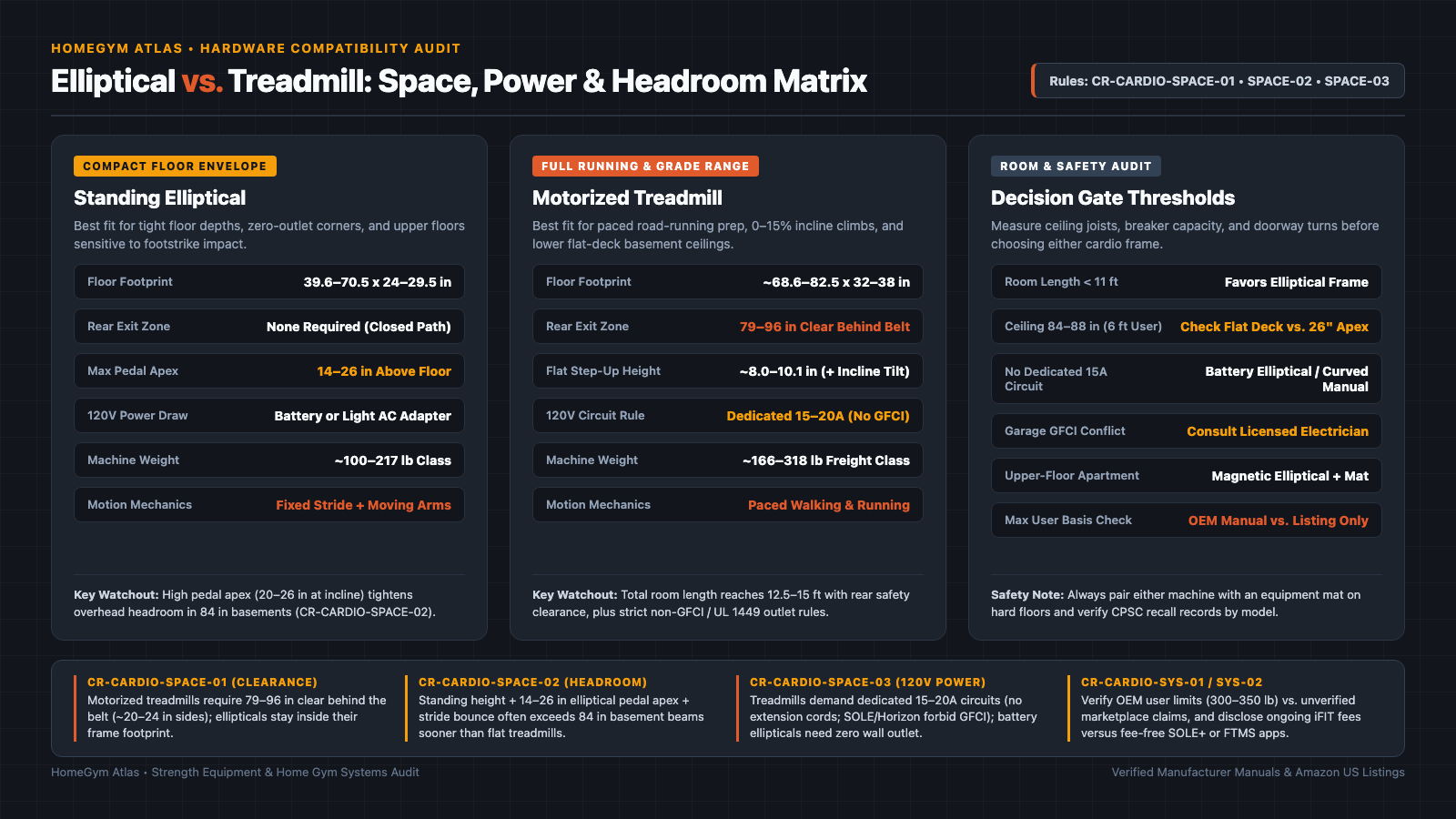
Choosing between an elliptical vs treadmill for a home gym rarely comes down to workout preference alone—it comes down to which machine physically clears your room length, ceiling obstructions, floor joists, and 120 V wall outlets. An elliptical packs standing stride mechanics into a 40 to 71 in (101.6 to 180.3 cm) footprint with zero rear exit zone and minimal or zero electrical draw, yet elevates your feet 14 to 26 in (35.6 to 66.0 cm) above the floor. A motorized treadmill keeps your flat step-up lower at roughly 8.0 to 10.1 in (20.3 to 25.7 cm), but requires 12.5 to 15 ft (150 to 180 in) of total room depth and a dedicated 120 V circuit.
Inside our best cardio machine for home hub, neither category wins every room. Before browsing individual models in our best elliptical for home and best treadmill for home audits, compare both machine classes side by side against IronGym Lab spatial, electrical, capacity, and subscription rules.
In This Comparison
- Quick Verdict Matrix: Elliptical vs. Treadmill by Home Setup
- Side-by-Side Verified Spec & Compatibility Table
- 1. Floor Footprint, Rear Clearance & Folding Reality (CR-CARDIO-SPACE-01)
- 2. Ceiling Headroom: Why Elliptical Pedal Apex Surprises Basements (CR-CARDIO-SPACE-02)
- 3. 120V Dedicated Circuits, GFCI Rules & Upper-Floor Placement (CR-CARDIO-SPACE-03/04)
- 4. Stride vs. Belt Mechanics, Capacity Basis, Subscriptions & CPSC Recalls
- Side-by-Side Decision Cards: Choose an Elliptical vs. Choose a Treadmill
- Verified Amazon US Elliptical & Treadmill Contenders
- Compatibility Rules Audited & Authoritative Sources
- Frequently Asked Questions: Elliptical vs. Treadmill
Quick Verdict Matrix: Elliptical vs. Treadmill by Home Setup
Every home space imposes a different limiting factor—shallow room depth, low basement beams, shared apartment floors, or non-dedicated electrical circuits. Match your room and training requirements against the scenario matrix below.
| Home Space or Training Scenario | Best Fit | Engineering & Compatibility Reason |
|---|---|---|
| Shallow spare bedroom (< 11 ft / 132 in room length) | Standing Elliptical | Closed pedal path needs zero 79–96 in rear run-off safety zone, keeping total working length near 40–71 in (CR-CARDIO-SPACE-01). |
| Room lacking a dedicated 15 A / 20 A 120 V outlet | Battery Elliptical (or Curved Manual Treadmill) | Battery-console magnetic ellipticals run with zero wall cord, avoiding NEMA 5-15/5-20 circuit and GFCI rules (CR-CARDIO-SPACE-03). |
| Low 84 in (7 ft) basement with a 6 ft+ (72 in+) user | Low-Deck Treadmill (or Seated Trainer) | An ~8.0 in flat treadmill step-up leaves more vertical ceiling margin than a 20–26 in inclined elliptical pedal apex (CR-CARDIO-SPACE-02). |
| Upper-floor apartment with noise-sensitive neighbors | Magnetic Belt Elliptical + Equipment Mat | Continuous pedal contact removes running footstrike impact and heavy motor hum, while cutting chassis weight roughly in half (CR-CARDIO-SPACE-04). |
| Outdoor road-race pacing, sprints & -3% to +15% grades | Motorized Treadmill | Variable 0.5–12 mph belt pacing, unrestricted stride length, and up to 15% power incline (or -3% decline) replicate road running gait. |
| Full-stride upper/lower body work without monthly fees | Subscription-Free Elliptical or Treadmill | Models like the SOLE E25, Schwinn 411, SOLE F63, and Horizon 7.0 AT operate offline without ongoing iFIT or Peloton memberships (CR-CARDIO-SYS-02). |
Side-by-Side Verified Spec & Compatibility Table
The ranges below reflect verified manufacturer specifications across representative residential machines audited on IronGym Lab (including SOLE E25, Schwinn 411 and 470, Niceday CT11S-18, SOLE F63 and F80, Horizon 7.0 AT, and NordicTrack Commercial 1750). Always confirm exact dimensions and circuit ratings in the specific model’s owner manual before purchase.
| Specification & Rule | Standing Elliptical (Residential Class) | Motorized Folding Treadmill (Residential Class) |
|---|---|---|
| Assembled Footprint (L × W) | ~39.6–70.5 in × 24–29.5 in (100.6–179.1 × 61.0–74.9 cm) | ~68.6–82.5 in × 32–38 in (174.2–209.6 × 81.3–96.5 cm) |
| Mandatory Rear Safety Zone (CR-CARDIO-SPACE-01) | None required by rear exit standards (leave modest entry clearance) | ~78.7 in (2.0 m) ASTM F2115 ref; 79 in (Horizon) to 96 in / 8 ft (NordicTrack) |
| Total Room Length Required | ~5.5 to 7.5 ft (66 to 90 in) including entry space | ~12.5 to 15 ft (150 to 180 in) including rear safety clearance |
| Step-Up / Max Pedal Height (CR-CARDIO-SPACE-02) | ~14–21 in base; up to 17 in (fixed) or 20–26 in (max power incline) | ~5.0–8.6 in flat (compact/standard) to ~10.1 in (decline frames); rises at incline |
| Folded Stowage Behavior | Most full-stride front-drive frames do not fold (compact models occasionally fold) | Hydraulic upright folding cuts parked length by ~25–35 in (needs full length in use) |
| 120V Circuit & Plug Rules (CR-CARDIO-SPACE-03) | Battery console (0 A) or light 120V AC (e.g., 2 A on Schwinn 470; 15 A line on incline frames) | Dedicated 120V 15–20 A NEMA 5-15/5-20; zero extension cords; manuals warn vs. GFCI |
| Machine Weight & Delivery (CR-SYS-04) | ~100–217 lb (45.4–98.4 kg); heavy incline models reach ~289 lb boxed | ~166–318 lb (75.3–144.2 kg); two-person doorway and stair rigging needed |
| OEM User Capacity (CR-CARDIO-SYS-01 / SYS-02) | 300–375 lb (136.1–170.1 kg) OEM verified; beware unverified 400–550 lb listings | 250–350 lb (113.4–158.8 kg) typical OEM verified (up to 400 lb on select frames) |
| Stride / Surface Mechanics | Fixed 15.5–20 in (39.4–50.8 cm) oval path (up to 32 in FreeStride) + arm handles | Open running gait on 16–22 × 47–60 in (40.6–55.9 × 119.4–152.4 cm) belt; 0.5–12 mph |
| Incline / Resistance Range | 16–26 magnetic resistance levels; 0–20% or -5% to +15% ramp on select frames | 0% to +10% or +15% power incline (-3% decline on Commercial 1750); speed-driven |
| Subscriptions & Open Apps (CR-CARDIO-SYS-02/03) | Fee-free on SOLE+/SunnyFit; optional Explore the World; ongoing iFIT on NordicTrack | Fee-free on SOLE+/FTMS Horizon; ongoing iFIT (NordicTrack/ProForm) & Peloton fees |
| Budget Tier Spread (G-08) | Budget (Under $500) to Mid-Range ($1,000–$2,500) and Premium ($2,500+) | Budget (Under $500) to Entry-Mid ($500–$1,200) and Mid-Range ($1,000–$2,500+) |
1. Floor Footprint, Rear Clearance & Folding Reality (CR-CARDIO-SPACE-01)
The biggest spatial mistake shoppers make when comparing elliptical vs treadmill dimensions is reading only the assembled machine length. A full-stride 20-inch elliptical like the SOLE E25 measures approximately 70.5 × 24 in (179.1 × 61.0 cm), while a 20 × 60 in folding treadmill like the SOLE F63 or Horizon 7.0 AT measures roughly 75 to 77 × 34 to 35 in (190.5 to 195.6 × 86.4 to 88.9 cm). On a tape measure, those two boxes look only 6 inches apart in length—but their active room footprint differs by more than 6 feet.
Under IronGym Lab rule CR-CARDIO-SPACE-01 (HARD), motorized treadmills require an unobstructed safety buffer behind and beside the belt so a runner who stumbles or loses pace can exit cleanly without being trapped against drywall, a squat rack, or storage shelving. As we detail in our treadmill space requirements guide, residential safety standards (ASTM F2115 / EN 957-6) widely reference roughly 78.7 in (2.0 m / ~6.6 ft) behind the deck and 19.7 in (0.5 m) on each side, and individual manuals go even further:
- Horizon 7.0 AT Manual: Specifies 79 in (2.0 m) of clear floor behind the belt plus 12 in (30.5 cm) in front for power-cord clearance—pushing total minimum operating length past 13.5 ft (162 in).
- NordicTrack Commercial 1750 Manual: Requires a full 8 ft (96 in / 2.4 m) behind the running surface and 2 ft (24 in / 0.6 m) per side, pushing a ~77 to 80 in frame to nearly 15 ft (180 in) of total length.
- Elliptical Closed-Path Advantage: Because your feet remain locked onto the pedals inside the frame, an elliptical needs no high-speed rear run-off zone. Compact 18-inch models like the Schwinn 411 (53.8 × 24 in) and Niceday CT11S-18 (39.6 × 24.4 in) operate comfortably inside a 6 to 7 ft corner as long as moving upper handles clear adjacent walls and furniture.
Folding vs. Stationary Trade-Off: Most full-stride front-drive ellipticals (including the SOLE E25 and Schwinn 470) are rigid, non-folding rails—what they occupy during use is what they occupy all week. By contrast, hydraulic folding treadmills lift vertically when stowed (shrinking the SOLE F63 from ~75 in long to ~50 in long by 67 in tall), freeing floor space between workouts in a guest bedroom or single-car garage, even though they still demand the full 13 to 15 ft clear runway whenever the deck drops down.
Delivery & Doorway Path (CR-SYS-04): Measure doorways, basement stair turns, and 90-degree hallways before checkout. Compact ellipticals weigh roughly 100 to 106 lb (45.4 to 48.1 kg) and break down into manageable subassemblies, whereas full-size motorized treadmills weigh 203 to 318+ lb (92.1 to 144.2+ kg) inside 78 to 85 in long freight crates that typically ship threshold-only and require two adults to move.
2. Ceiling Headroom: Why Elliptical Pedal Apex Surprises Basements (CR-CARDIO-SPACE-02)
Shoppers frequently assume an elliptical fits low basements easier than a treadmill because its floor footprint is shorter. Vertically, the opposite often happens. Under rule CR-CARDIO-SPACE-02 (HARD / SOFT), you must check user.height_in + cardio.max_step_up_in + stride_bounce_margin <= space.min_obstruction_in—measuring to your lowest exposed floor joist, HVAC trunk line, ceiling fan blade, or open garage-door track.
On a standing elliptical, your foot rides up to the maximum pedal apex on every rotation:
- Front-Drive Power-Incline Ellipticals: The SOLE E25 starts at a 14 in (35.6 cm) base step-up height and climbs significantly when its 0–20 power incline engages, while the Schwinn 470 manual explicitly documents a 21 in (53.3 cm) minimum pedal height rising to a 26 in (66.0 cm) max pedal height at 10-degree incline. A 6 ft 0 in (72 in) user at a 26 in pedal apex hits 98 in (8 ft 2 in) before adding head clearance—exceeding a standard 8 ft (96 in) drywall ceiling!
- Compact Fixed-Incline Ellipticals: Fixed-ramp frames stay lower. The Schwinn 411 tops out at a fixed 17 in (43.2 cm) max pedal height, allowing a 6 ft 0 in user to clear an 8 ft (96 in) room with roughly 7 in to spare—though an 84 in (7 ft) basement still limits anyone over roughly 5 ft 5 in (65 in).
- Motorized Treadmill Flat vs. Incline Step-Up: Standard home treadmills sit much closer to the floor at 0% grade—roughly 8.0 in (20.3 cm) on the SOLE F63 and F80, 8.625 in (21.9 cm) on the Horizon 7.0 AT, and ~10.1 in (25.7 cm) on the NordicTrack Commercial 1750 (down to 5.02 in on compact frames like the XTERRA TRX1000). At 0% to moderate grades, a 6 ft 0 in (72 in) runner adding 8 in of deck plus 3 in of running bounce stands at 83 in—barely clearing an unobstructed 84 in (7 ft IRC R305.1) ceiling, though max 12–15% incline still pushes the front half upward by several inches.
If your basement beams drop to 76 to 82 in, neither a tall standing elliptical nor an inclined running treadmill may pass CR-CARDIO-SPACE-02 safely for taller adults. In those low-beam rooms, a seated recumbent cross trainer (such as a 52-inch-tall step-through frame) or an air rower removes standing headroom constraints altogether.
3. 120V Dedicated Circuits, GFCI Rules & Upper-Floor Placement (CR-CARDIO-SPACE-03/04)
Electrical infrastructure separates these two machines cleanly in unfinished garages, older spare bedrooms, and rental apartments. Under rule CR-CARDIO-SPACE-03 (HARD / CONDITIONAL), power requirements diverge into three distinct tiers:
- Battery-Console Magnetic Ellipticals (Zero Wall Outlet): Units without motorized incline—such as the Niceday CT11S-18 and Sunny Health & Fitness Smart Upright—generate resistance purely via permanent magnets and run their LCD monitors on AA/AAA batteries. You can place them in the middle of a room, in a shed, or on a shared 15 A bedroom circuit with zero electrical upgrades, zero extension cords, and zero GFCI conflicts.
- Plug-In Incline Ellipticals (Low Current Draw): Power-incline ellipticals like the SOLE E25 and Schwinn 470 require a standard grounded 120 V outlet to drive the console and elevation motor (for example, Schwinn lists 110–120 V 60 Hz at 2 A for the 470, while the Schwinn 411 uses a 9 V DC wall adapter). Because you supply propulsion rather than a belt drive motor, they do not pull heavy startup motor inrush current like a treadmill.
- Motorized Treadmills (Dedicated 120 V 15–20 A + GFCI Caveat): Nearly every full-size running treadmill—including the SOLE F63, Horizon 7.0 AT, and NordicTrack Commercial 1750—requires a dedicated grounded 120 V circuit (15 A or 15–20 A depending on manual, fitted with a standard NEMA 5-15P plug; commercial 20 A NEMA 5-20P plugs will not fit 5-15R receptacles) and strictly prohibits extension cords or household power strips. Crucially, both SOLE Fitness and Horizon Fitness manuals explicitly advise against plugging into GFCI outlets due to startup inrush nuisance tripping, while NordicTrack’s manual mandates a single-outlet UL 1449 surge suppressor (≤400 V clamping, ≥450 joules) and warns against AFCI/GFCI tripping. Because US residential building codes commonly require GFCI protection in garages and basements, never use unapproved plug adapters and never bypass a GFCI breaker yourself—consult the manufacturer and have a licensed electrician verify your branch circuit.
Upper-Floor Acoustics & Flooring (CR-CARDIO-SPACE-04 & CR-CARDIO-ATT-01): On second-story apartments or wood-framed bedrooms above living spaces, running on a 200 to 318 lb motorized treadmill introduces repetitive footstrike thudding alongside motor noise. A belt-driven magnetic elliptical keeps your feet in continuous contact with the pedals, removing airborne landing impact and trimming chassis weight down to 100 to 217 lb. Regardless of machine type, follow manufacturer placement instructions, check building or lease rules for heavy equipment on upper floors (consult the building owner or a qualified professional for structural floor-load questions), and set either frame on a dense equipment mat (CR-CARDIO-ATT-01) to keep carpet lint and concrete dust away from moving rails or motor vents.
4. Stride vs. Belt Mechanics, Capacity Basis, Subscriptions & CPSC Recalls
Beyond room geometry, four mechanical and ownership rules decide long-term satisfaction:
Closed-Chain Stride vs. Open-Gait Running: Ellipticals lock your footpath to a fixed mechanical oval—15.5 to 16 in on compact budget frames, 18 in on mid-size units like the Schwinn 411 and Niceday CT11S-18, and 20 in (50.8 cm) on full-stride front-drive trainers like the SOLE E25 (with variable-stride trainers like the NordicTrack X16 reaching 32 in)—while linking moving upper-body handlebars to the flywheel. Treadmills keep your stride unrestricted on a powered belt up to 12 mph (19.3 km/h) with precise pace control and motorized grades (0–15% incline, or -3% downhill decline on decline trainers), though you should match belt length to user height (at least 20 × 60 in for regular running).
User Weight Ratings & Motor Basis (CR-CARDIO-SYS-01 & CR-SYS-02): Always verify whether a capacity claim comes from an identifiable OEM manual or only from marketplace marketing graphics. Manufacturer-documented limits like the SOLE E25 (350 lb), Schwinn 411/470 (300 lb), SOLE F63 (325 lb), and Horizon 7.0 AT (325 lb) carry traceable engineering documentation. By contrast, budget marketplace ellipticals and walking pads frequently advertise 400 to 550 lb limits on sub-110 lb frames—under rule CR-SYS-02, when we could not trace a rating to a manufacturer document, treat it as unverified and stay conservatively within it. Likewise, never compare treadmill motor labels (such as 3.0 HP vs. 3.0 CHP vs. 4.25 CHP) across brands as if evaluated under one identical standard; always read motor ratings alongside the manufacturer’s stated basis and written motor warranty.
Subscriptions & Brand Ownership Disclosures (G-19 & CR-CARDIO-SYS-02/03): Both categories span fee-free hardware and subscription-gated ecosystems. Machines built around iFIT (NordicTrack Commercial 1750, AirGlide 16, X16, and ProForm Carbon models), Peloton All-Access (Peloton Tread/Bike), or Hydrow (Hydrow rowers) require an ongoing paid membership for coached classes, scenic terrain, and automated SmartAdjust speed/incline control—though NordicTrack consoles keep basic Manual Mode available offline. Meanwhile, SOLE (`SOLE+` app), Sunny Health & Fitness (`SunnyFit` app), and Horizon (`7.0 AT` with open Bluetooth FTMS for Zwift, Strava, and Peloton Digital on your own tablet) operate without mandatory monthly fees. Note also that Schwinn Fitness and BowFlex changed ownership during the 2024 BowFlex sale, so buyers considering Schwinn ellipticals should confirm current US warranty terms at purchase.
Safety Keys & Official CPSC Recall Records (G-24): Every motorized treadmill relies on a magnetic tether safety key and rear clearance hygiene; ellipticals eliminate powered belt pull hazards, though moving linkages require keeping children and pets clear during rotation. In CPSC recall history, the U.S. Consumer Product Safety Commission and Peloton issued May 5, 2021 recalls for the Peloton Tread+ (Model TR01) over risks of adults, children, pets, or objects being pulled under the rear of the treadmill (later addressed with a rear guard remedy) and the Peloton Tread (Model TR02) over a touchscreen that could detach, followed by a May 2023 recall of the original Peloton Bike (Model PL01) seat post that could break during use (remedied with a free replacement seat post). Owners of any cardio machine should check their exact model number at cpsc.gov/Recalls and follow manufacturer inspection schedules.
Side-by-Side Decision Cards: Choose an Elliptical vs. Choose a Treadmill
Choose an Elliptical if…
- Your room is shorter than 11 to 12 ft and cannot accommodate a 79 to 96 in rear treadmill exit zone (CR-CARDIO-SPACE-01).
- You need zero wall outlet or live with shared 15 A / GFCI-protected circuits where motorized treadmills conflict (CR-CARDIO-SPACE-03).
- You are placing cardio gear on an upper floor and want continuous pedal contact without footstrike thudding (CR-CARDIO-SPACE-04).
- Your ceiling clears your standing height plus a 14 to 26 in max pedal apex and you want upper-body moving handles.
Choose a Treadmill if…
- You train for paced walking or road running up to 12 mph with unrestricted stride length and exact speed/incline targets.
- You have an 84 to 90 in basement where an ~8.0 in flat deck step-up clears beams more easily than a 26 in elliptical apex (CR-CARDIO-SPACE-02).
- You want hydraulic upright folding to reclaim floor space between runs and have 12.5 to 15 ft total length when deployed.
- You have access to a dedicated 120 V 15–20 A circuit aligned with manufacturer GFCI and surge rules (CR-CARDIO-SPACE-03).
Verified Amazon US Elliptical & Treadmill Contenders
To translate these compatibility checks into real Amazon US hardware, we paired two verified home ellipticals (one full-stride 120 V incline trainer and one zero-outlet compact model) against two verified subscription-free folding treadmills across matching budget tiers.
1. SOLE E25 Elliptical Machine (20″ Stride, 0-20 Power Incline) — Best Full-Stride Home Elliptical

Verified Specs: 20 in (50.8 cm) front-drive stride | 20 lb (9.1 kg) flywheel | 20 magnetic levels + 0–20 power incline | ~70.5 × 24 × 64–71 in footprint | 14 in (35.6 cm) base step-up (rises with incline) | 350 lb (158.8 kg) max user (per SOLE) | 120 V AC 15 A outlet | Free SOLE+ app (zero subscription) | Tier: Mid-Range ($1,000–$2,500)
Headroom & Listing Alert (CR-CARDIO-SPACE-02 / SYS-02): Check overhead basement beams against your standing height plus the E25’s rising power-incline pedal apex (~20–26 in at full tilt), and buy from the dedicated SOLE E25 listing (B0H5KTZ8KG) rather than multi-model pooled SOLE listings.
Pros
- Full 20 in stride, 20 lb flywheel, and 0–20 power incline fit inside a 24 in wide footprint without needing an 8 ft rear clearance zone
- OEM-backed 350 lb user capacity, lifetime frame and flywheel coverage, and zero ongoing app fees
Cons
- Elevated pedal apex at max power incline limits tall users under 84–90 in ceilings
- Requires a 120 V outlet for motorized incline and weighs ~209–217 lb (94.8–98.4 kg) during delivery
2. Niceday CT11S-18 Compact 18″ Stride Magnetic Elliptical — Best Zero-Outlet Compact Elliptical
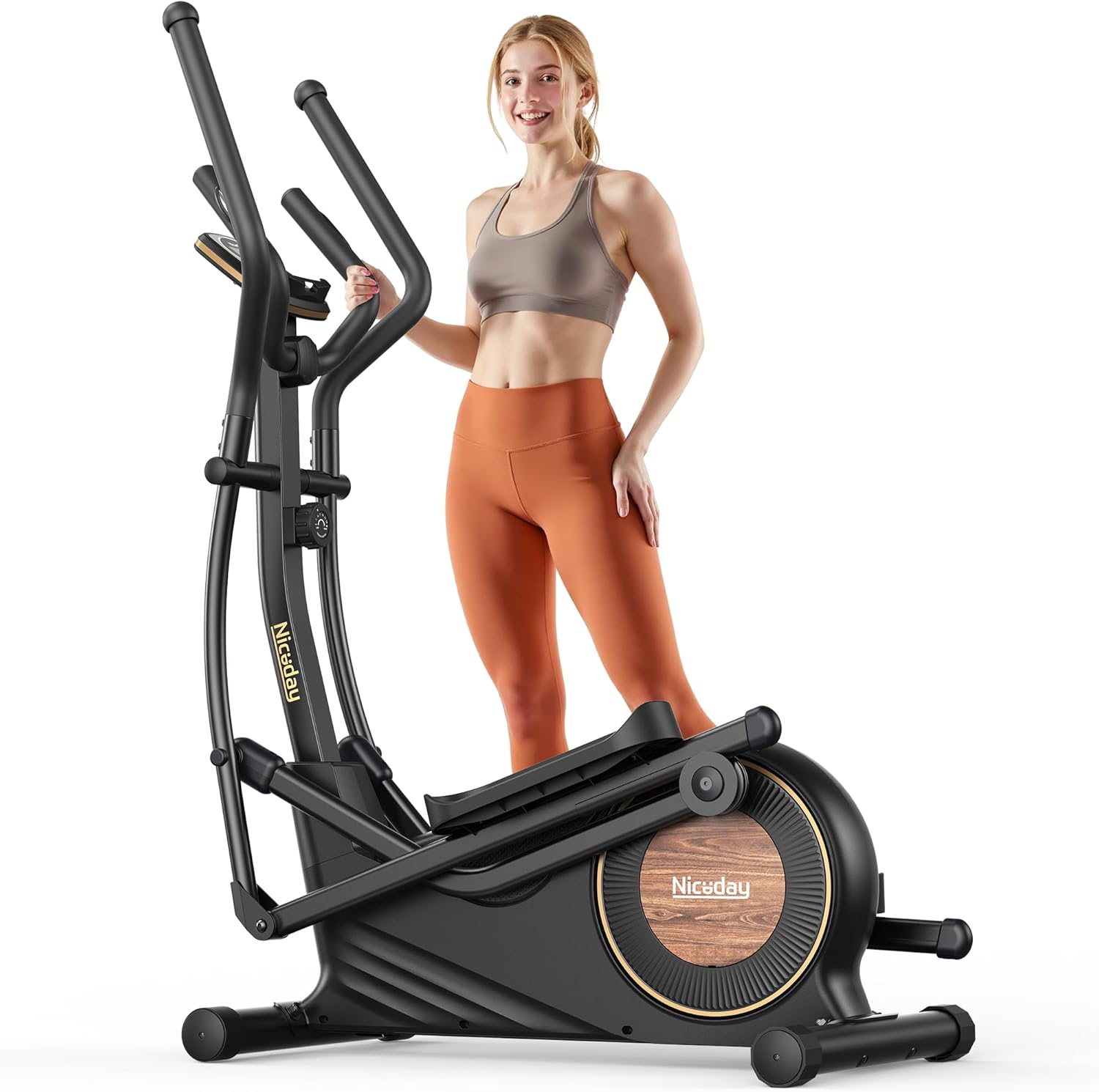
Verified Specs: 18 in (45.7 cm) dual-axis stride | 16 magnetic resistance levels | ~16 lb (7.3 kg) flywheel | 39.6 × 24.4 × ~61.4 in (100.6 × 62.0 × 156.0 cm) footprint | ~100–106 lb unit weight | 400 lb marketplace listing claim (CR-SYS-02 unverified basis) | Battery-powered console (zero 120 V cord) | Tier: Entry-to-Mid ($500–$1,000)
Capacity Traceability Alert (CR-SYS-02): Niceday’s Amazon listing advertises a 400 lb weight rating, but we could not trace this rating to a manufacturer engineering document—treat it as unverified and keep heavier users comfortably below the headline figure.
Pros
- Ultra-compact 39.6 × 24.4 in footprint and battery console eliminate 120 V circuit, GFCI, and rear clearance constraints
- Belt-driven magnetic resistance runs without footstrike thuds on upper apartment floors
Cons
- 400 lb capacity figure is marketplace-only without a verifiable OEM manual basis
- Fixed 18 in stride and zero incline offer less range than 20 in power-incline trainers
3. SOLE F63 Folding Treadmill (3.0 HP Brushless, 15% Incline) — Best Subscription-Free Folding Treadmill

Verified Specs: 3.0 HP brushless motor (per SOLE) | 0.5–12 mph | 0–15% motorized incline | 20 × 60 in (50.8 × 152.4 cm) 18 mm deck | ~8.0 in (20.3 cm) flat step-up | 325 lb (147.4 kg) max user (per SOLE) | Dedicated 120 V 15 A NEMA 5-15 (no GFCI per manual) | Free SOLE+ app | Tier: Mid-Range ($1,000–$2,500)
120V GFCI & Variant Alert (CR-CARDIO-SPACE-03): SOLE’s manual explicitly advises against GFCI outlets; consult SOLE support and a licensed electrician if garage/basement codes require GFCI protection. Confirm single-model F63 selection if viewing multi-model SOLE pools.
Pros
- Lower ~8.0 in flat deck step-up preserves more headroom under low joists than 20–26 in elliptical pedal-apex arcs
- Full 20 × 60 in running belt, 15% incline, lifetime frame/motor warranty, and completely fee-free SOLE+ operation
Cons
- Requires a dedicated 120 V 15 A non-GFCI circuit and prohibits extension cords
- Needs ~79 in (2.0 m) rear clearance and ~224–232 lb two-person doorway planning
4. Horizon Fitness 7.0 AT Folding Treadmill (Rapid Sync, 20″x60″ Deck) — Best Open-Bluetooth Interval Treadmill

Verified Specs: 3.0 CHP Rapid Sync motor (per Horizon) | 0.5–12 mph | 0–15% incline | 20 × 60 in (50.8 × 152.4 cm) 3-Zone deck | 8.625 in (21.9 cm) flat step-up | 325 lb (147.4 kg) max user | Dedicated 120 V 15–20 A circuit (no GFCI) | Open Bluetooth FTMS | Tier: Entry-to-Mid ($500–$1,200)
Pros
- QuickDial handlebar rollers shift speed and incline faster for intervals, while open Bluetooth FTMS streams to Zwift, Peloton app, and Strava
- 325 lb Horizon capacity, 60 in running surface, and 3-year parts warranty with zero required subscriptions
Cons
- 257 lb (116.6 kg) unit weight plus Horizon’s 79 in rear safety zone demands at least 13.5 ft of room depth
- Manual calls for a dedicated 15–20 A circuit and advises against GFCI outlets or extension cords
Compatibility Rules Audited & Authoritative Sources
Every room-sizing threshold, electrical note, and user-capacity check in this elliptical vs treadmill audit maps to IronGym Lab compatibility rules and primary manufacturer or federal documentation:
- CR-CARDIO-SPACE-01 (Clearance Zone): Motorized treadmills require the deck footprint plus 78.7–96 in rear clearance and 19.7–24 in side lanes; ellipticals keep users inside their frame footprint.
- CR-CARDIO-SPACE-02 (Ceiling Headroom): Measure standing height plus maximum pedal-apex height (14–26 in on standing ellipticals) or incline-adjusted deck step-up (~8.0–10.1 in flat on treadmills) plus bounce margin against the lowest joist, duct, or garage-door track.
- CR-CARDIO-SPACE-03 (120V Circuits & GFCI): Battery ellipticals need no wall outlet; motorized treadmills require dedicated 120 V 15–20 A circuits with zero extension cords and frequent non-GFCI/UL 1449 surge rules—have a licensed electrician verify compliance.
- CR-CARDIO-SPACE-04 & CR-CARDIO-ATT-01 (Upper Floors & Mats): Pair either unit with a dedicated equipment mat per manual guidance, and check building/lease rules and qualified structural advice before placing heavy motorized treadmills on upper floors.
- CR-CARDIO-SYS-01/02/03, CR-SYS-02 & CR-SYS-04: Verify OEM user weight limits (distinguishing manufacturer manuals from unverified marketplace claims), disclose iFIT/Peloton/Hydrow subscriptions, and plan doorways for 166–318 lb freight boxes.
Authoritative Manufacturer & Regulatory Citations:
- SOLE Fitness Official — E25 Elliptical & F63/F80 Treadmill Specifications, GFCI Notices, and Warranty Schedules
- Horizon Fitness Official — 7.0 AT Treadmill Manual Clearances, Electrical Rules, and Open Bluetooth FTMS Specs
- Schwinn Fitness Official — 411 & 470 Elliptical Manuals (Pedal Apex Height, Stride, and Power Draw)
- NordicTrack Official — Commercial 1750 Manual Clearances, UL 1449 Surge Mandate, and iFIT Disclosures
- U.S. Consumer Product Safety Commission (CPSC) — Official Fitness Equipment Recall Database
How We Audited This Guide
- Cardio machines were audited for CHP vs peak motor claims, running belt length and rear safety clearance, 120V NEMA 5-15/5-20 electrical limits with GFCI notes, and ongoing app subscriptions.
- Every power rack, barbell, weight plate, bench, adjustable dumbbell, cardio machine, and flooring spec was cross-checked against official manufacturer manuals, CPSC notices, and live Amazon US listings.
- Recommendations were evaluated against our weighted vertical scoring rubrics and documented CR-* compatibility rules; we never invent load capacities, motor ratings, rubber thickness, or decibels.
Continue Your Audit
Frequently Asked Questions: Elliptical vs. Treadmill
Does an elliptical or a treadmill need more floor space in a home gym?
A motorized treadmill needs substantially more total room length—roughly 12.5 to 15 ft versus 5.5 to 7.5 ft for an elliptical. Under rule CR-CARDIO-SPACE-01, treadmills require 79 to 96 in of unobstructed safety clearance behind the belt, whereas ellipticals keep your stride within the machine’s frame footprint.
Which fits better under low basement ceilings: an elliptical or a treadmill?
A flat-grade treadmill often preserves more ceiling headroom than a standing power-incline elliptical. Full-stride ellipticals lift pedals 20 to 26 in off the floor at max incline, whereas home treadmills sit around 8.0 to 10.1 in flat before incline tilt (CR-CARDIO-SPACE-02). Always measure to your lowest joist or duct.
Can I plug a treadmill or elliptical into a GFCI garage outlet or extension cord?
Battery-powered magnetic ellipticals need no wall outlet at all, while most motorized treadmills prohibit extension cords and often warn against GFCI receptacles. Because garage codes commonly mandate GFCI protection, never bypass breakers or use unapproved adapters—consult the manufacturer and a licensed electrician first (CR-CARDIO-SPACE-03).
Which machine is quieter for an upper-floor apartment?
A belt-driven magnetic elliptical avoids repetitive running footstrike impact on wood-framed upper floors. Treadmill running transmits dynamic impact forces and drive-motor vibration downward, even on mats (CR-CARDIO-SPACE-04). Check lease or building rules, use an equipment mat, and place the frame away from shared bedroom walls.
Do I need an ongoing subscription to use an elliptical or treadmill at home?
No—if you choose subscription-free hardware or use offline manual mode. Machines centered on iFIT (NordicTrack/ProForm) or Peloton gate guided classes and automated controls behind ongoing memberships (CR-CARDIO-SYS-02), whereas SOLE, Sunny Health & Fitness, and Horizon FTMS models operate completely fee-free.


