
Direct Answer: A treadmill tripping gfci breaker protection usually stems from normal pulse-width modulation (PWM) motor-drive harmonic leakage and startup inrush currents crossing the tight 4 to 6 milliampere (0.004 to 0.006 A) safety threshold of a Class A GFCI device, rather than a broken belt or motor. Start by unplugging the machine, removing unapproved extension cords or power strips, confirming a dedicated 120 V circuit (15 A or 20 A per your manual), and checking deck lubrication and belt tension. Because treadmill manuals and local electrical codes (NEC Article 210.8) often conflict in garages and basements, have a licensed electrician confirm circuit compliance—never alter home wiring or defeat GFCI protection yourself.
Electrical & Mechanical Safety Boundary (G-15 / CR-CARDIO-SPACE-03): Always unplug the power cord from the wall receptacle before removing the motor hood, checking belt alignment, or applying deck lubricant. Follow the manufacturer’s assembly, placement, and electrical instructions exactly. Never remove a grounding prong, never use a 2-prong adapter, never force a 20 A NEMA 5-20P plug into a 15 A outlet with an adapter, and never circumvent GFCI protection. For breaker upgrades, receptacle swaps, or new branch circuits, have a licensed electrician confirm your panel and local code requirements.
Few home gym interruptions are as frustrating as stepping onto a running deck, pressing start, and watching the entire garage or basement go dark two strides later. When you are dealing with a treadmill tripping a GFCI breaker, the problem sits right at the intersection of high-draw cardio engineering and residential life-safety electrical code. Unlike a lamp or television, a motorized treadmill combines an AC-to-DC rectifier or variable-speed drive board, a heavy-torque drive motor, an incline actuator, and high-speed belt friction—creating electrical transients that sensitive ground-fault and arc-fault interrupters frequently misinterpret as a fault.
This troubleshooting playbook walks through the exact lowest-risk, manufacturer-first checks documented across owner’s manuals from brands such as Sole Fitness, Horizon Fitness, and NordicTrack, alongside our home cardio machine lineup and treadmill dedicated circuit requirements. Before replacing parts or returning a heavy frame, work through each stage in order so you can separate a simple shared-circuit overload or dry belt from a genuine hardware fault or code conflict.
In This Diagnostic Guide
- Why Motorized Treadmills Trigger GFCI and AFCI Breakers
- Fast Symptom, Cause & Safe First-Check Matrix
- Six Manufacturer-First Diagnostic Steps (Lowest Risk First)
- Resolving the Manual vs. NEC 210.8 Garage & Basement Conflict
- Preventive Electrical & Mechanical Maintenance Schedule
- Authoritative Manufacturer & Safety References
- Frequently Asked Questions
Why Motorized Treadmills Trigger GFCI and AFCI Breakers
Understanding why a breaker trips starts with separating three different protective devices found in US residential homes: standard thermal-magnetic breakers, Ground-Fault Circuit-Interrupters (GFCIs), and Arc-Fault Circuit-Interrupters (AFCIs). Each monitors a completely different electrical signature on a nominal 120 V branch circuit, and a motorized treadmill stresses all three in distinct ways.
A standard 15 A or 20 A breaker protects building wiring from overloads and short circuits by tripping when total current exceeds the circuit rating over time or spikes instantaneously. By contrast, a Class A GFCI receptacle or panel breaker monitors the current balance between the hot (ungrounded) conductor and the neutral (grounded) return conductor. Per U.S. Consumer Product Safety Commission (CPSC) electrical safety documentation, if the outbound and returning currents differ by as little as 4 to 6 milliamperes (0.004 to 0.006 A), the GFCI opens the circuit within milliseconds to prevent severe electrical shock.
Inside most residential folding treadmills, incoming 120 V AC household power passes through EMI filter capacitors, a bridge rectifier, and a pulse-width modulated (PWM) motor controller before driving a DC motor. That power-conversion stage naturally produces tiny high-frequency capacitive leakage currents to the equipment ground chassis, alongside brief startup inrush spikes when the walking belt breaks static friction. Even on a mechanically healthy machine, those micro-currents can cross a sensitive GFCI’s 4 to 6 mA threshold—an issue documented across owner’s manuals as nuisance tripping (tracked in our knowledge base as ISS-CARDIO-GFCI-NUISANCE-TRIP and compatibility rule CR-CARDIO-SPACE-03).
AFCI and dual-function AFCI/GFCI breakers add a second layer of sensitivity. They scan the AC waveform for erratic high-frequency signatures that resemble dangerous loose-wire arcing. Brushed DC treadmill motors, worn motor carbon brushes, or rapid PWM switching transients during speed and incline adjustments can occasionally mimic an arc signature on older or non-motor-rated AFCI breakers.
Fast Symptom, Cause & Safe First-Check Matrix
Before changing anything in your training space, note the exact moment the power cuts out. Trip timing tells you whether you are looking at a circuit-sharing overload, a GFCI harmonic-leakage mismatch, high mechanical deck drag, or a suspected internal fault that warrants immediate service.
| Observed Trip Symptom | Likely Underlying Cause / CR Trigger | Immediate Safe First Check | Stop & Escalate Trigger |
|---|---|---|---|
| Trips the instant the cord plugs in or power switch flips ON | Active ground fault, pinched cord jacket, moisture condensation in lower board, or failed EMI filter (ISS-CARDIO-GFCI-NUISANCE-TRIP) | Unplug unit; inspect full cord length and NEMA plug blades; let damp garage/basement unit acclimate if newly delivered | Stop using immediately and contact OEM support if intact cord trips a verified outlet at idle |
| Trips the moment the walking belt starts moving (0.5–2.0 mph) | Motor startup inrush surge plus PWM high-frequency leakage crossing 4–6 mA GFCI threshold (CR-CARDIO-SPACE-03) | Confirm unit is plugged directly into wall without unapproved strips; verify whether outlet or panel breaker has GFCI/AFCI | Have a licensed electrician inspect circuit compliance and evaluate HF-rated protection |
| Trips mid-workout after 10–25 minutes or when raising incline | Shared circuit overload (space heater, freezer, washer) or dry deck/tight belt pushing motor draw past 15 A | Turn off breaker at panel to map every outlet/light that loses power; unplug treadmill and check deck silicone film | If dedicated 20 A non-GFCI circuit still trips mid-run, contact OEM tech for amp-draw service |
| Trips only during humid weather or in an unheated garage | Moisture tracking inside damp outlet box, concrete slab condensation, or lower control board contamination | Verify machine rests on an equipment mat (CR-CARDIO-ATT-01) and dry indoor environment per manual | Have a licensed electrician inspect garage receptacle housing and weather/GFCI integrity |
| Trips when incline motor activates alongside walking belt | Combined drive + elevation motor draw saturating a shared 15 A circuit or causing voltage sag through extension cord | Remove any extension cord; verify 15 A vs 20 A dedicated branch requirement in your model’s manual | Have a licensed electrician confirm branch voltage stability under load |
| Power cord plug has one horizontal blade and will not enter wall outlet | Machine uses a 20 A NEMA 5-20P plug while room has a 15 A NEMA 5-15R receptacle (CR-CARDIO-SPACE-03 HARD fail) | Verify plug stamp and model manual electrical spec; do not force plug or attach adapters | Have a licensed electrician install a dedicated 20 A 120 V circuit and NEMA 5-20R outlet |
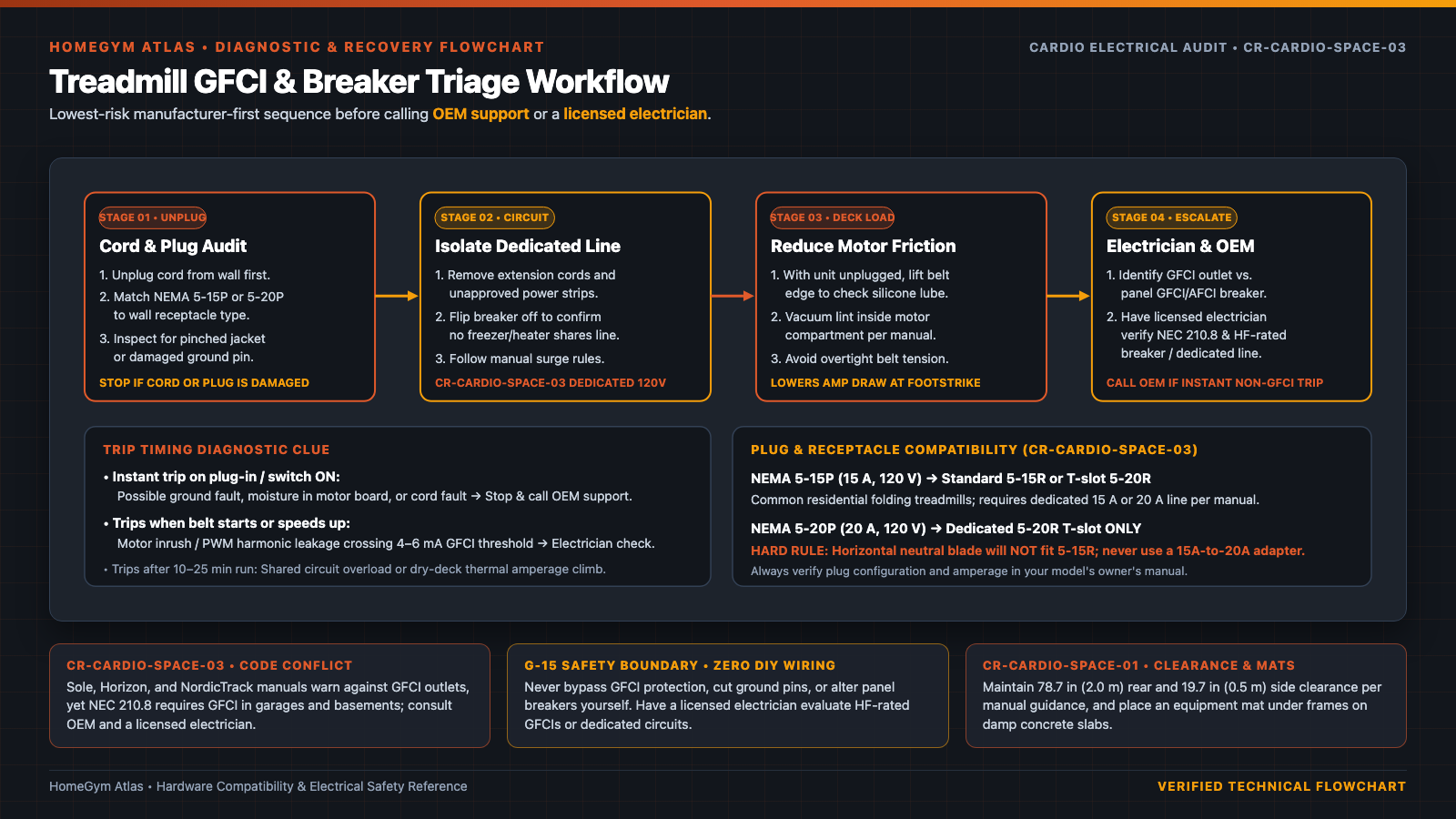
Six Manufacturer-First Diagnostic Steps (Lowest Risk First)
Follow these six steps in sequence. Steps 1 through 4 require zero electrical modifications and zero tools near live wiring, while Steps 5 and 6 establish clear boundaries for when a licensed electrician or OEM service technician must take over.
Step 1: Unplug the Treadmill and Inspect the Cord, Plug Standard, and Reset Switch
Before troubleshooting anything mechanical or resetting a breaker repeatedly, switch the treadmill’s main power rocker to OFF and unplug the cord from the wall receptacle. Visually inspect the entire power cord jacket from the wall plug to the motor frame grommet. On folding treadmills, cords frequently get pinched underneath rear leveling feet, crushed against a baseboard when the deck lowers, or nicked by frame hinge hardware. Any cut outer jacket, exposed copper, heat-discolored prong, or loose ground pin means the cord must be replaced by the manufacturer or an authorized service technician before plugging it back in.
Next, confirm your plug matches the wall receptacle under rule CR-CARDIO-SPACE-03. Most consumer folding treadmills—including models like the Sole F80—use a standard 15 A three-prong grounded plug (NEMA 5-15P with two parallel flat blades and a round ground pin). Heavier commercial-class or high-output incline trainers may ship with a 20 A plug (NEMA 5-20P), which turns the neutral blade sideways in a T-orientation. A NEMA 5-20P plug will not physically enter a standard NEMA 5-15R 15 A outlet—this is a hard electrical mismatch, and you must never file a prong or use an adapter to force it.
Also inspect the treadmill’s own onboard circuit breaker/reset button located near the power cord inlet on the front frame. If that small reset button has popped outward, wait 5 minutes for the internal thermal protector to cool before pressing it back in—and investigate why the machine drew excess current in Steps 2 and 3 rather than repeatedly tripping it.
Step 2: Isolate a Dedicated 120 V Circuit and Follow Brand-Specific Surge Rules
Almost every residential motorized treadmill manual specifies a dedicated grounded 120 V circuit—typically 15 A or 20 A depending on the model. “Dedicated” does not simply mean the second socket on the duplex outlet is empty. A single residential branch breaker often feeds four to eight receptacles across an entire garage wall, basement rec room, hallway lighting, or even an outdoor porch outlet.
You can safely verify whether your treadmill shares a circuit without touching any wiring:
- Unplug the treadmill from the outlet first so it does not experience a sudden surge when power returns.
- Walk to your main electrical panel and switch OFF the breaker serving that treadmill outlet.
- Check every garage chest freezer, refrigerator, dehumidifier, sump pump, overhead garage door opener, ceiling light, TV, and adjacent room outlet. If any device loses power, that circuit is shared.
- Unplug or turn off every other load on that breaker—or coordinate with a licensed electrician to install a true dedicated 120 V line—before flipping the breaker back on.
At the same time, remove any household extension cords or multi-outlet power strips. Voltage sag across an undersized or long extension cord forces the treadmill’s motor controller to pull higher current to maintain belt speed, heating components and triggering breakers. Follow your exact model’s owner’s manual on surge protection, because brands diverge sharply here:
- Horizon Fitness: Horizon Fitness Support specifies plugging directly into a properly grounded 3-prong wall receptacle on a dedicated 15 A or 20 A circuit and warns against extension cords, power strips, and surge protectors.
- Sole Fitness: Sole Fitness manuals require a dedicated 120 V, 15 A grounded circuit with no other appliances sharing the line and advise avoiding extension cords (only permitting a heavy-duty 14 AWG or better single-outlet cord temporarily if unavoidable).
- NordicTrack: Many NordicTrack manuals explicitly instruct owners to plug the treadmill into a single-outlet surge suppressor meeting their published clamping/rating spec, and then into a dedicated 120 V circuit of 15 A or more—never plugging additional appliances into that suppressor. Note also that connected NordicTrack models rely on an ongoing
iFITmembership for interactive coaching classes, though basic manual belt operation does not require streaming.
Step 3: Audit Walking Belt Friction, Tension, and Motor Hood Dust
Electrical troubleshooting often overlooks mechanical resistance, yet belt friction is one of the fastest ways to push a borderline 15 A circuit over the edge. When the silicone film between the underside of the walking belt and the phenolic deck wears dry, or when an owner overtightens the rear roller bolts to stop slipping, the drive motor works dramatically harder during every footstrike. Higher mechanical torque translates directly into higher continuous amperage draw, motor heat, and current spikes.
With the treadmill completely unplugged, perform these three mechanical checks per your owner’s manual:
- Check deck lubrication: Slide a clean hand carefully underneath the center of the walking belt (where your feet land). If the deck surface feels chalky, rough, or bone-dry—or if you notice black rubber dust—apply 100% pure silicone treadmill lubricant strictly following your manual’s quantity and interval instructions (never use petroleum sprays, WD-40, or silicone blends with solvents, and note that select commercial decks are pre-waxed and prohibit extra silicone).
- Check belt tension: Lift the edges of the centered walking belt midway along the deck. Most manuals specify about 2 to 3 in (51 to 76 mm) of lift from the deck surface. If the belt feels drum-tight and barely lifts 1 in (25 mm), excessive tension is straining the rollers, bearings, and drive motor. Follow our step-by-step guide on fixing a slipping treadmill belt to dial tension back into manufacturer tolerance.
- Clear motor compartment lint: If your manual authorizes removing the plastic motor shroud with the unit unplugged, gently vacuum pet hair, carpet fibers, and rubber dust around the motor vents, flywheel, and lower control board heatsink. Heavy dust blankets trap heat and degrade insulation paths over time.
Step 4: Identify Whether the Wall Outlet GFCI or Main Panel Breaker Tripped
Many owners assume a circuit lacks GFCI protection simply because the wall receptacle behind the treadmill looks like a plain duplex outlet without buttons. In modern homes, however, ground-fault protection is frequently installed in one of two hidden ways: either at an upstream GFCI receptacle earlier on the same daisy-chained circuit (such as near a garage workbench or basement utility sink), or directly inside the main electrical panel as a GFCI or dual-function AFCI/GFCI breaker.
Look closely at what actually tripped when your treadmill shut down:
- Wall Receptacle Button Popped: If you have to press the small “Reset” button on the wall outlet itself (or on another outlet in the room/garage) to restore power, the trip is a 4 to 6 mA ground-fault interruption at the GFCI receptacle.
- Main Panel Breaker Handle Tripped to Center/OFF: Check the breaker label and colored indicator window in your panel. Standard breakers have no reset button on the breaker body, whereas GFCI, AFCI, and dual-function breakers include an integrated push-button and often flash an LED trip code or show a colored flag indicating ground fault vs. arc fault vs. thermal overload.
Knowing the exact device that tripped gives your electrician immediate diagnostic clarity. For instance, Sole Fitness notes in its recent owner documentation that when modern codes require GFCI or AFCI breakers, nuisance trips stem from motor inrush and drive electronics across all treadmill brands—and that Sole’s own evaluations on dedicated circuits found better compatibility with specific breaker lines such as Eaton (Cutler-Hammer series), Leviton (Smartlock Pro), and Schneider Electric (Canadian series), provided zero other devices share the circuit. Never purchase or swap a panel breaker yourself; share that manual note directly with your licensed electrician.
Step 5: Resolve the Manual vs. Local Electrical Code Conflict With a Licensed Electrician
This step addresses the single biggest source of confusion in home gym electrical setups: the direct conflict between treadmill manuals and the National Electrical Code (NEC). If you read the Sole F80 manual, Horizon Fitness support pages, or NordicTrack safety sections, you will see explicit warnings stating not to plug the treadmill into a GFCI-protected outlet or circuit because large drive motors frequently cause nuisance tripping.
At the same time, under NFPA 70 (National Electrical Code) Article 210.8, residential garages and both finished and unfinished basements require GFCI protection on 125 V receptacles because concrete floors and damp environments create elevated shock risks. Recent NEC cycles have also removed older single-appliance exemptions for dedicated garage or basement receptacles. Under IronGym Lab rule CR-CARDIO-SPACE-03, we never resolve a manual-versus-code conflict in prose or suggest breaking electrical code.
Instead, follow a two-party resolution path:
- Contact the treadmill manufacturer’s technical support with your exact model and serial number to confirm whether your unit has an updated EMI/noise filter kit or specific breaker compatibility list approved for code-mandated GFCI spaces.
- Have a licensed electrician inspect the branch circuit to confirm wire gauge, clean grounding continuity, dedicated breaker capacity (15 A vs. 20 A), and whether your local jurisdiction permits a UL 943 high-frequency-tolerant (“HF” or “HF+”) GFCI device engineered to ignore harmless motor-drive harmonics while preserving 4 to 6 mA personnel protection, or whether relocating the machine to a non-GFCI habitable room is the cleanest code-compliant path.
For a deeper breakdown of plug standards and branch sizing before scheduling an electrician visit, review our guide to treadmill dedicated circuit requirements.
Step 6: Recognize Hardware Faults and Non-Motorized Alternatives
If your treadmill trips a verified, dedicated, non-GFCI 15 A or 20 A circuit inside a dry habitable room—or trips an upstream breaker immediately when plugged in before the belt is even started—stop troubleshooting the house wiring and do not keep resetting the breaker. Repeated resets against an internal short or failing lower control board can burn traces on the controller or trip the main panel violently.
Common internal hardware triggers that require OEM customer service or a certified fitness equipment technician include:
- Degraded motor winding insulation or worn carbon brushes leaking current directly to the motor chassis ground.
- Failed EMI filter capacitor or shorted bridge rectifier on the lower motor control board (MCB).
- Pinched internal wiring harness inside the upright console mast from initial assembly.
Finally, if your only workout space is a damp garage or older basement where upgrading the electrical service is impractical, consider whether a motorized deck is the right fit for that room. As noted in our circuits and clearances audit for home treadmills and our main best cardio machines for home hub, non-motorized cardio machines—such as curved manual slat-belt treadmills, battery-monitored air rowers, and fan-resistance air bikes—require zero 120 V wall power and eliminate GFCI tripping altogether.
Resolving the Manual vs. NEC 210.8 Garage & Basement Conflict
To help you have a productive conversation with both OEM support and a licensed electrician, keep the exact compliance boundaries clear:
- Why you cannot simply swap in a non-GFCI outlet in a garage or basement: NEC Article 210.8 exists because barefoot or sweaty gym users standing near concrete slabs or ground-level moisture face severe electrocution risks if an appliance develops a real ground fault. Removing GFCI protection in a code-mandated zone violates building codes and can create insurance or inspection liabilities.
- Why plug-in GFCI adapters or 15A-to-20A adapters fail: Portable plug-in GFCI pigtails add extra contact resistance and still trip on motor-drive noise, while 15A-to-20A adapters allow a 20 A machine to draw current over 15 A-rated branch conductors.
- Why room placement matters beyond electricity: When repositioning a treadmill to a dry interior room with a dedicated non-GFCI circuit, re-verify rear and side safety clearances. Widely cited safety standards (ASTM F2115 / EN 957-6) specify leaving roughly 78.7 in (2.0 m) of clear space behind the running deck and 19.7 in (0.5 m) along each side, and checking ceiling height against your stature plus maximum incline step-up height (
CR-CARDIO-SPACE-01andCR-CARDIO-SPACE-02)—always confirm your exact model’s manual figures.
Preventive Electrical & Mechanical Maintenance Schedule
Once your circuit and outlet setup are verified by a licensed electrician, routine preventive upkeep keeps belt drag, static discharge, and motor temperatures within manufacturer specifications—preventing gradual amperage creep that causes mid-workout breaker trips months later.
| Maintenance Cadence | Inspection or Task (Unit Unplugged Except GFCI Check) | Why It Protects Circuit Stability |
|---|---|---|
| Before Every Session | Confirm power cord sits clear of folding hinges, rear rollers, and incline pivot arms; attach safety key | Prevents cord-jacket pinch damage and sudden ground faults during elevation changes |
| Monthly | Press the GFCI receptacle or panel breaker self-check and reset buttons per CPSC guidance; wipe deck edges and frame | Confirms life-safety GFCI trip mechanics operate cleanly and removes conductive sweat or dust residue |
| Every 3 Months (or 150 Miles) | Check walking-belt silicone film and lift margin (2 to 3 in / 51 to 76 mm typical per manual) | Prevents dry-deck friction spikes that raise continuous motor amperage draw |
| Every 6 Months | Unplug machine, remove motor hood if manual permits, and vacuum lint/dust from drive motor and MCB heatsink | Reduces thermal buildup on PWM drive components and prevents dust-bridged leakage paths |
| Seasonal (Garages / Basements) | Inspect equipment mat underneath frame (CR-CARDIO-ATT-01) and check for slab condensation or outlet corrosion | Protects frame electronics from damp concrete moisture and maintains clean grounding contact |
Authoritative Manufacturer & Safety References
Every electrical boundary, diagnostic step, and safety rule in this guide aligns with official manufacturer documentation and US electrical safety standards rather than unverified forum workarounds. You can review our IronGym Lab hardware audit methodology or consult the primary sources below:
- Sole Fitness Official Owner’s Manuals & Support — Dedicated 120 V 15 A circuit requirements, GFCI/AFCI nuisance-tripping disclosures, and manufacturer-evaluated breaker families.
- Horizon Fitness Support Center — Dedicated 15 A–20 A circuit verification steps, extension cord/surge strip prohibitions, and GFCI incompatibility warnings.
- U.S. Consumer Product Safety Commission (CPSC) — Class A GFCI 4 to 6 mA interruption thresholds, monthly check/reset guidance, and flood/moisture replacement warnings.
- National Fire Protection Association (NFPA 70 / NEC) — Article 210.8 GFCI requirements for dwelling unit garages and finished or unfinished basements.
How We Audited This Guide
- Cardio machines were audited for CHP vs peak motor claims, running belt length and rear safety clearance, 120V NEMA 5-15/5-20 electrical limits with GFCI notes, and ongoing app subscriptions.
- Every power rack, barbell, weight plate, bench, adjustable dumbbell, cardio machine, and flooring spec was cross-checked against official manufacturer manuals, CPSC notices, and live Amazon US listings.
- Recommendations were evaluated against our weighted vertical scoring rubrics and documented CR-* compatibility rules; we never invent load capacities, motor ratings, rubber thickness, or decibels.
Continue Your Audit
Frequently Asked Questions
Why does my treadmill trip a GFCI breaker even when nothing else is plugged in?
Motorized treadmills convert 120 V AC into DC power using PWM controllers and filter capacitors that generate minor high-frequency leakage currents and startup inrush surges. Class A GFCIs trip at just 4 to 6 mA (0.004 to 0.006 A), so normal motor-drive noise can trigger nuisance trips even on an empty circuit.
Can I remove or replace a GFCI outlet with a regular outlet for my treadmill?
Do not modify home wiring or remove GFCI protection yourself. Under NEC Article 210.8, receptacles in residential garages and basements require GFCI protection to guard against severe shock near concrete floors and moisture. Have a licensed electrician evaluate code-compliant dedicated circuits or HF-rated GFCI options.
Will lubricating my treadmill belt stop a breaker from tripping?
Lubricating a dry walking deck with 100% silicone (when specified by your manual) reduces friction between the belt and deck, lowering motor amperage draw during running. That often resolves mid-workout thermal overcurrent trips on 15 A lines, though it will not eliminate GFCI harmonic leakage trips on its own.
Should I use a surge protector or extension cord with a treadmill?
Follow your exact model’s owner’s manual, because manufacturers disagree. Horizon and Sole manuals prohibit surge strips and extension cords and instruct plugging directly into the wall receptacle, whereas many NordicTrack manuals require a single-outlet surge suppressor meeting their published clamping specification on a dedicated 120 V circuit.
When does a tripping breaker indicate a broken treadmill motor or control board?
Stop using the machine and contact OEM technical support if it trips a verified, dedicated, non-GFCI 15 A or 20 A circuit in a dry interior room, or if it trips the breaker the instant you plug it in or flip the main power switch before starting the walking belt.


