
Disclosure: As an Amazon Associate, IronGym Lab earns from qualifying purchases. If you buy through verified Amazon US links on this page, we may earn a small commission at no extra cost to you. Connected-fitness memberships (such as iFIT) carry ongoing subscription fees disclosed beside applicable machines, and all electrical guidance defers strictly to manufacturer manuals and licensed electricians.
Every homeowner planning a garage, basement, or spare-bedroom cardio setup eventually runs into the same electrical gate: does a treadmill need a dedicated circuit, or can it share a standard bedroom or garage wall outlet? Under IronGym Lab compatibility rule CR-CARDIO-SPACE-03, power compatibility sits alongside footprint and headroom before you ever choose a machine from our best cardio machine for home guide or compare models in our best treadmill for home audit.
Quick Answer — Does a Treadmill Need a Dedicated Circuit?
Yes. Virtually every motorized residential treadmill manual requires a dedicated, grounded 120V circuit—typically 15 A (NEMA 5-15) for home folders and 15–20 A or 20 A (NEMA 5-20) for heavy-duty or commercial frames—with no other appliances sharing that breaker, zero standard extension cords, and a licensed electrician confirming GFCI compliance.
In This Treadmill Electrical Guide
- Why Manuals Mandate a Dedicated 120V Circuit (CR-CARDIO-SPACE-03)
- 15 A vs. 20 A & Surge Matrix by Machine Class
- The Garage & Basement GFCI Conflict (NEC 210.8 vs. Manuals)
- Extension Cords, Power Strips & UL 1449 Surge Suppressors
- Myth vs. Engineering Reality: Electrical Mistakes
- Verified Amazon US Treadmills, Surge Hardware & Zero-Outlet Options
- Compatibility Rules, Authoritative Citations & FAQs
Why Treadmill Manuals Mandate a Dedicated 120V Circuit (CR-CARDIO-SPACE-03)
In residential US wiring, a dedicated circuit means a single branch breaker at your main electrical panel feeds only the treadmill—with no other wall outlets, ceiling lights, garage door openers, freezers, space heaters, or basement dehumidifiers sharing the same hot or neutral conductors. While a treadmill at an easy walking pace does not constantly max out a 15-amp line, motor start-up and dynamic running loads behave very differently from steady lighting or electronics.
1. Inrush Current, Belt Friction & Voltage Drop
Motorized treadmills combine a main DC or AC drive motor, a PWM (pulse-width modulated) motor control board, an elevation actuator motor, and console electronics. When the belt starts moving under a runner’s footstrike—especially at higher speeds, steeper inclines, or heavier user weights—electrical draw spikes well above idle wattage. A standard 120V / 15 A residential circuit supports a nominal 1,800 W ceiling (and 1,440 W continuous 80% design limit), while a 120V / 20 A circuit supports 2,400 W nominal (1,920 W continuous).
If a basement dehumidifier, chest freezer, or space heater pulls 6 to 12 amps on the same branch line, starting the treadmill can overload the thermal-magnetic breaker or cause momentary voltage sag. Low voltage forces the motor controller to pull higher current to maintain belt speed, heating internal components and risking premature board damage.
2. NEMA 5-15 vs. NEMA 5-20 Plug & Receptacle Standards
Under IronGym Lab compatibility rule CR-CARDIO-SPACE-03 (HARD / CONDITIONAL), you must verify both the branch circuit amperage and the physical NEMA plug type before delivery:
- NEMA 5-15 (120V / 15 A): Uses two parallel vertical blades plus a round or U-shaped grounding pin. Most residential folding treadmills—including the SOLE F63, SOLE F80, NordicTrack Commercial 1750, and NordicTrack T6.5s—ship with a NEMA 5-15P cord and specify a dedicated 15 A grounded circuit.
- NEMA 5-20 (120V / 20 A): Features one vertical hot blade and one horizontal T-shaped neutral blade (on the plug, the neutral blade sits rotated 90 degrees; on the wall receptacle, a T-slot accepts both 5-15P and 5-20P plugs). Commercial and heavy-duty machines from brands such as Precor and select True models frequently require a dedicated 20 A circuit with a NEMA 5-20R receptacle.
- HARD Plug Mismatch Rule: A NEMA 5-20P cord physically will not insert into a standard 15 A NEMA 5-15R wall outlet. Never modify a power cord, force an adapter or cheater plug between a 20 A cord and a 15 A outlet, or swap a 20 A T-slot outlet onto 14 AWG 15 A wiring. Dedicated 20 A circuits require properly sized wiring (typically 12 AWG copper) and breaker hardware installed by a licensed electrician.
3. What Major Treadmill Owner Manuals Actually State
Across manufacturer documentation audited in our cardio knowledge base, electrical guidance varies meaningfully by brand—making model-specific manual verification mandatory:
- SOLE Fitness (F63 / F80): Manuals specify a grounded 120V / 15 A dedicated circuit with only the treadmill connected. SOLE’s 2026 F80 owner documentation explicitly instructs owners not to use a GFCI outlet and cautions that household breakers and GFCI/AFCI devices may trip due to high motor inrush current.
- NordicTrack (Commercial 1750 / T-Series): Manuals specify a grounded 120V / 15 A dedicated circuit paired with a UL 1449 transient voltage surge suppressor (400V or less suppressed voltage rating, minimum 450 joules, 120V / 15 A, with an active monitoring light). NordicTrack notes that control-system damage from missing surge protection can affect warranty coverage, and notes arc-filter options where AFCI outlets exhibit nuisance trips.
- Horizon Fitness (7.0 AT / 7.4 AT): Manuals call for a dedicated 15–20 A 120V grounded circuit, explicitly instruct users not to use extension cords, and state that Horizon treadmills are not compatible with GFCI-equipped outlets.
- Precor (Commercial & Heavy Residential): Requires a dedicated individual branch circuit with a non-shared neutral and ground (commonly 20 A / NEMA 5-20 on 120V commercial models, or 15 A minimum with 20 A strongly recommended on select lines), prohibiting cheater plugs and ungrounded outlets.
- True Fitness: Specifies a dedicated 15 A or 20 A 120V circuit depending on the exact residential or commercial chassis—confirming on the cover page or electrical spec sheet of each model’s manual before placement.
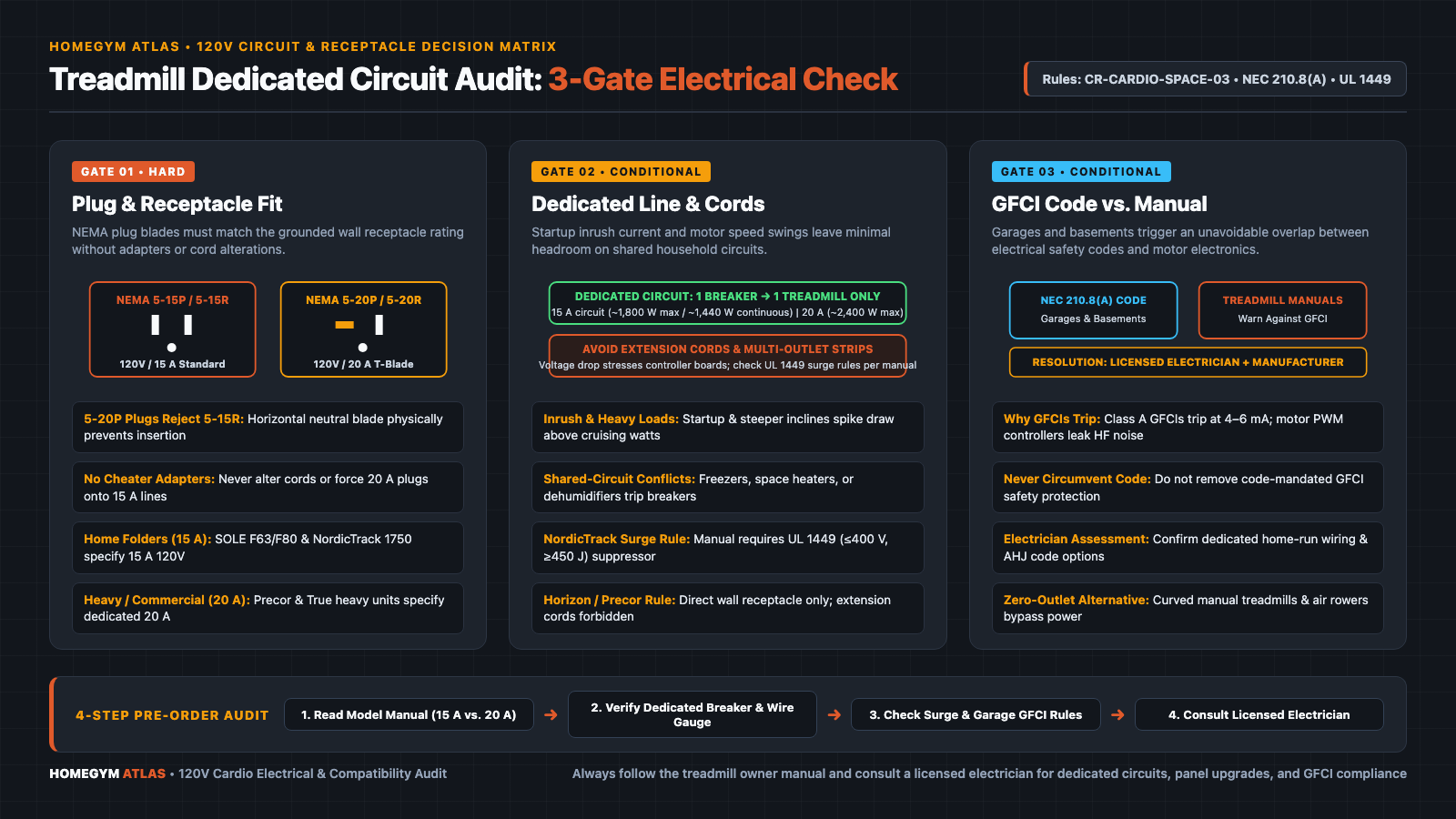
Decision Matrix: Treadmill Circuit Requirements by Room & Machine Class
Match your room’s existing electrical panel and outlet hardware against the treadmill class you plan to buy. Remember that electrical fit is only one piece of room planning—pair this table with our treadmill space requirements guide to verify rear safety clearance (commonly 79 to 96 in / 2.0 to 2.4 m), step-up ceiling headroom, and stairway freight delivery before checkout.
| Treadmill / Room Scenario | Typical Plug & Circuit Spec | Extension Cord & Surge Rule | Critical Caveat & Recommended Action |
|---|---|---|---|
| Home Folding Treadmill (SOLE F63/F80, NordicTrack 1750/T6.5s) | Dedicated 120V / 15 A (NEMA 5-15P plug) | No multi-outlet power strips; NordicTrack mandates UL 1449 (≤400V, ≥450J) single suppressor; SOLE forbids standard cords | Verify that no freezer, TV, or space heater shares the breaker; confirm exact UL surge spec in your model manual. |
| High-Output Home / Studio Runner (Horizon 7.0 AT / 7.4 AT) | Dedicated 120V / 15–20 A (NEMA 5-15P plug) | Strictly direct wall outlet; Horizon forbids extension cords and warns against GFCI outlets | 20 A dedicated line gives extra thermal headroom for heavy intervals; have a licensed electrician inspect older 15 A wiring. |
| Commercial / Heavy-Duty 20 A (Precor, True Commercial Lines) | Dedicated 120V / 20 A (NEMA 5-20P T-blade) | Direct dedicated NEMA 5-20R receptacle only; no adapters or shared neutrals | HARD fail on 15 A NEMA 5-15R outlets; requires a licensed electrician to install a true 20 A branch circuit. |
| Under-Desk Walking Pad (Low-speed compact motors) | 120V / 15 A grounded (Verify specific manual) | Plug directly into wall outlet; avoid daisy-chained desk strips | Confirm manufacturer manual for dedicated-line wording and max user weight limits (often 220–300 lb / 99.8–136.1 kg). |
| Garage or Basement Setup (Unfinished slab or wet-zone code) | NEC 210.8(A) GFCI Area (15 A or 20 A line) | Direct outlet per manual; GFCI protection mandated by US electrical code | CONDITIONAL conflict: Manuals advise against GFCI, while local code requires it. Consult the maker and a licensed electrician. |
| No Dedicated Outlet Available (Shed, patio room, shared circuit) | Zero 120V AC Draw (Battery console only) | Not applicable — no power cord, surge suppressor, or breaker load | Choose a self-powered curved manual treadmill (e.g., SOLE C80) or air rower (e.g., Concept2 RowErg). |
The Garage & Basement GFCI Conflict: NEC 210.8 vs. Owner Manuals
The single most confusing electrical collision in home-gym setups happens in garages and basements. Read a typical treadmill owner’s manual—such as SOLE, Horizon, or True—and you will see a prominent warning stating do not plug this treadmill into a GFCI outlet. Yet if you look at your garage or unfinished basement wall, nearly every receptacle has trip/reset buttons or connects to a GFCI breaker in the main panel.
Under National Electrical Code (NFPA 70 / NEC) Section 210.8(A), 125-volt through 250-volt receptacles installed in dwelling-unit garages and basements require Class A GFCI (Ground-Fault Circuit-Interrupter) protection. A Class A GFCI monitors current balance between the hot and neutral wires and shuts power off within milliseconds if leakage reaches roughly 4 to 6 milliamps (mA). Unfortunately, variable-speed PWM treadmill motor controllers naturally generate tiny high-frequency leakage currents and sharp inrush spikes that can fool sensitive GFCI electronics into nuisance tripping mid-run.
Because IronGym Lab enforces manufacturer-instruction-first and code-compliant safety wording (CR-CARDIO-SPACE-03 and guardrail G-15), we never resolve this conflict with DIY shortcuts. Removing, disabling, or circumventing required GFCI protection violates local electrical codes and creates shock hazards on damp concrete slabs. Instead, take two concrete steps:
- Consult a licensed electrician and local AHJ: Ask an electrician to inspect whether your garage or basement outlet is daisy-chained with other GFCI loads (a common cause of false trips), evaluate a dedicated branch circuit with modern motor-tolerant GFCI breaker hardware where permitted by your Authority Having Jurisdiction (AHJ), or verify code-compliant placement inside a finished room if local rules differ.
- Contact the treadmill manufacturer before buying: If you already experience breaker shutoffs, review our step-by-step treadmill tripping a GFCI breaker guide for manufacturer-first troubleshooting steps.
Extension Cords, Power Strips & UL 1449 Surge Suppressors
Shoppers often ask whether a heavy-duty 12-gauge contractor extension cord or a multi-outlet workshop power strip solves an inconveniently placed outlet. Across Horizon, NordicTrack, ProForm, Precor, and SOLE manuals, standard extension cords and multi-outlet strips are strongly discouraged or outright prohibited—for three engineering reasons:
- Voltage sag under load: Extra wire length and loose strip contacts increase electrical resistance, dropping voltage at the treadmill plug during heavy acceleration and heating up cord ends.
- Shared-load temptation: Multi-outlet strips invite plugging a box fan, TV, or phone charger block into the same receptacle—breaking the dedicated-circuit rule immediately.
- Brand-specific surge rules: Manuals diverge sharply on surge protection. NordicTrack and ProForm manuals require plugging into a UL 1449 listed surge suppressor (400V or less clamping voltage, 450+ joules, 120V / 15 A, with an operational indicator light) to protect sensitive touchscreen and control boards. Conversely, Horizon and several commercial brands warn against power strips altogether and specify plugging straight into the wall outlet (leaving whole-home panel surge protection to a licensed electrician).
Myth vs. Engineering Reality: 4 Treadmill Electrical Traps
Buyer Alert — Common Treadmill Circuit Misconceptions
- Myth 1: “If the plug fits my bedroom outlet, the circuit is good enough.”
Reality: A 15 A NEMA 5-15P plug fits every standard household outlet—including daisy-chained 15 A circuits powering hallway lights, a home office PC, and an adjacent room’s space heater. Verify what else shuts off when you flip that breaker off before calling it dedicated. - Myth 2: “A hardware-store adapter lets a 20 A treadmill run safely on a 15 A outlet.”
Reality: Forcing a horizontal-blade NEMA 5-20P plug into a 15 A NEMA 5-15R receptacle via a cord adapter violates CR-CARDIO-SPACE-03 (HARD) and manual safety rules. A 15 A line typically uses thinner 14 AWG wire not rated for 20 A loads; have a licensed electrician pull a true 12 AWG 20 A circuit. - Myth 3: “Any inexpensive surge strip gives NordicTrack or ProForm the protection they ask for.”
Reality: Basic power strips often lack UL 1449 certification, exceed 400V let-through thresholds, or use thin internal busbars. Match the manual’s UL 1449, clamping-voltage (≤400V), joule (≥450J), and indicator-light criteria—and keep other appliances unplugged from it. - Myth 4: “You can swap a garage GFCI outlet for a plain outlet yourself to stop trips.”
Reality: Modifying dwelling electrical outlets or disabling code-mandated GFCI protection violates NEC 210.8 safety requirements and creates shock hazards. Always involve a licensed electrician, or switch to a zero-outlet curved manual treadmill.
Verified Amazon US Hardware Across Treadmill Electrical Classes
The four verified Amazon US products below illustrate the three main electrical paths covered in this explainer: a subscription-free 120V / 15 A folding runner with explicit non-GFCI manual guidance, a touchscreen runner requiring a UL 1449 surge suppressor, a cordless direct-plug UL 1449 suppressor, and a zero-outlet manual curved treadmill for rooms without dedicated power.
1. SOLE F63 Folding Treadmill — Standard 120V / 15 A Dedicated Circuit Benchmark

Verified Electrical & Mechanical Specs: Dedicated 120V / 15 A grounded circuit (NEMA 5-15P; SOLE manuals advise against GFCI outlets) | Motor: 3.0 HP brushless (SOLE stated rating, 0.5–12 mph, 0–15% incline) | Deck: 20 x 60 in (50.8 x 152.4 cm), 8 in (20.3 cm) step-up | Max User Weight: 325 lb (147.4 kg) | App: Free SOLE+ app; zero monthly subscription required | Price Tier: Mid-Range ($1,000–$2,500)
The SOLE F63 represents the mainstream residential 15-amp category cleanly. Because it runs on a NEMA 5-15P plug without an iFIT subscription paywall, it drops neatly into a spare bedroom or dedicated indoor circuit—just remember SOLE’s strict warning against GFCI outlets if you plan to place it in a code-regulated garage or basement.
- Pros: Works on a standard dedicated 120V / 15 A residential circuit; full 20 x 60 in running deck and 325 lb capacity with zero ongoing membership fees.
- Cons: SOLE documentation advises against GFCI outlets, creating a potential NEC 210.8 garage/basement conflict requiring a licensed electrician; heavy 224–232 lb (101.6–105.2 kg) chassis needs two-person delivery planning (CR-SYS-04).
2. NordicTrack Commercial 1750 Folding Treadmill — 120V / 15 A + Mandatory UL 1449 Surge Rule

Verified Electrical & Mechanical Specs: Dedicated 120V / 15 A grounded circuit + UL 1449 surge suppressor (≤400V, ≥450J, indicator light) | Motor & Grade: Commercial-grade drive motor, 0–12 mph, -3% decline to 12% incline | Footprint & Weight: 80 x 36 in (203.2 x 91.4 cm), 265.7 lb (120.5 kg) | Subscription: Ongoing paid iFIT Pro Membership required for interactive classes & auto-adjust terrain (manual mode runs offline) | Price Tier: Mid-to-Premium ($1,200–$2,500)
Unlike brands that prohibit surge accessories, NordicTrack’s Commercial 1750 owner manual explicitly mandates a UL 1449-listed single-outlet surge suppressor meeting its clamping and joule thresholds on a dedicated 15 A circuit, alongside 8 ft (96 in / 2.4 m) rear clearance and 2 ft (24 in / 61.0 cm) side clearance.
- Pros: Clear documented electrical and UL 1449 surge protection criteria; pivoting 16-inch touchscreen and -3% decline to 12% incline range.
- Cons: Guided workouts, terrain streaming, and automatic speed/incline control require an ongoing paid iFIT Pro Membership (CR-CARDIO-SYS-02); large 80 x 36 in footprint and inclined step-up demand tall ceiling clearance (CR-CARDIO-SPACE-02).
3. Eaton Tripp Lite ULTRABLOK Metal Surge Protector — Direct-Plug UL 1449 Suppressor

Verified Electrical Specs: UL 1449 listed direct-wall plug-in surge suppressor (Model IBAR2-6D) | Rating: 120V / 15 A NEMA 5-15, 1,410 joules, <35V let-through suppression rating with diagnostic status LEDs | Cord Length: Zero trailing extension cord (mounts directly to wall duplex outlet) | Price Tier: Accessory ($50–$150)
When your treadmill manual—such as NordicTrack or ProForm—calls for a UL 1449 surge suppressor rated at or below 400V and at least 450 joules, a cordless direct-wall Isobar unit avoids the resistance and tripping hazards of 6-foot plastic power strips. Keep the second receptacle empty so the treadmill remains the sole load on its dedicated branch circuit.
- Pros: Meets UL 1449 and exceeds 450-joule / 400V manual thresholds in a rugged metal direct-wall housing with status indicator LEDs and zero trailing cord.
- Cons: Only for 15 A manuals that explicitly permit or require a plug-in suppressor (skip if your Horizon or Precor manual forbids all surge strips); check if your specific manual specifies a single-outlet-only suppressor.
4. SOLE Fitness C80 Curved Manual Treadmill — Zero-Circuit Alternative

Verified Electrical & Mechanical Specs: Zero 120V AC wall circuit required (battery-powered LCD Bluetooth console) | Drive & Surface: Self-powered 19 x 62 in (48.3 x 157.5 cm) curved slat belt with 8 magnetic resistance levels | Dimensions & Weight: 72 x 32 x 61 in (182.9 x 81.3 x 154.9 cm) non-folding frame, ~261 lb (118.4 kg) | Max User Weight: 330 lb (149.7 kg) | Subscription: None required | Price Tier: Mid-to-Premium ($1,200–$2,500+)
If your garage subpanel is maxed out, a detached shed has no dedicated branch wiring, or local GFCI mandates conflict with motorized treadmills, a motorless curved slat-belt machine removes CR-CARDIO-SPACE-03 electrical constraints entirely. You can place it anywhere on a level floor with adequate rear clearance.
- Pros: Eliminates dedicated circuit wiring, extension-cord restrictions, and GFCI breaker tripping completely; 8 magnetic resistance levels add sled-style sprint resistance with zero monthly subscriptions.
- Cons: Heavy ~261 lb (118.4 kg) non-folding frame takes permanent floor space and demands two-person freight handling (CR-SYS-04); curved slat belt requires active pacing rather than hands-free motorized cruise speed.
Compatibility Rules Appendix & Authoritative Citations
Every electrical recommendation in this guide maps directly to IronGym Lab compatibility rules and non-affiliate electrical or manufacturer standards:
- CR-CARDIO-SPACE-03 (HARD / CONDITIONAL): Plug blade geometry must match the wall receptacle (NEMA 5-20P cannot enter NEMA 5-15R); motorized units require dedicated 120V circuits per manual; resolve any NEC 210.8(A) GFCI conflict strictly through the manufacturer and a licensed electrician.
- CR-CARDIO-SPACE-01, 02 & 04 (HARD / SOFT): Confirm unobstructed rear safety clearance (commonly 79 to 96 in / 2.0 to 2.4 m), user height plus step-up incline headroom below the lowest ceiling obstruction, and upper-floor weight/noise considerations.
- CR-CARDIO-SYS-01, 02 & CR-SYS-04 (HARD / CONDITIONAL / INFO): Verify manufacturer maximum user weight with stated basis, disclose ongoing paid subscriptions such as iFIT Pro, and inspect doorway widths for 200+ lb freight delivery.
Authoritative Non-Affiliate Sources Cited:
- National Fire Protection Association (NFPA 70 / NEC Section 210.8) — US residential Class A GFCI protection requirements for dwelling-unit garages and basements.
- SOLE Fitness Official Specifications & Owner Manuals — F63 and F80 120V 15A dedicated-circuit guidelines, inrush current notes, and non-GFCI manual instructions.
- NordicTrack Official Commercial 1750 Specifications & Manual — Dedicated 120V 15A circuit rules, UL 1449 surge suppressor rating (≤400V / ≥450J), and iFIT membership disclosure.
- Horizon Fitness Official Treadmill Electrical Guidance — Dedicated 15–20 A circuit guidance, extension-cord prohibition, and GFCI incompatibility warnings.
- Precor Official Treadmill Electrical Specifications — Dedicated 120V / 20 A NEMA 5-20P branch circuit requirements, non-shared neutral rules, and grounding instructions.
How We Audited This Guide
- Cardio machines were audited for CHP vs peak motor claims, running belt length and rear safety clearance, 120V NEMA 5-15/5-20 electrical limits with GFCI notes, and ongoing app subscriptions.
- Every power rack, barbell, weight plate, bench, adjustable dumbbell, cardio machine, and flooring spec was cross-checked against official manufacturer manuals, CPSC notices, and live Amazon US listings.
- Recommendations were evaluated against our weighted vertical scoring rubrics and documented CR-* compatibility rules; we never invent load capacities, motor ratings, rubber thickness, or decibels.
Continue Your Audit
Frequently Asked Questions: Treadmill Dedicated Circuit Requirements
Does every home treadmill need a dedicated 15-amp or 20-amp circuit?
Almost all motorized treadmill owner manuals specify a dedicated 120V circuit—usually 15 A (NEMA 5-15) for residential folders and 15–20 A or 20 A (NEMA 5-20) for heavy-duty or commercial machines—meaning nothing else shares that breaker. Only motorless curved treadmills need zero wall power.
Can I plug a treadmill into an outlet shared with lights or a freezer?
Manuals advise against sharing the branch circuit. When a chest freezer compressor, space heater, or dehumidifier runs on the same breaker as a motorized treadmill, startup inrush spikes can overload the breaker or drop line voltage and stress the treadmill’s motor controller.
What happens if a treadmill has a 20-amp NEMA 5-20P plug and my room has 15-amp outlets?
Under rule CR-CARDIO-SPACE-03 (HARD), the horizontal blade on a 20 A NEMA 5-20P plug physically will not fit a 15 A NEMA 5-15R outlet. Never force an adapter or modify the cord; hire a licensed electrician to install a true 12 AWG 20 A dedicated circuit.
Why do treadmill manuals forbid GFCI outlets when garages require GFCI by code?
Under NEC 210.8(A), garages and basements require Class A GFCI protection (which trips at 4–6 mA), while treadmill PWM motor controllers generate minor high-frequency leakage currents that trigger nuisance trips. Never disable required GFCI hardware yourself—have a licensed electrician evaluate code-compliant options.
Should I plug a treadmill into a surge protector or directly into the wall?
Follow your exact model’s owner manual. NordicTrack and ProForm manuals mandate a UL 1449 surge suppressor rated at 400V or less and 450+ joules with an indicator light, whereas Horizon, Precor, and SOLE instruct plugging directly into the wall outlet without multi-outlet strips.


