
Disclosure: As an Amazon Associate, I earn from qualifying purchases. If you buy through links on this page, we may earn a small commission at no extra cost to you.
Choosing the best cardio machine for home comes down to room geometry, electrical circuits, and software independence—not headline motor numbers or touchscreen hype. A machine that looks sleek in a product photo can fail immediately if your basement beams clip overhead headroom on an inclined deck, if your garage receptacle lacks a dedicated 120V circuit, or if essential tracking disappears behind a canceled membership.
We audited nine verified Amazon US cardio machines across air rowers, folding treadmills, indoor cycling bikes, fan bikes, front-drive ellipticals, and incline walking pads against manufacturer manuals, EN/ASTM standards, and Consumer Product Safety Commission (CPSC) notices. Whether you are mapping a single-modality corner or building out a full room with our home gym setup guide, every recommendation below pairs verified specifications with clear room, power, and ownership trade-offs.
In This Guide
Quick Picks: Best Cardio Machine for Home Winners at a Glance
#1 Best Overall
Concept2 RowErg (PM5 Monitor)
Battery-powered air rower with dual 500 lb / 300 lb EN capacity ratings, open Bluetooth FTMS, and zero required subscriptions. (Jump to audit)
#2 Best Treadmill for Runners
NordicTrack Commercial 1750
Heavy folding runner’s treadmill offering -3% decline to 12% incline and a 16-inch pivoting screen with optional iFIT Pro control. (Jump to audit)
#3 Best Subscription-Free Treadmill
SOLE F63 Folding Treadmill
Full 20 x 60 in cushioned deck, 15% incline, and 325 lb user capacity backed by free SOLE+ tracking and zero monthly fees. (Jump to audit)
Side-by-Side Comparison: Best Cardio Machine for Home Picks
| Product & Award | Modality & Tier | Footprint & Clearance | Power, Capacity & Apps | Link |
|---|---|---|---|---|
| Concept2 RowErg (PM5) Best Overall | Air Rower Mid-Range ($500–$1,000) | 96 x 24 in (244 x 61 cm) 108 x 48 in in-use zone | No outlet (D-cell battery) 500 lb Concept2 / 300 lb EN Open FTMS / ANT+ (no fee) | View on Amazon |
| NordicTrack Commercial 1750 Best Treadmill for Runners | Folding Treadmill Premium (over $1,000) | 80 x 36 in (203 x 91 cm) + 79 in (2 m) rear clear zone | 120V AC dedicated circuit 265.7 lb unit; verify gen spec iFIT Pro optional/gated | View on Amazon |
| SOLE F63 Treadmill Best Subscription-Free Treadmill | Folding Treadmill Premium (over $1,000) | 75 x 34 in (190.5 x 86.4 cm) + 79 in (2 m) rear clear zone | 120V 15A (no GFCI per manual) 325 lb (147.4 kg) rated Free SOLE+ app (no fee) | View on Amazon |
| Horizon Fitness 7.0 AT Best Value Treadmill for Open Apps | Folding Treadmill Mid-Range ($500–$1,000) | 76.5 x 36 in (194 x 91 cm) + 79 in (2 m) rear clear zone | 120V 15–20 A dedicated 325 lb (147.4 kg) rated Open Bluetooth FTMS (no fee) | View on Amazon |
| Schwinn IC4 Indoor Cycle Best Open-Platform Exercise Bike | Magnetic Cycle Mid-Range ($500–$1,000) | 54.6 x 30.7 in (138.7 x 78 cm) Compact studio footprint | 120V AC console adapter 330 lb (149.7 kg) rated Open FTMS (Peloton/Zwift) | View on Amazon |
| Schwinn Airdyne AD7 Best Air Bike for Conditioning | Air Fan Bike Mid-Range ($500–$1,000) | 53 x 26.5 in (134.6 x 67.3 cm) Clear handle swing arc | No outlet (battery console) 348 lb (157.9 kg) rated No subscription required | View on Amazon |
| SOLE E25 Elliptical Best Elliptical for Full Stride | Front-Drive Elliptical Premium (over $1,000) | 70 x 24 in (177.8 x 61 cm) Check pedal + incline height | 120V AC cord (incline) 350 lb (158.8 kg) rated Free SOLE+ app (no fee) | View on Amazon |
| Hydrow Wave Rower Best Connected Studio Rower | Magnetic Rower Premium (over $1,000) | 80 x 19 in (203.2 x 48.3 cm) Wall kit for upright store | 120V AC adapter required 375 lb (170.1 kg) rated Hydrow Membership gated | View on Amazon |
| MERACH W50 Walking Pad Best Under-Desk Walking Pad | Incline Walking Pad Budget (under $500) | 50.2 x 22.2 in (127.5 x 56.4 cm) 16.5 x 41.3 in walking mat | 120V AC grounded cord 400 lb listed (verify manual) Free MERACH app (no fee) | View on Amazon |
Match Your Room & Use Case
| Buyer Scenario | Best Match | Why & Verified Fit Factors |
|---|---|---|
| Upper-floor apartment or garage without a dedicated 120V circuit | Concept2 RowErg (PM5) | Battery-powered monitor requires zero outlet, splits into two compact pieces for upright storage, and carries dual 500 lb / 300 lb EN capacity ratings. |
| Dedicated runner needing incline and decline terrain programming | NordicTrack Commercial 1750 | Provides -3% decline to 12% incline and a 16-inch pivoting screen when your room clears 79 in (2 m) rear space, ceiling height, and dedicated 120V power. |
| Subscription-free daily treadmill walking and distance running | SOLE F63 Folding Treadmill | Pairs a 20 x 60 in (50.8 x 152.4 cm) deck, 15% incline, and 325 lb (147.4 kg) user rating with free SOLE+ tracking and zero ongoing fees. |
| App-flexible HIIT intervals with Peloton, Zwift, or Strava | Horizon Fitness 7.0 AT | Combines open Bluetooth FTMS and QuickDial rotary rollers with a 3.0 CHP motor and full 20 x 60 in (50.8 x 152.4 cm) cushioned deck. |
| Quiet studio cycling without brand-locked monthly fees | Schwinn IC4 Indoor Cycle | Delivers 100 magnetic levels, dual SPD/toe-cage pedals, and 330 lb (149.7 kg) capacity across Peloton, Zwift, or JRNY in a 54.6 x 30.7 in footprint. |
| Full-body sprint intervals with zero wall outlet or subscriptions | Schwinn Airdyne AD7 | Single-stage belt-driven fan delivers unlimited progressive air resistance on a 348 lb (157.9 kg) frame with only a battery interval console. |
Detailed Audits: Best Cardio Machine for Home Models (1–9)
1. Concept2 RowErg Indoor Rowing Machine (PM5 Monitor) — Best Overall

Quick Specs: 10-level air flywheel damper | 96 x 24 in (244 x 61 cm) assembled; 108 x 48 in (274 x 122 cm) in-use zone | 57 lb (25.9 kg) standard legs / 68 lb (30.8 kg) tall legs | 500 lb (226.8 kg) Concept2 rating / 300 lb (136.1 kg) EN 20957-7 | Battery PM5 (no 120V outlet) | Price Tier: Mid-Range ($500–$1,000)
Audit Score: 9.4 / 10
- Core Manual Specs & Load Capacity (30%): 9.6 / 10
- Space, Clearance & 120V Electrical Fit (25%): 9.1 / 10
- Ecosystem Openness & Subscription Value (20%): 9.8 / 10
- Warranty, Safety Record & Tier Value (25%): 9.2 / 10
The Concept2 RowErg earns our top overall rank because it sidesteps the two biggest failure points in residential cardio hardware: electrical circuit conflicts and subscription obsolescence. According to Concept2’s official RowErg specifications, the flywheel generator powers the Performance Monitor 5 (PM5) during strokes alongside two D-cell batteries, eliminating any need for a 120V wall outlet. Its load documentation is equally transparent: Concept2 rates the chassis to a 500 lb (226.8 kg) maximum user weight while explicitly publishing the European Stationary Fitness Equipment standard EN 20957-7 limit of 300 lb (136.1 kg).
Against the Hydrow Wave, the RowErg trades whisper-quiet magnetic drag and a built-in 16-inch video display for open Bluetooth FTMS and ANT+ FE-C connectivity across more than 40 third-party training apps with zero ongoing membership cost. Under rule CR-CARDIO-SPACE-05, note that while the assembled monorail measures 96 x 24 in (244 x 61 cm), Concept2 recommends 108 x 48 in (9 x 4 ft / 274 x 122 cm) of clear floor space during full-stroke rowing; afterward, the frame splits into two lightweight sections without tools. For buyers choosing specifically between air and magnetic rowers, explore our best rowing machine for home breakdown.
Buyer Verification Alert: Check the Amazon product title and variation selector to confirm whether the listing includes standard 14 in (35.6 cm) seat-height legs (57 lb / 25.9 kg unit weight) or tall 20 in (50.8 cm) legs (68 lb / 30.8 kg unit weight), as well as standard 9 x 4 ft operating clearance.
Pros
- Dual-verified maximum user weight: 500 lb (226.8 kg) per Concept2 and 300 lb (136.1 kg) under EN 20957-7
- PM5 console runs on D-cell batteries and supports open Bluetooth FTMS and ANT+ FE-C without paid memberships
- Separates cleanly into two pieces with caster wheels for upright closet or garage wall storage
Cons
- Needs a full 108 x 48 in (274 x 122 cm) operating footprint when assembled for rowing
- Air flywheel damper creates noticeable airflow noise compared with electromagnetic rowers
Verdict: Buy it if you want commercial-grade mechanical longevity, zero wall-outlet restrictions, and standardized metrics without recurring software fees. Skip it if you need whisper-quiet midnight sessions next to thin apartment walls. Add a 96 x 36 in (244 x 91 cm) rubber equipment mat under the stabilizer feet to protect finished wood or vinyl flooring.
2. NordicTrack Commercial 1750 Folding Treadmill (16" Touchscreen) — Best Treadmill for Runners

Quick Specs: Commercial-grade drive motor; 0–12 mph (0–19.3 km/h) | -3% decline to 12% incline | 80 x 36 in (203 x 91 cm) footprint | 265.7 lb (120.5 kg) unit weight | 120V AC grounded circuit | iFIT Pro Membership optional/gated | Price Tier: Premium (over $1,000)
Audit Score: 8.9 / 10
- Core Manual Specs & Load Capacity (30%): 9.3 / 10
- Space, Clearance & 120V Electrical Fit (25%): 8.3 / 10
- Ecosystem Openness & Subscription Value (20%): 8.1 / 10
- Warranty, Safety Record & Tier Value (25%): 9.3 / 10
For distance runners who prioritize steep elevation profiles and a stiff chassis under fast paces, the NordicTrack Commercial 1750 stands apart in the folding residential class by combining a 0–12 mph (0–19.3 km/h) belt speed range with -3% motorized decline to 12% incline. Per NordicTrack’s Commercial 1750 product documentation, the 265.7 lb (120.5 kg) frame anchors the pivoting 16-inch touchscreen cleanly during sprints, though that weight also triggers rule CR-SYS-04: measure doorways, tight hallway turns, and stairwells before freight delivery arrives.
Compared with the SOLE F63 and Horizon 7.0 AT, the Commercial 1750 delivers unmatched terrain simulation and integrated video coaching, but comes with a steeper software dependency under rule CR-CARDIO-SYS-02. While manual belt operation works without paying for software, streaming trainer-led workouts, automated incline/decline tracking, and route mapping require an active, ongoing paid iFIT Pro Membership. Because the deck lifts substantially at 12% incline, measure your standing height plus the raised deck step-up height and stride bounce against your lowest ceiling joist or garage-door track (CR-CARDIO-SPACE-02), and reserve at least 79 in (2 m) of clear space behind the belt (CR-CARDIO-SPACE-01). See how it stacks up against pure non-subscription decks in our best treadmill for home guide.
Buyer Verification Alert: NordicTrack has updated the Commercial 1750 across model revisions—recent revisions carry a 22 x 60 in (55.9 x 152.4 cm) belt and 400 lb (181.4 kg) user capacity, while earlier revisions shipped with a 20 x 60 in deck and 300 lb limit. Confirm the exact SKU revision, circuit amperage, and GFCI guidance in the listing spec sheet, and have a licensed electrician verify your 120V circuit.
Pros
- Motorized -3% decline to 12% incline supports varied downhill and uphill pacing
- Heavy 265.7 lb (120.5 kg) folding frame dampens console wobble at higher running speeds
- Pivoting 16-inch HD touchscreen rotates for off-deck strength and mobility routines
Cons
- Guided classes, automated incline control, and streaming features require an ongoing paid iFIT Pro Membership
- Large 80 x 36 in (203 x 91 cm) frame plus high incline step-up height demands tall ceilings and 79 in (2 m) rear clearance
Verdict: Buy it if you want automated incline/decline pacing and an integrated HD studio console in a heavy folding chassis. Skip it if you dislike ongoing memberships or have low 84 in (7 ft) basement ceilings. Budget for a 40 x 84 in (101.6 x 213.4 cm) equipment mat and verify a dedicated 120V circuit with a licensed electrician before unboxing.
3. SOLE F63 Folding Treadmill (3.0 HP Brushless, 15% Incline) — Best Subscription-Free Treadmill

Quick Specs: 3.0 HP motor (SOLE stated); 0.5–12 mph (0.8–19.3 km/h) | 0% to 15% power incline | 20 x 60 in (50.8 x 152.4 cm) 18 mm deck | 75 x 34 in (190.5 x 86.4 cm) footprint | 325 lb (147.4 kg) max user weight | Dedicated 120V 15A circuit | Free SOLE+ app | Price Tier: Premium (over $1,000)
Audit Score: 8.8 / 10
- Core Manual Specs & Load Capacity (30%): 8.9 / 10
- Space, Clearance & 120V Electrical Fit (25%): 8.2 / 10
- Ecosystem Openness & Subscription Value (20%): 9.2 / 10
- Warranty, Safety Record & Tier Value (25%): 8.9 / 10
If your goal is straightforward, subscription-free daily walking and running, the SOLE F63 delivers a full-length 20 x 60 in (50.8 x 152.4 cm) 18 mm cushioned running deck, 15% power incline, and a 325 lb (147.4 kg) maximum user weight rating without locking a single metric behind a monthly paywall. Per SOLE Fitness specifications and owner documentation, its 3.0 HP motor (quoted strictly under SOLE’s rating method rather than compared directly as continuous horsepower across competing brands) drives speeds from 0.5 to 12 mph (0.8 to 19.3 km/h) inside a slightly narrower 75 x 34 in (190.5 x 86.4 cm) footprint than the NordicTrack Commercial 1750.
Against the Horizon 7.0 AT, the SOLE F63 trades rotary QuickDial controls for traditional handlebar rocker buttons and a 6.5-inch backlit LCD console paired with the free SOLE+ app. However, every prospective F63 buyer must read SOLE’s electrical rules carefully before ordering: SOLE manuals specify a dedicated 120V, 15 A grounded circuit with no other appliances sharing the breaker, and explicitly warn owners not to use a GFCI wall outlet because motor inrush current frequently triggers nuisance trips. Because US building codes commonly mandate GFCI protection in garages and unfinished basements, treat that potential conflict under CR-CARDIO-SPACE-03 by consulting both SOLE support and a licensed electrician.
Buyer Verification Alert: SOLE owner manuals state not to plug the treadmill into a GFCI wall outlet, which may conflict with garage or basement electrical code requirements. Never use extension cords or adapters; have a licensed electrician inspect your receptacle and panel first.
Pros
- Full 20 x 60 in (50.8 x 152.4 cm) cushioned running deck and 325 lb (147.4 kg) user capacity with zero monthly fees
- 0% to 15% power incline with handlebar toggle switches and free SOLE+ Bluetooth app syncing
- Proven mechanical simplicity with lifetime frame and motor warranty coverage from SOLE
Cons
- Manual prohibits GFCI outlets, creating installation friction in code-mandated GFCI garages and basements
- Basic backlit LCD console requires bringing your own tablet for video workouts
Verdict: Buy it if you want a durable, full-stride folding treadmill with zero recurring subscription costs and simple controls. Skip it if you want decline grades or cannot place the treadmill on a dedicated, code-compliant non-GFCI interior circuit. Pair it with a 36 x 78 in (91.4 x 198.1 cm) treadmill mat and silicone belt lubricant.
4. Horizon Fitness 7.0 AT Folding Treadmill (Rapid Sync, 20"x60" Deck) — Best Value Treadmill for Open Apps

Quick Specs: 3.0 CHP Rapid Sync motor (Horizon stated); 0.5–12 mph (0.8–19.3 km/h) | 0% to 15% incline | 20 x 60 in (50.8 x 152.4 cm) deck; 8.625 in (21.9 cm) step-on height | 257 lb (116.6 kg) unit weight; 325 lb (147.4 kg) max user | Dedicated 120V 15–20 A circuit | Open Bluetooth FTMS | Price Tier: Mid-Range ($500–$1,000)
Audit Score: 8.8 / 10
- Core Manual Specs & Load Capacity (30%): 8.9 / 10
- Space, Clearance & 120V Electrical Fit (25%): 8.1 / 10
- Ecosystem Openness & Subscription Value (20%): 9.5 / 10
- Warranty, Safety Record & Tier Value (25%): 8.7 / 10
The Horizon Fitness 7.0 AT is engineered around open-platform interval running. Rather than locking buyers into a proprietary touchscreen ecosystem, Horizon’s 7.0 AT specification sheet pairs a 3.0 CHP (continuous horsepower, Horizon basis) Rapid Sync drive system with Bluetooth FTMS, letting runners stream real-time speed, cadence, and distance directly into Peloton Digital, Zwift, Strava, or Apple Watch on their own tablet. Knurled QuickDial rollers mounted on the front handlebars allow rapid speed and incline transitions during sprint intervals without hunting through touchscreen menus.
Compared with the SOLE F63, the Horizon 7.0 AT matches the 20 x 60 in (50.8 x 152.4 cm) deck length, 15% incline ceiling, and 325 lb (147.4 kg) user capacity while sitting in a lower mid-range tier and offering faster dial ergonomics. Horizon’s owner manual is unusually specific on room geometry: alongside the ~76.5 x 36 in (194 x 91 cm) footprint and 8.625 in (21.9 cm) step-on height, it requires at least 12 in (30.5 cm) of front clearance for the power cord and a clear rear safety zone measuring at least the deck width by 79 in (2 m / ~6.5 ft) long behind the belt, plus a dedicated 15 A to 20 A grounded 120V circuit without extension cords.
Buyer Verification Alert: Reserve the full 79 in (2 m) rear safety zone and 12 in (30.5 cm) front cord margin required by the Horizon manual, and have a licensed electrician confirm a dedicated 15–20 A 120V circuit before delivery of this 257 lb (116.6 kg) unit.
Pros
- QuickDial handlebar rollers execute swift speed and incline jumps for interval sessions
- Open Bluetooth FTMS pairs cleanly with Zwift, Peloton app, Strava, and Apple Watch without mandatory fees
- Full 20 x 60 in (50.8 x 152.4 cm) 3-Zone cushioned deck with 325 lb (147.4 kg) rating in the mid-range tier
Cons
- Heavy 257 lb (116.6 kg) unit weight complicates multi-flight stair delivery under CR-SYS-04
- Requires dedicated 15–20 A 120V branch circuit and full 79 in (2 m) rear clearance zone
Verdict: Buy it if you run interval workouts using third-party fitness apps on your own tablet and want tactile handlebar dials at a mid-range price tier. Skip it if you want a built-in HD screen or lack dedicated 120V outlet capacity. Pair it with a 36 x 80 in (91.4 x 203.2 cm) rubber mat and check hallway turns before shipping.
5. Schwinn IC4 Indoor Cycling Bike (100-Level Magnetic) — Best Open-Platform Exercise Bike

Quick Specs: 100 micro-adjustable magnetic resistance levels | 54.6 x 30.7 in (138.7 x 78 cm) footprint | Dual SPD & toe-cage pedals | 330 lb (149.7 kg) max user weight | 120V AC low-draw console adapter | Open Bluetooth FTMS | Price Tier: Mid-Range ($500–$1,000)
Audit Score: 8.6 / 10
- Core Manual Specs & Load Capacity (30%): 8.6 / 10
- Space, Clearance & 120V Electrical Fit (25%): 9.0 / 10
- Ecosystem Openness & Subscription Value (20%): 9.3 / 10
- Warranty, Safety Record & Tier Value (25%): 7.6 / 10
The Schwinn IC4 occupies the sweet spot for riders who want studio-grade magnetic resistance without locking their bike to a single software brand. Its 100 micro-indexed magnetic levels adjust smoothly without friction pad wear, while dual-sided SPD clipless and toe-cage pedals accommodate both cycling cleats and running shoes straight out of the box. At 54.6 x 30.7 in (138.7 x 78 cm), the footprint tucks cleanly into an apartment corner or low-ceiling room where tall treadmills and ellipticals run into vertical limits, and the 330 lb (149.7 kg) maximum user weight rating per Schwinn’s IC4 specifications exceeds the 297 lb (134.7 kg) limit on the Peloton Cross Training Bike.
Software openness is the IC4’s primary advantage over connected studio bikes: its open Bluetooth signal broadcasts cadence and metrics directly to the Peloton app, Zwift, or JRNY (a 2-month JRNY trial is typically included, after which JRNY requires a paid subscription; zero subscription is needed for manual riding). Unlike the Concept2 RowErg or Schwinn Airdyne AD7, the IC4’s console uses a low-voltage 120V AC wall adapter rather than batteries, though it does not require a dedicated high-amperage treadmill circuit. Note one brand-support caveat before checkout: Schwinn Fitness and BowFlex assets transitioned to new ownership in 2024, so buyers should verify current warranty and replacement-parts terms. Compare additional stationary cycles in our best exercise bike for home roundup.
Buyer Verification Alert: Schwinn Fitness and BowFlex underwent an ownership transition in 2024—verify current US warranty registration, labor terms, and replacement-parts fulfillment on the seller listing prior to ordering, and confirm whether the listing bundles 3 lb (1.4 kg) dumbbells and a Bluetooth heart-rate armband.
Pros
- 100 magnetic resistance levels operate quietly without felt brake pads to replace
- Open Bluetooth exports cadence to Peloton Digital, Zwift, and third-party cycling apps
- 330 lb (149.7 kg) capacity and dual-sided SPD/toe-cage pedals fit varied household riders
Cons
- Post-2024 BowFlex/Schwinn ownership sale makes confirming active warranty and parts support prudent
- Console requires plugging in a low-voltage 120V AC adapter rather than self-powering via flywheel
Verdict: Buy it if you want a quiet, SPD-ready indoor cycle that pairs freely with Peloton or Zwift on your own tablet. Skip it if you want automatic app-controlled resistance or prefer an outlet-free fan bike. Place a 30 x 60 in (76.2 x 152.4 cm) mat beneath the stabilizers to catch sweat.
6. Schwinn Airdyne AD7 Exercise Fan Bike — Best Air Bike for Conditioning

Quick Specs: Progressive air fan resistance (single-stage belt drive) | 53 x 26.5 in (134.6 x 67.3 cm) footprint | 348 lb (157.9 kg) max user weight | Battery-powered LCD console (no 120V outlet) | Zero subscription required | Price Tier: Mid-Range ($500–$1,000)
Audit Score: 8.5 / 10
- Core Manual Specs & Load Capacity (30%): 8.8 / 10
- Space, Clearance & 120V Electrical Fit (25%): 8.9 / 10
- Ecosystem Openness & Subscription Value (20%): 8.5 / 10
- Warranty, Safety Record & Tier Value (25%): 7.8 / 10
Where magnetic indoor cycles isolate lower-body cadence, the Schwinn Airdyne AD7 links moving upper-body arms to a 26-blade fan via a single-stage belt drive. Because air drag scales exponentially with pedaling and pushing speed, resistance adjusts instantaneously to effort without dialing knobs or changing gears. Per Schwinn’s Airdyne AD7 technical details, the steel frame holds up to 348 lb (157.9 kg) within a compact 53 x 26.5 in (134.6 x 67.3 cm) footprint and uses a battery-powered interval console—meaning zero 120V power requirements in unpowered garage bays.
Compared with the Schwinn IC4, the AD7 eliminates electrical cords and drive-chain lubrication altogether, though the fan creates substantial wind sound and airflow during hard intervals. For upper-floor apartments with noise-sensitive neighbors (CR-CARDIO-SPACE-04), a magnetic bike or rower makes a quieter roommate; for garage conditioning alongside a barbell rack, the AD7’s small footprint and belt drive require minimal upkeep. As with the IC4, double-check current warranty terms following the 2024 BowFlex/Schwinn sale.
Buyer Verification Alert: Account for the forward swing of the dual-action handlebars beyond the 53 in (134.6 cm) base length when placing the AD7 near walls or racks, and confirm post-2024 Schwinn Fitness warranty coverage before checkout.
Pros
- Single-stage belt drive reduces drivetrain stretch and chain maintenance compared with chain air bikes
- 348 lb (157.9 kg) user capacity in a compact 53 x 26.5 in (134.6 x 67.3 cm) footprint
- Zero electrical outlets or subscription fees required
Cons
- Open fan wheel generates noticeable wind noise and direct breeze during sprint intervals
- Lacks Bluetooth FTMS app integration for Zwift or connected studio leaderboards
Verdict: Buy it if you want rugged, outlet-free full-body conditioning intervals in a garage or basement gym. Skip it if you need quiet evening rides or live streaming classes. Add the snap-on wind shield if you train in cool winter garages.
7. SOLE E25 Elliptical Machine (20" Stride, 0-20 Power Incline) — Best Elliptical for Full Stride

Quick Specs: 20-level Eddy Current magnetic resistance + 0–20 power incline | 20 lb (9.1 kg) flywheel | 20 in (50.8 cm) stride | 70 x 24 x 70 in (177.8 x 61 x 177.8 cm) | 209 lb (94.8 kg) unit weight | 350 lb (158.8 kg) max user weight | 120V AC cord | Free SOLE+ app | Price Tier: Premium (over $1,000)
Audit Score: 8.4 / 10
- Core Manual Specs & Load Capacity (30%): 8.8 / 10
- Space, Clearance & 120V Electrical Fit (25%): 7.7 / 10
- Ecosystem Openness & Subscription Value (20%): 8.7 / 10
- Warranty, Safety Record & Tier Value (25%): 8.5 / 10
Compact under-desk and short-rail ellipticals often feel choppy for adults over 5 ft 8 in (172.7 cm) because their pedal arcs stay too steep and short. According to SOLE’s official E25 specifications, this front-drive elliptical pairs a full 20 in (50.8 cm) stride length and 20 lb (9.1 kg) flywheel with 20 magnetic resistance levels and 20 levels of motorized power incline—supporting up to 350 lb (158.8 kg) in a slim 24 in (61 cm) width with zero paid membership required.
The trade-off sits squarely in vertical geometry under CR-CARDIO-SPACE-02. Elliptical pedals raise your standing height above the floor, and cranking the E25’s power incline raises your head even higher at the top of each stride. In an 84 in (7 ft) basement with low HVAC ductwork, a 6 ft 1 in (185.4 cm) user can easily run out of overhead clearance, whereas a Concept2 RowErg or Schwinn IC4 leaves plenty of room. Also remember the E25 weighs 209 lb (94.8 kg) assembled and does not fold upright like a treadmill or split like an air rower.
Buyer Verification Alert: Measure your standing height plus the E25’s maximum pedal elevation at full 20-level incline against your lowest ceiling joist or duct before ordering, and confirm a nearby 120V outlet for the incline motor and console.
Pros
- Full 20 in (50.8 cm) stride length, 20 lb (9.1 kg) flywheel, and 0–20 power incline
- 350 lb (158.8 kg) user weight capacity in a narrow 24 in (61 cm) wide footprint
- Free SOLE+ app connectivity with zero ongoing subscription fees
Cons
- Elevated pedal path plus power incline restricts usability under low 84 in (7 ft) basement ceilings
- Non-folding 209 lb (94.8 kg) frame permanently claims 70 x 24 in (177.8 x 61 cm) of floor space
Verdict: Buy it if you want a full 20 in (50.8 cm) elliptical stride with power incline, zero subscriptions, and high ceiling clearance. Skip it if you have low basement beams or need folding storage. Use a 30 x 72 in (76.2 x 182.9 cm) rubber mat beneath the steel guide rails.
8. Hydrow Wave Rowing Machine (Magnetic Drag, Connected Screen) — Best Connected Studio Rower

Quick Specs: Computer-controlled electromagnetic drag | 80 x 19 x 43 in (203.2 x 48.3 x 109.2 cm) footprint | 102 lb (46.3 kg) unit weight | 375 lb (170.1 kg) max user weight (36 in / 91.4 cm max inseam) | 120V AC adapter required | Hydrow Membership required for full screen features | Price Tier: Premium (over $1,000)
Audit Score: 8.1 / 10
- Core Manual Specs & Load Capacity (30%): 8.7 / 10
- Space, Clearance & 120V Electrical Fit (25%): 8.2 / 10
- Ecosystem Openness & Subscription Value (20%): 6.8 / 10
- Warranty, Safety Record & Tier Value (25%): 8.4 / 10
For apartments and shared living spaces where fan roar is a non-starter, the Hydrow Wave replaces air resistance with computer-controlled electromagnetic drag inside a compact 80 x 19 in (203.2 x 48.3 cm) footprint—16 in (40.6 cm) shorter and 5 in (12.7 cm) narrower than an assembled Concept2 RowErg. Per Hydrow’s official Wave specifications, its 102 lb (46.3 kg) aluminum-and-steel chassis supports up to 375 lb (170.1 kg) and accommodates riders up to a 36 in (91.4 cm) inseam while streaming 6,000+ coached sessions on a 16-inch Full HD touchscreen.
That connected polish carries two firm constraints under rules CR-CARDIO-SYS-02 and CR-CARDIO-SPACE-05. First, while unsubscribed “Just Row” mode operates the electromagnetic drag manually, touchscreen workout tracking, metrics history, and coached rows require an ongoing paid Hydrow Membership. Second, unlike the self-standing two-piece RowErg, the Wave requires wall-plug 120V power for its screen and drag control, and Hydrow mandates purchasing its separate Vertical Anchor Kit (secured per manufacturer instructions into structural framing) before standing the rower upright for storage.
Buyer Verification Alert: Do not stand the Hydrow Wave vertically against a wall without Hydrow’s separate Vertical Anchor Kit installed per the manual, and factor the ongoing Hydrow Membership into long-term ownership planning.
Pros
- Electromagnetic resistance runs much quieter than air flywheels for shared homes and apartments
- Compact 80 x 19 in (203.2 x 48.3 cm) footprint with 375 lb (170.1 kg) user rating
- Integrated 16-inch Full HD display delivers immersive instructor-led water workouts
Cons
- Ongoing paid Hydrow Membership required for coached classes, leaderboards, and saved stats
- Requires a 120V outlet during use and a separately sold Vertical Anchor Kit for upright storage
Verdict: Buy it if you want quiet magnetic rowing and thrive on studio-style coaching in a slimmer footprint than an air rower. Skip it if you refuse ongoing monthly software fees or want battery-powered portability. Budget for a 24 x 90 in (61 x 228.6 cm) equipment mat and the official Vertical Anchor Kit if storing upright.
9. MERACH W50 12% Auto Incline Walking Pad (3.5 HP, 400 lb Cap) — Best Under-Desk Walking Pad

Quick Specs: 3.5 HP brushless motor (MERACH listing); up to 4.0 mph (6.4 km/h) | 12% motorized auto incline | 16.5 x 41.3 in (41.9 x 104.9 cm) mat; 50.2 x 22.2 in (127.5 x 56.4 cm) frame | 400 lb (181.4 kg) listed capacity (verify manual doc) | 120V AC outlet | Free MERACH app | Price Tier: Budget (under $500)
Audit Score: 7.9 / 10
- Core Manual Specs & Load Capacity (30%): 7.6 / 10
- Space, Clearance & 120V Electrical Fit (25%): 8.6 / 10
- Ecosystem Openness & Subscription Value (20%): 8.3 / 10
- Warranty, Safety Record & Tier Value (25%): 7.3 / 10
For home-office workers who cannot fit a 75 in (190.5 cm) folding treadmill, the MERACH W50 slides beneath a standing desk or sofa with a 50.2 x 22.2 in (127.5 x 56.4 cm) frame while adding a rare 12% motorized auto incline. Its brushless motor caps speed at 4.0 mph (6.4 km/h) on a 16.5 x 41.3 in (41.9 x 104.9 cm) walking belt and pairs with the free MERACH Bluetooth app with zero monthly fees. Per MERACH’s product documentation, it plugs into a standard 120V AC grounded receptacle.
However, an honest engineering audit highlights two essential guardrails. First, under CR-SYS-02, compact walking pads frequently advertise headline weight ratings—400 lb (181.4 kg) on this listing—that deserve careful confirmation inside the enclosed manufacturer manual, alongside continuous-runtime duty limits. Second, because walking pads omit upright handrails and narrow the belt to 16.5 in (41.9 cm) wide by 41.3 in (104.9 cm) long, they are strictly walking-pace tools rather than substitutes for the 20 x 60 in (50.8 x 152.4 cm) running decks on the SOLE F63 or Horizon 7.0 AT.
Buyer Verification Alert: Because 400 lb (181.4 kg) capacity claims on compact under-desk pads can outpace typical residential walking-pad specs, verify the exact rating and motor duty-cycle limit in the enclosed MERACH owner manual, keep rear clearance clear, and place a thin mat under the motor housing on carpet.
Pros
- Motorized 12% auto incline adds uphill walking resistance in a compact under-desk form factor
- Brushless drive motor keeps noise low during daytime office calls
- Budget-friendly price tier with free MERACH Bluetooth workout tracking
Cons
- 4.0 mph (6.4 km/h) top speed, 41.3 in (104.9 cm) belt length, and lack of handrails preclude running strides
- Listing-level 400 lb (181.4 kg) capacity and 3.5 HP claim should be cross-checked directly in the printed manual
Verdict: Buy it if you work at a standing desk and want compact, uphill walking intervals without paying for a subscription. Skip it if you want to jog or run, or if you need upright handrails. Keep silicone belt lubricant on hand and follow manual oiling intervals.
Buying Guide: How to Choose the Best Cardio Machine for Home
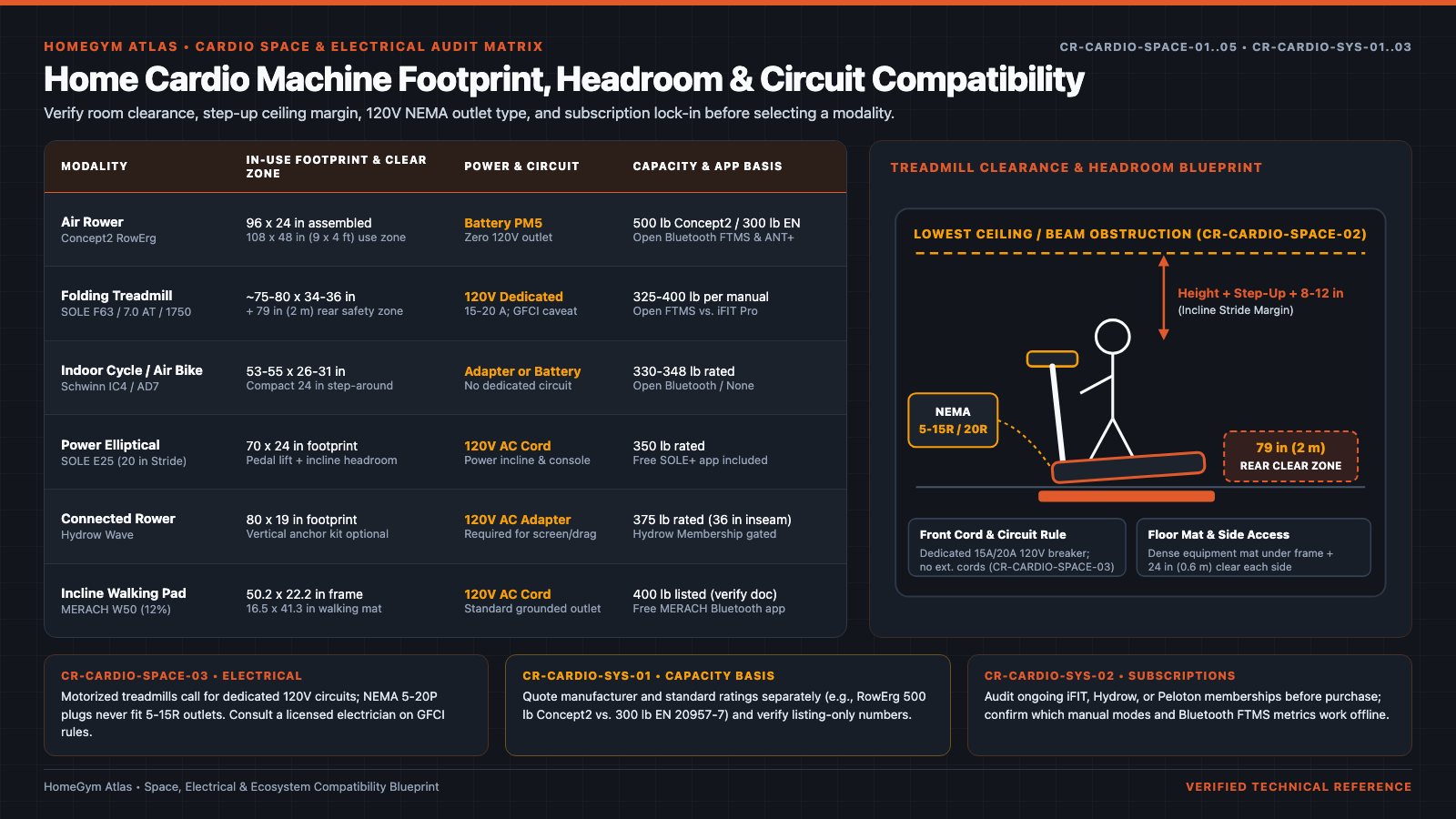
Selecting the best cardio machine for home requires verifying physical clearances, branch-circuit capacity, and software lock-in before you compare console bells and whistles. The four engineering checkpoints below prevent expensive freight returns and breaker trips.
1. Clearance Zones, Rower Footprints & Ceiling Headroom (CR-CARDIO-SPACE-01, 02, 05)
Never size a room from a machine’s shipping box or folded footprint alone. Under rule CR-CARDIO-SPACE-01, motorized treadmills like the Horizon 7.0 AT, SOLE F63, and NordicTrack Commercial 1750 require an unobstructed rear safety clearance zone behind the belt—Horizon’s manual specifies 79 in (2 m / ~6.5 ft) of clear length at least the full width of the machine, plus 12 in (30.5 cm) in front so the power cord never pinches against drywall. Rowers follow rule CR-CARDIO-SPACE-05: while the Concept2 RowErg sits 96 x 24 in (244 x 61 cm) assembled, its full-stroke operating footprint expands to 108 x 48 in (9 x 4 ft / 274 x 122 cm).
Vertical ceiling headroom (CR-CARDIO-SPACE-02) trips up basement buyers just as often. Add your standing height to the machine’s maximum step-up height—8.625 in (21.9 cm) flat on the Horizon 7.0 AT, rising sharply when tilted to 12% or 15% incline—plus several inches of running bounce, and check that total against your lowest ceiling joist, ductwork, or garage-door track. Front-drive ellipticals such as the SOLE E25 lift your feet even higher at the top of the pedal arc and power incline. If your room has an 84 in (7 ft) basement ceiling, seated machines like the Concept2 RowErg, Hydrow Wave, Schwinn IC4, or Schwinn Airdyne AD7 clear overhead obstructions effortlessly.
2. 120V Dedicated Circuits, NEMA Plugs & GFCI Caveats (CR-CARDIO-SPACE-03)
Motorized treadmills draw heavy starting inrush current. Most residential manuals—including SOLE and Horizon—call for a dedicated 120V circuit (15 A or 15–20 A depending on model) using a grounded NEMA 5-15 three-prong wall receptacle, with zero shared refrigerators, space heaters, or garage door openers on the same breaker and zero extension cords. If you ever encounter a commercial treadmill sporting a 20 A NEMA 5-20P plug, it physically will not fit a standard residential NEMA 5-15R outlet without a licensed electrician upgrading the circuit and receptacle.
Watch closely for GFCI outlet conflicts in garages and unfinished basements. SOLE owner manuals explicitly instruct owners not to plug treadmills into a GFCI wall outlet because motor startup surges trigger nuisance trips, yet local electrical codes often mandate GFCI protection in garages and basements. Never bypass protective devices or improvise wiring: follow the manufacturer’s instructions and have a licensed electrician inspect your breaker panel and receptacle to resolve local code requirements safely. Review our dedicated treadmill dedicated circuit requirements guide before running a heavy motor in a garage bay.
3. Connected Subscriptions vs. Open Bluetooth FTMS & ANT+ FE-C (CR-CARDIO-SYS-02, 03)
Connected fitness platforms fall into two sharply different ownership models. Closed or semi-closed systems like the NordicTrack Commercial 1750 (iFIT Pro Membership) and Hydrow Wave (Hydrow Membership) deliver polished studio coaching and automatic terrain feedback, but gate core video classes, workout history, and interactive features behind an ongoing paid monthly subscription. If you cancel, manual belt or drag movement still works, yet the screen loses its primary value.
Open-protocol machines—led by the Concept2 RowErg (Bluetooth FTMS and ANT+ FE-C), Horizon 7.0 AT (Bluetooth FTMS), and Schwinn IC4 (open Bluetooth)—broadcast standardized speed, stroke, or cadence data to third-party apps on your own phone or tablet with zero mandatory fees. Similarly, the SOLE F63, SOLE E25, and MERACH W50 include free brand apps, while the Schwinn Airdyne AD7 skips apps entirely for distraction-free interval clocks.
4. Upgrade Roadmap & Hidden Ownership Costs (CR-CARDIO-ATT-01, CR-SYS-04)
Hardware checkout is rarely your final expense. First, plan for a dense rubber or PVC equipment mat sized to your machine’s footprint (CR-CARDIO-ATT-01): many manuals advise against setting motorized treadmills directly on deep carpet because dust and fibers get pulled into the motor compartment, and mats help protect hardwood or LVP from heavy stabilizer feet and sweat. Second, factor in freight delivery logistics (CR-SYS-04)—257 to 265.7 lb (116.6 to 120.5 kg) treadmills typically ship curbside, requiring two strong helpers and wide doorway turns to move upstairs or into basements. Third, budget for basic maintenance consumables: 100% silicone treadmill belt lubricant for the F63, 7.0 AT, and W50, D-cell batteries for the RowErg PM5, and optional accessories such as Hydrow’s Vertical Anchor Kit for upright wall storage.
5. Room & Budget Resolver: Garage Gym vs. Quiet Apartment
Match your machine to the room’s weakest link rather than forcing a treadmill into a compromised space. In a second- or third-floor apartment with strict noise rules and unknown subfloor load limits (CR-CARDIO-SPACE-04), skip 260 lb motorized treadmills and choose the whisper-quiet Schwinn IC4 indoor cycle or the electromagnetic Hydrow Wave—or explore compact cycles in our best exercise bike for home guide. In an unheated two-car garage with no spare 120V breaker capacity, a Concept2 RowErg or Schwinn Airdyne AD7 delivers unlimited conditioning work on battery power alone. Finally, reserve motorized folding treadmills like the NordicTrack 1750, SOLE F63, or Horizon 7.0 AT for ground-floor rooms, slabs, or reinforced spaces with verified ceiling height, dedicated circuits, and full 79 in (2 m) rear safety zones.
How We Audited, Scored & Filtered These Models
Rather than publishing unsubstantiated lab numbers, IronGym Lab conducts engineering specification audits grounded strictly in manufacturer owner manuals, official spec sheets, ASTM/EN equipment standards, and federal CPSC safety notices. Read our full Evaluation Methodology for our sourcing hierarchy. Every pick above is evaluated against a transparent 100% weighted rubric:
| Evaluation Criterion | Weight | What We Audited |
|---|---|---|
| Core Manual Specs & Load Capacity | 30% | Deck size, stride length or flywheel resistance, speed/incline range, motor rating with stated basis (never equating peak vs. continuous HP across brands), and traceable maximum user weight capacity. |
| Space, Clearance & 120V Electrical Fit | 25% | Assembled and stored dimensions, 79 in (2 m) treadmill rear safety clearance, step-up ceiling headroom, upper-floor weight/freight path, and dedicated 120V NEMA/GFCI rules. |
| Ecosystem Openness & Subscription Value | 20% | Bluetooth FTMS and ANT+ FE-C protocol support, manual offline usability, and whether core tracking or resistance requires an ongoing paid subscription. |
| Warranty, Safety Record & Tier Value | 25% | Frame, motor, parts, and labor warranty terms, brand ownership stability, official CPSC recall status, and hardware value within its budget tier. |
Models We Audited & Rejected (And Why)
- Peloton Cross Training Exercise Bike & Legacy PL01 Listings: Excluded from our top 9 picks because core studio metrics and classes require an ongoing paid Peloton All-Access Membership (CR-CARDIO-SYS-02), its 297 lb (134.7 kg) user limit trails the Schwinn IC4’s 330 lb (149.7 kg) rating, and legacy original Bike (Model PL01, non-swivel screen) inventory is subject to the May 11, 2023 CPSC recall covering roughly 2.2 million units whose seat posts can break during use (free replacement seat post remedy available from Peloton; buyers of older bikes should check the CPSC recall page and verify replacement compliance).
- Unbranded Budget Walking Pads (Under $200): Disqualified under CR-SYS-02 because advertised user weight limits could not be traced to verifiable manufacturer manuals or US warranty centers, and listings frequently omit 120V electrical draw specifications.
- Commercial 20 A NEMA 5-20P Treadmills: Excluded from residential roundup rankings under CR-CARDIO-SPACE-03 (HARD plug mismatch) because a NEMA 5-20P plug physically cannot insert into a standard household 15 A NEMA 5-15R wall outlet without a licensed electrician installing a dedicated 20 A branch circuit.
- Niceday CT11S-18 Compact Dual-Axis Elliptical: Left off our main roster because its ultra-short 39.6 in (100.6 cm) dual-axis track prioritizes micro-footprints over the flatter 20 in (50.8 cm) front-drive stride mechanics offered by full-length trainers like the SOLE E25.
Frequently Asked Questions About Home Cardio Machines
What is the best cardio machine for home spaces with low ceilings or no dedicated 120V circuit?
An air rower like the Concept2 RowErg or a battery-console fan bike like the Schwinn Airdyne AD7 fits best. Both operate without a 120V outlet, avoid treadmill deck step-up height limits under low basement beams, and require zero ongoing monthly subscriptions.
How much clearance space does a home treadmill actually require?
Beyond the 75–80 in (190.5–203.2 cm) frame length, owner manuals such as Horizon’s specify at least 79 in (2 m) of unobstructed rear safety clearance behind the belt and 12 in (30.5 cm) in front for the power cord, plus clear side access.
Can I plug a motorized treadmill into a GFCI outlet or extension cord?
Most treadmill manuals prohibit extension cords and warn that motorized treadmills frequently nuisance-trip GFCI outlets—SOLE manuals explicitly advise against GFCI use. Because garage and basement electrical codes often require GFCI protection, have a licensed electrician inspect your panel and advise.
Which home cardio machines work without a paid monthly subscription?
The Concept2 RowErg, SOLE F63, Horizon 7.0 AT, Schwinn IC4, Schwinn Airdyne AD7, SOLE E25, and MERACH W50 all operate fully without paid memberships. By contrast, NordicTrack iFIT and Hydrow restrict guided classes, streaming, and workout history behind ongoing paid plans.
Why does the Concept2 RowErg list both 500 lb and 300 lb weight limits?
Concept2 rates the RowErg to 500 lb (226.8 kg) based on its internal factory standard, while the European Stationary Fitness Equipment standard EN 20957-7 rates it to 300 lb (136.1 kg). Always note both figures and their rating basis when comparing capacities.
Do I need an equipment mat under a treadmill, rower, or exercise bike?
Yes—many manufacturers recommend a dense rubber or PVC equipment mat under cardio hardware. Mats help keep carpet fibers and floor dust out of treadmill motor housings, protect flooring finishes from stabilizer feet, and keep rowing rails from creeping.
Final Verdict: Which Cardio Machine Should You Buy?
For most households, the best cardio machine for home use is the Concept2 RowErg (review above). Its battery-powered PM5 console bypasses dedicated 120V circuit headaches, its two-piece split storage solves small-room bottlenecks, its dual 500 lb (226.8 kg) Concept2 and 300 lb (136.1 kg) EN 20957-7 capacity ratings are transparently documented, and its open Bluetooth FTMS and ANT+ FE-C telemetry avoids membership lock-in forever.
If your training centers on indoor running and your room passes the 79 in (2 m) rear safety zone, ceiling headroom, and dedicated 120V electrical checks, pick the NordicTrack Commercial 1750 for -3% decline to 12% incline terrain or the SOLE F63 and Horizon 7.0 AT for subscription-free running decks. Cyclists wanting quiet apartment rides with open app support should choose the Schwinn IC4, garage conditioning athletes should grab the outlet-free Schwinn Airdyne AD7, and remote workers adding under-desk steps can slot the MERACH W50 beneath a standing workstation.


