
Disclosure: As an Amazon Associate, IronGym Lab earns from qualifying purchases. If you buy through Amazon links on this page, we may earn a small commission at no extra cost to you.
Choosing between the Titan T-3 vs X-3 is one of the clearest structural decisions in home strength equipment. Both power rack lines sit inside the mid-range rack tier ($500–$1,500) on Amazon US, and both share 11-gauge steel, ~11/16 in laser-cut holes for 5/8 in (15.9 mm) hardware pins, a 42 in (106.7 cm) inside cage width, and Westside 1 in (25.4 mm) bench-zone hole spacing. Where they diverge is critical: the Titan T-3 uses 2″ x 3″ (50.8 x 76.2 mm) rectangular bolt-down tubing rated to 1,100 lb (499.0 kg) rackable, whereas the Titan X-3 steps up to 3″ x 3″ (76.2 x 76.2 mm) square uprights rated to 1,650 lb (748.4 kg) rackable with both Flat Foot freestanding and Bolt-Down models.
If you are mapping out your primary barbell station alongside our best power rack for home gym hub, there is no single universal winner between the T-3 and X-3. Instead, your decision comes down to four verified engineering criteria: 4-way square attachment compatibility versus compact 2″ x 3″ tubing, freestanding Flat Foot placement versus concrete floor anchoring, available ceiling clearance, and whether 24 in or 36 in inside cage depth fits your lifting stance best.
In This Comparison
- Quick Verdict Matrix: Titan T-3 vs. X-3 by Use Case
- Side-by-Side Verified Spec & Compatibility Table
- 1. 2×3 vs. 3×3 Uprights & Attachment Cross-Fit (CR-RACK-ATT-01 / 03)
- 2. Rackable vs. Whole-Rack Capacity & Weakest-Link Limits (CR-RACK-SYS-02)
- 3. Flat Foot vs. Bolt-Down Anchoring & Room Fit (CR-RACK-SPACE-01 / 05)
- 4. Hole Spacing, Bench Clearance & Warranty Terms
- Side-by-Side Decision Cards: Choose T-3 vs. Choose X-3
- Verified Amazon US Configurations & Audits
- Compatibility Rules Audited & Authoritative Sources
- Frequently Asked Questions: Titan T-3 vs. X-3
Quick Verdict Matrix: Titan T-3 vs. X-3 by Use Case
Before comparing hardware tolerances in detail, match your room constraints and training priorities to the exact configuration that solves them. Notice that Titan sells multiple variants inside each series—including full 4-post cages and wall-mounted space-saving frames—so the base style and depth matter just as much as the series badge.
| Lifter Scenario & Room Constraint | Best Fit | Engineering & Compatibility Reason |
|---|---|---|
| Garage or rental floor where drilling concrete is off-limits | Titan X-3 Flat Foot | Extended flat-foot base rails stand freestanding on concrete or 3/4 in (19 mm) rubber stall mats without mandatory floor anchors (CR-RACK-SPACE-05). |
| Dedicated powerlifting bay anchored to slab or plywood platform | Titan T-3 Bolt-Down (36 in) | 11-gauge 2″ x 3″ frame offers a generous 36 in (91.4 cm) inside depth and 1,100 lb (499.0 kg) rackable capacity once bolted per Titan’s manual. |
| Future expansion with 4-way 3×3 aftermarket accessories | Titan X-3 (Flat Foot or Bolt-Down) | True 3″ x 3″ square uprights with 6 in side holes accept front, rear, and side-mounted add-ons across the largest 5/8 in ecosystem (CR-RACK-ATT-01). |
| Low 84 in (7 ft) basement ceiling under beams or ducts | Titan X-3 Bolt-Down (80 in) | 80 in (203.2 cm) tall Bolt-Down upright option clears tight 84 in basement joists with assembly margin; Flat Foot starts at 82 in (CR-RACK-SPACE-01). |
| Ultra-compact wall bay needing 24 in fixed depth | Titan T-3 Space Saving (24 in) | 2″ x 3″ 11-gauge wall-mounted half-rack trims floor depth to 24 in (61.0 cm) while preserving Westside 1 in bench-zone spacing. |
| Heavy barbell loads approaching 1,000+ lb on J-cups | Titan X-3 Series | 1,650 lb (748.4 kg) rackable rating gives 50% more rated barbell headroom than the T-3’s 1,100 lb (499.0 kg) rackable limit (CR-RACK-SYS-01). |
Side-by-Side Verified Spec & Compatibility Table
Every specification below is verified directly from Titan Fitness’s published T-3 Series, X-3 Series, and comparison documentation. Because Titan updates production runs and differentiates Flat Foot from Bolt-Down models, we separate configuration-level dimensions clearly rather than blending them into one row.
| Specification | Titan T-3 Series Power Rack | Titan X-3 Series (Flat Foot / Bolt-Down) |
|---|---|---|
| Upright Tube Size & Gauge | 2″ x 3″ (50.8 x 76.2 mm), 11-gauge rectangular steel | 3″ x 3″ (76.2 x 76.2 mm), 11-gauge square steel |
| Hardware Pin & Hole Size | 5/8 in (15.9 mm) pins inside ~11/16 in holes | 5/8 in (15.9 mm) pins inside ~11/16 in holes |
| Hole Spacing Pattern | Westside 1 in (25.4 mm) bench/clean zone; 2 in (50.8 mm) above/below | Westside 1 in (25.4 mm) bench/clean zone; 2 in above/below; 6 in side holes |
| Rackable Capacity (Basis) | 1,100 lb (499.0 kg) rackable (Titan Fitness spec) | 1,650 lb (748.4 kg) rackable (Titan Fitness spec) |
| Whole-Rack Capacity (Basis) | 4,400 lb (1,995.8 kg) whole rack (Titan Fitness spec) | 6,170 lb (2,798.7 kg) whole rack (Titan Fitness spec) |
| Height Options | 82 in (208.3 cm) or 91 in (231.1 cm) | Flat Foot: 82 in / 91 in • Bolt-Down: 80 in / 90 in (203.2 / 228.6 cm) |
| Inside Width & Depth | 42 in (106.7 cm) inside width; 24 in or 36 in (61.0 or 91.4 cm) inside depth | 42 in (106.7 cm) inside width; Flat Foot 30 in (76.2 cm) depth; Bolt-Down 24 in or 36 in |
| Base Style & Anchoring | Bolt-down base plates (requires anchoring per manual unless stabilizer feet added) | Flat Foot: freestanding base • Bolt-Down: requires floor/platform anchoring |
| Attachment Mounting Axes | 2-way front/rear orientation (2 in face width) | 4-way square orientation (3 in equal faces on all sides) |
| Included Hardware | UHMW-lined J-hooks, pin-and-pipe safeties, pull-up bars | UHMW-lined J-hooks, pin-and-pipe safeties, 1.25 in skinny & 2 in fat pull-up bars |
| US Manufacturer Warranty | 1-year limited warranty (90-day failure claim rule; Scratch & Dent excluded) | 1-year limited warranty (90-day failure claim rule; Scratch & Dent excluded) |
| Budget Tier & Channel | Mid-Range ($500–$1,500) on Amazon US & direct | Mid-Range ($500–$1,500) on Amazon US & direct |
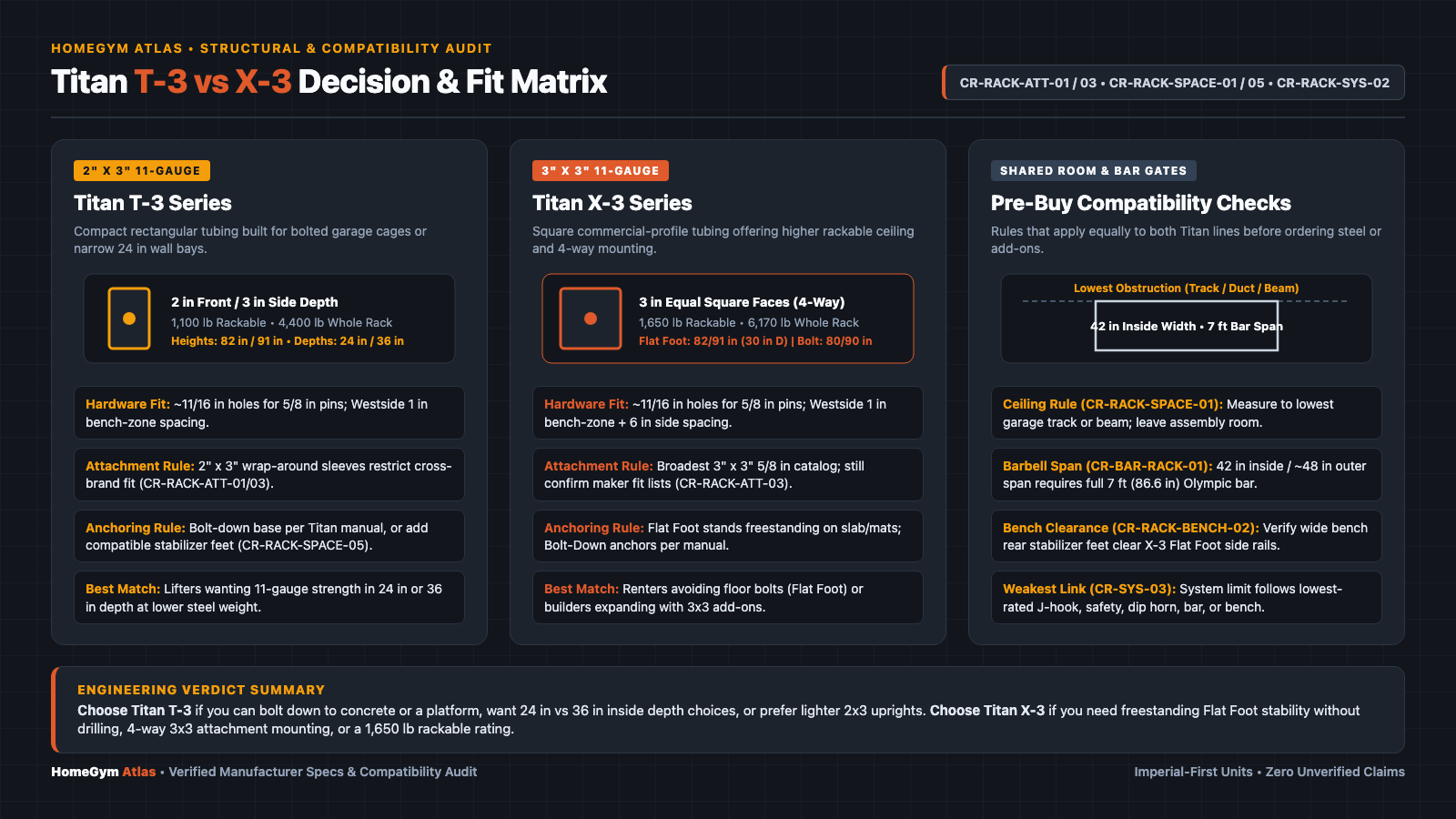
1. 2×3 vs. 3×3 Uprights & Attachment Cross-Fit (CR-RACK-ATT-01 / 03)
The defining hardware difference in the Titan T-3 vs X-3 matchup is upright tube geometry. Under rack compatibility rule CR-RACK-ATT-01, an attachment’s upright bracket must match the rack’s outer tube profile, while rule CR-RACK-ATT-02 requires the hardware pin diameter to match independently. Both the T-3 and X-3 use ~11/16 in laser-cut holes sized for 5/8 in (15.9 mm) pins—meaning pin diameter is identical—but their outer tube shapes create very different accessory ecosystems.
The Titan T-3 uses 2″ x 3″ (50.8 x 76.2 mm) 11-gauge rectangular steel oriented with the narrower 2 in face pointing front and back and the 3 in face forming the sides. Because wrap-around J-hooks, spotter arms, and lever-arm brackets are welded to hug a 2″ x 3″ sleeve, accessories built for 3″ x 3″ racks will sit loosely with a 1 in gap if mounted on a T-3, and T-3 attachments physically will not slide over a 3″ x 3″ X-3 post. Just as important, a rectangular 2″ x 3″ upright restricts wrap-around hardware to front or rear mounting rather than rotating 90 degrees onto the side face. For a broader breakdown of how tube geometry drives accessory selection across brands, see our dedicated 3×3 vs 2×3 power rack guide.
The Titan X-3 moves to symmetrical 3″ x 3″ (76.2 x 76.2 mm) 11-gauge square tubing with holes down the front/rear faces plus 6 in spacing along the sides. That square profile enables true 4-way mounting: you can mount Titan X-3 Y-dip horns, band pegs, plate storage horns, or landmines on the outside, inside, front, or rear faces without geometry conflicts. Better still, 3″ x 3″ with 5/8 in pins is North America’s most widely supported aftermarket rack standard. However, under conditional rule CR-RACK-ATT-03, matching 3″ x 3″ tube width and 5/8 in pin diameter does not automatically guarantee cross-brand fit: hole offset from the upright edge, weld gussets, and crossmember flanges still vary across manufacturers. Always confirm that a third-party accessory maker explicitly lists the Titan X-3 (or T-3) before ordering. Note also that competing 3″ x 3″ 5/8 in racks like the Rogue Monster Lite and REP PR-4000, as well as 1 in hardware systems like the REP PR-5000, are not sold on Amazon and must be sourced direct if you cross-shop outside Amazon US.
2. Rackable vs. Whole-Rack Capacity & Weakest-Link Limits (CR-RACK-SYS-02)
Power rack shoppers frequently misread capacity numbers because brands quote different engineering bases—a pitfall flagged under rule CR-RACK-SYS-02. Titan Fitness transparently publishes two distinct figures for both racks: rackable capacity (how much loaded barbell weight the J-cups and safety system are rated to carry during squats and presses) and whole-rack capacity (cumulative vertical load across all four uprights, pull-up bars, and storage pegs).
- Titan T-3 Series: Rated by Titan Fitness to 1,100 lb (499.0 kg) rackable capacity and 4,400 lb (1,995.8 kg) whole-rack capacity (note: the 2-post T-3 Space Saving wall-mounted variant carries a 1,000 lb / 453.6 kg listing rating).
- Titan X-3 Series: Rated by Titan Fitness to 1,650 lb (748.4 kg) rackable capacity and 6,170 lb (2,798.7 kg) whole-rack capacity.
In practical home gym terms, 1,100 lb (499.0 kg) rackable capacity on the T-3 already exceeds what nearly all recreational and competitive strength lifters load onto a 20 kg (~44.1 lb) Olympic barbell. Where the X-3’s 50% higher 1,650 lb rackable rating and stiffer 3″ x 3″ tube cross-section stand out is reduced lateral sway during heavy walkouts, racked band work, or loaded attachment leverage, especially when you hang plate storage horns, dip stations, or lever arms off the uprights. Keep rule CR-SYS-03 in mind as well: a home gym setup is capped by its lowest-rated load-bearing component. If you mount an X-3 Y-Dip Bar rated to 550 lb (249.5 kg), your combined body weight plus dipped belt load must stay within that 550 lb attachment limit (CR-RACK-ATT-05), regardless of the frame’s 6,170 lb whole-rack ceiling. Similarly, check your Olympic barbell’s published load rating (or tensile PSI without fabricating a pound conversion under CR-PLATE-BAR-04) and your bench’s combined user-plus-barbell limit (CR-BENCH-SYS-01).
3. Flat Foot vs. Bolt-Down Anchoring & Room Fit (CR-RACK-SPACE-01 / 05)
Installation and room geometry separate these two Titan racks more sharply in everyday garages than raw steel thickness does. Under rule CR-RACK-SPACE-05, you must follow the manufacturer’s assembly and anchoring instructions rather than treating floor bolts as optional on bolt-down cages:
- Titan T-3 Power Rack Anchoring: The standard 4-post T-3 uses flanged bolt-down base plates and is designed to be anchored into a concrete slab or a multi-layer wood lifting platform per Titan’s manual. If you cannot drill your floor, Titan sells bolt-on front/rear stabilizer extension feet specifically engineered for T-3/X-3 bolt-down frames to resist tipping during rack pull-ups or off-center racking.
- Titan X-3 Flat Foot vs. X-3 Bolt-Down: The X-3 family splits into two distinct structural bases. The X-3 Flat Foot integrates long side-rail base tubes (50 in D x 48 in W footprint; ~280 lb assembled weight) so it stands freestanding on concrete or 3/4 in (19 mm) rubber horse-stall mats without floor bolts. By contrast, the X-3 Bolt-Down uses compact base plates similar to the T-3 and requires structural anchoring to concrete or a platform per Titan’s instructions. If you rent a house, have a post-tensioned garage slab you cannot drill, or want flexibility to relocate the cage later, the X-3 Flat Foot solves anchoring cleanly; consult a qualified installer if you are uncertain about your slab or framing.
Height and room clearance checks (CR-RACK-SPACE-01) also differ slightly between configurations. The T-3 full cage and X-3 Flat Foot ship in 82 in (208.3 cm) and 91 in (231.1 cm) height options, whereas the X-3 Bolt-Down ships in slightly shorter 80 in (203.2 cm) and 90 in (228.6 cm) upright heights. For low 84 in (7 ft) basements with overhead ductwork or garages with low door tracks, that 2 in difference on the 80 in X-3 Bolt-Down can decide whether top crossmembers clear obstructions during assembly. Always measure down to the lowest beam, light fixture, or open garage-door rail—never just drywall—and leave extra headroom if you plan strict pull-ups above the top bar (CR-RACK-SPACE-02). Widthwise, both cages share a 42 in (106.7 cm) inside width (~46–48 in outer J-cup span), requiring a standard 7 ft (86.6 in / 2,200 mm) Olympic barbell with ~51.6 in (1,310 mm) between inner collars (CR-BAR-RACK-01) plus roughly 24 to 36 in per end for loading plates comfortably (CR-RACK-SPACE-04).
4. Hole Spacing, Bench Clearance & Warranty Terms
In the bench press and squat stations, the T-3 and X-3 feel remarkably alike—with one subtle floor-rail catch on the X-3 Flat Foot. Current production runs of both the T-3 and X-3 power racks incorporate Westside hole spacing (1 in / 25.4 mm center-to-center increments through the bench and clean-pull zones, transitioning to 2 in / 50.8 mm increments above and below per CR-RACK-ATT-06). That 1 in micro-adjustment makes it easy to position pin-and-pipe safeties—which are designed and rated to catch a loaded barbell within Titan’s rackable spec—just below your chest arch without interfering with bar touch points (CR-RACK-BENCH-01). Both cages also ship with UHMW-lined J-hooks (CR-BAR-RACK-02) to protect barbell shaft coatings and knurling from bare-metal contact.
Check your weight bench’s rear base width before choosing the X-3 Flat Foot, however (CR-RACK-BENCH-02). Because the X-3 Flat Foot relies on gusseted horizontal side rails sitting directly on the floor along the 42 in inside width, extra-wide adjustable bench stabilizer feet can bump into the lower side rails when sliding the bench back for incline pressing. Bolt-down T-3 and Bolt-Down X-3 frames lack full-length side-floor rails (aside from rear crossmembers), leaving slightly cleaner floor clearance along the interior sides. Note also that the T-3 and X-3 Bolt-Down offer a 36 in (91.4 cm) inside depth option—6 in deeper than the X-3 Flat Foot’s fixed 30 in (76.2 cm) inside depth—which tall squatters appreciate for wide walkouts.
Finally, factor in warranty coverage and delivery logistics. Both the Titan T-3 and X-3 carry Titan Fitness’s 1-year limited warranty against manufacturer defects (with claims required within 90 days of failure, and Scratch & Dent items excluded per Titan policy). Heavy 200 to 280+ lb steel cages ship in multiple boxed cartons (CR-SYS-04), so verify doorway access and assemble uprights sequentially per Titan’s manual. Remember also that Titan has occasionally revised hole geometry or upright specs across older rack generations (ISS-RACK-SPEC-CONFLICT-TITAN), so confirm exact crossmember and attachment fit against your rack’s current product sheet before buying add-ons.
Side-by-Side Decision Cards: Choose T-3 vs. Choose X-3
Choose Titan T-3 Series if…
- You can bolt your rack cleanly to a concrete garage slab or a multi-layer wood lifting platform per Titan’s manual (CR-RACK-SPACE-05).
- You want a deep 36 in (91.4 cm) inside cage or compact 24 in (61.0 cm) wall-mount depth in 11-gauge steel without paying for 3×3 tubing.
- Your heaviest barbell squats and bench presses sit comfortably below the 1,100 lb (499.0 kg) rackable limit.
- You prefer lighter upright cartons during delivery and solo garage assembly (CR-SYS-04).
Choose Titan X-3 Series if…
- You want a freestanding Flat Foot cage that does not require drilling concrete or rental floors.
- You want 3″ x 3″ 11-gauge uprights with 4-way mounting and the broadest 5/8 in aftermarket attachment compatibility (CR-RACK-ATT-01).
- You want Titan’s higher 1,650 lb (748.4 kg) rackable rating and added frame mass for heavy squats, dips, or band work.
- You need the 80 in (203.2 cm) X-3 Bolt-Down upright height to squeeze under an 84 in basement obstruction (CR-RACK-SPACE-01).
Verified Amazon US Configurations & Audits
To see how the X-3 and T-3 compare against rival sub-$1,000 cages from PRx, Major Fitness, and REP Fitness, browse our full best power racks under $1,000 comparison. Below are the four verified Titan Fitness T-3 and X-3 configurations currently active on Amazon US.
1. Titan Fitness X-3 Series Flat Foot Power Rack (3″x3″ 11-Gauge) — Best Freestanding 3×3

Key Specs: 3″ x 3″ (76.2 x 76.2 mm) 11-gauge square steel | ~11/16 in holes for 5/8 in (15.9 mm) pins, Westside 1 in bench-zone spacing + 6 in side holes | 1,650 lb (748.4 kg) rackable / 6,170 lb (2,798.7 kg) whole rack (Titan Fitness) | 50″ D x 48″ W x 82″ H (127.0 x 121.9 x 208.3 cm); 30″ inside depth, 42″ inside width | Price Tier: Mid-Range ($500–$1,500)
The X-3 Flat Foot is the most versatile pick in the Titan lineup for garage and basement lifters who cannot—or choose not to—bolt into concrete. Its extended side-rail base keeps the 280 lb (127.0 kg) frame planted on slab or 3/4 in (19 mm) rubber mats while giving you true 3″ x 3″ 4-way attachment mounting, UHMW-lined J-hooks, pin-and-pipe safeties, and dual 1.25 in skinny / 2 in fat pull-up bars.
Pros
- Stands freestanding without mandatory floor bolts on level concrete or stall mats (CR-RACK-SPACE-05)
- 1,650 lb (748.4 kg) rackable capacity with 3″ x 3″ 11-gauge steel and 4-way 5/8 in mounting
- Includes UHMW-lined J-hooks and dual skinny/fat pull-up bars in the base kit
Cons
- Flat-foot lower side rails can contact wide adjustable bench stabilizer feet inside the 42 in cage (CR-RACK-BENCH-02)
- Fixed 30 in inside depth offers less room than the 36 in Bolt-Down T-3 and X-3 models
- Titan’s 1-year limited warranty is shorter than lifetime frame warranties on direct-sale rivals
2. Titan Fitness T-3 Series Power Rack (2″x3″ 11-Gauge) — Best Bolt-Down Value

Key Specs: 2″ x 3″ (50.8 x 76.2 mm) 11-gauge rectangular steel | ~11/16 in holes for 5/8 in (15.9 mm) pins, Westside 1 in bench-zone spacing | 1,100 lb (499.0 kg) rackable / 4,400 lb (1,995.8 kg) whole rack (Titan Fitness) | 82 in or 91 in height; 24 in or 36 in inside depth; 42 in inside width | Price Tier: Mid-Range ($500–$1,500)
If your garage already has a bolted plywood lifting platform or you do not mind anchoring four base flanges into concrete, the T-3 Power Rack delivers genuine 11-gauge steel and Westside 1 in bench-zone adjustability at a lower price and carton weight than the X-3. Choosing the 36 in inside-depth model also gives tall lifters generous inside-cage walking room with zero side floor rails blocking bench legs.
Pros
- 11-gauge 2″ x 3″ steel with 1,100 lb (499.0 kg) rackable rating covers heavy home barbell training
- Available in both 24 in compact and 36 in deep inside configurations plus 82 in or 91 in heights
- Retains 5/8 in hardware and Westside 1 in bench-zone hole spacing
Cons
- Requires concrete or platform floor anchoring per Titan instructions unless compatible stabilizer feet are added (CR-RACK-SPACE-05)
- Rectangular 2″ x 3″ uprights restrict wrap-around 3″ x 3″ third-party attachment compatibility (CR-RACK-ATT-01)
3. Titan Fitness X-3 Series Bolt-Down Power Rack (3″x3″ 11-Gauge) — Best 3×3 for Low Ceilings & 36 in Depth

Key Specs: 3″ x 3″ (76.2 x 76.2 mm) 11-gauge square steel | ~11/16 in holes for 5/8 in (15.9 mm) pins, Westside 1 in bench-zone spacing + 6 in side holes | 1,650 lb (748.4 kg) rackable / 6,170 lb (2,798.7 kg) whole rack (Titan Fitness) | 80 in or 90 in height; 24 in or 36 in inside depth; 42 in inside width | Price Tier: Mid-Range ($500–$1,500)
The X-3 Bolt-Down combines the T-3’s flexible 24 in / 36 in depth options and cleaner side-floor bench clearance with the X-3’s 3″ x 3″ square uprights and 1,650 lb rackable rating. Better yet, its shorter 80 in (203.2 cm) height variant offers valuable extra margin under 84 in (7 ft) basement joists compared with 82 in Flat Foot models (CR-RACK-SPACE-01).
Pros
- 80 in short option and 36 in inside depth option solve tight ceilings and deep squat walkouts
- Removes side flat-foot floor rails, improving interior clearance for wide bench feet (CR-RACK-BENCH-02)
- Full 3″ x 3″ 5/8 in 4-way mounting ecosystem with 1,650 lb (748.4 kg) rackable rating
Cons
- Requires concrete or wood platform anchoring per Titan’s installation manual (CR-RACK-SPACE-05)
- Heavy ~240+ lb steel package arrives across multiple boxes requiring planned assembly (CR-SYS-04)
4. Titan Fitness T-3 Series Space Saving Rack (91″ H x 24″ D) — Best Narrow Wall Bay

Key Specs: 2″ x 3″ (50.8 x 76.2 mm) 11-gauge steel | ~11/16 in holes for 5/8 in (15.9 mm) pins, Westside 1 in bench-zone spacing | 1,000 lb (453.6 kg) listing capacity | 91 in (231.1 cm) H x 24 in (61.0 cm) fixed wall depth | Price Tier: Budget-to-Mid ($350–$500)
For single-bay garages that need 11-gauge T-3 uprights and Westside bench spacing without giving up 4 to 5 feet of floor depth, the T-3 Space Saving Rack anchors directly to wall framing and the floor at a fixed 24 in (61.0 cm) depth. Because it is a 2-post wall-mounted half-rack rather than a 4-post cage, pair it with Titan T-3 spotter arms (CR-RACK-ATT-04) for solo squats and presses.
Pros
- 24 in (61.0 cm) fixed wall projection preserves garage aisle and parking space
- 91 in upright height gives taller lifters comfortable strict pull-up clearance where ceilings exceed 96 in
Cons
- 2-post design cannot use 4-post pin-pipe or strap safeties; compatible spotter arms must be ordered separately (CR-RACK-ATT-04)
- Requires structural wall and floor anchoring per Titan’s manual; unsuitable for unbolted rentals (CR-RACK-SPACE-05)
Compatibility Rules Audited & Authoritative Sources
To prevent mismatched upright accessories, overlooked ceiling obstructions, or misleading headline load figures, our Titan T-3 vs X-3 audit evaluated the following IronGym Lab compatibility rules and primary manufacturer documents:
- CR-RACK-ATT-01 & CR-RACK-ATT-02 (Tube & Pin Independence): Both T-3 and X-3 use 5/8 in (15.9 mm) pins inside ~11/16 in holes, but 2″ x 3″ and 3″ x 3″ attachment brackets do not interchange cleanly.
- CR-RACK-ATT-03 & CR-RACK-ATT-04 (Maker Fit Lists & Configuration): Confirm the attachment maker lists your exact T-3 or X-3 model, and check 4-post vs. 2-post requirements for safeties and lat towers.
- CR-RACK-SPACE-01, 02, 04 & 05 (Clearance & Anchoring): Measure lowest overhead tracks/ducts, allow 7 ft (86.6 in) bar width plus plate-loading space, and follow Titan’s anchoring manual strictly (or select the freestanding X-3 Flat Foot).
- CR-RACK-SYS-01, CR-RACK-SYS-02 & CR-SYS-03 (Capacity Basis & Weakest Link): Compare rackable barbell ratings (1,100 lb vs. 1,650 lb) separately from whole-rack figures (4,400 lb vs. 6,170 lb), and cap setups at the lowest-rated attachment, bar, or bench.
- CR-RACK-BENCH-01, 02 & CR-BAR-RACK-01, 02: Check wide bench stabilizer clearance against X-3 Flat Foot lower side rails, use a full-length Olympic bar spanning 42 in inside width, and leverage UHMW J-hook liners.
Authoritative Manufacturer Citations:
- Titan Fitness — Power Rack Comparison Guide (T-2, T-3, X-3)
- Titan Fitness — T-3 Series Power Rack Official Specifications
- Titan Fitness — X-3 Series Power Rack Official Specifications
- Titan Fitness — Official Warranty Policy & Terms
How We Audited This Guide
- Strength hardware was audited across upright tube dimensions (2x2, 2x3, 3x3 in), 5/8-in vs 1-in pin hardware, sleeve fit, rated vs rackable capacities, and bench pad height clearances.
- Every power rack, barbell, weight plate, bench, adjustable dumbbell, cardio machine, and flooring spec was cross-checked against official manufacturer manuals, CPSC notices, and live Amazon US listings.
- Recommendations were evaluated against our weighted vertical scoring rubrics and documented CR-* compatibility rules; we never invent load capacities, motor ratings, rubber thickness, or decibels.
Continue Your Audit
- Best Power Racks Under $500 (2026): 8 Budget Cages Audited
- Best Squat Racks for Low Ceilings 2026: Under 80 in Racks Audited
Frequently Asked Questions: Titan T-3 vs. X-3
Do Titan T-3 and X-3 attachments fit each other?
Most structural attachments do not cross-fit because of upright tube width (CR-RACK-ATT-01). While both racks use 5/8 in (15.9 mm) pins inside ~11/16 in holes, J-hooks, spotter arms, and lever brackets built for 2″ x 3″ T-3 uprights cannot slide onto 3″ x 3″ X-3 uprights, and 3″ x 3″ brackets sit loose on 2″ x 3″ tubes.
Does the Titan T-3 or X-3 need to be bolted to the floor?
Bolt-down T-3 and X-3 models require anchoring per Titan’s manual, whereas the X-3 Flat Foot does not (CR-RACK-SPACE-05). Anchor bolt-down cages to concrete or a plywood platform as Titan instructs, add Titan’s compatible stabilizer extensions if approved, or pick the freestanding X-3 Flat Foot.
Is 1,100 lb rackable capacity on the Titan T-3 enough for home lifting?
Yes—1,100 lb (499.0 kg) rackable capacity covers nearly all home barbell squats and presses (CR-RACK-SYS-01). Titan backs the T-3 with a 4,400 lb whole-rack limit, while the X-3 raises rackable capacity to 1,650 lb (748.4 kg) for extra stiffness under loaded attachments.
Which Titan rack fits better under a low basement ceiling?
The 80 in (203.2 cm) Titan X-3 Bolt-Down gives the tightest vertical clearance (CR-RACK-SPACE-01). Standard T-3 and X-3 Flat Foot short models measure 82 in (208.3 cm) tall, so measure down to your lowest duct, beam, or garage track before ordering.
Do both the Titan T-3 and X-3 have Westside hole spacing?
Yes—current Titan T-3 and X-3 cages both feature Westside 1 in (25.4 mm) bench-zone spacing (CR-RACK-ATT-06). Holes sit 1 in apart center-to-center through the bench and clean-pull zones and 2 in apart elsewhere, giving equal safety-bar height precision inside both cages.


