
Disclosure: As an Amazon Associate, IronGym Lab earns from qualifying purchases. If you buy through verified Amazon US links on this page, we may earn a commission at no extra cost to you. Direct-sale manufacturer lines referenced for technical context are explicitly labeled as not sold on Amazon and carry zero affiliate links.
When comparing an olympic bar vs standard bar for a home gym, the defining split comes down to sleeve diameter, inner collar span, and load ratings—not just total length. An Olympic barbell uses rotating 2 in (~50 mm) sleeves, measures ~86.6 in (2,200 mm) at 20 kg (~44.1 lb) for men’s bars or ~79.1 in (2,010 mm) at 15 kg (~33.1 lb) for women’s bars, and maintains a ~51.6 in (1,310 mm) collar span that racks cleanly inside standard power cages. A standard 1 in (25.4 mm) barbell runs 1 in thick from end to end without rotating sleeves, pairs exclusively with 1 in center-hole plates, and commonly tops out around 250 lb (113.4 kg) on entry retail listings.
Neither bar is universally right for every room or budget. If you are planning a full strength setup from our best Olympic barbells for home gyms hub, an Olympic system prevents expensive dead ends when adding racks, bumper plates, or landmines. If you already own 1 in cast-iron plates for light accessory work in a compact bedroom, a standard 5 ft or 6 ft bar keeps upfront costs in the Budget (Under $100) tier—provided you understand its hard compatibility ceilings.
In This Barbell Comparison
- Quick Verdict: Olympic vs. Standard by Use Case
- Side-by-Side Spec & Compatibility Table
- 2 in vs. 1 in Sleeves: Plate Fit & Sleeve Capacity
- Collar Span, Power Rack Fit & Room Width
- Bar Weight (20 kg vs. 45 lb), Shaft Diameter & Sleeve Spin
- Tensile Strength (PSI) vs. Pound Capacity Ratings
- Safe Loading, Collars & Manufacturer-First Setup
- Decision Summary: Olympic vs. Standard Bar
- Verified Amazon US Olympic & Standard Barbells
- CR-* Rules, Authoritative Sources & FAQs
Quick Verdict: Olympic vs. Standard Barbell by Use Case
Because sleeve standard dictates your entire plate and rack ecosystem, there is no single universal winner. Match the barbell standard to your training space, target loads, and existing equipment below.
| Home Gym Scenario | Recommended Standard | Technical Basis & Trade-Off |
|---|---|---|
| Garage or basement power rack strength setup | Men’s 20 kg (~44.1 lb) Olympic Bar | ~51.6 in (1,310 mm) collar span clears 42–49 in rack J-cups (CR-BAR-RACK-01) and accepts heavy 2 in iron or bumper plates. |
| Lifters preferring a thinner grip or lighter empty bar | Women’s 15 kg (~33.1 lb) Olympic Bar | 25 mm shaft improves grip leverage while retaining the same ~51.6 in inner collar span to fit standard power racks—though sleeves are shorter. |
| Snatches, cleans, and bumper-plate overhead drops | 28 mm Needle-Bearing Olympic Bar | Independent needle-bearing sleeves reduce wrist torque during bar turnover and pair with drop-rated 2 in bumper plates on suitable flooring. |
| Tight spare bedroom without a rack (curls, rows, floor work) | Standard 1 in (25.4 mm) 5 ft / 6 ft Bar | Shorter 60–72 in footprint clears tight bedroom walls and fits Budget (Under $100) setups, but caps load ratings around 250 lb (113.4 kg). |
| Lifter who already owns 1 in cast-iron plates | Standard 1 in Bar (Short-Term) | Avoids immediate plate replacement if target loads remain within the bar’s verified rating; plan an Olympic upgrade before buying a power cage. |
| Landmine rows and plate-loaded rack attachments | 2 in (~50 mm) Olympic Bar | Standard landmine pivots and most commercial rack loading horns are machined for 2 in Olympic sleeves (CR-BAR-ATT-01). |
Side-by-Side Spec & Compatibility Comparison
The matrix below contrasts published International Weightlifting Federation (IWF) and International Powerlifting Federation (IPF) Olympic geometry against typical US retail standard 1 in straight bars. Where standard bars vary by brand or lack standardized tolerances, those gaps are flagged explicitly rather than assumed.
| Specification / Audit Factor | Olympic Barbell (Men’s 20 kg / Women’s 15 kg) | Standard Barbell (1 in / 25.4 mm) |
|---|---|---|
| Sleeve Diameter | ~1.97 in (~50 mm; STD-SLEEVE-OLY-50MM) | 1 in (25.4 mm; STD-SLEEVE-STD-1IN) |
| Plate Center-Hole Match | 2 in (~50.4–51 mm) Olympic iron, calibrated, or bumper plates | 1 in (~25.4–27 mm) standard iron or vinyl plates only |
| Overall Length | ~86.6 in (2,200 mm) men’s; ~79.1 in (2,010 mm) women’s | Commonly 60 in (5 ft) or 72 in (6 ft); occasional 84 in models |
| Bar Mass (Unloaded) | 20 kg (~44.1 lb) men’s; 15 kg (~33.1 lb) women’s | Non-standardized (~12–25 lb depending on length and hollow vs. solid steel) |
| Grip Shaft Diameter | 28–28.5 mm multipurpose; 29 mm power; 25 mm women’s | ~1 in (25.4 mm) throughout shaft and plate ends |
| Inner Collar Span | ~51.6 in (1,310 mm; IPF 1,310–1,320 mm) | Varies (~37–46 in on 5–6 ft bars); often too short for power racks |
| Loadable Sleeve Length | ~16.1–16.5 in per side (men’s); ~12.6–12.8 in (women’s) | Varies (~8–12 in threaded/smooth ends on 5–6 ft bars; verify per SKU) |
| Sleeve Rotation | Independent brass/bronze bushings or needle bearings | Fixed one-piece or pinned shaft (no rotating sleeve bearings) |
| Capacity & Tensile Reporting | 700–1,500+ lb on Amazon listings, or PSI-only on direct-sale bars (190,000+ PSI) | Commonly 250 lb (113.4 kg) stated on entry listings (verify basis per CR-SYS-02) |
| Power Rack J-Cup Fit | Passes CR-BAR-RACK-01 on standard 42–49 in wide cages | Frequently FAILS CR-BAR-RACK-01 on 5 ft and 6 ft lengths |
| Direct-Sale Reference Lines | Rogue Ohio Bar, REP Colorado Bar (not sold on Amazon) | Primarily budget retail and Amazon-native brands |
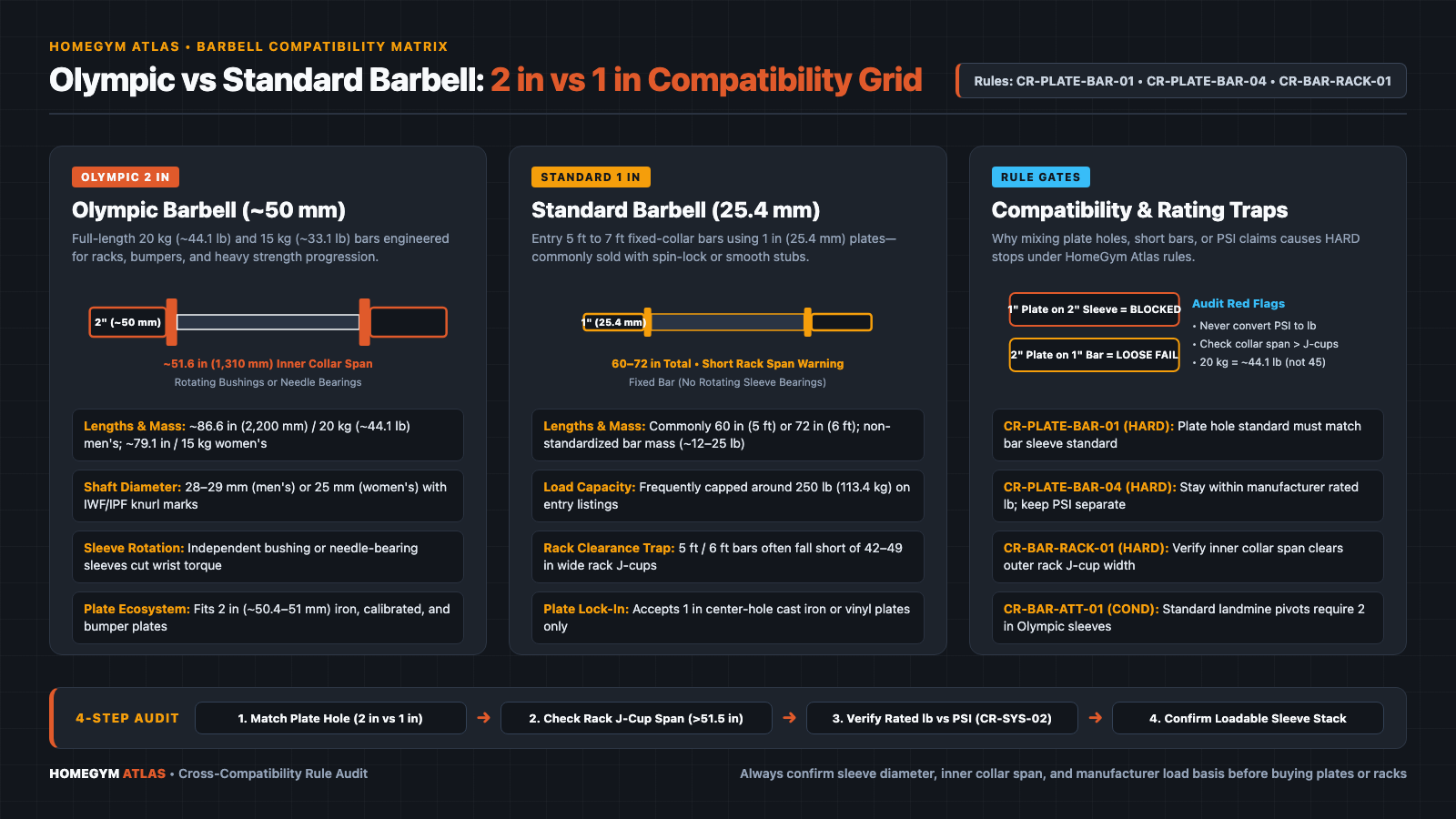
2 in vs. 1 in Sleeves: Plate Fit, Adapters & Sleeve Capacity
The fundamental divide in an olympic bar vs standard bar decision is sleeve diameter—because your choice locks in every weight plate, collar, and plate-loaded attachment you buy afterward. Under IronGym Lab compatibility rule CR-PLATE-BAR-01 (HARD), a weight plate’s center-hole standard must match the barbell’s sleeve standard.
Why Mixing 1-Inch and 2-Inch Plates Triggers a HARD Failure
Standard 1 in plates have a center bore just over 1 in (25.4 mm). They physically cannot slide onto a ~50 mm (~1.97 in) Olympic sleeve. Conversely, sliding a 2 in (~50.4–51 mm) Olympic plate onto a 1 in bar leaves nearly a full inch of radial slop. Under load, the plate shifts off-center, rattles asymmetrically during reps, and can slip past small collars. Rule CR-PLATE-BAR-01 treats Olympic plates on a 1 in bar as an automatic fail unless the barbell manufacturer sells a purpose-built 2 in adapter sleeve and explicitly publishes a load rating for that combined assembly—a CONDITIONAL path that few entry 1 in bars support.
Loadable Sleeve Length & Plate Thickness (CR-PLATE-BAR-02)
Even when center holes match, sleeve length determines how much total weight actually fits on the bar. Under rule CR-PLATE-BAR-02, your usable sleeve length equals the bar’s loadable sleeve minus your collar width (~0.5–1 in for spring clips or ~1.5–2 in for clamp collars). A full-length 20 kg (~44.1 lb) Olympic bar typically provides ~16.1–16.5 in (40.9–41.9 cm) of loadable sleeve per side—enough for heavy iron stacks or multiple pairs of best bumper plates for home gyms. By contrast, a 60 in (5 ft) standard 1 in bar leaves much shorter threaded or smooth loading stubs, limiting how many thick vinyl or cast-iron plates fit inside its star-lock collars.
Keep in mind two related plate rules as well: competition and calibrated Olympic plates feature tight ~50.4 mm tolerances that slide snugly onto ~50 mm sleeves by design (CR-PLATE-BAR-03, informational), and if you ever mix kilogram and pound plates on the same bar, total both sides in a single unit before loading (CR-PLATE-SYS-01).
Collar Span, Power Rack Fit & Room Width
Many first-time home gym buyers purchase a 5 ft or 6 ft standard 1 in bar assuming any straight bar fits inside a power cage. Under rule CR-BAR-RACK-01 (HARD), a barbell’s inner collar-to-collar distance must exceed the outer span of your rack’s J-cups—otherwise the bar’s collars collide with the hooks or the sleeves sit directly on the J-cups.
Why ~51.6 Inches Matters for 42–49 Inch Power Racks
Both IWF and IPF competition specifications anchor men’s and women’s full-length Olympic barbells at ~51.6 in (1,310 mm, up to 1,320 mm IPF) between the inner sleeve collars. Standard 2×2, 2×3, and 3×3 home power racks typically measure 42–45 in inside width and 47–49 in outside upright width. That ~51.6 in span leaves roughly 1.3–2.3 in of clearance outside each J-cup so you can unrack and rerack smoothly without scraping your knuckles or pinching plates against the uprights.
A 60 in (5 ft) standard bar has only ~37–42 in of shaft between collars, making it physically impossible to rack inside standard 47–49 in cages. Even 72 in (6 ft) standard bars frequently measure ~43–46 in between collars—leaving zero margin or failing completely depending on J-cup geometry. Additionally, rack J-cups with protective UHMW liners help preserve shaft finishes and knurling compared to bare steel hooks (CR-BAR-RACK-02), and landmine attachments are almost universally sized for 2 in Olympic sleeves (CR-BAR-ATT-01, CONDITIONAL).
Room Width Reality Check (CR-RACK-SPACE-04)
Where standard 5 ft bars hold an authentic spatial advantage is narrow bedrooms. Under rule CR-RACK-SPACE-04, a full ~86.6 in (7.2 ft) Olympic bar plus an editorial convention of ~24–36 in of plate-loading room on each end requires roughly 11–13 ft of clear room width. If you train exclusively with floor movements or a compact bench inside an 8–9 ft spare bedroom, a 60 in (5 ft) standard bar—or a specialty short Olympic bar whose collar span is verified before rack use—clears walls without gouging drywall during plate changes.
Bar Weight (20 kg vs. 45 lb), Shaft Diameter & Sleeve Spin
Beyond sleeve width and rack fit, Olympic and standard bars behave completely differently in your hands due to standardized mass, precision shaft diameters, and independent sleeve rotation.
The 20 kg (~44.1 lb) vs. 45 lb Rounding Clarification
In US commercial gyms, lifters routinely call a men’s Olympic barbell a “45 lb bar.” Technically, an IWF/IPF men’s 20 kg Olympic barbell weighs ~44.1 lb (CR-PLATE-SYS-01), while a women’s 15 kg Olympic barbell weighs ~33.1 lb. Some US manufacturers machine dedicated 45 lb bars, whereas metric 20 kg bars—including most imported Amazon Olympic bars—weigh ~44.1 lb unloaded. For a complete breakdown of bar weights across straight, curl, and trap bars, see our guide on how much an Olympic barbell weighs.
Standard 1 in bars, by contrast, have no universal empty weight. Depending on whether a 5 ft or 6 ft standard bar uses solid cold-rolled steel or hollow tubing, unloaded weights range anywhere from ~12 lb to ~25 lb—meaning you must weigh the bar on a calibrated scale before tracking exact working loads.
Shaft Diameter (mm) & Rotating Sleeves
Barbell shafts are specified in millimeters because half a millimeter noticeably alters grip closure:
- 28 mm to 28.5 mm (Multipurpose & Weightlifting Olympic): Balances whip and grip comfort for squats, presses, deadlifts, and cleans, featuring dual IWF (910 mm / 35.8 in) and IPF (810 mm / 31.9 in) knurl ring marks.
- 29 mm (Powerlifting Olympic): Stiffer shaft with single IPF 810 mm rings and typically a center knurl for back-squat shelf traction.
- 25 mm (Women’s 15 kg Olympic): Narrower grip suited for smaller hands while preserving full rack compatibility.
- 25.4 mm / 1 in (Standard Bars): Uniform 1 in steel across the grip and plate ends, typically without standardized IWF/IPF spacing or rotating sleeves.
Equally important is sleeve rotation. Every true Olympic barbell mounts its 2 in sleeves over bronze/brass bushings (smooth, controlled rotation favored for slow strength lifts) or needle bearings (fast rotation favored for cleans and snatches). When you press, curl, or clean a loaded Olympic bar, the plates stay stationary around the sleeve axis while the shaft turns in your hands—eliminating the rotational torque that fixed 1 in standard bars transmit straight into your wrists and forearms when heavy plates want to spin.
Tensile Strength (PSI) vs. Pound Capacity Ratings
When shopping Amazon US for either bar style, capacity marketing is where buyers get misled most often. Two separate rules govern how we audit load limits: CR-PLATE-BAR-04 (HARD) and CR-SYS-02 (CONDITIONAL).
Never Convert Tensile Strength (PSI) Into Pound Capacity (ISS-BAR-PSI-AS-CAPACITY)
Premium direct-sale Olympic barbells—such as the Rogue Ohio Bar (190,000 PSI black oxide / 200,000 PSI stainless, not sold on Amazon) and REP Colorado Bar (not sold on Amazon)—publish steel tensile strength in PSI (pounds per square inch of material cross-section before fracture) rather than a flat pound weight capacity. Under IronGym Lab rule CR-PLATE-BAR-04, tensile strength PSI is strictly a material-grade metric and must never be converted into a pound capacity figure. Meanwhile, many Amazon-sold Olympic bars publish both a PSI spec and a pound rating—such as the Mikolo 7ft Olympic Barbell (190,000 PSI tensile strength; stated 1,500 lb / 680.4 kg capacity by Mikolo, though rating basis is not specified) or budget entries in our best Olympic barbells under $200 roundup.
Standard 1-Inch Low Load Ceilings (ISS-BAR-1IN-LOW-RATING & CR-SYS-03)
Standard 1 in bars carry low stated ratings—commonly 250 lb (113.4 kg) on popular retail models like the CAP Standard Straight Bar and Amazon Basics 60″ Straight Barbell Bar (where the Amazon Basics figure appears on the marketplace listing without a standalone engineering spec sheet, so we treat it conservatively per CR-SYS-02). Under whole-setup rule CR-SYS-03 (HARD), the weakest rated component limits your entire gym. Even if you place a 250 lb standard bar onto a 1,000 lb power rack, 250 lb remains your ceiling—and loading beyond a bar’s stated rating risks permanent shaft bending.
Safe Loading, Collars & Manufacturer-First Setup
Regardless of which bar standard fits your space, safe operation depends on matching collars, flooring, and rack instructions rather than assumptions:
- Secure Collars Properly: Always inspect threaded star-lock collars on 1 in bars between sets because bar vibration can loosen spin-lock nuts during high-rep work. On 2 in Olympic bars, pair ~50 mm clamp or spring collars matched to sleeve diameter.
- Follow Plate & Flooring Drop Guidance (CR-PLATE-ATT-01): Cast-iron plates and standard 1 in plates are not manufactured to be dropped. If you perform overhead lifts or drop from lockout, use drop-rated Olympic bumper plates over suitable rubber mats or a lifting platform as instructed by both the plate and flooring manufacturers.
- Manufacturer-First Rack Setup: Follow your rack manufacturer’s assembly, anchoring, and J-cup capacity instructions strictly, and never describe bar ratings or rack safeties as guaranteeing injury prevention.
Final Verdict: Choose an Olympic vs. Standard Barbell
Choose an Olympic Barbell If…
- You train with—or plan to buy—a power rack, squat stand, or 2 in bumper plates.
- You want standardized 20 kg (~44.1 lb) or 15 kg (~33.1 lb) bar weight and ~51.6 in rackable collar span.
- You need independent rotating sleeves (bushings or needle bearings) and higher load capacities above 250 lb.
- Your training room has at least 11–13 ft of width to load plates cleanly on an 86.6 in bar.
Choose a Standard 1-Inch Bar If…
- You already own a set of 1 in cast-iron or vinyl plates and plan to stay strictly under 250 lb (113.4 kg).
- Your space is too narrow for an ~86.6 in bar and you only need floor-based accessory work (curls, rows, floor presses).
- You want the lowest upfront cost in the Budget (Under $100) tier without buying a power cage.
- You accept zero cross-compatibility with 2 in Olympic plates, landmines, and standard 42–49 in power racks.
Verified Amazon US Olympic & Standard Barbells Compared
While flagship direct-sale bars like the Rogue Ohio Bar and REP Colorado Bar are not sold on Amazon, the four verified Amazon US barbells below represent real-world contenders across both 2 in Olympic and 1 in standard configurations.
1. Mikolo 7ft Olympic Barbell — Best High-Tensile Amazon Olympic Contender

Verified Specs: 86.6 in (2,200 mm) overall length | 20 kg (~44.1 lb) bar weight | 28 mm shaft diameter | 2 in (~50 mm) Olympic sleeves with 8 needle bearings & bronze bushings | 190,000 PSI tensile strength | Stated capacity: 1,500 lb (680.4 kg) per Mikolo (rating basis not specified) | Hard chrome finish with dual IWF/IPF marks | Price Tier: Mid-Range ($100–$200)
For home lifters transitioning from entry gear to a full power rack, the Mikolo 7ft Olympic Barbell pairs IWF-standard 28 mm shaft geometry and dual knurl rings with 190,000 PSI steel. Its hybrid needle-bearing and bronze-bushing sleeves spin smoothly for cleans while remaining controllable for squats and bench pressing inside standard 42–49 in cages.
- Pros: True 86.6 in (2,200 mm) full Olympic geometry with ~51.6 in rackable span; 190,000 PSI alloy shaft; hybrid needle bearings and bronze bushings.
- Cons: Mikolo publishes a 1,500 lb capacity figure without specifying static vs. drop rating basis (CR-SYS-02); hard chrome offers less raw steel bite than bare or stainless steel, and requires ~11–13 ft room width for loading.
2. LIONSCOOL 7ft Olympic Barbell — Best Corrosion-Resistant Budget/Mid Olympic Bar

Verified Specs: 86.6 in (2,200 mm) overall length | 20 kg (~44.1 lb) bar weight | 28.5 mm shaft diameter | 2 in (~50 mm) Olympic sleeves (~16.5 in loadable length) with needle bearing & bushing hybrid | 130,000 PSI tensile strength | Stated capacity: 700 lb (317.5 kg) on listing (verify rating basis per CR-SYS-02) | Black E-coating | Price Tier: Mid-Range ($100–$200)
The LIONSCOOL 7ft Olympic Barbell gives humid garage gyms a black E-coated 28.5 mm multipurpose shaft with ~16.5 in loadable sleeves. Even with a more modest 130,000 PSI shaft and 700 lb stated ceiling compared to 190,000 PSI bars, it vastly outperforms 1 in standard bars on sleeve spin, plate capacity, and power-rack compatibility.
- Pros: 28.5 mm multipurpose shaft fits all standard power racks (CR-BAR-RACK-01); black E-coating resists garage humidity; ~16.5 in sleeves hold deep plate stacks.
- Cons: Lower 130,000 PSI tensile rating and 700 lb listing-stated limit require strict adherence to maximum load ceilings (CR-PLATE-BAR-04 / CR-SYS-02); E-coating can wear over time against unlined steel J-cups.
3. CAP Barbell Standard Straight Bar — Benchmark 1-Inch Threaded Bar

Verified Specs: 60 in (5 ft) or 72 in (6 ft) variant options | 1 in (25.4 mm) shaft and fixed ends | Threaded spin-lock ends (variant-dependent) | Stated capacity: 250 lb (113.4 kg) per CAP/retailer specs | Fits 1 in center-hole standard plates only | Price Tier: Budget (Under $100)
With thousands of verified home-gym buyers, CAP’s Standard Straight Bar illustrates both the utility and the boundaries of the 1 in standard format. If you already own 1 in cast-iron plates for curls, bent-over rows, or light overhead presses in a small room, its 1 in solid bar keeps equipment compact—but its 250 lb ceiling and sub-50 in collar span keep it out of full-size power cages.
- Pros: Compact 5 ft and 6 ft variants fit narrow bedrooms; accepts widely available 1 in standard plates; Budget (Under $100) entry tier.
- Cons: 250 lb (113.4 kg) capacity ceiling restricts progressive squats and deadlifts (ISS-BAR-1IN-LOW-RATING); 5 ft and most 6 ft lengths fail CR-BAR-RACK-01 on standard 47–49 in wide power racks; non-rotating ends transmit plate torque to wrists.
4. Amazon Basics Standard 60″ Straight Barbell Bar — Compact 5-Foot 1-Inch Option

Verified Specs: 60 in (5 ft / 152.4 cm) overall length | 1 in (25.4 mm) diameter | Chrome finish with knurled grip zones | Stated capacity: 250 lb (113.4 kg) on marketplace listing (we could not trace this rating to a standalone manufacturer engineering document per CR-SYS-02) | Fits 1 in center-hole plates only | Price Tier: Budget (Under $100)
The Amazon Basics 60″ Straight Barbell Bar serves tight apartment or spare-bedroom spaces where an 86.6 in Olympic bar simply cannot swing safely. Like other 5 ft standard bars, it is strictly a floor-loaded accessory tool: verify collar security before each set and never pair it with 2 in Olympic plates or standard power-rack J-cups.
- Pros: 60 in (5 ft) length maneuvers easily in tight spare rooms; straightforward chrome finish and non-slip knurling for light curls, lunges, and rows.
- Cons: 250 lb listing-stated capacity cannot be traced to an independent engineering spec sheet (CR-SYS-02); ~37–40 in inner grip span will not span standard power racks (CR-BAR-RACK-01); zero sleeve spin and incompatible with 2 in bumper plates (CR-PLATE-BAR-01).
Compatibility Rules Appendix & Authoritative Sources
Every recommendation in this comparison was audited against the IronGym Lab compatibility rule set. A barbell setup is only marked compatible when every applicable HARD rule passes and unpublished manufacturer data is flagged explicitly:
- CR-PLATE-BAR-01 (HARD): Weight plate center holes (2 in Olympic vs. 1 in standard) must match the bar’s sleeve standard. Never load 2 in plates onto a 1 in bar without a maker-approved, load-rated adapter sleeve.
- CR-PLATE-BAR-02 (HARD / SOFT): Total plate thickness per side plus collar width must fit within the bar’s published loadable sleeve length.
- CR-PLATE-BAR-04 (HARD): Target barbell load must remain within the manufacturer’s published pound capacity; never convert tensile strength (PSI) into pound capacity.
- CR-BAR-RACK-01 (HARD): Inner collar-to-collar distance (~51.6 in on full Olympic bars) must exceed your rack’s outer J-cup span.
- CR-BAR-ATT-01 (CONDITIONAL) & CR-SYS-02 / CR-SYS-03: Standard landmine pivots fit 2 in Olympic sleeves; marketplace-only load claims without manufacturer documentation are treated conservatively, and the weakest rated component governs your setup limit.
Authoritative Non-Affiliate Citations:
- International Weightlifting Federation (IWF) Technical & Equipment Rules — Official specifications for 20 kg (2,200 mm / 28 mm shaft / 50 mm sleeve) men’s bars and 15 kg (2,010 mm / 25 mm shaft) women’s bars with 1,310 mm inner collar span.
- International Powerlifting Federation (IPF) Technical Rules — Official barbell geometry limits (2,200 mm max length, 1,310–1,320 mm collar spacing, 28–29 mm shaft, 50–52 mm sleeves, 810 mm ring marks).
- Mikolo Fitness Official Barbell Specifications — Published 86.6 in (2,200 mm), 20 kg, 28 mm shaft, 190,000 PSI, and 1,500 lb stated capacity specs for the 7ft Olympic Barbell.
- CAP Barbell Official Product Catalog & Rogue Fitness Reference Specifications — CAP 1 in Standard Straight Bar (250 lb rating) specifications and direct-only Rogue Ohio Bar (190,000 PSI, 16.4 in sleeve, not sold on Amazon) reference tolerances.
How We Audited This Guide
- Strength hardware was audited across upright tube dimensions (2x2, 2x3, 3x3 in), 5/8-in vs 1-in pin hardware, sleeve fit, rated vs rackable capacities, and bench pad height clearances.
- Every power rack, barbell, weight plate, bench, adjustable dumbbell, cardio machine, and flooring spec was cross-checked against official manufacturer manuals, CPSC notices, and live Amazon US listings.
- Recommendations were evaluated against our weighted vertical scoring rubrics and documented CR-* compatibility rules; we never invent load capacities, motor ratings, rubber thickness, or decibels.
Continue Your Audit
Frequently Asked Questions: Olympic vs. Standard Barbells
Can I use 2-inch Olympic weight plates on a 1-inch standard barbell?
No—under rule CR-PLATE-BAR-01, 2 in Olympic plates sit loose and off-center on a 1 in bar, creating uneven balance and collar slip risks. Treat them as incompatible unless the bar manufacturer sells a dedicated 2 in adapter sleeve with a published load rating.
Will a 5-foot or 6-foot standard 1-inch bar fit in a power rack?
Almost never on standard 42–49 in wide power racks. Under CR-BAR-RACK-01, a 60 in (5 ft) bar’s inner grip span (~37–42 in) cannot reach both J-cups, and most 72 in (6 ft) bars leave little or no collar margin. Always verify inner collar distance first.
How much does an Olympic barbell actually weigh—44.1 lb or 45 lb?
Most metric Olympic barbells weigh 20 kg (~44.1 lb) for men’s bars and 15 kg (~33.1 lb) for women’s bars per IWF and IPF rules. US gyms often round 20 kg colloquially to 45 lb, though true 45 lb US-machined bars also exist—always check the manufacturer’s stated unit.
Does 190,000 PSI tensile strength mean a barbell holds 1,900 lb?
No. Tensile strength (PSI) measures steel resistance to breaking per square inch of cross-section, not a barbell’s safe loaded weight rating. Under rule CR-PLATE-BAR-04, never convert PSI into a pound capacity; check whether the manufacturer publishes a separate pound rating.
When is a standard 1-inch barbell better than an Olympic barbell?
A standard 1 in bar only makes practical sense when you already own 1 in cast-iron plates, train strictly below 250 lb (113.4 kg) with floor-based accessory exercises like curls or rows, or lack the 11–13 ft room width required to load a 7.2 ft Olympic bar.


