
Disclosure: As an Amazon Associate, IronGym Lab earns from qualifying purchases. If you buy through verified Amazon US links on this page, we may earn a small commission at no extra cost to you. Direct-sale manufacturer lines referenced for specification benchmarking are explicitly labeled as not sold on Amazon and carry zero affiliate links.
If you have ever stepped onto a gym floor or unboxed a bar for your garage and wondered how much does an olympic barbell weigh, you have probably heard one quick answer: “45 pounds.” In practice, that shortcut hides two critical engineering details that affect training logs, plate math, and equipment compatibility. True metric competition bars weigh 44.1 lb (20 kg), women’s Olympic bars weigh 33.1 lb (15 kg), and some full-length 7-foot bars sold online weigh only 35.3 lb (16.0 kg). Before choosing the best Olympic barbell for home gym lifting, auditing empty bar mass keeps every calculation honest.
Quick Answer — How Much Does a Barbell Weigh?
A standard men’s Olympic barbell weighs 44.1 lb (20 kg) under international IWF and IPF rules, though many US commercial gyms sell 45 lb (20.4 kg) bars. Women’s Olympic bars weigh 33.1 lb (15 kg). Standard 1-inch bars typically weigh 10 to 25 lb (4.5 to 11.3 kg), while trap and safety squat bars range from 45 to 70 lb (20.4 to 31.8 kg).
In This Barbell Weight Guide
- 20 kg (~44.1 lb) vs. 45 lb: Why Olympic Barbell Weights Differ
- Complete Barbell Weight Chart by Bar Type & Standard
- Plate Math, Collar Weight, Sleeve Capacity & Rack Fit
- Myth vs. Engineering Reality: Barbell Weight Traps
- Verified Amazon US Barbells by Weight Class
- Compatibility Rules, Citations & FAQs
20 kg (~44.1 lb) vs. 45 lb: Why Olympic Barbell Weights Differ
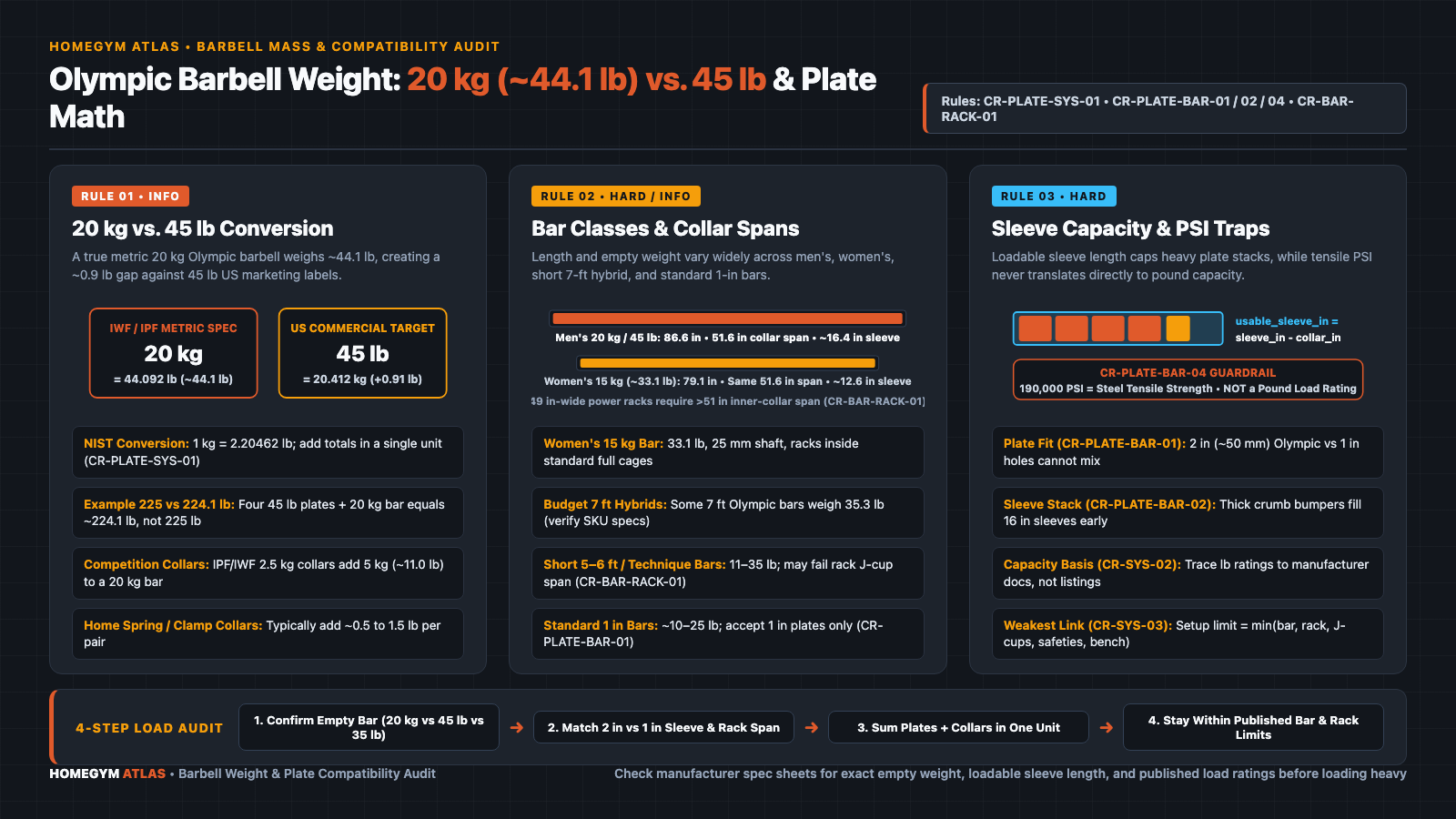
The confusion between 20 kg and 45 lb starts with unit conversion. According to the National Institute of Standards and Technology (NIST), one international kilogram equals 2.20462 pounds. Multiply a 20 kg competition bar by 2.20462 and you get 44.092 lb (~44.1 lb)—nearly a full pound lighter than 45 lb (20.412 kg).
Under IronGym Lab compatibility rule CR-PLATE-SYS-01 (INFO), treating a 20 kg bar as 45 lb introduces a recurring ~0.9 lb error into every loaded lift. That small gap compounds when US home gym owners mix metric bars with pound plates, or pair imported pound bars with metric bumper sets.
International IWF & IPF Specifications vs. US Commercial Rounding
Both major international barbell federations govern bar geometry and mass in metric units:
- Olympic Weightlifting (IWF): Per International Weightlifting Federation (IWF) technical rules, a men’s competition bar weighs 44.1 lb (20 kg), measures 86.6 in (2,200 mm) overall with a 28 mm shaft, and holds 51.6 in (1,310 mm) between inner collars with ~50 mm (~1.97 in) sleeves. A women’s IWF bar weighs 33.1 lb (15 kg) and measures 79.1 in (2,010 mm) long with a 25 mm shaft.
- Powerlifting (IPF): Per International Powerlifting Federation (IPF) technical rules, an approved power bar weighs 44.1 lb (20 kg), spans up to 86.6 in (2,200 mm) total length, uses a 28 to 29 mm shaft, and leaves 51.6 to 52.0 in (1,310 to 1,320 mm) between inner sleeve collars.
- US Commercial & Marketplace Labeling: Because commercial American gyms standardized around 45 lb cast-iron plates decades ago, many US retail listings label 2,200 mm multipurpose bars as “20 kg / 45 lb” interchangeably—even when the factory target is 20 kg (~44.1 lb). Conversely, some American-made specialty or commercial gym bars are machined intentionally to 45 lb (20.4 kg), and some direct-sale bars such as the Rogue Ohio Bar and REP Colorado Bar (both not sold on Amazon) publish exact 20 kg (~44.1 lb) specifications on their engineering sheets.
Manufacturing Tolerance, Collar Weight & Finish Differences
Even within a single weight class, two barbells stamped “20 kg” or “45 lb” rarely register identical numbers on a calibrated shipping scale. Machining tolerances on raw alloy steel stock, sleeve end-cap construction, and protective shaft coatings create slight variance. Uncalibrated economy bars may drift by several tenths of a pound to over a pound from nominal targets, whereas calibrated competition bars are held within tight federation gram tolerances.
Collars add another layer that lifters frequently overlook. Standard home-gym spring clips or polymer clamp collars typically weigh roughly 0.5 to 1.5 lb (0.2 to 0.7 kg) per pair, leaving total bar weight close to nominal. In sanctioned IPF and IWF competition, however, calibrated metal competition collars weigh 5.5 lb (2.5 kg) each—raising an empty 44.1 lb (20 kg) barbell to 55.1 lb (25 kg) before a single plate touches the sleeves.
Complete Barbell Weight Chart by Bar Type & Standard
Not every barbell in a home gym or commercial facility is a 7-foot men’s bar. Use the audited reference table below to verify empty weights, shaft diameters, sleeve standards, and hard compatibility constraints before adding weight plates or racking inside a power cage.
| Bar Type / Standard | Empty Weight (Imperial / Metric) | Overall Length & Shaft Diameter | Sleeve Standard & Loadable Length | Critical Compatibility Gate |
|---|---|---|---|---|
| Men’s IWF / IPF Olympic Bar (STD-BAR-OLY-20KG) | 44.1 lb (20 kg) (44.092 lb exact) | ~86.6 in (2,200 mm); 28 mm (IWF) or 28.5 mm (multipurpose) | 2 in (~50 mm) Olympic; ~16.1 to 16.5 in loadable per side | CR-PLATE-SYS-01: Weighs ~0.9 lb less than 45 lb; ~51.6 in collar span fits standard racks. |
| US Commercial 45 lb Bar (US gym standard) | 45 lb (20.4 kg) | ~86 to 87 in; 28.5 to 30 mm depending on model | 2 in (~50 mm) Olympic; ~15.0 to 16.4 in loadable | CR-SYS-02: Many marketplace bars say “45 lb” while shipping at 20 kg (~44.1 lb); verify spec sheet. |
| IPF Powerlifting Bar (STD-BAR-POWER-29MM) | 44.1 lb (20 kg) (or 45 lb / 20.4 kg US) | ~86.6 in (2,200 mm); 29 mm stiff shaft with center knurl | 2 in (~50 mm) Olympic; ~16.25 in typical (verify per bar) | CR-PLATE-BAR-02: Pairs with thin iron or calibrated steel plates to maximize total sleeve load. |
| Women’s Olympic Bar (STD-BAR-OLY-15KG) | 33.1 lb (15 kg) (33.069 lb exact) | ~79.1 in (2,010 mm); 25 mm thinner grip shaft | 2 in (~50 mm) Olympic; shorter ~12.6 to 12.8 in sleeves | CR-BAR-RACK-01: Keeps full ~51.6 in inner-collar span so it racks cleanly in standard cages. |
| Budget 7 ft Hybrid / Light Olympic Bar | 35.3 lb (16.0 kg) (e.g., CAP 7 ft 35 lb SKU) | ~86.0 in (2,185 mm); 30 mm shaft common | 2 in (~50 mm) Olympic; ~15.3 in loadable sleeves | CR-PLATE-BAR-04: Lower mass often signals lighter tube/alloy construction and ~500 lb listing caps. |
| Technique / Short Aluminum Bar | 11.0 to 22.0 lb (5 to 10 kg) (short steel up to ~35 lb) | 60 to 72 in (5 to 6 ft); 25 to 28 mm shaft | 2 in (~50 mm) Olympic; shorter sleeves (~9 to 13 in) | CR-BAR-RACK-01 (HARD): Shorter inner-collar spans may fail to reach both J-cups on 49 in racks. |
| Standard 1-Inch Bar (STD-SLEEVE-STD-1IN) | 10 to 25 lb (4.5 to 11.3 kg) (varies by 5–7 ft & core) | 60 to 84 in (5 to 7 ft); ~1 in (25.4 mm) uniform shaft | 1 in (~25.4 mm) solid or threaded spin-lock ends | CR-PLATE-BAR-01 (HARD): Accepts 1 in plates only; 2 in Olympic plates sit loose and unsafe. |
| Olympic EZ Curl Bar | 15 to 25 lb (6.8 to 11.3 kg) (varies widely by brand) | ~47 to 48 in (1,194 to 1,219 mm); angled cambered shaft | 2 in (~50 mm) Olympic; short ~9 to 10 in sleeves | CR-PLATE-BAR-02: Short sleeves fill rapidly with wide plates; never assume a flat 20 lb weight. |
| Olympic Trap / Hex Bar | 45 to 60+ lb (20.4 to 27.2+ kg) (verified SKUs: 47 lb / 55 lb) | ~59 to 86 in overall frame; neutral high/low handles | 2 in (~50 mm) Olympic; ~10 to 16 in sleeves | CR-BAR-RACK-03 (INFO): Closed trap frames are floor-loaded; only rackable hex frames fit J-cups. |
| Safety Squat Bar (SSB) | 60 to 70+ lb (27.2 to 31.8+ kg) (verify maker spec) | ~86 in (2,184 mm); padded yoke + forward handles | 2 in (~50 mm) Olympic; model-specific sleeve length | CR-BAR-RACK-03 (CONDITIONAL): Confirm yoke width and J-cup depth fit your rack before loading. |
Notice the biggest takeaway from the chart above: physical length does not guarantee weight, and Olympic sleeves do not guarantee a 44.1 or 45 lb empty bar. If you own an unbranded 5-foot, 6-foot, or budget 7-foot barbell—or if you are deciding between a 2-inch Olympic ecosystem and an older 1-inch setup—our Olympic vs. standard barbell sleeve and shaft breakdown covers the dimensional differences in detail. When in doubt about an unlabeled bar already sitting in your garage, weigh yourself holding the bar on a reliable digital scale, then subtract your body weight.
Plate Math, Collar Weight, Sleeve Capacity & Rack Fit
Knowing an empty barbell’s mass is only step one. In a working home gym, bar weight interacts directly with plate units, sleeve length, rack width, and structural load limits.
1. Mixing Kilogram Bars with Pound Plates (CR-PLATE-SYS-01)
Under CR-PLATE-SYS-01 (INFO), mixing a metric 20 kg barbell with imperial 45 lb, 25 lb, and 10 lb plates is mechanically seamless as long as both use the 2-inch Olympic standard—you simply need to add everything in one consistent unit using 1 kg = 2.205 lb:
- One 45 lb plate per side (“135” in commercial gyms): On a 45 lb bar,
45 + 2 × 45 = 135 lb (61.2 kg). On a true 20 kg (~44.1 lb) bar, the exact total is 134.1 lb (60.8 kg). - Two 45 lb plates per side (“225”): On a 45 lb bar,
45 + 4 × 45 = 225 lb (102.1 kg). On a 20 kg bar, the total is 224.1 lb (101.6 kg). - Three 45 lb plates per side (“315”): On a 45 lb bar,
45 + 6 × 45 = 315 lb (142.9 kg). On a 20 kg bar, the total is 314.1 lb (142.5 kg). - Women’s 15 kg (~33.1 lb) bar math: One 45 lb plate per side equals 123.1 lb (55.8 kg), and two 45 lb plates per side equals 213.1 lb (96.7 kg)—over 11 lb lighter than the same plate stack on a men’s 20 kg bar.
Does a 0.9 lb difference on a men’s 20 kg bar ruin recreational strength progression? No—as long as you track training loads consistently on the same bar. However, if you switch between a 44.1 lb bar at home and a 45 lb bar at a commercial gym, or compete in a sanctioned powerlifting meet where every 0.5 kg jump is tracked, logging the exact empty bar mass eliminates guesswork.
2. Plate Hole Standard & Loadable Sleeve Capacity (CR-PLATE-BAR-01 & CR-PLATE-BAR-02)
Barbell weight classes also signal sleeve geometry. Under CR-PLATE-BAR-01 (HARD), Olympic 2-inch plates (~50.4 to 51 mm center holes) pair only with ~50 mm Olympic sleeves, while standard 1-inch plates pair only with 1-inch bars. Standard 1-inch plates cannot slide over a 2-inch sleeve, and sliding loose 2-inch plates onto a 1-inch shaft creates an off-center hazard unless the bar manufacturer supplies an officially rated adapter sleeve.
Next, check how many plates physically fit on the bar under CR-PLATE-BAR-02 (HARD / SOFT) using the IronGym Lab sleeve-stack formula:
usable_sleeve_in = bar.loadable_sleeve_in - collar_width_intarget_load_lb = bar.bar_weight_lb + 2 × sum(plate.weight_lb per side)
A full-size men’s 20 kg / 45 lb bar typically provides 16.1 to 16.5 in (409 to 419 mm) of loadable sleeve per side. Subtract roughly 1.5 to 2 in for a wide clamp collar, and ~14.1 to 15.0 in remain for plates. Women’s 15 kg (~33.1 lb) Olympic bars shorten total length by cutting sleeve length down to roughly 12.6 to 12.8 in (320 to 325 mm), while budget bars like CAP’s 7-foot lines often use 15.0 to 15.3 in sleeves. If you load thick recycled-crumb bumper plates rather than slim iron or calibrated steel plates, a 12.6-inch or 15-inch sleeve fills up quickly well before you reach heavy deadlift targets.
3. Inner-Collar Span & Power Rack Fit (CR-BAR-RACK-01 & CR-BAR-RACK-03)
Lifters frequently worry that a lighter 33.1 lb (15 kg) women’s Olympic bar will not span the uprights of a garage power rack. Under CR-BAR-RACK-01 (HARD), rack compatibility depends on bar.inner_collar_distance_in > rack.jcup_outer_span_in, not overall length. Both men’s 20 kg bars (86.6 in) and women’s 15 kg bars (79.1 in) maintain the exact same ~51.6 in (1,310 mm) distance between inner sleeve shoulders, meaning both rack cleanly inside standard 47 to 49 in wide power cages.
In contrast, 5-foot and 6-foot short bars, technique bars with narrow shafts, and Olympic EZ curl bars have much narrower inner-collar spans and cannot safely rest across standard rack J-cups. Closed hex/trap bars are floor-loaded bars under CR-BAR-RACK-03 (INFO)—only dedicated extra-wide rackable trap bars (such as 85.7 in frames with extended sleeve shoulders) fit standard J-cups. Also remember CR-PLATE-ATT-01 (SOFT): if you plan to drop loaded barbells from waist or overhead height, follow plate and flooring manufacturer guidance by using drop-rated bumper plates over dense rubber stall mats or a lifting platform rather than cast-iron plates.
4. Tensile Strength PSI vs. Pound Capacity (CR-PLATE-BAR-04 & CR-SYS-02)
A barbell’s empty weight does not tell you how much weight it can safely carry. Under CR-PLATE-BAR-04 (HARD) and CR-SYS-02 (CONDITIONAL), never convert steel tensile strength (measured in pounds per square inch, or PSI) into a maximum pound load capacity. Tensile strength measures the breaking stress of the steel alloy itself—for example, 130,000 PSI versus 190,000 PSI—not the static or dynamic yield limit of the assembled bar, snap rings, or sleeves.
Notice how reputable direct-sale brands handle this: on official specification sheets for the Rogue Ohio Bar and REP Colorado Bar (both not sold on Amazon), manufacturers publish empty weight (20 kg) and steel tensile strength (190,000 to 200,000 PSI) without inventing a static pound cap. On Amazon US listings, many value-tier bars publish a headline pound rating such as “700 lb” or “1,500 lb.” Where we cannot trace a marketplace rating to an independent manufacturer engineering document, treat the figure cautiously per CR-SYS-02 and CR-SYS-03 (HARD)—your home gym setup is always limited by its weakest verified component across the bar, rack uprights, J-cups, safeties, and bench.
Myth vs. Engineering Reality: 4 Barbell Weight Misconceptions
Buyer Alert — 4 Common Barbell Weight Myths Exposed
- Myth 1: “Every 7-foot barbell with 2-inch sleeves weighs 45 lb.”
Engineering Reality: International 20 kg Olympic and power bars weigh ~44.1 lb (20 kg), and some 7-foot budget Olympic bars—such as CAP’s 7-foot 35 lb model—weigh only 35.3 lb (16.0 kg) due to thinner-walled or lighter sleeve/shaft profiles. Always check the SKU spec table. - Myth 2: “190,000 PSI tensile strength means a bar holds 1,900 lb.”
Engineering Reality: Under CR-PLATE-BAR-04, PSI measures material tensile stress per square inch, not loaded barbell pounds. Never treat PSI as a pound rating. - Myth 3: “A 15 kg (33.1 lb) women’s Olympic bar won’t fit a full-size power rack.”
Engineering Reality: Women’s 15 kg bars shorten the sleeves (~12.6 in), not the shaft span (~51.6 in between inner collars), so they rack identically inside standard 47–49 in cages under CR-BAR-RACK-01. - Myth 4: “You can ignore collar weight when tracking heavy singles.”
Engineering Reality: Plastic clamps weigh roughly 0.5 to 1.5 lb per pair, whereas competition 2.5 kg metal collars add 11.0 lb (5 kg) per pair—changing a 20 kg empty bar to 25 kg (~55.1 lb).
Verified Amazon US Barbells Across Weight & Sleeve Classes
The four verified Amazon US barbells below demonstrate how empty bar mass, shaft diameter, sleeve length, and listing-stated capacity differ across real retail SKUs. Direct-sale benchmark lines like the Rogue Ohio Bar and REP Colorado Bar are not sold on Amazon and carry zero affiliate links here.
1. LIONSCOOL 7ft Olympic Barbell — 20 kg / 45 lb Multipurpose 28.5 mm Benchmark

Verified Specs & Weight Class: Listed Weight: 20 kg / 45 lb (~44.1 lb metric / 45 lb US) | Length: 86.6 in (2,200 mm) | Shaft: 28.5 mm | Sleeves: 2 in (~50 mm) Olympic, hybrid needle bearing & bushing | Finish: Black E-coating | Listing Capacity: 700 lb (317.5 kg) & 130,000 PSI tensile strength | Price Tier: Mid-Range ($100–$200)
The LIONSCOOL 7ft Olympic Barbell follows the classic 86.6 in (2,200 mm) multipurpose footprint with a 28.5 mm shaft and corrosion-resistant black E-coating. Notice how the listing pairs “20 kg” and “45 lb” together—if exact half-pound precision matters for your logbook, verify the unloaded bar on a scale once delivered. Its 700 lb rating and 130,000 PSI tensile spec come from the retail listing rather than an independent engineering report (CR-SYS-02), suiting general garage strength progressions well under that ceiling.
- Pros: Full 86.6 in Olympic geometry with a versatile 28.5 mm shaft; hybrid bearing/bushing rotation and protective black E-coating for humid garages.
- Cons: 130,000 PSI tensile strength and 700 lb listing rating limit headroom for heavy powerlifting; retail listing mixes 20 kg and 45 lb labels.
2. Mikolo 7ft Olympic Barbell — 20 kg / 45 lb High-Tensile 28 mm Hard Chrome

Verified Specs & Weight Class: Listed Weight: 20 kg / 45 lb (~44.1 lb metric) | Length: 86.6 in (2,200 mm) | Shaft: 28 mm | Sleeves: 2 in (~50 mm) Olympic, needle bearings & brass bushings | Finish: Hardened chrome | Listing Capacity: 1,500 lb (680.4 kg) & 190,000 PSI tensile strength | Price Tier: Mid-Range ($100–$200)
Stepping up to a 190,000 PSI alloy spec while staying inside the same mid-range bracket, the Mikolo 7ft Olympic Barbell combines a true 28 mm Olympic weightlifting shaft diameter with needle bearings and brass bushings. As with other marketplace-stated ratings under CR-SYS-02 and CR-PLATE-BAR-04, treat the 1,500 lb headline capacity cautiously unless backed by a printed manufacturer manual, and note that 190,000 PSI reflects shaft steel tensile grade rather than a guaranteed pound capacity.
- Pros: 190,000 PSI steel specification with full 86.6 in (2,200 mm) dimensions; 28 mm shaft and needle-bearing/bushing hybrid suit mixed strength and Olympic lifts.
- Cons: 1,500 lb load figure is a marketplace listing claim without an independently published static/drop method (CR-SYS-02); dual 20 kg / 45 lb labeling.
3. CAP Pro Series “The Beast” 7ft Olympic Barbell — Explicitly Listed at 44 lb (20 kg)

Verified Specs & Weight Class: Listed Weight: 44 lb (20 kg) | Length: 7 ft (~86 in) | Shaft: 30 mm | Sleeves: 2 in (~50 mm) Olympic, 15 in (38.1 cm) loadable sleeve length | Finish: Black phosphate, volcano knurling | Listing Capacity: 1,200 lb (544.3 kg) | Price Tier: Mid-Range ($100–$200)
Unlike listings that round 20 kg up to 45 lb, CAP’s Pro Series “The Beast” explicitly declares 44 lb (20 kg) in its product specification—making it a textbook example of rule CR-PLATE-SYS-01 in the retail market. Note two trade-offs before pairing it with bulky rubber bumpers: its shaft measures a thicker 30 mm (compared with 28 to 29 mm competition bars), and its 15-inch loadable sleeves hold fewer thick plates per side than 16.4-inch competition-length sleeves (CR-PLATE-BAR-02).
- Pros: Transparent 44 lb (20 kg) weight specification avoids 45 lb marketing inflation; 1,200 lb listing rating and black phosphate grip texture.
- Cons: 30 mm grip diameter feels noticeably thicker than 28–28.5 mm bars; 15 in loadable sleeves fill faster with thick recycled-rubber bumpers (CR-PLATE-BAR-02).
4. CAP Barbell 7ft 35 lb Olympic Barbell — Proof That 7 Feet Does Not Always Mean 45 lb

Verified Specs & Weight Class: Listed Weight: 35.3 lb (16.0 kg) | Length: 86.02 in (7 ft) | Shaft: 30 mm | Sleeves: 2 in (~50 mm) Olympic, 15.3 in (38.9 cm) loadable length | Finish: Chrome, volcano knurling with center knurl | Listing Capacity: 500 lb (226.8 kg) | Price Tier: Budget (Under $100)
This entry-level CAP 7-foot bar illustrates why buyers must never assume every 7-foot barbell weighs 44.1 or 45 lb. Despite spanning 86.02 inches end to end with 2-inch Olympic sleeves, its published weight is 35.3 lb (16.0 kg)—nearly 10 lb lighter than a US 45 lb bar—paired with a 500 lb listing rating. That lower empty mass can work well for beginners starting with lighter total loads, provided you log 35.3 lb accurately and upgrade before approaching the 500 lb cap (CR-PLATE-BAR-04).
- Pros: Entry-tier budget option with full ~86 in rackable span and 2-inch Olympic sleeves for beginners starting below 45 lb.
- Cons: 35.3 lb empty weight throws off standard 45 lb plate math if unmarked; 30 mm shaft and 500 lb rating ceiling limit long-term heavy barbell progression.
Compatibility Rules Appendix & Authoritative Citations
Every weight conversion, plate-loading formula, and barbell recommendation in this guide follows the IronGym Lab compatibility framework and verified external standards. For questions about our audit methodology or to contact the IronGym Lab editorial team, reach out via our contact page.
- CR-PLATE-SYS-01 (INFO): A 20 kg Olympic barbell weighs ~44.1 lb (44.092 lb), not 45 lb; when mixing kilogram and pound gear, convert all weights into one unit (
1 kg = 2.205 lb). - CR-PLATE-BAR-01 (HARD): Plate center-hole standard must match bar sleeve standard—2 in (~50 mm) Olympic plates on Olympic sleeves, 1 in plates on 1 in bars.
- CR-PLATE-BAR-02 (HARD / SOFT): Total plate thickness per side plus collar width must fit inside the bar’s loadable sleeve length; shorter 15 kg (~12.6 in) or 15 in sleeves cap thick bumpers early.
- CR-PLATE-BAR-04 & CR-SYS-02 / CR-SYS-03 (HARD / CONDITIONAL): Never convert steel tensile PSI into pound load capacity; trace capacity claims to manufacturer documents and cap total setup load at the weakest rated component.
- CR-BAR-RACK-01 & CR-BAR-RACK-03 (HARD / CONDITIONAL): Men’s 20 kg and women’s 15 kg bars share a ~51.6 in inner-collar span that clears standard cages, whereas short bars and non-rackable trap bars do not rest in standard J-cups.
Authoritative Non-Affiliate Sources Cited:
- International Weightlifting Federation (IWF) — Equipment Technical Rules — Official 20 kg men’s (2,200 mm, 28 mm shaft) and 15 kg women’s (2,010 mm, 25 mm shaft) barbell masses, 1,310 mm collar span, and 50 mm sleeve tolerances.
- International Powerlifting Federation (IPF) — Technical Rules — Official 20 kg bar specification, 28–29 mm shaft rules, and 2.5 kg competition collar requirements (25 kg bar + collars).
- NIST — Metric SI Unit Conversion Factors — Exact conversion (
1 kg = 2.20462 lb) confirming20 kg = 44.092 lband15 kg = 33.069 lb. - Rogue Fitness — Official Ohio Bar Engineering Specs (not sold on Amazon) — Direct-sale benchmark demonstrating 20 kg (~44.1 lb) mass, 16.4 in loadable sleeves, and tensile strength PSI reporting without converted pound ratings.
How We Audited This Guide
- Strength hardware was audited across upright tube dimensions (2x2, 2x3, 3x3 in), 5/8-in vs 1-in pin hardware, sleeve fit, rated vs rackable capacities, and bench pad height clearances.
- Every power rack, barbell, weight plate, bench, adjustable dumbbell, cardio machine, and flooring spec was cross-checked against official manufacturer manuals, CPSC notices, and live Amazon US listings.
- Recommendations were evaluated against our weighted vertical scoring rubrics and documented CR-* compatibility rules; we never invent load capacities, motor ratings, rubber thickness, or decibels.
Continue Your Audit
- Best Power Rack for Home Gym (2026): 9 Audited Amazon Picks
- Best Power Racks Under $500 (2026): 8 Budget Cages Audited
- Best Power Racks Under $1,000 2026: Mid-Range Racks Compared
Frequently Asked Questions: Barbell Weight
How much does a standard Olympic barbell weigh without plates?
A men’s Olympic barbell weighs 44.1 lb (20 kg) under official IWF and IPF rules, though many US gyms label multipurpose bars as 45 lb (20.4 kg). A women’s Olympic barbell weighs 33.1 lb (15 kg) and shares the same inner-collar rack span.
Is a 20 kg barbell the same weight as a 45 lb barbell?
No, though they are close. Using the exact NIST conversion (1 kg = 2.20462 lb), a 20 kg barbell weighs 44.092 lb (~44.1 lb)—about 0.91 lb lighter than a true 45 lb (20.41 kg) barbell. Under rule CR-PLATE-SYS-01, log totals in one consistent unit.
Why do some 7-foot Olympic barbells only weigh 35 pounds?
Length alone does not determine mass. Entry-level 7-foot bars like CAP’s 35 lb Olympic model use lighter shaft/sleeve wall construction, measuring 35.3 lb (16.0 kg) across an 86-inch length. Always read the manufacturer’s weight spec or weigh an unmarked bar before loading.
How much does a standard 1-inch barbell weigh?
Standard 1-inch barbells generally weigh between 10 and 25 lb (4.5 to 11.3 kg) depending on overall length (5, 6, or 7 feet), solid versus hollow steel construction, and spin-lock collar hardware. They accept 1-inch plates only under rule CR-PLATE-BAR-01.
Do barbell collars count toward total barbell weight?
Yes, though home spring or plastic clamp collars typically add only 0.5 to 1.5 lb (0.2 to 0.7 kg) per pair. By contrast, calibrated competition collars weigh 5.5 lb (2.5 kg) each, raising a 20 kg bar to 55.1 lb (25 kg) before adding plates.


