
Disclosure: As an Amazon Associate, IronGym Lab earns from qualifying purchases. If you buy through verified Amazon US links on this page, we may earn a small commission at no extra cost to you. Direct-sale manufacturer lines referenced for specification benchmarking are explicitly labeled as not sold on Amazon and carry zero affiliate links.
Before you order a 300 lb or 400 lb weight set for your garage gym, one geometric question decides whether your heaviest lifts actually load onto the bar: how many plates fit on a barbell? Buyers often assume every 7-foot Olympic bar holds the same plate stack, only to discover that thick recycled crumb bumpers max out around 315 lb while slim cast-iron plates fit far past 700 lb. Auditing sleeve length, plate thickness, and collar width upfront prevents expensive compatibility bottlenecks when pairing plates with the best bumper plates or upgrading your bar.
Quick Answer — How Many Plates Fit on a Barbell?
On a standard men’s 20 kg (~44.1 lb) Olympic barbell with 16.4 in sleeves and 1.5 in clamp collars (leaving 14.9 in usable per side), you can fit 3 thick crumb 45 lb bumpers (314.1 lb), 5 standard virgin-rubber 45s (494.1 lb), 6 slim 2.40 in 45s (584.1 lb), or up to 11 cast-iron 45s per side if the bar is rated for the load.
In This Barbell Sleeve Math Guide
- The Barbell Sleeve-Capacity Formula (CR-PLATE-BAR-02)
- Loadable Sleeve Lengths by Barbell Class
- How Many 45 lb Plates Fit: Bumper vs. Iron vs. Calibrated Matrix
- Mixed-Weight Plate Stacks, Collar Width & Unit Math
- Beyond Sleeve Fit: Hole Standards, Bar Capacity & Storage Horns
- Myth vs. Engineering Reality: 4 Sleeve Capacity Traps
- Verified Amazon US Weight Plates Across Sleeve Profiles
- Compatibility Rules, Citations & FAQs
The Barbell Sleeve-Capacity Formula (CR-PLATE-BAR-02)
Barbell plate capacity is governed by straightforward linear arithmetic, not guesswork. Under IronGym Lab compatibility rule CR-PLATE-BAR-02 (HARD / SOFT), whether a target weight fits on a barbell depends on three published dimensions: the bar’s loadable sleeve length per side, the width of your collar, and the sum of the plate thicknesses on one side.
usable_sleeve_in = bar.loadable_sleeve_in - collar_width_instack_in(side) = sum(plate.thickness_in for each plate on one side)fits = stack_in(side) <= usable_sleeve_intarget_load_lb = bar.bar_weight_lb + 2 × sum(plate.weight_lb on one side)
Every plate-loading pairing produces one of four engineering outcomes under CR-PLATE-BAR-02:
- PASS: Your plate stack fits inside
usable_sleeve_inwith full collar engagement on the sleeve shaft. - SOFT Limit: The plates fit on the bare sleeve (
stack_in <= bar.loadable_sleeve_in), but adding your clamp collar pushes the stack past the sleeve tip—forcing you to switch to thinner spring clips or lighter/slimmer plates. - HARD Fail: The required plates exceed
bar.loadable_sleeve_ineven without any collar. The target weight physically cannot fit onto that bar. - Not Yet Verified (Unknown): Either
plate.thickness_inorbar.loadable_sleeve_inis omitted by the manufacturer or retail listing, which is a widespread gap on marketplace plate listings.
Notice how much collar geometry swings the result. Standard wire spring clips typically consume 0.5 to 1.0 in (13 to 25 mm) of sleeve width per side, whereas popular hinged polymer clamp collars take roughly 1.5 to 2.0 in (38 to 51 mm) per side. On a bar loaded near its limit, choosing a 2.0 in lock-jaw clamp over a 0.75 in spring clip sacrifices 1.25 in of usable sleeve per side—often the difference between fitting one extra 10 lb or 25 lb plate or running out of bar.
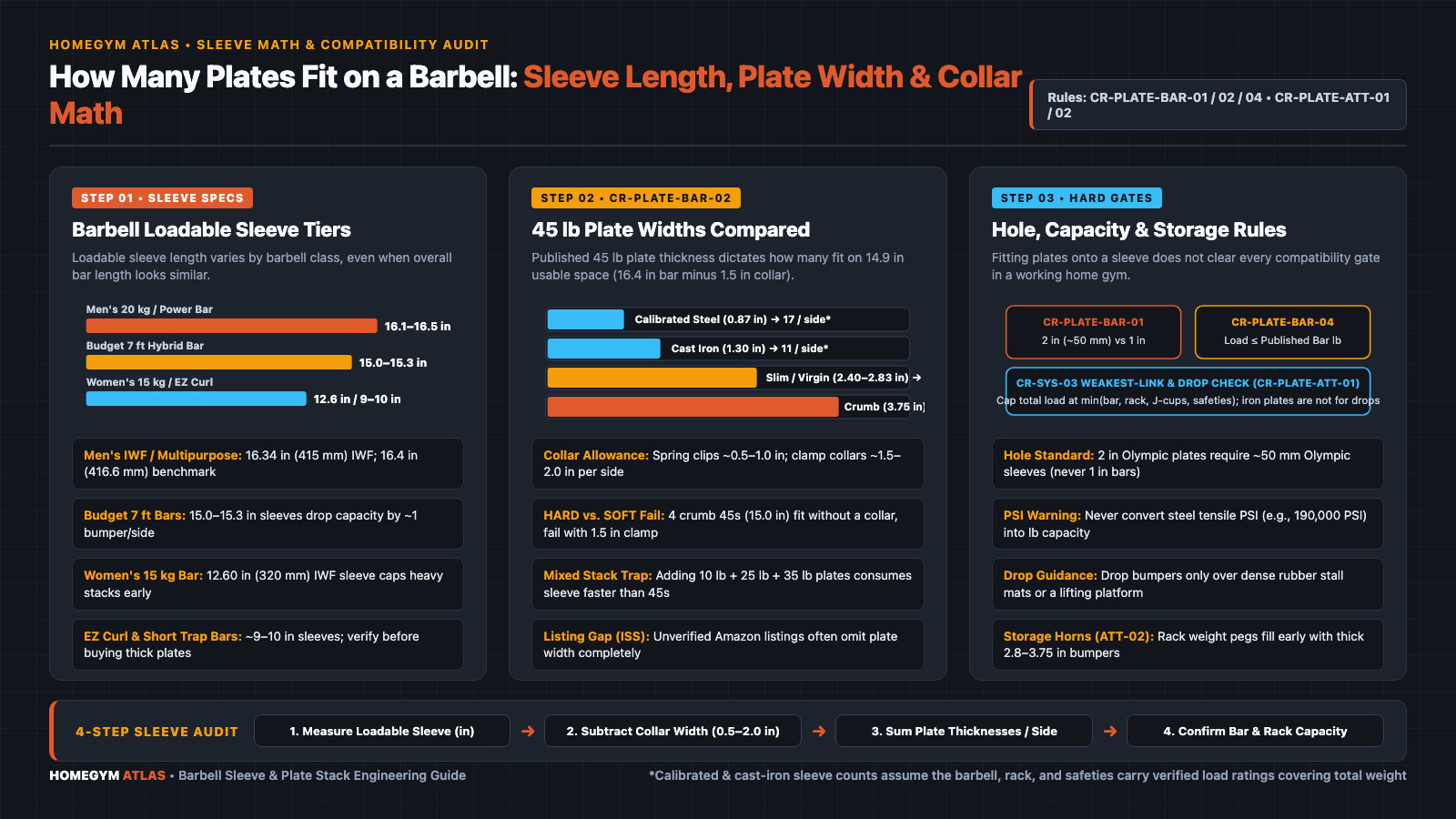
Loadable Sleeve Lengths by Barbell Class
Before measuring plates, verify how much loadable sleeve your barbell actually offers. Overall bar length includes the center shaft and the inner sleeve shoulders (collars), so two “7-foot” bars can differ by more than an inch of plate room per side. If you are shopping for a new bar, compare sleeve lengths across our best Olympic barbell for home gym guide before buying a bulky bumper set.
| Barbell Class / Standard | Overall Length | Empty Bar Mass (Imperial / Metric) | Loadable Sleeve Length (Per Side) | Usable Sleeve After 1.5 in Clamp |
|---|---|---|---|---|
| IWF Men’s Weightlifting Bar (STD-BAR-OLY-20KG) | 86.6 in (2,200 mm) | 44.1 lb (20 kg) | 16.34 in (415 mm) | 14.84 in (377 mm) |
| Men’s Multipurpose / Power Bar (e.g., Rogue Ohio Bar — not sold on Amazon) | ~86.6 in (2,200 mm) | 44.1 lb (20 kg) or 45 lb (20.4 kg) | 16.1 to 16.5 in (409 to 419 mm) (Ohio Bar: 16.4 in) | 14.6 to 15.0 in (14.9 in on 16.4 in bar) |
| Budget 7-Foot Hybrid Olympic Bar (e.g., CAP 7 ft Beast / 35 lb SKUs) | ~86.0 in (2,185 mm) | 35.3 lb (16.0 kg) to 44.1 lb (20 kg) | 15.0 to 15.3 in (381 to 389 mm) | 13.5 to 13.8 in (343 to 351 mm) |
| IWF Women’s Olympic Bar (STD-BAR-OLY-15KG) | 79.1 in (2,010 mm) | 33.1 lb (15 kg) | 12.60 in (320 mm) (typical 12.6–12.8 in) | 11.10 in (282 mm) |
| Olympic Trap / Hex Bar (2 in sleeves) | ~59 to 86 in frame | ~45 to 60+ lb (20.4 to 27.2+ kg) | ~10.0 to 16.0 in (254 to 406 mm) (varies by maker) | ~8.5 to 14.5 in |
| Olympic EZ Curl Bar (2 in sleeves) | ~47 to 48 in (1,194–1,219 mm) | ~15 to 25 lb (6.8 to 11.3 kg) | ~9.0 to 10.0 in (229 to 254 mm) (verify per maker) | ~7.5 to 8.5 in |
Two critical patterns jump out from the sleeve table above. First, budget 7-foot bars frequently trim loadable sleeve length down to 15.0 to 15.3 in—roughly 1.1 to 1.4 in shorter per side than an IWF or 16.4 in multipurpose bar. That seemingly minor reduction immediately removes one thick bumper plate per side on deadlifts and squats. Second, a women’s 33.1 lb (15 kg) Olympic bar maintains the full 51.6 in (1,310 mm) inner-collar span so it racks in standard cages (CR-BAR-RACK-01), achieving its shorter 79.1 in length entirely by shortening the sleeves to 12.60 in (320 mm). On a 15 kg bar, thick bumpers fill the sleeve remarkably early.
How Many 45 lb Plates Fit: Bumper vs. Iron vs. Calibrated Matrix
Plate thickness varies by more than 400% between calibrated competition steel and recycled crumb-rubber bumpers. Because plate width dictates sleeve consumption directly, the audited matrix below applies verified manufacturer-published 45 lb plate widths across three real sleeve lengths—a 16.4 in multipurpose sleeve, a 15.0 in budget 7-foot sleeve, and a 12.6 in women’s 15 kg sleeve—assuming a 1.5 in clamp collar per side and a 44.1 lb (20 kg) men’s bar (or 33.1 lb / 15 kg women’s bar).
| 45 lb Plate Type & Verified Benchmark | Published 45 lb Thickness | Max on 16.4 in Sleeve (14.9 in usable) | Max on 15.0 in Sleeve (13.5 in usable) | Max on 12.6 in Sleeve (11.1 in usable) |
|---|---|---|---|---|
| Recycled Crumb / Hi-Temp Bumper (e.g., Rogue Hi-Temp — not sold on Amazon) | 3.75 in (95.3 mm) | 3 / side (11.25 in) 314.1 lb on 20 kg bar | 3 / side (11.25 in) 314.1 lb on 20 kg bar | 2 / side (7.50 in) 213.1 lb on 15 kg bar |
| Standard Virgin Rubber Bumper (e.g., REP Black Bumper 45 lb) | 2.83 in (71.9 mm) | 5 / side (14.15 in) 494.1 lb on 20 kg bar | 4 / side (11.32 in) 404.1 lb on 20 kg bar | 3 / side (8.49 in) 303.1 lb on 15 kg bar |
| Slim Virgin Rubber Bumper (e.g., Rogue Echo V2 — not sold on Amazon) | 2.40 in (61.0 mm) | 6 / side (14.40 in) 584.1 lb on 20 kg bar | 5 / side (12.00 in) 494.1 lb on 20 kg bar | 4 / side (9.60 in) 393.1 lb on 15 kg bar |
| Standard Cast Iron Olympic (e.g., Titan Cast Iron 45 lb — no drops) | 1.30 in (34.0 mm) | 11 / side* (14.30 in) 1,034.1 lb* (verify bar rating) | 10 / side* (13.00 in) 944.1 lb* (verify bar rating) | 8 / side* (10.40 in) 753.1 lb* (verify bar rating) |
| Calibrated Steel Competition (e.g., Rogue Calibrated LB — not sold on Amazon) | 0.87 in (22.0 mm) | 17 / side* (14.79 in) 1,574.1 lb* (exceeds many bars) | 15 / side* (13.05 in) 1,394.1 lb* (exceeds many bars) | 12 / side* (10.44 in) 1,113.1 lb* (exceeds many bars) |
*Capacity Caveat (CR-PLATE-BAR-04): Geometric sleeve space for slim cast-iron or calibrated steel plates routinely exceeds the structural weight rating of entry-level and mid-range barbells. Never load 700+ lb or 1,000+ lb onto a barbell unless the bar, rack uprights, J-cups, and safeties carry verified manufacturer ratings covering that exact total.
Look closely at the jump between 3.75 in crumb rubber and 2.40 in slim virgin rubber on a 16.4 in sleeve. A crumb bumper setup hits a wall at three 45s per side (314.1 lb on a 20 kg bar, or 315 lb on a 45 lb bar) once you include a 1.5 in clamp collar. Want to pull 404.1 lb (four 45s per side)? Four 3.75 in plates measure 15.00 in—meaning they slide onto a 16.4 in sleeve with 1.40 in left over, triggering a CR-PLATE-BAR-02 SOFT limit if you use a 1.5 in clamp collar, or leaving barely enough room for a thin 0.75 in spring clip. Meanwhile, slim 2.40 in bumpers allow six 45s per side (584.1 lb) with room for a full 1.5 in clamp collar.
Mixed-Weight Plate Stacks, Collar Width & Unit Math
Real home gym sets rarely consist of pure stacks of 45 lb plates. Most lifters buy a 160 lb or 260 lb starter set containing pairs of 10, 15, 25, 35, and 45 lb plates, then add extra 45s later. That mixed stack eats sleeve space disproportionately faster per pound than loading uniform 45s.
Using verified REP Black Bumper specifications—where a 45 lb plate measures 2.83 in, a 25 lb plate measures 1.75 in, and a 10 lb plate measures 1.00 in—compare two ways of loading roughly 300 lb on a 20 kg (44.1 lb) bar:
- Pure 45s Approach (3 × 45 lb per side = 314.1 lb): Stack width is
3 × 2.83 = 8.49 inper side, leaving 6.41 in free on a 14.9 in usable sleeve. - Mixed Starter Set Approach (1 × 45 + 1 × 25 + 2 × 10 lb per side = 224.1 lb): Stack width already reaches
2.83 + 1.75 + 2.00 = 6.58 inper side—consuming 77% as much sleeve for 90 lb less barbell weight.
Even more importantly, remember CR-PLATE-SYS-01 (INFO) when calculating total barbell weight. Under NIST metric conversion standards (1 kg = 2.20462 lb), a true 20 kg barbell weighs 44.092 lb (~44.1 lb), not 45 lb. Mixing a 20 kg bar with four 45 lb plates per side yields 404.1 lb rather than 405 lb, and adding a pair of IPF/IWF 2.5 kg competition collars adds 11.0 lb (5.0 kg) rather than the negligible ~0.5 to 1.5 lb of home spring or clamp collars. Always total bar, plates, and collars in one consistent unit.
Beyond Sleeve Fit: Hole Standards, Bar Capacity & Storage Horns
Fitting plates physically onto the sleeve is only one rule in a multi-part compatibility chain. Before loading heavy weight or buying extra pairs, check four companion gates:
1. Center Hole vs. Sleeve Standard (CR-PLATE-BAR-01 & CR-PLATE-BAR-03)
Under CR-PLATE-BAR-01 (HARD), Olympic 2 in (~50.4 to 51 mm) center holes pair exclusively with ~50 mm Olympic sleeves, while standard 1 in plates pair exclusively with 1 in bars. Standard 1 in plates cannot slide over a 2 in sleeve, and loose 2 in Olympic plates placed on a 1 in shaft sit off-center and create a loading hazard unless the bar manufacturer supplies an officially rated adapter sleeve. Additionally, under CR-PLATE-BAR-03 (INFO), calibrated competition plates use tight-tolerance center hubs that fit snugly onto 50 mm sleeves by design—not a defect, though slower to load.
2. Tensile Strength PSI Is Not a Pound Rating (CR-PLATE-BAR-04 & CR-SYS-02)
When thin cast-iron or steel plates allow 800+ lb to fit on a sleeve, CR-PLATE-BAR-04 (HARD) becomes the decisive limit: total loaded weight must stay within the barbell’s published load rating. Never convert steel tensile strength (for example, 190,000 PSI) into a pound capacity—PSI measures breaking stress of the steel alloy per square inch, not static or drop yield of the assembled sleeves and snap rings. Many reputable direct-sale bars such as the Rogue Ohio Bar (not sold on Amazon) publish tensile strength without a static pound cap. Conversely, marketplace bars often advertise headline figures like “700 lb” or “1,500 lb”; per CR-SYS-02 (CONDITIONAL), treat listing-only ratings without a traceable manufacturer engineering document cautiously, and under CR-SYS-03 (HARD) cap your setup at the weakest verified rating across bar, rack, J-cups, safeties, and bench.
3. Drop-Use & Flooring Limits (CR-PLATE-ATT-01)
Switching to slim cast-iron plates doubles or triples sleeve capacity, but iron plates are not designed to be dropped from overhead or lockout height. Under CR-PLATE-ATT-01 (SOFT), if your training includes dropped lifts, use manufacturer-designated drop-rated bumper plates over dense rubber stall mats (typically 3/4 in × 4 × 6 ft) or a dedicated lifting platform as instructed by the plate and flooring manufacturers. For a detailed breakdown of rubber vs. metal trade-offs, read our bumper plates vs. iron plates comparison.
4. Rack Storage Horns & Loading Pins (CR-PLATE-ATT-02 & CR-PLATE-ATT-03)
The exact same sleeve-stack arithmetic governs rack-mounted weight pegs and plate-loaded pulley pins. Under CR-PLATE-ATT-02 (CONDITIONAL) and CR-PLATE-ATT-03 (CONDITIONAL), many power rack storage horns and cable loading pins measure just 8 to 12 in long. Two 2.83 in virgin-rubber 45s (5.66 in) or two 3.75 in crumb 45s (7.50 in) can completely fill a short rack horn or loading pin before your planned cable resistance or plate storage fits—making an A-frame plate tree or longer storage horns necessary.
Myth vs. Engineering Reality: 4 Sleeve Capacity Traps
Buyer Alert — 4 Barbell Sleeve & Plate Sizing Myths Exposed
- Myth 1: “Every 7-foot Olympic bar holds at least five 45 lb bumpers per side.”
Engineering Reality: Thick 3.75 in crumb bumpers cap at 3 plates per side (314.1 lb) with a 1.5 in collar on a 16.4 in sleeve, and budget 7-foot bars with 15.0 in sleeves drop virgin-rubber 45s from 5 down to 4 per side (404.1 lb). - Myth 2: “All rubber bumper plates are roughly the same thickness.”
Engineering Reality: A 45 lb bumper ranges from 2.40 in (slim virgin rubber) up to 3.75 in (recycled crumb)—a 56% width swing that changes sleeve capacity by up to 270 lb on the same bar. - Myth 3: “If a barbell fits 10 iron plates per side, it is built to hold 945 lb.”
Engineering Reality: Sleeve length and bar strength are independent limits. Entry-level bars often carry 500 to 700 lb listing ratings (CR-PLATE-BAR-04), and tensile PSI never converts directly to pound capacity. - Myth 4: “Amazon plate listings always publish plate thickness.”
Engineering Reality: Under IronGym Lab issue ISS-PLATE-THICKNESS-UNPUBLISHED, most marketplace plate listings omit per-weight thickness entirely, forcing buyers to confirm width with the brand before assuming maximum sleeve load.
Verified Amazon US Weight Plates Across Sleeve Profiles
The four verified Amazon US plate options below represent the distinct plate categories—economy rubber bumpers, slim-profile bumpers, low-odor virgin rubber, and slim cast iron—that change how much total weight fits on a barbell sleeve. Note that direct-sale benchmarks such as Rogue Echo Bumper V2, Rogue Calibrated LB Steel Plates, and REP Calibrated Plates are not sold on Amazon and carry zero affiliate links here. Also note that the Amazon retail listings below omit exact per-weight thickness measurements (ISS-PLATE-THICKNESS-UNPUBLISHED), so confirm exact plate width with the seller if you plan to max out a shorter 12.6 in or 15.0 in sleeve.
1. CAP 2-Inch Olympic Bumper Plate Set (260 lb Set, Steel Floating Hub) — Full Mixed Starter Stack

Verified Specs & Sleeve Profile: Set Breakdown: Pairs of 10, 15, 25, 35, and 45 lb (260 lb total) | Hole Standard: 2 in Olympic with steel floating hub | Material: Medium-bounce rubber blend | Published Thickness: Not published on listing (verify per weight) | Price Tier: Mid-Range ($100–$250)
A 260 lb mixed set gives beginners and intermediate lifters a full progression ladder without exceeding a standard 16.4 in sleeve when loading one plate of each weight—though loading all five pairs simultaneously onto one bar still requires checking total width against shorter 12.6 in or 15.0 in sleeves (CR-PLATE-BAR-02). Because CAP’s Amazon listing omits exact per-plate widths, factor in extra margin for clamp collars when stacking 10, 15, and 25 lb bumpers together, and inspect steel floating hubs periodically during drop sessions per manufacturer instructions.
- Pros: Complete 10–45 lb pair spread covers foundational barbell progressions in one shipment; 2 in steel floating hub protects the center bore during bar loading.
- Cons: Exact per-weight thickness is not published on the retail listing (ISS-PLATE-THICKNESS-UNPUBLISHED); medium-bounce rubber blend takes more sleeve space than cast iron for heavy deadlifts.
2. Body Sport 2-Inch Rubber Olympic Bumper Plate Set (70 lb Set, Stainless Insert) — Slim-Profile Rubber
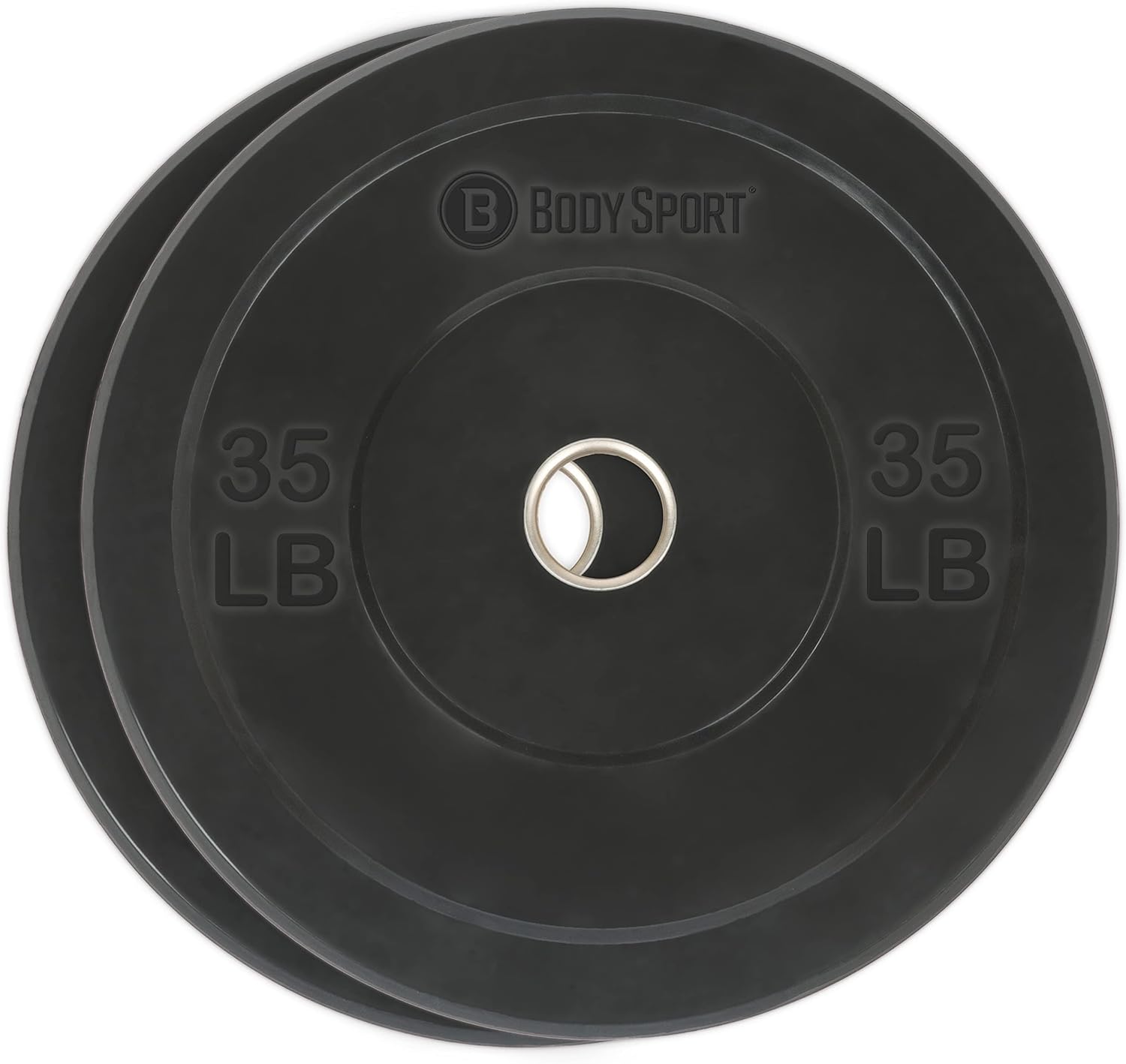
Verified Specs & Sleeve Profile: Total Weight: 70 lb set | Hole Standard: 2 in Olympic stainless steel center bushing | Material: Thin-profile recycled impact-absorbing rubber | Published Thickness: Not published numerically on listing | Price Tier: Under $100 ($50–$100)
Body Sport markets this 70 lb set specifically around a thinner-profile rubber casting and stainless steel center bushing to conserve barbell sleeve length compared with oversized crumb bumpers. Because no exact inch width is published in the retail table, we cannot calculate a verified maximum stack count for heavy 45 lb pairs under CR-PLATE-BAR-02; however, as an add-on starter pair for shorter EZ curl, trap, or 15 kg women’s bars, a thinner recycled rubber profile preserves collar clearance. Follow manufacturer guidance regarding drop surfaces and dense rubber flooring.
- Pros: Thinner-profile design aims to leave more usable sleeve length on short-sleeve bars; 2 in stainless steel bushing resists corrosion and hub wear.
- Cons: 70 lb total set weight requires adding heavier pairs as strength climbs; numeric plate thickness in inches is not published on the Amazon listing.
3. Mikolo 2-Inch Virgin Rubber Olympic Bumper Plate Set (140 lb Set, Steel Insert) — Dense Low-Bounce Rubber

Verified Specs & Sleeve Profile: Total Weight: 140 lb color-coded bumper set | Hole Standard: 2 in Olympic stainless steel insert | Material: 100% low-odor virgin rubber, low bounce | Published Thickness: Not published on listing | Price Tier: Full Sets ($250+)
Higher-density virgin rubber compounds generally pack weight into a more compact cross-section than airy recycled crumb rubber, while producing lower bounce when dropped onto suitable stall mats or a lifting platform (CR-PLATE-ATT-01). Keep two KM rules in mind before ordering color-coded pound sets: under STD-IWF-COLOR, pound plates borrow competition colors loosely rather than following strict IWF kilogram weights (always read the stamped pound number), and exact inch widths are absent from the listing so max 45 lb stack math remains unverified until measured.
- Pros: Dense low-odor virgin rubber with lower dead-bounce characteristics than crumb bumpers; stainless steel center inserts glide smoothly onto 50 mm sleeves.
- Cons: 140 lb total set costs more per set than economy black rubber; exact thickness per weight is not published on the Amazon listing (ISS-PLATE-THICKNESS-UNPUBLISHED).
4. Amazon Basics 2-Inch Olympic Cast Iron Grip Weight Plate (45 lb Single) — Maximum Sleeve Density

Verified Specs & Sleeve Profile: Weight Option: 45 lb single plate (2.5 to 45 lb options) | Hole Standard: 2 in Olympic barbell compatible | Material: Recycled cast iron with dual grip slots | Published Thickness: Not published on listing | Price Tier: Budget (Under $50)
When heavy squatters, benchers, or deadlifters run out of sleeve space with thick rubber bumpers, switching to cast-iron 45 lb plates (typically ~1.25 to 1.4 in thick across standard Olympic castings, though exact thickness is unpublished on this listing) roughly doubles how many plates fit per side. Pair two bumper 45s on the inside for floor height if desired, then stack slim iron 45s outside—just remember CR-PLATE-ATT-01 (never drop iron plates from overhead or lockout) and CR-PLATE-BAR-04 (keep total weight inside your barbell’s verified load rating).
- Pros: Cast-iron profile dramatically increases total weight capacity per sleeve inch for heavy strength lifts; opposing grip slots simplify loading and unloading.
- Cons: Sold as a single 45 lb plate rather than a pair; cast iron is not drop-rated (CR-PLATE-ATT-01), and exact thickness/weight tolerance are unpublished on the listing.
Compatibility Rules Appendix & Authoritative Citations
Every sleeve-capacity formula, plate-width benchmark, and safety gate in this guide traces directly to the IronGym Lab compatibility rule set and primary standards documents. Have a specific bar-and-plate pairing you want verified, or want to learn more about our editorial standards? Reach out via our about page or contact the IronGym Lab team.
- CR-PLATE-BAR-02 (HARD / SOFT): Sum of plate thicknesses per side plus collar width must not exceed loadable sleeve length; fitting bare sleeves without room for collars triggers a SOFT limit.
- CR-PLATE-BAR-01 & CR-PLATE-BAR-03 (HARD / INFO): Match 2 in (~50.4–51 mm) Olympic holes strictly to ~50 mm sleeves (never 1 in bars); calibrated plates fit snugly by design.
- CR-PLATE-BAR-04 & CR-SYS-02 / CR-SYS-03 (HARD / CONDITIONAL): Never exceed a barbell’s published load rating or convert tensile PSI into pound capacity; trace listing ratings to manufacturer documents and cap loads at the weakest rated part.
- CR-PLATE-ATT-01 / ATT-02 / ATT-03 (SOFT / CONDITIONAL): Use drop-rated bumpers on manufacturer-appropriate rubber mats or platforms rather than dropping iron plates, and verify rack storage horns and cable loading pins accommodate thick bumpers.
- CR-PLATE-SYS-01 (INFO): A 20 kg Olympic barbell weighs ~44.1 lb (44.092 lb), not 45 lb; convert mixed kilogram and pound gear into one unit (
1 kg = 2.20462 lb).
Authoritative Non-Affiliate Sources Cited:
- International Weightlifting Federation (IWF) — Equipment Technical Rules — Official 415 mm (16.34 in) men’s and 320 mm (12.60 in) women’s loadable sleeve specs, 50 mm sleeve diameter, and 2.5 kg competition collar rules.
- International Powerlifting Federation (IPF) — Technical Rules — Official 20 kg bar geometry, 50–52 mm sleeve bounds, calibrated plate thickness ceilings, and 25 kg bar-plus-collar standard.
- NIST — Metric SI Unit Conversion Factors — Exact conversion factor (
1 kg = 2.20462 lb) confirming20 kg = 44.092 lband15 kg = 33.069 lb. - Rogue Fitness — Official Echo Bumper V2 & Ohio Bar Specs (not sold on Amazon) — Direct-sale manufacturer benchmarks confirming 2.40 in 45 lb Echo Bumper width, 3.75 in Hi-Temp width, 0.87 in calibrated steel width, and 16.4 in loadable sleeves.
- REP Fitness — Official Black Bumper Plate Specifications — Manufacturer thickness table confirming 2.83 in (45 lb), 1.75 in (25 lb), and 1.00 in (10 lb) virgin rubber bumper dimensions.
How We Audited This Guide
- Strength hardware was audited across upright tube dimensions (2x2, 2x3, 3x3 in), 5/8-in vs 1-in pin hardware, sleeve fit, rated vs rackable capacities, and bench pad height clearances.
- Every power rack, barbell, weight plate, bench, adjustable dumbbell, cardio machine, and flooring spec was cross-checked against official manufacturer manuals, CPSC notices, and live Amazon US listings.
- Recommendations were evaluated against our weighted vertical scoring rubrics and documented CR-* compatibility rules; we never invent load capacities, motor ratings, rubber thickness, or decibels.
Continue Your Audit
- Best Power Rack for Home Gym (2026): 9 Audited Amazon Picks
- Best Power Racks Under $500 (2026): 8 Budget Cages Audited
Frequently Asked Questions: Barbell Plate Capacity
How many 45 lb bumper plates fit on an Olympic barbell?
On a standard men’s Olympic bar with 16.4 in sleeves and 1.5 in clamp collars (14.9 in usable), you can fit 3 thick 3.75 in crumb bumpers per side (314.1 lb), 5 standard 2.83 in virgin-rubber bumpers (494.1 lb), or 6 slim 2.40 in bumpers (584.1 lb).
How many cast iron 45 lb plates fit on a barbell?
Using standard 1.30 in cast-iron 45 lb plates on a 16.4 in sleeve with 1.5 in collars (14.9 in usable), up to 11 plates fit per side (1,034.1 lb on a 20 kg bar). Always verify that total weight stays below your barbell and rack load ratings (CR-PLATE-BAR-04).
How much sleeve space do barbell collars take up?
Standard wire spring clips take roughly 0.5 to 1.0 in (13 to 25 mm) per side, whereas wide polymer clamp collars consume 1.5 to 2.0 in (38 to 51 mm) per side. Switching from a wide clamp to a spring clip can recover enough sleeve for an extra slim plate.
How many plates fit on a women’s 15 kg (33.1 lb) barbell?
A women’s IWF 15 kg barbell has 12.60 in (320 mm) loadable sleeves (11.10 in usable with 1.5 in collars). That space holds 2 thick 3.75 in crumb 45s per side (213.1 lb), 3 standard 2.83 in bumpers (303.1 lb), or 4 slim 2.40 in bumpers (393.1 lb).
Does tensile strength PSI tell you how many plates a barbell holds?
No. Under rule CR-PLATE-BAR-04, tensile strength (such as 190,000 PSI) measures steel alloy breaking stress per square inch, never a pound load capacity. Check the manufacturer’s published load rating alongside physical sleeve length before loading heavy iron or calibrated stacks.


