
Disclosure: As an Amazon Associate, IronGym Lab earns from qualifying purchases. If you buy through verified Amazon US links on this page, we may earn a commission at no extra cost to you. Direct-sale manufacturer lines referenced for technical context are explicitly labeled as not sold on Amazon and carry zero affiliate links.
Choosing between bumper plates vs iron plates shapes far more than how your barbell looks—it governs whether you can drop weights safely, how much total load fits onto a barbell sleeve, how high the bar sits for deadlifts, and what flooring your garage or spare room requires. Under IronGym Lab compatibility standards, Olympic bumper plates use a uniform 17.72 in (450 mm) outer diameter in high-density virgin rubber, urethane, or recycled crumb rubber built around a steel or brass 2 in (~50.4–51 mm) center insert for manufacturer-approved drops. Olympic cast-iron plates pack mass into a noticeably thinner profile that maximizes sleeve load capacity, but they vary in diameter below 45 lb and are not manufactured to be dropped.
Neither plate type wins every home gym scenario. If you train cleans, snatches, or heavy deadlifts in a garage gym where dropping the bar is part of your routine, our best bumper plates for home gyms hub shows why virgin rubber bumpers paired with dense rubber flooring prevent cracked iron and concrete damage. Conversely, if you lift inside a power rack with controlled lowering and want maximum weight on a standard 20 kg (~44.1 lb) barbell sleeve or plate-loaded cable pin, slim cast iron solves sleeve bottlenecks without blowing up your budget tier.
In This Weight Plate Comparison
- Quick Verdict: Bumper Plates vs. Iron Plates by Use Case
- Side-by-Side Spec & Compatibility Comparison
- Drops, Bounce & Subfloor Demands (CR-PLATE-ATT-01 & CR-ATT-SPACE-01)
- Barbell Sleeve Capacity & Plate Thickness (CR-PLATE-BAR-02)
- Deadlift Height, Storage Horns & Cable Loading Pins
- Hub Inserts, Weight Variance, Odor & Listing Traps
- Final Verdict: Choose Bumper Plates vs. Cast Iron
- Verified Amazon US Bumper & Cast Iron Plate Contenders
- CR-* Rules Appendix, Authoritative Sources & FAQs
Quick Verdict: Bumper Plates vs. Iron Plates by Use Case
Because plate material directly interacts with barbell sleeves, rack storage horns, and subfloor construction, there is no single universal winner. Use the matrix below to match plate architecture to your training space and lift selection.
| Home Gym Scenario | Recommended Plate Type | Technical Basis & Compatibility Trade-Off |
|---|---|---|
| Olympic lifts (snatch, clean & jerk) with overhead drops | Virgin Rubber or Urethane Bumpers | Satisfies CR-PLATE-ATT-01 when paired with drop-suitable flooring; low bounce keeps barbell rebounds predictable after drops. |
| Garage powerlifting (heavy squat, bench & controlled deadlifts) | Olympic Cast Iron (or Calibrated Steel) | Slimmer width fits higher total weight on ~16.1–16.5 in barbell sleeves (CR-PLATE-BAR-02) without crowding collars. |
| Beginner deadlifts using lighter 10 lb or 25 lb sets | Full-Diameter Bumper Plates | Universal 17.72 in (450 mm) diameter keeps the bar at standard pull height instead of sitting low on smaller iron discs. |
| Plate-loaded lat pulldown, cable pulley & short storage horns | Olympic Cast Iron Grip Plates | Thin cross-section loads more resistance onto short cable pins (CR-PLATE-ATT-03) and rack horns (CR-PLATE-ATT-02). |
| Conditioning circuits on concrete garage slab with mats | Virgin Rubber or Recycled Crumb Bumpers | Handles repeated floor contact and deadlift drops over 3/4 in (19 mm) dense rubber stall mats (CR-ATT-SPACE-01), though crumb rubber fills sleeves fastest. |
| Upper-floor apartment or wood-framed spare bedroom | Virgin Bumpers + Platform (Controlled Lowering) | Check building rules first; even with rubber plates and layered flooring, never assume upper-floor drops are safe without professional floor evaluation. |
Side-by-Side Spec & Compatibility Comparison
The audit table below contrasts the three major Olympic 2 in plate architectures found across US home gyms: virgin rubber bumper plates, recycled crumb (“hi-temp” style) bumpers, and Olympic cast-iron plates. Because individual SKU thickness varies by mold and manufacturer, unpublished widths are flagged explicitly rather than estimated.
| Specification / Audit Criterion | Virgin Rubber Bumper Plates | Recycled Crumb Bumper Plates | Olympic Cast Iron Plates |
|---|---|---|---|
| Center Hole Standard | ~2 in (~50.4–51 mm) steel or brass insert (STD-HOLE-PLATE-OLY) | ~2 in steel insert (STD-HOLE-PLATE-OLY) | ~2 in (~50.4–51 mm) machined or cast iron bore |
| Outer Diameter (45 lb / 20 kg) | 17.72 in (450 mm) per IWF standard | 17.72 in (450 mm) uniform | ~17.7 in (450 mm max per IPF rules) on 45 lb; smaller on lighter plates |
| Outer Diameter (10 lb & 25 lb) | 17.72 in (450 mm) full size | 17.72 in (450 mm) full size | Progressively smaller diameters (varies by brand) |
| Drop Suitability (CR-PLATE-ATT-01) | Drop-rated per maker on suitable rubber mats or platform | Drop-rated per maker; notably higher rebound | NOT drop-rated; controlled lowering only |
| Barbell Sleeve Efficiency (CR-PLATE-BAR-02) | Moderate to wide profile; fills sleeves sooner than iron | Thickest plate profile; fills barbell sleeves fastest | Thinnest cross-section; maximizes sleeve load capacity |
| Storage Horn & Loading Pin Fit | Fills rack horns & cable pins quickly (CR-PLATE-ATT-02/03) | Quickly exhausts short horns & cable pins | Ideal for rack horns and plate-loaded pulley pins |
| Weight Tolerance & Finish Notes | Typically ±1% to tight competition specs (quote per SKU) | Utility casting variance; textured speckled rubber | Economy foundry variance unless machined/calibrated; enamel can chip |
| Odor & Maintenance Watch | Lower odor on quality virgin rubber; monitor hub insert tightness | Stronger recycled rubber off-gassing; ventilate early | No rubber odor; protect bare/enamel iron from garage humidity |
| Direct-Sale Context (Not on Amazon) | Rogue Echo Bumpers (not sold on Amazon) | Direct-sale specialty crumb lines | REP Calibrated Steel Plates (not sold on Amazon) |
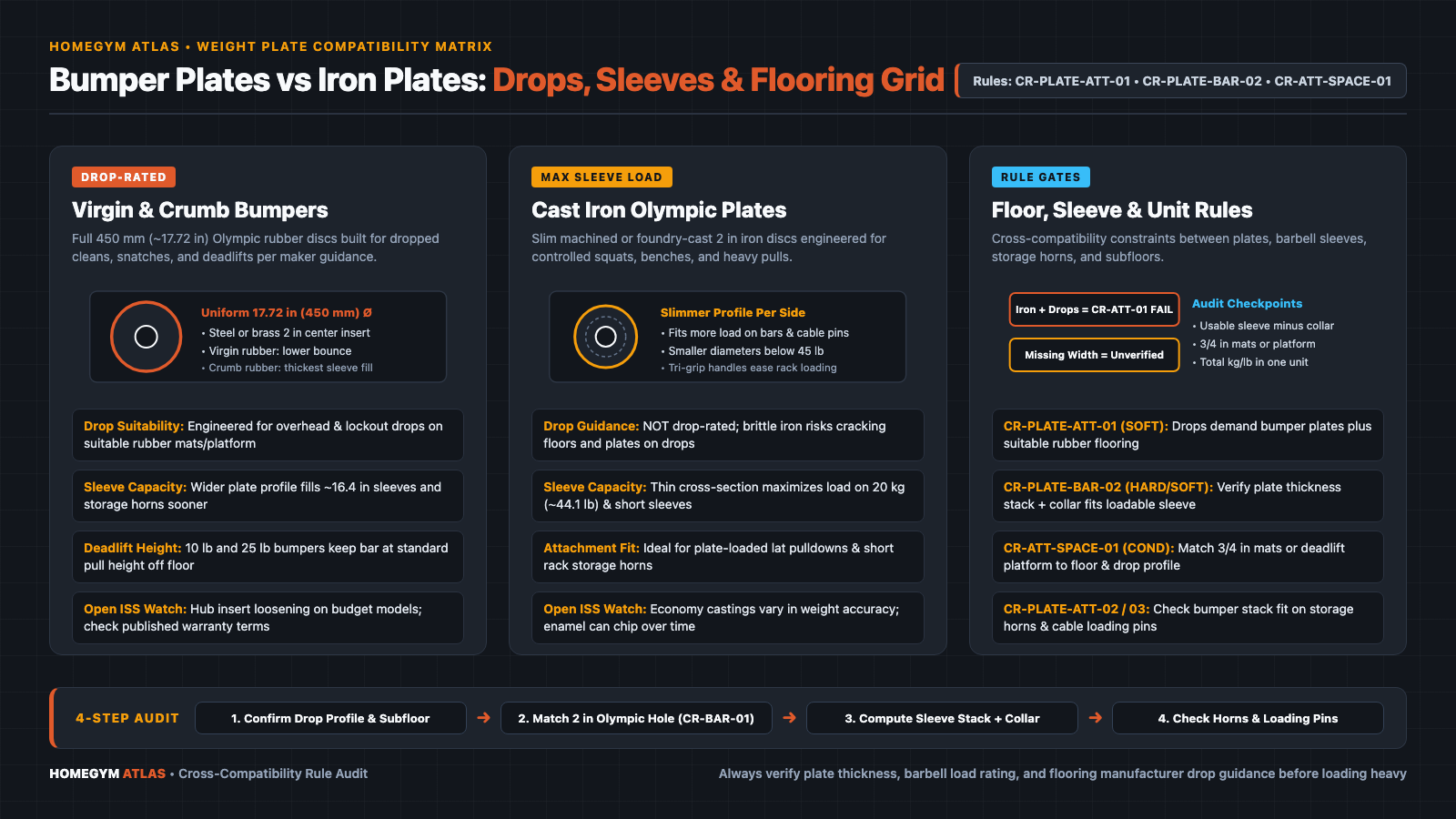
Drops, Bounce & Subfloor Demands (CR-PLATE-ATT-01 & CR-ATT-SPACE-01)
The single most decisive compatibility divide in a bumper plates vs iron plates matchup is vertical impact energy. When a loaded barbell hits the floor from waist, shoulder, or overhead height, all kinetic energy concentrates into the outer rim of the plates and transfers directly into your barbell sleeves and subfloor.
Why Cast Iron Plates Are Not Drop-Rated (CR-PLATE-ATT-01)
Under IronGym Lab rule CR-PLATE-ATT-01 (SOFT), cast-iron plates and calibrated steel plates are not intended by their manufacturers to be dropped. Cast iron is stiff and brittle under sudden impact; dropping an iron-loaded bar from overhead or a deadlift lockout risks cracking the plate flange, chipping concrete slabs, denting wood subfloors, and transmitting sharp shock loads through barbell sleeve bearings or bushings.
Even rubber-coated tri-grip iron plates—such as the REP Fitness Rubber Coated Olympic Plates sold on Amazon US—only wrap an iron core in a thin protective skin to cut down on plate-to-plate clanging and resist rust. They are still utility weight plates for controlled lifts inside a rack or bench station, not full-diameter drop bumpers. Follow each plate manufacturer’s written drop guidance strictly, and never treat rubber-coated grip iron as drop-safe.
Virgin Rubber vs. Recycled Crumb Bumpers & Flooring Rules (CR-ATT-SPACE-01)
True bumper plates distribute impact energy across a full 17.72 in (450 mm) elastomeric tire around a steel or brass center hub. Within the bumper category, material density splits performance into two distinct profiles:
- Virgin Rubber Bumpers: Dense, smooth rubber construction delivers a low, controlled rebound after drops, making them easier to manage inside tighter garage bays where an unpredictable bounce could hit a rack upright or drywall.
- Recycled Crumb (“Hi-Temp” Style) Bumpers: Molded from vulcanized crumb rubber granules, these plates typically cost less per set in entry tiers, but they bounce noticeably higher and carry a thicker profile that fills sleeves fastest.
Under rule CR-ATT-SPACE-01 (CONDITIONAL / SOFT), bumper plates alone do not replace proper flooring. If you drop weights onto bare concrete, thin foam puzzle tiles, or residential hardwood, you still risk subfloor cracking or uneven plate wear. Pair drop-rated bumpers with dense 3/4 in (19 mm) vulcanized rubber horse-stall mats or a layered wood-and-rubber lifting platform as instructed by both your plate and flooring makers—see our best home gym flooring guide for mat density and subfloor matching. In upper-floor apartments or wood-framed rooms, control every eccentric lowering phase, check lease and building rules before lifting heavy, and consult a qualified structural professional rather than assuming any mat eliminates floor vibration or prevents structural damage.
Barbell Sleeve Capacity & Plate Thickness (CR-PLATE-BAR-02)
If your training centers on heavy squats, bench presses, and deadlifts rather than overhead drops, plate thickness becomes your primary hardware constraint. Under IronGym Lab rule CR-PLATE-BAR-02 (HARD / SOFT), the total width of plates per side plus your collar thickness must fit within your barbell’s published loadable sleeve length:
usable_sleeve_in = bar.loadable_sleeve_in - collar_width_instack_in(side) = sum(plate.thickness_in for each plate on one side)
A standard men’s 20 kg (~44.1 lb) Olympic multipurpose bar provides roughly 16.1 to 16.5 in (40.9 to 41.9 cm) of loadable sleeve per side—subtract roughly 0.5–1 in for spring clips or 1.5–2 in for clamp collars, leaving around 14.5–15.5 in of usable space. On a women’s 15 kg (~33.1 lb) Olympic bar, an Olympic EZ curl bar (~9–10 in sleeves), or a short-sleeved trap bar, usable sleeve space shrinks dramatically. For worked stacking scenarios across bar types, check our explainer on how many plates fit on a barbell.
Why Omitted Plate Width Blocks Exact Sleeve Checks (ISS-PLATE-THICKNESS-UNPUBLISHED)
Plate thickness by weight is one of the most critical—yet least consistently published—specs on Amazon US listings (ISS-PLATE-THICKNESS-UNPUBLISHED). When an Amazon product page omits individual 45 lb, 25 lb, and 10 lb plate widths, we flag sleeve capacity as not yet verified rather than guessing thickness from product photos. Qualitatively, three physics-driven patterns always hold:
- Recycled crumb bumpers occupy the greatest width per pound, exhausting ~16.4 in barbell sleeves earliest—especially when sets rely on multiple 25 lb or thicker 45 lb crumb discs.
- Virgin rubber bumpers sit in the middle; thin-profile training bumpers fit more pairs than crumb rubber, though heavy deadlifters above 400–500 lb can still run out of sleeve room before hitting bar limits.
- Cast iron and calibrated steel plates pack iron density into the narrowest width per pound, giving powerlifters and trap-bar lifters substantial headroom before collars run off the sleeve end.
Remember also to check your barbell’s load rating under CR-PLATE-BAR-04 (HARD) and whole-setup rule CR-SYS-03. Many premium direct-sale bars publish steel tensile strength in PSI (for example, 190,000 PSI) rather than a pound capacity; never convert PSI into a pound limit. Your weakest rated component—whether a 700 lb budget barbell or your rack J-cups—sets the ceiling for your entire gym.
Deadlift Height, Storage Horns & Cable Loading Pins
Beyond floor impact and sleeve length, three everyday mechanical interactions separate bumper plates from cast iron in a real home gym: pull height off the floor, center-hole fit, and attachment horn clearance.
Universal 17.72 in (450 mm) Diameter vs. Stepped Iron Sizes
Under IWF technical rules, competition and training bumper plates standardize at 450 mm (~17.72 in, ±1 mm) across 10 lb, 15 lb, 25 lb, 35 lb, and 45 lb discs. That uniform radius holds an unloaded Olympic barbell shaft at roughly 8.86 in (225 mm) above the mat even when a beginner loads only a single pair of 10 lb or 15 lb bumpers. However, note one critical durability caveat on 10 lb bumpers: because a 10 lb rubber disc spans the full 17.72 in diameter with minimal core mass, dropping a bar loaded with only 10 lb bumpers can taco or fold the rubber rim unless the maker explicitly rates thin 10 lb plates for solo drops.
Cast-iron plates follow a stepped diameter curve: a 45 lb iron plate reaches full ~17.7 in height (matching IPF’s 45 cm maximum disc rule), while 25 lb, 10 lb, and 5 lb iron plates shrink progressively smaller. If you pull deadlifts or barbell rows from the floor with less than 135 lb (one 45 lb plate per side on a 20 kg / ~44.1 lb bar), iron plates force a deeper starting deficit unless you elevate the bar on pulling blocks—or keep one pair of 10 lb or 25 lb bumper plates on hand specifically for lighter floor pulls.
Center-Hole Fit, Storage Horns & Loading Pins (CR-PLATE-BAR-01, ATT-02 & ATT-03)
Every plate in this comparison uses the 2 in (~50.4–51 mm) Olympic center hole (STD-HOLE-PLATE-OLY). Under rule CR-PLATE-BAR-01 (HARD), 2 in Olympic plates pair only with ~50 mm Olympic barbell sleeves—never load 2 in plates onto a 1 in (25.4 mm) standard bar without a maker-approved, load-rated adapter sleeve, as loose radial slop causes off-center loading. Tight-tolerance competition or calibrated plates also slide more snugly onto sleeves by design (CR-PLATE-BAR-03).
Where bumper plates frequently surprise rack buyers is auxiliary hardware:
- Rack Plate Storage Horns (CR-PLATE-ATT-02, CONDITIONAL): Many rack-mounted weight horns measure 8–10 in long. Two or three thick bumper plates can fill a horn completely and overhang past the upright, blocking in-rack squat or bench clearance unless you add a freestanding plate tree.
- Plate-Loaded Cable Attachments (CR-PLATE-ATT-03, CONDITIONAL): Lat pulldown and low-row loading pins have fixed sleeve lengths. Thin cast-iron plates let you stack substantially more cable resistance onto a single pin than wide rubber bumpers.
- Mixing Kilogram and Pound Plates (CR-PLATE-SYS-01, INFO): Mixing kg and lb plates on the same bar is mechanically fine as long as you match each side symmetrically and total your load in one unit—remembering that a standard 20 kg Olympic bar weighs ~44.1 lb, not 45 lb.
Hub Inserts, Weight Variance, Odor & Listing Traps
Before clicking buy on any Amazon plate set, audit four recurring quality and listing issues documented in IronGym Lab knowledge base cards:
- Bumper Hub Insert Loosening (ISS-PLATE-INSERT-LOOSENING): According to community reports, not officially confirmed across every budget brand, molded steel center rings on economy bumpers can loosen or spin inside the rubber body after repeated drops. Favor plates with hooked/flanged steel inserts and verify written warranty coverage—for example, REP Fitness separates bumper warranties between 6 months on lighter 10/15 lb plates and 3 years home / 1 year commercial on 25–45 lb plates, and voids coverage if dropped alongside Hi-Temp style plates of differing diameter.
- Cast Iron Weight Variance & Coating Wear (ISS-PLATE-WEIGHT-VARIANCE): Economy cast-iron plates rarely publish tight calibration tolerances. Foundry castings can drift slightly above or below face weight unless you step up to machined iron or direct-sale calibrated steel (such as REP Calibrated Plates, not sold on Amazon). Baked enamel finishes also chip over time when iron plates bang together on sleeves.
- Single vs. Pair & Bar-Included Traps: Many Amazon cast-iron listings sell 45 lb plates as a single disc rather than a pair, while 110 lb or 140 lb sets almost always exclude the ~44.1 lb (20 kg) barbell. Always verify exact piece counts in the listing title and bullet specs.
- Heavy Parcel & Freight Splitting (CR-SYS-04): Full 260 lb or 320 lb plate bundles ship in multiple heavy cartons or freight pallets; inspect steel inserts and iron bores for transit damage upon arrival before discarding packaging. For a broader look at iron, grip, and rubber-coated bundles across tiers, visit our best Olympic weight plates guide.
Final Verdict: Choose Bumper Plates vs. Cast Iron Plates
Choose Olympic Bumper Plates If…
- You perform cleans, snatches, push presses, or heavy deadlifts where dropping the bar is planned (CR-PLATE-ATT-01).
- You lift on 3/4 in (19 mm) rubber stall mats or a lifting platform and want consistent 17.72 in (450 mm) pull height even with 10–25 lb plates.
- You want quieter plate contact during controlled rack work and rust-free virgin rubber surfaces in damp garages.
- Your heaviest target barbell loads fit comfortably within your bar’s loadable sleeve length (CR-PLATE-BAR-02).
Choose Cast Iron Olympic Plates If…
- You focus on squats, bench presses, rows, and controlled deadlifts inside a power rack without dropping the bar.
- You load heavy total weights or train with shorter sleeves (15 kg bars, trap bars, EZ curl bars) where slim plate thickness matters.
- You run plate-loaded lat pulldown, cable pulley, or rack storage horns with limited pin length (CR-PLATE-ATT-02 / ATT-03).
- You prefer built-in dual or tri-grip handles and lower entry-tier bundle costs in the Budget to Mid-Range tiers.
Verified Amazon US Bumper & Cast Iron Plate Contenders
While several well-known direct-sale lines—such as Rogue Echo Bumpers and REP Calibrated Plates—are not sold on Amazon, the four verified Amazon US contenders below cover both drop-rated virgin rubber bumpers and slim Olympic cast-iron plates across entry and mid-range tiers.
1. REP Color Bumper Plates — Best Low-Bounce Amazon Bumper Contender

Verified Specs: 17.72 in (450 mm) universal outer diameter | 2 in (~50.4–50.5 mm) steel center insert | High-density virgin rubber, low-bounce drop-rated construction | Color-coded 10, 15, 25, 35, and 45 lb pairs & sets | REP Warranty: 6 months (10/15 lb) & 3 years home / 1 year commercial (25–45 lb) | Price Tier: Mid-Range ($100–$250) to Full Sets ($250+)
Sold directly through the official REP Store on Amazon US, REP Color Bumper Plates bring low-bounce virgin rubber construction and standardized 450 mm geometry to garage strength spaces. Their color-coded pound markings follow IWF color conventions visually while keeping plate increments in US pounds, and weighted steel inserts seat cleanly on ~50 mm Olympic sleeves.
- Pros: Low-bounce virgin rubber controls rebound on concrete slabs with rubber mats; uniform 17.72 in (450 mm) diameter keeps light pulls at full bar height; clear tiered manufacturer warranty.
- Cons: Lighter 10 lb and 15 lb plates carry only a 6-month warranty and should not be dropped solo without heavier plates on the bar; exact per-run plate thickness should be verified on the variant listing before max-load sleeve math, and warranty voids if mixed with Hi-Temp style plates.
2. Mikolo 2-Inch Virgin Rubber Bumper Plate Set (140 lb) — Low-Odor Starter Set

Verified Specs: 140 lb total color-coded bumper set (excludes barbell) | 17.72 in (450 mm) IWF outer diameter | 2 in stainless steel center insert | 100% low-odor virgin rubber, low bounce | Exact plate thickness per weight not published on Amazon listing | Price Tier: Full Sets ($250+)
For lifters starting a home barbell setup from scratch, the Mikolo 140 lb Virgin Rubber Set bundles color-coded bumper pairs with stainless steel 2 in inserts. Using virgin rubber rather than recycled crumb keeps initial rubber odor lower in enclosed garages or spare rooms while preserving full 450 mm deadlift height.
- Pros: Low-odor, low-bounce virgin rubber construction with stainless steel inserts; full 17.72 in (450 mm) diameter across the set; convenient 140 lb starter composition.
- Cons: Individual plate thickness is not published on the Amazon listing, preventing exact CR-PLATE-BAR-02 sleeve stack math prior to delivery; 140 lb total excludes the ~44.1 lb (20 kg) barbell and will require additional 45 lb pairs as strength progresses.
3. Amazon Basics 2-Inch Cast Iron Grip Plate (45 lb Single) — Slim Heavy Add-On

Verified Specs: 45 lb single plate (2.5–45 lb variant options) | 2 in Olympic center bore | GRS-certified recycled cast iron with dual grip cutouts | Charcoal finish | Not drop-rated (CR-PLATE-ATT-01) | Thickness & exact tolerance unpublished | Price Tier: Budget (Under $50)
When your squat or deadlift climbs past what bulky bumpers allow on a barbell sleeve, adding slim 45 lb cast-iron plates extends your bar’s usable loading capacity. The Amazon Basics 45 lb Olympic Grip Plate features opposing hand slots that make carrying and loading a 45 lb disc onto high rack pins significantly easier than smooth-rim iron.
- Pros: Slim cast-iron profile preserves barbell sleeve and cable loading-pin space; opposing dual grip holes simplify plate handling; Budget (Under $50) entry bracket for single 45 lb add-ons.
- Cons: Sold as a single plate (order two for a barbell pair); not intended for dropping from overhead or lockout (CR-PLATE-ATT-01); exact width and foundry weight tolerance are not published on a standalone OEM engineering sheet (ISS-PLATE-THICKNESS-UNPUBLISHED / ISS-PLATE-WEIGHT-VARIANCE).
4. CAP Barbell 2-Inch Cast Iron Grip Plate Set (110 lb) — Best Compact Starter Bundle

Verified Specs: 110 lb set (4 x 5 lb, 4 x 10 lb, 2 x 25 lb; excludes bar) | Machined 2 in Olympic center hole | Solid cast iron with baked enamel finish & grip cutouts | Not drop-rated (CR-PLATE-ATT-01) | Exact width & foundry tolerance unpublished | Price Tier: Mid-Range ($100–$250)
CAP Barbell’s 110 lb Cast Iron Grip Set covers incremental loading for bench presses, overhead presses, EZ curl bars, and plate-loaded lat pulldown towers. Its machined 2 in center holes slide cleanly over Olympic sleeves and cable loading pins without taking up excessive horn length.
- Pros: Granular 5 lb and 10 lb pairs support smooth upper-body and cable progression; slim cast iron stacks cleanly on short pulley pins and rack storage horns (CR-PLATE-ATT-02/03); integrated grip holes double for solo plate work.
- Cons: Lacks full-diameter 45 lb plates, meaning floor-pulled deadlifts sit low off the ground without pulling blocks; not drop-rated (CR-PLATE-ATT-01); utility cast iron carries unpublished thickness and foundry weight variance (ISS-PLATE-WEIGHT-VARIANCE), and enamel finishes can chip with heavy plate-to-plate contact.
Compatibility Rules Appendix & Authoritative Sources
Every conclusion in this bumper plates vs iron plates audit follows the IronGym Lab cross-compatibility rule engine. Never assume a setup passes until each relevant rule is satisfied and missing listing dimensions are flagged transparently:
- CR-PLATE-BAR-01 (HARD) & CR-PLATE-BAR-03 (INFO): 2 in (~50.4–51 mm) Olympic plates fit ~50 mm Olympic sleeves only; competition/calibrated plates fit more snugly by design.
- CR-PLATE-BAR-02 (HARD / SOFT): Total plate stack width per side plus collar width must not exceed your barbell’s loadable sleeve length; missing width specs keep max stack verification open (ISS-PLATE-THICKNESS-UNPUBLISHED).
- CR-PLATE-BAR-04 (HARD) & CR-SYS-02 / CR-SYS-03: Target loads must remain within the barbell’s published pound rating; never convert PSI tensile strength into pound capacity, and treat marketplace-only claims conservatively.
- CR-PLATE-ATT-01 (SOFT) & CR-ATT-SPACE-01 (CONDITIONAL / SOFT): Drops require bumper plates paired with 3/4 in (19 mm) dense rubber mats or a lifting platform per manufacturer instructions; cast iron is for controlled lowering only.
- CR-PLATE-ATT-02 / CR-PLATE-ATT-03 (CONDITIONAL) & CR-PLATE-SYS-01 (INFO): Count bumper width before relying on rack storage horns or cable loading pins, and total mixed kg/lb plates in one unit (20 kg ≈ 44.1 lb).
Authoritative Non-Affiliate Citations:
- International Weightlifting Federation (IWF) Technical & Equipment Rules — Official 450 mm (±1 mm) bumper disc diameter standard and color-coding specifications.
- International Powerlifting Federation (IPF) Technical Rules — Competition disc diameter ceiling (45 cm max), thickness limits, and 52–53 mm center-hole tolerances.
- REP Fitness Official Bumper Plate & Warranty Specifications — Published 450 mm diameter, virgin rubber steel-insert design, drop rating, and 6-month vs. 3-year/1-year warranty terms.
- Mikolo Fitness Official Bumper Specifications & CAP Barbell Product Catalog — Virgin rubber 450 mm bumper specs and 2 in Olympic cast-iron plate finishing specifications.
How We Audited This Guide
- Strength hardware was audited across upright tube dimensions (2x2, 2x3, 3x3 in), 5/8-in vs 1-in pin hardware, sleeve fit, rated vs rackable capacities, and bench pad height clearances.
- Every power rack, barbell, weight plate, bench, adjustable dumbbell, cardio machine, and flooring spec was cross-checked against official manufacturer manuals, CPSC notices, and live Amazon US listings.
- Recommendations were evaluated against our weighted vertical scoring rubrics and documented CR-* compatibility rules; we never invent load capacities, motor ratings, rubber thickness, or decibels.
Continue Your Audit
Frequently Asked Questions: Bumper Plates vs. Iron Plates
Can you drop cast iron or rubber-coated iron weight plates?
No. Under rule CR-PLATE-ATT-01, cast-iron and thin rubber-coated grip iron plates are not manufactured for dropping. Dropping iron risks fracturing plates, damaging barbell sleeves, and cracking concrete or wood subfloors. Use drop-rated Olympic bumper plates over suitable rubber mats or a lifting platform whenever dropping is planned.
Do bumper plates fit on all Olympic barbells?
Bumper plates with 2 in (~50.4–51 mm) center holes fit standard ~50 mm Olympic sleeves under CR-PLATE-BAR-01, but thick rubber or crumb bumpers fill loadable sleeves much faster than cast iron (CR-PLATE-BAR-02). Always check total plate width plus collar width against your bar’s loadable sleeve length.
Why are 10 lb and 25 lb bumper plates bigger than iron plates?
Bumper plates follow the IWF 17.72 in (450 mm) universal diameter across 10 lb through 45 lb weights so the barbell stays at standard deadlift pull height regardless of weight loaded. Cast-iron plates shrink in diameter at lighter weights, which lowers the bar off the floor unless elevated.
Can you mix bumper plates and cast iron plates on the same barbell?
Yes, for controlled lifts—with one strict drop rule. Never drop a barbell loaded with smaller-diameter iron plates alongside bumpers unless the bumpers carry the full floor impact, and verify with your bumper maker’s warranty first. Mixing 17.72 in bumpers with smaller iron plates inside bumpers is common for heavy controlled deadlifts.
Which is better for a garage gym floor: virgin rubber or recycled crumb bumpers?
Virgin rubber bumpers produce less rebound bounce, typically emit less odor, and take up less barbell sleeve space than thick recycled crumb bumpers. Whichever bumper style you choose, pair it with 3/4 in (19 mm) dense rubber stall mats or a dedicated platform per CR-ATT-SPACE-01.


