
Disclosure: As an Amazon Associate, IronGym Lab earns from qualifying purchases. If you buy through verified Amazon US links on this page, we may earn a small commission at no extra cost to you. Direct-sale manufacturer lines referenced for pulley-ratio benchmarking are explicitly labeled as not sold on Amazon and carry zero affiliate links.
When shopping for a functional trainer, rack-mounted lat tower, or plate-loaded cable station, having the cable pulley ratio explained clearly before you order prevents one of the most frequent home gym surprises: pinning 200 lb (90.7 kg) on a weight stack and discovering it feels like 100 lb (45.4 kg) at the handle. Under our best power rack attachments compatibility framework, pulley ratio is a core mechanical specification alongside steel upright size and ceiling clearance—because stack weight alone tells you nothing about actual pulling resistance or cable travel length.
Quick Answer — 1:1 vs. 2:1 Cable Pulley Ratio
A 1:1 pulley ratio transfers 100% of the loaded plate or stack weight to your handle (200 lb / 90.7 kg loaded feels like 200 lb) with equal cable-to-stack travel. A 2:1 pulley ratio cuts felt resistance in half (200 lb / 90.7 kg stack feels like 100 lb / 45.4 kg) while doubling usable cable travel distance and cutting increment jumps by 50%.
In This Cable Pulley Ratio Guide
- How Pulley Ratios Work: Fixed vs. Traveling Pulleys (CR-ATT-01)
- 1:1 vs. 2:1 vs. Convertible vs. 4:1 Comparison Matrix
- Resistance Math, Increment Steps & Stack Inertia
- Converting Dual 2:1 Stacks Into a 1:1 Pull
- Loading Pins, Ceiling Clearance, Anchoring & ASTM Standards
- Myth vs. Engineering Reality: 4 Cable Ratio Traps
- Verified Amazon US Examples Across Pulley Ratios
- Compatibility Rules, Authoritative Citations & FAQs
How Cable Pulley Ratios Work: Fixed Redirects vs. Traveling Blocks (CR-ATT-01)
Every gym cable machine obeys classical block-and-tackle mechanics. Under IronGym Lab rule CR-ATT-01 (INFO), you can identify any cable machine’s true mechanical advantage—even when an online product title omits the ratio—simply by tracing the steel cable from the handle back to the weight carriage and counting how many active cable segments directly support the moving weight.
The 1:1 Direct Path: Fixed Redirect Pulleys Only
In a 1:1 pulley system, every pulley wheel on the machine stays bolted to a stationary point on the steel frame. Those fixed sheaves only redirect the cable around corners—from the top crossmember, across to the rear tower, and down to the weight carriage—without multiplying force. Because only one single cable leg terminates at the top of the weight carriage, pulling the handle down 12 in (30.5 cm) lifts the weight stack or loading pin exactly 12 in (30.5 cm).
Ignoring modest bearing and sheave friction, handle force equals loaded weight: F_handle = W_stack. Almost all dedicated rack-mounted lat pulldown and low-row towers—including models featured in our best lat pulldown attachment for a power rack audit—use a 1:1 ratio so lifters can pull heavy vertical and horizontal rows without exhausting short plate-loading sleeves.
The 2:1 Traveling-Pulley Path: Mechanical Advantage of Two
In a 2:1 pulley system, the cable does not bolt directly to the top of the weight stack. Instead, it routes down from an overhead frame pulley, loops underneath a traveling (floating) pulley block mounted directly on top of the selector rod or plate carriage, and runs back up to anchor permanently to the frame header. Two parallel vertical cable segments now share the weight carriage load equally.
Because two cable legs suspend the stack, each leg carries only half of the gravitational load (F_handle = 0.50 × W_stack, neglecting minor pulley friction). By conservation of work (Force × Distance), halving the handle force doubles the cable travel required to raise the weight: pulling the handle 24 in (61.0 cm) lifts the weight stack only 12 in (30.5 cm). That doubled cable length is why compact dual-stack functional trainers standing around 80 to 84 in (203.2 to 213.4 cm) tall can still deliver 75 to 85+ in (190.5 to 215.9+ cm) of continuous cable payout for long lunges, woodchoppers, and standing chest flyes.
What About 4:1 Pulley Ratios?
A smaller subset of commercial athletic stations and specialty single-column towers use a 4:1 ratio, achieved with a compound traveling pulley block where four supporting cable segments lift the weight stack. On a 4:1 column, a 200 lb (90.7 kg) stack yields roughly 50 lb (22.7 kg) at the handle while extending cable payout to four times the stack stroke—allowing explosive rotational throws or multi-step sport movements without bottoming out the top plate against the bumper stop.
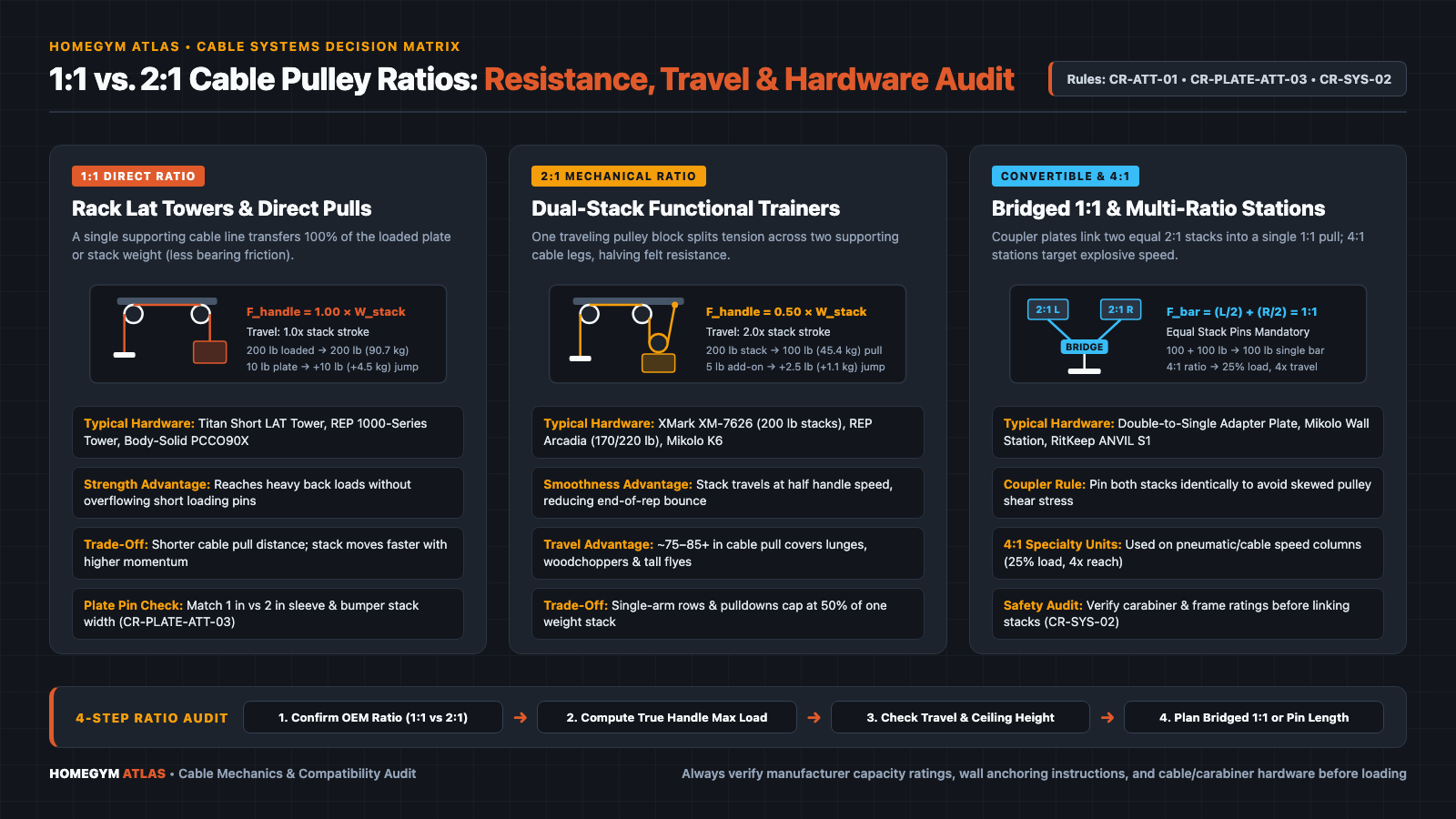
1:1 vs. 2:1 vs. Convertible vs. 4:1 Cable Ratio Comparison Matrix
Use the decision matrix below to compare how each pulley ratio behaves across felt handle load, cable travel multiplier, progressive weight increments, and real home gym exercise selection.
| Pulley Ratio Class | Handle Resistance Formula | Cable Travel Multiplier | Increment Feel (Per 10 lb / 4.5 kg Plate) | Best Exercise Fit & Critical Caveat |
|---|---|---|---|---|
| 1:1 Direct Ratio (Rack lat towers, wide crossovers) | 100% of loaded weightF = W_stack | 1.0x (1 in pull = 1 in stack lift) | 10 lb (4.5 kg) (Coarser jumps on 10 lb stack plates) | Heavy lat pulldowns, seated cable rows, straight-bar pressdowns. Shorter maximum cable reach; faster stack velocity increases momentum bounce on fast reps. |
| 2:1 Mechanical Ratio (Dual-stack functional trainers) | 50% of loaded weightF = 0.50 × W_stack | 2.0x (2 in pull = 1 in stack lift) | 5 lb (2.3 kg) (2.5 lb with 5 lb add-on) | Cable chest flyes, lateral raises, face pulls, triceps extensions, unilateral rows. Very smooth stroke, long travel, but single-arm heavy rows cap at half the stack. |
| Convertible 2:1 / 1:1 (Dual-drive or 2-to-1 coupler) | 50% split or 100% bridgedF = (L/2) + (R/2) | 2.0x split / 2.0x bridged across two stacks | 5 lb split / 10 lb when matching both stacks | Covers both fine isolation work and heavy compound pulldowns in one footprint. Requires identical pin settings on both stacks when bridged. |
| 4:1 Speed Ratio (Athletic speed columns) | 25% of loaded weightF = 0.25 × W_stack | 4.0x (4 in pull = 1 in stack lift) | 2.5 lb (1.1 kg) | Explosive punches, rotational woodchoppers, sled-style gait drills. Too light for heavy hypertrophy rows or pulldowns. |
If you are currently comparing dual-column machines versus integrated rack stations, our best functional trainer for a home gym roundup and best power rack with cable system guide categorize verified Amazon US machines directly by their 1:1, 2:1, or switchable pulley architecture.
Resistance Math, Increment Steps & Stack Inertia Explained
Three practical training differences separate 1:1 and 2:1 systems in daily use—even when two machines appear to carry identical weight stacks on paper.
1. Effective Handle Weight Across Common Stack Sizes
Because Amazon and direct-sale specs frequently advertise combined weight-stack mass (for example, “340 lb dual stacks” or “400 lb stacks”), buyers must divide by two stacks first and then apply the pulley ratio. The reference table below translates common weight loads into true single-handle and bridged-bar resistance.
| Weight Selected / Loaded (Per Carriage) | 1:1 Direct System (Single Handle or Bar) | 2:1 Functional Trainer (Single Handle) | Two 2:1 Stacks Bridged via 2-to-1 Coupler |
|---|---|---|---|
| 50 lb (22.7 kg) | 50 lb (22.7 kg) | 25 lb (11.3 kg) | 50 lb (22.7 kg) (50 lb left + 50 lb right) |
| 100 lb (45.4 kg) | 100 lb (45.4 kg) | 50 lb (22.7 kg) | 100 lb (45.4 kg) (100 lb left + 100 lb right) |
| 150 lb (68.0 kg) | 150 lb (68.0 kg) | 75 lb (34.0 kg) | 150 lb (68.0 kg) (150 lb left + 150 lb right) |
| 170 lb (77.1 kg) (e.g., stock REP Arcadia stack) | 170 lb (77.1 kg) | 85 lb (38.6 kg) | 170 lb (77.1 kg) (170 lb left + 170 lb right) |
| 200 lb (90.7 kg) (e.g., XMark XM-7626 stack) | 200 lb (90.7 kg) | 100 lb (45.4 kg) | 200 lb (90.7 kg) (200 lb left + 200 lb right) |
| 220 lb (99.8 kg) (e.g., upgraded Arcadia stack) | 220 lb (99.8 kg) | 110 lb (49.9 kg) | 220 lb (99.8 kg) (220 lb left + 220 lb right) |
Notice what that arithmetic means for real workouts. A dual 170 lb (77.1 kg) functional trainer like the REP Fitness Arcadia gives you 85 lb (38.6 kg) of effective resistance per single handle at its 2:1 ratio—plenty for single-arm cable flyes, lateral raises, curls, and face pulls, where 2.5 lb (1.1 kg) effective steps from a 5 lb magnetic add-on weight make progression effortless. However, if you perform heavy one-arm rows or unbridged pulldowns above 100 lb, a 2:1 machine requires either heavier 200–220 lb stacks, a stack-pin extender, or bridging both stacks together.
2. Stack Velocity, Momentum & Perceived Smoothness
Why do commercial gym functional trainers feel remarkably silky compared with budget plate-loaded lat towers? Bearing quality and CNC aluminum pulleys play a role, but physics favors the 2:1 ratio. Because the weight stack moves at half the linear speed of your hands on a 2:1 machine, the stack carries only one-quarter of the kinetic energy (KE = 1/2 m v²) for a given handle velocity compared with a 1:1 stack lifting the same effective resistance at full speed. That lower stack velocity keeps plates from rattling, floating, or slackening the cable at the top of rapid concentric reps.
3. Micro-Increments for Small Muscle Groups
Most selectorized weight stacks step in 10 lb (4.5 kg) or 15 lb (6.8 kg) plate increments. On a 1:1 lat tower with 10 lb stack plates, every pin move forces a full 10 lb jump—which feels steep on strict cable lateral raises, rear-delt flyes, or triceps overhead extensions. On a 2:1 trainer, that same 10 lb selector plate feels like 5 lb (2.3 kg) at the handle, and slipping a 5 lb magnetic add-on block onto the top plate yields a granular 2.5 lb (1.1 kg) progression.
Converting Dual 2:1 Stacks Into a Combined 1:1 Pull
Home gym owners do not have to choose exclusively between 2:1 isolation smoothness and 1:1 compound pulling strength. Two proven hardware mechanisms bridge both worlds on modern trainers:
- Double-to-Single Spreader / Adapter Plates: On any dual-column 2:1 functional trainer whose two trolleys can slide close together or link overhead via a rigid steel coupler plate, clipping both the left and right cables onto one central lat bar sums their effective forces:
F_bar = (W_left / 2) + (W_right / 2). When both stacks are pinned to the same weight (for instance, 150 lb left + 150 lb right), the bar delivers75 lb + 75 lb = 150 lb (68.0 kg)—giving you a true 1:1 pull across your combined stack total. - Integrated Dual-Drive / Convertible Cable Linkages: Single-tower wall stations and hybrid trainers (such as Mikolo’s Wall Mount Cable Station or RitKeep’s ANVIL S1) include an adapter carabiner or rear dual-drive cable latch that ties both cable paths onto a single carriage or merges dual rear stacks for 1:1 lat pulldowns, then unclips in seconds back to 2:1 dual handles.
Mandatory Operational Rule: Whenever you link two separate 2:1 stacks onto a single bar with a double-to-single adapter plate, pin both stacks to the exact same weight. Uneven left/right stack weights tilt the spreader plate, pull guide-rod carriages crookedly, and concentrate shear friction on one cable path.
Loading Pins, Ceiling Clearance, Anchoring & ASTM Standards
Evaluating a cable system requires checking four physical compatibility gates alongside the pulley ratio so your plates, room height, and mounting surfaces work safely together.
- Plate Loading-Pin Diameter & Sleeve Length (CR-PLATE-ATT-03): Plate-loaded 2:1 towers demand twice as many pounds on the carriage to match a 1:1 handle load. If your 2:1 carriage provides only 8 to 9 in (20.3 to 22.9 cm) of loadable sleeve per side, thick recycled crumb-rubber bumper plates fill the pin rapidly before you reach heavy row loads. Verify whether the carriage accepts 1 in (25.4 mm) standard or 2 in (50 mm) Olympic plates, and prioritize thin cast-iron plates when loading high 2:1 stacks.
- Rack Tube, Pin & Crossmember Prerequisites (CR-RACK-ATT-01..04): Bolt-on 1:1 lat pulldown towers are never universal. Always match rack brand, upright size (2×2, 2×3, or 3×3 in), hardware pin size (5/8 in vs 1 in), rack height, and base style (bolt-down vs flat-foot). Note that direct-sale modular cable racks such as the REP Fitness PR-4000 and PR-5000 (with Ares or Athena attachments) are not sold on Amazon and require direct manufacturer configuration.
- Ceiling Obstructions & Structural Anchoring (CR-RACK-SPACE-01 / 05): Dedicated lat towers stand 71 to 91 in (180.3 to 231.1 cm) tall; measure to the lowest basement beam, duct, or open garage-door rail before ordering. Wall-mounted cable stations must be lag-bolted into structural wood studs or solid concrete strictly per the manufacturer’s installation instructions—if you are unsure about framing or masonry behind drywall, consult a qualified installer.
- ASTM F2276 / F2216 Guarding & Traceable Ratings (CR-SYS-02, ISS-ATT-PULLEY-UNRATED): Recognized US fitness standards—ASTM F2276 and ASTM F2216—require enclosed or guarded pinch points around pulley sheaves, endurance-rated cables and end fittings, and routine cable inspection signage. On budget marketplace pulley kits where capacity ratings appear only on the Amazon title without a traceable manufacturer document (CR-SYS-02), inspect carabiners, cable crimps, and thimble eyes before every session and treat unverified capacities conservatively.
Myth vs. Engineering Reality: 4 Cable Pulley Ratio Misconceptions
Buyer Alert — 4 Common Cable Pulley Ratio Myths
- Myth 1: “A 400 lb functional trainer lets me pull 400 lb on one cable.”
Reality: Listings almost always quote the combined weight of two stacks (dual 200 lb / 90.7 kg stacks) on a 2:1 ratio. Each independent handle maxes out at 100 lb (45.4 kg), and bridging both stacks yields 200 lb (90.7 kg)—never 400 lb. - Myth 2: “A 2:1 cable machine is lower quality or ‘cheating’ compared with 1:1.”
Reality: Commercial functional trainers use 2:1 mechanical advantage intentionally to double cable travel (~75–85+ in), halve stack inertia for smoother concentric acceleration, and create finer 2.5 to 5 lb progression steps. - Myth 3: “Adding extra pulleys always increases cable friction until the ratio is useless.”
Reality: While every sheave adds minor bearing drag, sealed-bearing CNC aluminum pulleys (especially paired with nylon-coated 7×19 aircraft steel cable) keep mechanical losses low while preserving predictable 2:1 travel and resistance math. - Myth 4: “You can bridge two stacks using any cheap hardware-store snap clip.”
Reality: Generic unrated aluminum clips fail under dynamic cable loads (ISS-ATT-PULLEY-UNRATED). Use manufacturer-supplied spreader plates and rated steel carabiners within the cable and pulley frame’s verified rating (CR-SYS-02).
Verified Amazon US Hardware Examples Across Pulley Ratios
The four verified Amazon US products below demonstrate each major pulley-ratio architecture in real home gym hardware—from a 1:1 bolt-on rack tower and a 2:1 dual-stack functional trainer to a convertible 2:1/1:1 wall station and a 2-to-1 spreader adapter plate.
1. Titan Fitness Short LAT Tower Rack Attachment — 1:1 Direct Plate-Loaded Benchmark

Verified Specs & Pulley Profile: 1:1 direct pulley ratio (CR-ATT-01) | Rated Capacity: 300 lb (136.1 kg) plate-loaded capacity per Titan specification | Dimensions: 78 in (198.1 cm) H × 42 in (106.7 cm) W | Dual 9.25 in (23.5 cm) Olympic sleeves | Fits post-October 2021 bolt-down Titan T-3 (2×3 in) & X-3 (3×3 in) racks | Price Tier: Mid-Range ($100–$250)
Titan’s Short LAT Tower exemplifies why 1:1 routing dominates rack-mounted back stations. Loading two 45 lb plates per sleeve (180 lb / 81.6 kg) delivers 180 lb of pulling resistance directly at the 37 in lat bar or 14 in low-row handle without requiring heavy counterweight stacks. Its 78 in height also clears standard 8-foot (96 in) garage ceilings cleanly (CR-RACK-SPACE-01).
- Pros: True 1:1 resistance transfers 100% of plate weight; dual 9.25 in Olympic sleeves and diamond-textured footplates handle heavy rows within Titan’s published 300 lb rating.
- Cons: Strictly fits post-October 2021 bolt-down T-3/X-3 racks (excludes flat-foot frames; CR-RACK-ATT-04); nylon pulleys and 1:1 stroke feel less fluid than 2:1 functional trainers for light unilateral flyes.
2. XMARK Commercial Functional Trainer (XM-7626) — 2:1 Dual 200 lb Stack Architecture

Verified Specs & Pulley Profile: 2:1 pulley ratio (CR-ATT-01) | Weight Stacks: Dual 200 lb (90.7 kg) stacks (400 lb / 181.4 kg combined), delivering 100 lb (45.4 kg) max effective pull per single handle | Adjustments: 19 vertical slots spaced 3.5 in (8.9 cm) apart | Frame: 2 × 3 in (50.8 × 76.2 mm) 11-gauge steel, ~84 in (213.4 cm) height | Price Tier: Premium ($1,500+)
The XMARK XM-7626 illustrates the classic commercial 2:1 functional trainer trade-off. Pinning an entire 200 lb (90.7 kg) stack produces 100 lb (45.4 kg) of crisp, low-inertia resistance per handle with doubled cable payout across 19 swivel positions—ideal for standing chest flyes, cable lunges, curls, and woodchoppers—while 11-gauge 2×3 steel anchors heavy freestanding pulls.
- Pros: Dual 200 lb selectorized stacks and 2:1 ratio deliver smooth cable travel, half-weight incremental steps, and 100 lb per-side max isolation resistance on heavy 11-gauge steel.
- Cons: Individual 2:1 arms cap single-side pulls at 100 lb without linking both stacks via a coupler bar; ~84 in height requires checking basement joists and freight doorway access (CR-SYS-04).
3. Mikolo Wall Mount Cable Station — Convertible 2:1 / 1:1 Compact Tower

Verified Specs & Pulley Profile: Convertible 2:1 dual-handle / 1:1 bridged routing via adapter | Listed Capacity: Up to 400 lb (181.4 kg) marketplace/spec claim (confirm manual basis per CR-SYS-02) | Dimensions: ~82.7 in (210.0 cm) H × ~27 in (68.6 cm) W wall-mount footprint | Sleeves: Removable sleeves for 1 in & 2 in plates | Price Tier: Budget-to-Mid ($150–$500)
For tight rooms that cannot accommodate a 55-to-65-inch wide dual-stack machine, the Mikolo Wall Mount Cable Station demonstrates convertible ratio engineering on a single wall column. Pulling one handle runs at 2:1 (half the loaded weight, double travel) for curls and flyes, while bridging both lines onto a single lat bar shifts to a combined 1:1 pull for back work.
- Pros: Switches between 2:1 unilateral travel and bridged 1:1 compound resistance inside a narrow ~27 in wall profile with 19 or 27 height positions.
- Cons: Mandatory structural anchoring into solid wood studs or concrete per Mikolo’s manual rules out drywall-only rental mounts (CR-RACK-SPACE-05); narrow tower width restricts wide two-arm chest-fly stretch.
4. Double-to-Single Stainless Steel Cable Adapter Plate — Bridging 2:1 Stacks to 1:1

Verified Specs & Pulley Profile: 2:1-to-1:1 mechanical bridge | Hardware: Solid stainless steel spreader plate with three included carabiners | Application: Links left and right 2:1 functional trainer cables onto one central lat bar or row handle | Price Tier: Budget (Under $100)
If you already own a dual-stack 2:1 functional trainer whose two pulley carriages can slide near center—or a wide trainer paired with a long lat bar—a solid stainless double-to-single adapter plate solves the 50% resistance ceiling immediately. Clipping both equal-weight 2:1 stacks to the outer holes converts the central carabiner loop into a combined 1:1 load.
- Pros: Unlocks combined 1:1 lat pulldown and seated row weight on dual 2:1 functional trainers without buying a separate lat tower; compact stainless plate stores on any peg.
- Cons: Marketplace listing lacks an independent engineering load certification (CR-SYS-02, ISS-ATT-PULLEY-UNRATED)—confirm carabiner limits and pin both weight stacks identically before heavy pulls; requires columns close enough for balanced cable angles.
Compatibility Rules Appendix & Authoritative Citations
Every pulley-ratio formula, stack conversion, and hardware fit note in this guide aligns with the following IronGym Lab compatibility rules and non-affiliate manufacturer or engineering standards:
- CR-ATT-01 (INFO): Pulley ratio governs effective handle resistance and cable travel; always compare cable machines by both ratio (1:1 vs 2:1) and total stack or plate weight.
- CR-PLATE-ATT-03 (CONDITIONAL): Plate-loaded carriages must match your plates’ center hole (1 in standard vs 2 in Olympic) and provide adequate pin length for thick bumper plates.
- CR-RACK-ATT-04 (CONDITIONAL): Bolt-on 1:1 lat towers require verified rack line, upright size, pin diameter, height, and base-style compatibility.
- CR-RACK-SPACE-01 & CR-RACK-SPACE-05 (HARD / CONDITIONAL): Confirm overhead beam and door-track clearance above cable towers, and anchor wall-mounted stations into studs or concrete strictly per the manufacturer’s manual.
- CR-SYS-02 (CONDITIONAL): Separate manufacturer-documented stack/tower capacities from marketplace-only listing claims, and inspect carabiners and cable crimps per the owner’s manual.
Authoritative Non-Affiliate Sources Cited:
- ASTM International — F2276 & F2216 Fitness Equipment Standards — Safety guarding, pulley pinch-point rules, cable endurance requirements, and maintenance warning labels for selectorized and externally loaded cable equipment.
- Titan Fitness Official Power Rack & Short LAT Tower Specifications — Documents 1:1 plate-loaded Short LAT Tower 300 lb (136.1 kg) capacity, 78 in height, 9.25 in sleeves, and post-October 2021 bolt-down T-3/X-3 fit boundaries.
- REP Fitness Official Functional Trainer & 1000-Series Specs — Verifies Arcadia 2:1 ratio, dual 170 lb / 220 lb stack options, 5 lb magnetic add-ons (2.5 lb feel), and 81 in cable travel alongside direct-sale PR-4000/PR-5000 ecosystem notes (not sold on Amazon).
- XMark Fitness Official XM-7626 Functional Trainer Documentation — Confirms 2:1 pulley ratio, dual 200 lb (90.7 kg) weight stacks (100 lb max per handle), and 19 vertical height stops on 11-gauge 2×3 steel.
- Mikolo Official Wall-Mount Cable Station Specifications — Documents convertible 2:1 / 1:1 pulley rigging, 19/27 adjustment positions, and removable 1 in / 2 in plate sleeves.
How We Audited This Guide
- Rack attachments, pulley stacks, safeties, rubber mats, and gym tiles were verified for true hole-spacing fit, 1:1 vs 2:1 pulley ratios, drop-rating limits, and off-gassing ventilation care.
- Every power rack, barbell, weight plate, bench, adjustable dumbbell, cardio machine, and flooring spec was cross-checked against official manufacturer manuals, CPSC notices, and live Amazon US listings.
- Recommendations were evaluated against our weighted vertical scoring rubrics and documented CR-* compatibility rules; we never invent load capacities, motor ratings, rubber thickness, or decibels.
Continue Your Audit
Frequently Asked Questions: Cable Pulley Ratios
What is the difference between a 1:1 and 2:1 cable pulley ratio?
A 1:1 pulley ratio transfers 100% of the loaded plate or stack weight to the handle with equal stack travel. A 2:1 ratio cuts felt handle resistance to 50% of the selected stack weight while doubling cable payout distance and halving increment jumps.
Why does my 200 lb functional trainer stack only feel like 100 lb?
Most dual-stack functional trainers use a traveling floating pulley on top of each weight stack, creating a 2:1 mechanical advantage. Two vertical cable legs support the 200 lb (90.7 kg) stack equally, so each handle pulls 100 lb (45.4 kg) across twice the distance.
Is a 1:1 or 2:1 pulley ratio better for a home gym?
Choose 1:1 if your priority is heavy lat pulldowns and seated rows using existing Olympic plates on a rack tower. Choose 2:1 if you want smoother low-inertia cable travel, smaller 2.5 to 5 lb weight steps, and wide range of motion for flyes and isolation lifts.
Can you turn a 2:1 functional trainer into a 1:1 pulley machine?
Yes. Clipping both left and right 2:1 cables onto a single double-to-single spreader adapter plate sums both handles onto one bar, yielding an effective 1:1 pull of your combined weight. Always pin both stacks to identical weights to prevent crooked cable tracking.
Does a 2:1 cable machine lose weight to pulley friction?
Every pulley wheel introduces minor bearing and cable-bend friction regardless of ratio, though sealed-bearing CNC aluminum sheaves keep losses small. Always compare machines by both manufacturer-published pulley ratio and stack capacity rather than assuming friction explains a 50% weight difference.


